
Last week I spent time with the incredible team at the U.S. Kids Golf Academy at Longleaf in Southern Pines, North Carolina. While I was there to work with coaches on communicating with today’s athletes, I learned something that has changed how I think about accountability conversations.
It’s called the Longleaf Tee System.
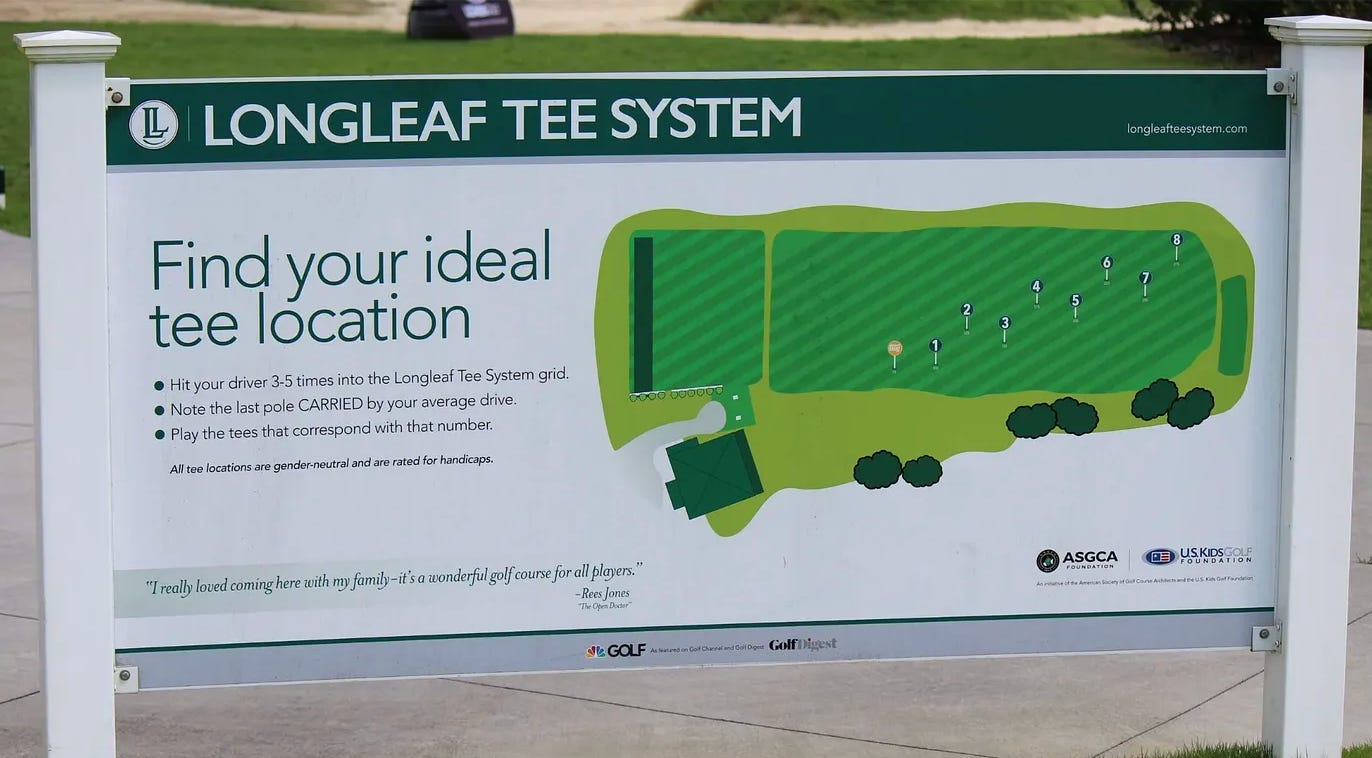
Rather than asking golfers to choose between the “men’s tees,” “ladies tees,” “senior tees,” or even the traditional colored tees, Longleaf does something wonderfully simple.
All players begin by hitting their driver 3-5 times into the Longleaf Tee Grid System. After the RightStart marker, poles numbered 1-8 are 25 yards apart and a player’s average driving distance determines which tee they should play from out on the course. This allows players of all ages and abilities to compete on each hole from a starting point that matches their current ability.
As they develop, they move back and as distance decreases later in life, they simply move forward again.
Regardless of age or skill, everyone out on the course feels they can be successful.
The goal isn’t to protect people from challenge - it’s to create the right amount of challenge so they stay engaged and keep growing.
Which made me wonder...
What if we approached accountability conversations in a similar way?
Too often, we expect people to communicate from the Championship tees.
We ask people to deliver difficult feedback with confidence, regulate their emotions, ask thoughtful questions, listen without becoming defensive, collaborate on solutions, and strengthen the relationship - all in one conversation!
That’s like asking someone who’s never played golf to get a hole-in-one.
When people struggle with accountability conversations we often assume they’re afraid, unwilling, or less committed to the health of a relationship.
What if they simply need a conversational starting point that matches their current ability? Here are 9 accountabiliTees - find your starting point and grow from there!
The AccountabiliTee System
RightStart Tee: Regulate Your Emotions
If you can’t manage your emotions, you’ll often:
Avoid the conversation.
Become defensive.
Lecture instead of collaborate.
Escalate instead of clarify.
Regulation isn’t about ignoring or suppressing emotions - it’s about being able to feel your emotions without letting them drive the conversation.
To practice this skill:
Pause throughout the day to notice what you’re feeling in various contexts. Seek to name at least one emotion each time you pause to reflect.
Download a “Feelings Wheel” or “Emotions Wheel” to help broaden your emotional vocabulary.
Tee 1: Separate Intention from Impact
One of the biggest barriers to accountability is assuming motive. The impact we feel often dictates the narrative we create about someone’s intention.
Instead of: “You don’t care.”
Try: “What was your intention when you said ___?” and/or “Here’s the impact it had.”
Separating intention from impact keeps the discussion grounded in observable reality rather than mind reading.
To practice this skill:
Write down what someone said or did and what you think their intention was. Now ask yourself, “What else could it be?” and list as many alternate reasons as you can think of to possibly explain their behavior.
Use a conversational script designed to help separate the two:
“When you did/said _____, I noticed that I felt/heard _____. Was that your intention?”
Tee 2: Observe Behaviors Objectively
People who are good at accountability conversations avoid making judgments about personalities or character, and instead describe observable behaviors objectively.
Judgment: “You’re lazy.”
Observation: “The scouting report was submitted two days after the deadline.”
While someone’s identity is debatable, a person’s behavior is coachable.
To practice this skill:
Recount a portion of your day using only objective, observable behaviors.
Put on noise cancelling headphones and sit in a public space, or turn the volume off on a tv show. As people have conversations with each other, write down the behaviors that you notice.
Tee 3: Listen to Understand
Too often, accountability conversations involve one person lecturing, and the other feeling defensive or defeated. Rather than talking more, lead with genuine curiosity and ask questions with the goal of understanding.
It’s discovering:
What happened?
What came up or got in the way?
What assumptions were made?
What did you try to get back on track?
Curiosity often uncovers information that facilitates better understanding, which in turn allows us to have better quality conversations.
To practice this skill:
Ask questions that start with “what” or “how” instead of “why”. Why can cause defensiveness even when our intention is to understand.
Instead of “Why did you do that?”, try “What were you trying to accomplish?”
Use a phrase like, “Help me understand” before recounting an observable behavior.
“Help me understand what you meant when you said, _____.”
Tee 4: Tolerate Discomfort
During important conversations many people mistake discomfort for danger. People often avoid difficult conversations not because the conversation doesn’t matter to them, but because having the conversation feels uncomfortable which can translate to unsafe.
Accountability conversations require the ability to stay engaged while experiencing:
awkwardness
disappointment
silence
emotions
disagreement
Learning to tolerate discomfort allows us to stay present in the conversations that matter most.
To practice this skill:
Make a list of situations, conversations, or emotions that make you uncomfortable. Now make a list of things you can try (pausing, breathing, asking for a short break, tapping, etc) the next time discomfort arises.
The next time you feel uncomfortable, see if you can name the specific emotions that make up your discomfort and write them down. Over time, notice which emotions come up most frequently or are most strongly felt, and work to develop regulation tools for those specific emotions.
See you next week for Part 2
and accountability skills for tees 5-8.
With gratitude,
Betsy
(Thanks for being a subscriber! Please share this with anyone you feel may benefit from reading it.)
This Substack is reader-supported. To receive new posts and support my work, please consider becoming a free or paid subscriber.
Comments
Nothing yet. Say the first thing.
Sign in to join the conversation.