
Anyone trying to make sense of the current state of America would do well to look to Urbana, Ohio, the subject of my latest book, Paper Girl. Over the past several decades, my small hometown has traced many of the same paths as the nation: plummeting graduation rates, rising poverty and addiction, a hollowed-out middle class, and a steep climb in political polarization.
Eighteen miles south of Urbana sits Springfield, a smallish city slammed by globalization and opioids where falsehoods about Haitians eating pets became the fulcrum for ginning up hate in the lead-up to the 2024 election. As Donald Trump and JD Vance fomented lies and rage, Urbana employers were becoming increasingly reliant on Haitians from Springfield to do jobs that native Urbanans were no longer well or stable enough to do.
This week, the Trump Administration moved to suspend the Temporary Protected Status these immigrants were granted due to strife in Haiti and its deadly earthquake in 2010. The move to suspend TPS was led by the white nationalists now running our country, but a federal court blocked the suspension, giving the 10,000 to 15,000 Haitians who live in Springfield a temporary reprieve.
ICE and the Republican Administration operating it are murdering, detaining, and deporting immigrants and citizens alike in an effort to shore up power and enrich themselves and their friends, and people in Minneapolis—my heroes—are teaching us all how to fight back.
A Haitian friend who writes poetry and is a Pennsylvania civic leader, just two years away from getting his citizenship, told me he now drives anxiously around his city—not too fast, not too slow—after giving copies of his legal paperwork to his lawyer and several friends so they might fight for him if he gets detained. Were he to be deported back to his homeland, he would immediately be kidnapped for ransom because in Haiti he’s considered rich.
How did we get to the point where hard-working, contributing immigrants in our country are treated this way? In Paper Girl, I tell the story of my ex-boyfriend Bill Monaghan; we dated for about a year in the mid-1980s. Reporting on Bill’s metamorphosis from Deadhead liberal to a right-wing extremist who spent many hours a day consuming Russian propaganda on YouTube enlightened me about just how quickly and insidiously radicalization can occur. I interviewed several conspiracists and QAnon adherents for the book, but no one was angrier or more deeply entrenched in the kind of views that the old Bill would have found disgraceful.
Below is an excerpt. I’m offering it free to Substack readers because it explains why my friend in Pittsburgh doesn’t leave his home without looking behind him and why those brave Minnesotans are marching in the streets armed with whistles and something sorely lacking among too many Americans today: morality.
If you’d like to help the Haitians in Springfield, please consider donating to these community organizations. I’m told community unity is strong but also that right-wing activists are calling for counter protests and threatening to attack protesters, and that the Ohio Immigrant Alliance requests that allies who have not had training organized by local organizers G92 and Springfield Neighbors United refrain from coming to the city.
For an example of helping from afar, some of my sweetest Urbana friends are collecting food, hygiene, and diaper donations to deliver to families as well as assembling 3D-printed whistle kits for local demonstrators. Contact Champaign County Democratic Party Chair Heather Tiefenthaler if you want to help at heathertief24@gmail.com.
***
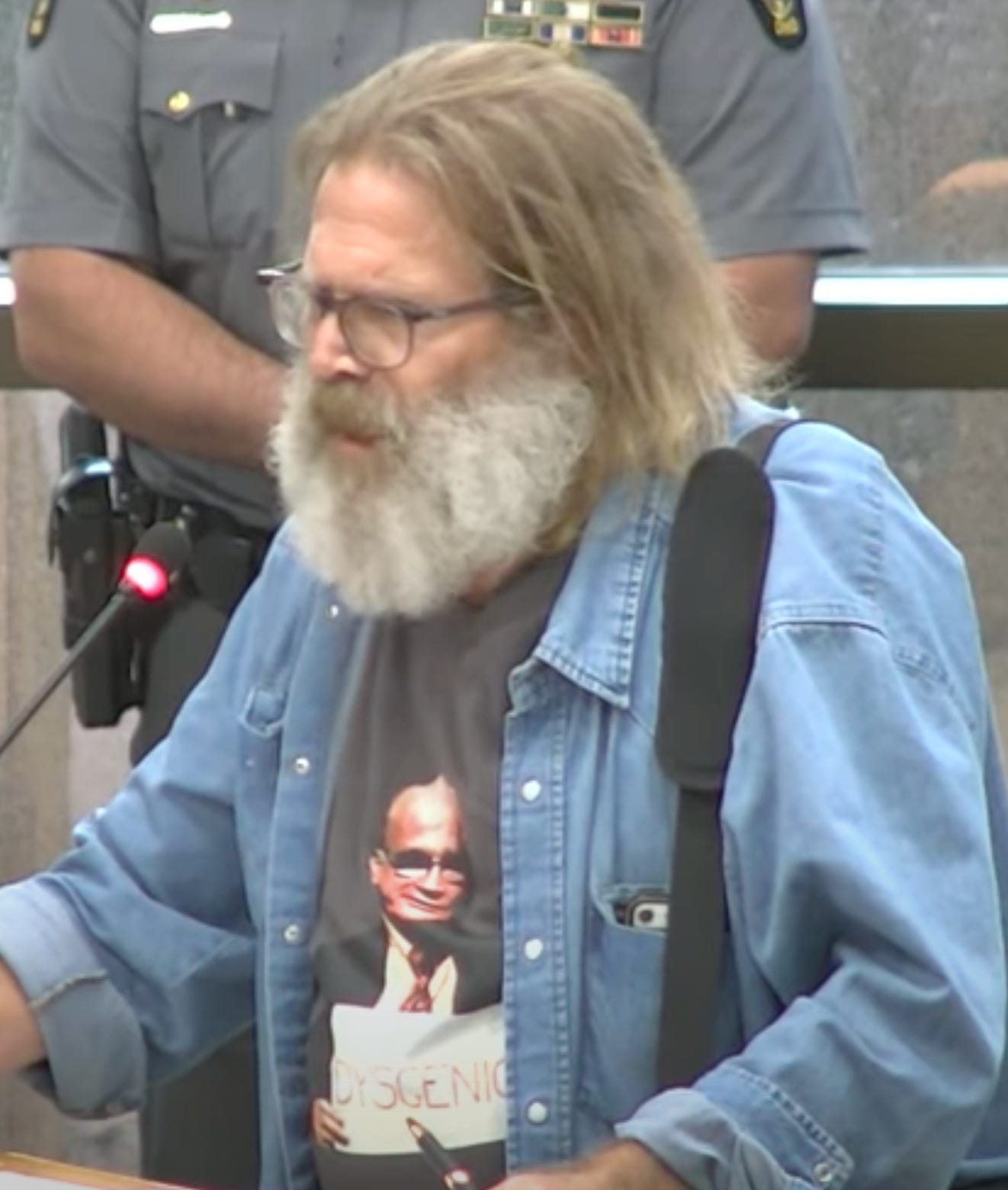
In the fall of 2024, a man with a chest-length gray beard and long hair appeared on national television, complaining to a crowded city commission meeting about the sudden influx of Haitians into Springfield, Ohio—18 miles from my hometown of Urbana.
It was just weeks after JD Vance had begun spreading the false news that Haitian immigrants in Springfield were eating pets, which Donald Trump amplified a few days later during the 2024 presidential debate. Swiftly, colleges, schools, and hospitals in Springfield were besieged by bomb threats. Proud Boys marched in Springfield’s streets. Governor Mike DeWine, a Republican, refuted the rumors and sent in state troopers to quell potential violence.
Who was the man with the chest-length beard? In a segment on PBS NewsHour, he was identified as a former journalist and an operator of a Facebook group called Stop the Influx into Springfield, Ohio. He insisted that Haitian immigrants were stressing the community, causing jumps in rents, insurance rates, and reckless driving incidents, including an unlicensed Haitian driver who hit a school bus and killed an 11-year-old boy in 2023.
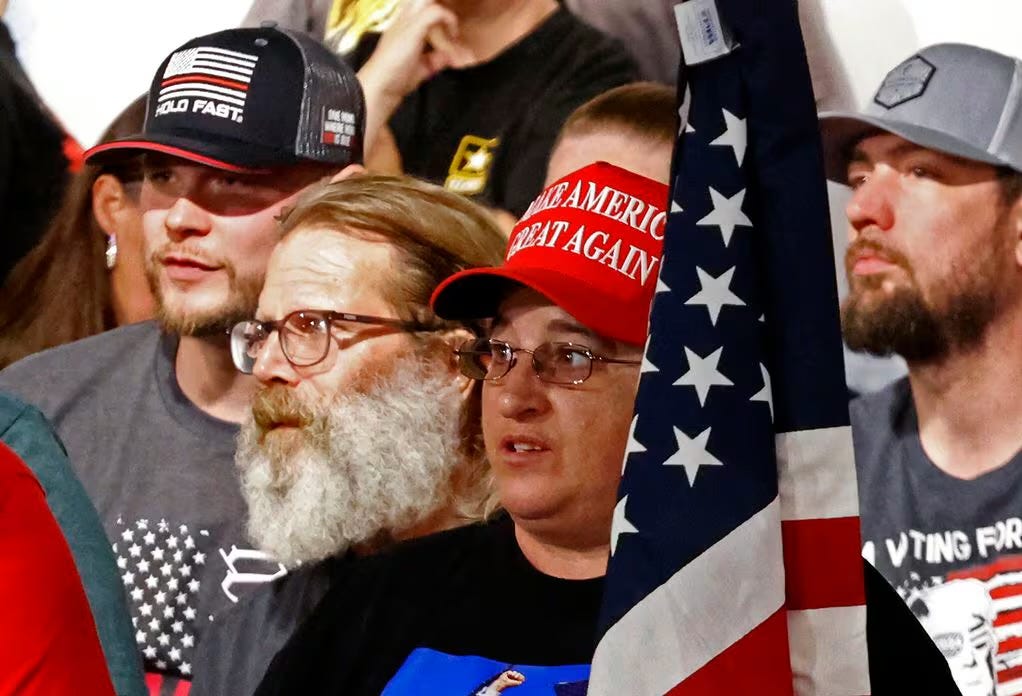
“Our concerns don’t have anything to do with racism,” he said. “But they want to make it sound like a race issue so they can demonize us and ignore our concerns.”
There was a shred of truth to his claims—immigration had indeed changed the landscape of the town. But amid the lies being spread by Trump and Vance, the fervor over the Haitian population quickly got out of hand. The CEO of Springfield’s McGregor Metal had praised his Haitian workers in national news reports and was now, following credible death threats, being coached by FBI agents and security experts to arm and protect himself. A reporter friend covering the Haitian pushback said the whole town was panicked and on edge.
I knew the man from the news stories. His name was Bill, he was my ex-boyfriend, and he used to be one of the happiest people I knew.
***
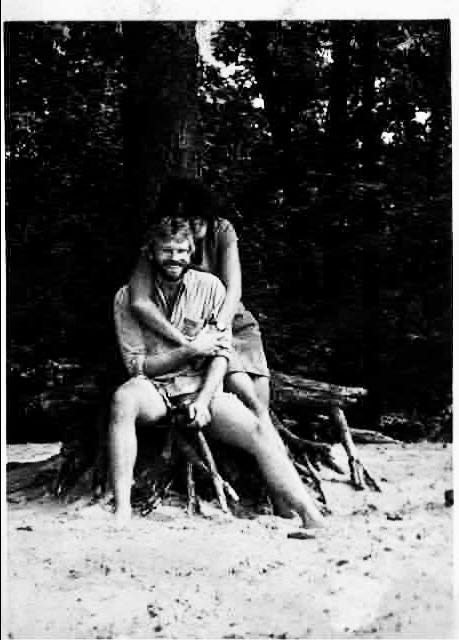
We had dated for a year in the 1980s—mostly long distance. I was in college in Bowling Green, Ohio; he was working as a newspaper reporter in Cincinnati.
It was the Reagan years, and Bill, a recent graduate of Miami University, was probably the most liberal person I knew. He gave me a “The Moral Majority is Neither” sticker, which I slapped on my back bumper in 1986, to my Republican family’s bewilderment. He’s also the one who, when the frame underneath the battery of my 15-year-old Volkswagen Beetle started to crumble, wedged a cutting board underneath it to shore it up.
Bill went to Grateful Dead shows and planted herbs and vegetables. For most of our courtship, he wooed me by mail with scores of cartoons he’d drawn from his daily life that were quirky, self-deprecating, and full of joy. So in the mid-2010s, when a mutual friend described watching Bill turn from an NPR-tote-bag-carrying Bernie Sanders supporter to someone on the far-right who got most of his news from the Duran, a website based in Cyprus with known connections to Moscow spy agencies, I thought my friend had to be mistaken.
“I don’t know how to describe it, but he suddenly just turned really . . . angry,” the friend said. When I asked if he thought it was safe to meet with Bill in public, he said, “I think so.”
About two years before the Haitian controversy erupted, I met up with Bill for the first time in 38 years, to interview him for my latest book: a memoir of sorts, and an investigation into America’s political polarization. When I asked to talk about his political shift, he seemed eager to explain himself and quickly agreed. Over the next two years, I met with Bill three times, compiling ten hours of recorded interviews.
• • •
For our first interview, he showed up in jeans and a sport coat, looking sharp. It was St. Patrick’s Day, and he’d asked for an early dinner reservation—5:00 p.m.—which I thought was odd.
As soon as he sat down, he said, “Sorry I was such a douchebag,” referring to the end of our relationship. He’d cheated on me with a newspaper co-worker and, when I found out about it, broke up with me abruptly over the phone.
“Yeah, you were,” I said. “But it’s okay; I’m good.”
We laughed nervously.
He was 61 and presently single, after marrying the same woman twice. They were divorced and the parents of two grown kids when she died of cancer in 2020; he’d helped care for her at the end. When she drew her last breath, he sat next to her hospital bed holding her hand.
He said he’d left journalism decades before for a job in the public sector but grew disillusioned with government’s tendency toward waste and political corruption, retiring early. He inherited a house in Springfield, where he grew most of his own food and told me he spent four to seven hours a day watching news on YouTube.
The reunion dinner stretched over three hours, and I mostly enjoyed it. The only awkward part came when, in the middle of describing his political conversion, he repeatedly steered the conversation back to his hatred of Hillary Clinton. He claimed she’d ordered the deposed Libyan strongman Muammar Qaddafi “raped up the ass with a bayonet and then laughed about it. She’s a monster.”
When I offered that I hadn’t seen his version of the story in the national newspapers I read daily—The New York Times and The Washington Post—he smirked and said, “The Times is fully captured by the Democratic Party, whereas the Post is wholly owned by the CIA. They’re going to tell you what those two groups want you to think.”
Bill was also furious about Obamacare, saying his health-care premiums doubled in the wake of its passage. “It was all about getting poor people health care off the backs of the middle class,” he said. He wanted nothing to do with it and hadn’t had health insurance since he quit his last job.
That explained our 5 p.m. dinner reservation: He had cataracts and no longer drove at night. His cataracts could be surgically removed, and he was thinking of paying cash for it. But he hadn’t yet, because he didn’t trust doctors. He didn’t trust much.
***
What happened to Bill? How did he turn from a hardcore liberal into someone wracked with paranoia and fiercely opposed to the Democratic Party—and then later into a nationally notorious anti-immigration activist?
People like him are often maligned as crazy conspiracists. But Bill’s philosophical journey began with very clear policy grievances, some of them legitimate. In one 7,000-word email he sent me in mid-2023—which he jokingly called his manifesto—he described the harrowing economic effects of the North American Free Trade Agreement on his hometown and state, which had lost almost a third of its manufacturing jobs post-NAFTA. Given that parts of Springfield now lie derelict—with escalating violent crime, a 43-percent chronic absenteeism rate in the schools, and one of the highest overdose rates in Ohio—it was a fair point.
In fact, many of his theories contained chunks of truth that liberals like me are in the knee-jerk habit of dismissing out of hand.
Bill had initially soured on the Democratic Party when the Monica Lewinsky scandal broke, followed quickly by the U.S. military’s bombing of Serbia, which he saw as a scheme meant to take American eyeballs off the sex-with-an-intern ball.
After eight years of Obama (“a crushing disappointment”), Bill became a third-party independent, voting for Jill Stein in 2016. He hated that Obama had essentially reneged on a promise to change bankruptcy laws that would have helped struggling homeowners during the 2008 recession while bailing out big banks and carmakers. He also hated Obama’s support for unprecedented mergers in big tech and pharma.
But his friends were furious about his support of Stein, calling it a vote for Trump. A deacon at his church even invited Bill out for beers before the 2016 election, only to excoriate him for his planned vote. Other friends called him a fascist to his face. Bill responded by leaving the church, dropping Facebook, and cutting off connections with many old friends. No wonder he was angry.
When Trump won in 2016, Bill found him refreshing at first. During our conversations, though, he no longer saw Trump as capable. “But as failed as his presidency was, and as bad as he may be, he is nowhere near as bad as the lying, cheating, murdering political, bureaucratic, and media forces arrayed against him.”
Between visits, he emailed me detailed critiques of left-wing gender theory and of The New York Times’s 1619 Project, which he called an effort “to demonize Caucasians to foster further social polarization and disintegration.”
At the same time, he regularly took shreds of truth and twisted them into conspiracies. Bill was suspicious of everything, including me. Near the end of our third dinner meeting, he ordered a third beer, then said he’d be paying for his own dinner and drinks this time, adding, “I can’t accept New York Times–adjacent money.” When I explained that I’m not a Times employee and that my book advances cover my work and travel expenses, he let me buy. Penguin Press: good. The New York Times: bad.
As I drove him home in my car, he accused me of going behind his back to interview his grown children about him—something I hadn’t considered, let alone attempted. Another time, when I emailed a follow-up question about something I’d spotted in his living room, he turned testy and demanded to be able to “veto” what I wrote, harrumphing that I held all the power in this reporter-subject relationship.
When I asked if he still made cartoons—the daily journals he’d mailed to me by the scores—he didn’t remember ever drawing them.
***
My last face-to-face conversation with him was in the spring of 2024, a handful of months before the controversy over Haitian migrants.
Around the time Bill appeared on television, friends started to warn me about him and his ever-increasing radicalism. Chad Seeberg, a cop friend of mine in nearby Marysville, urged caution. “He’s regressing,” he said, when I showed him a front-page newspaper photo of my angry ex looking like a Civil War re-enactor.
Around this time, I reached out to Bill about scheduling a fact-checking session for the content from our interviews. We’d been e-mailing back and forth about our gardens and our grown kids. I also sent him a memo written by my friend Anthony Flaccavento, a Virginia farmer, after Anthony read an early draft of my book. I hoped the memo would show Bill that I was genuinely trying to consider his point of view, including the fact that Democrats and Republicans alike had failed working-class America.
Flaccavento wrote that MAGA proponents now “believe that the system is too broken, too rigged to be reformed and needs to be burned down so we can start over.”
But my memo-sharing backfired, infuriating Bill. “We want to burn it all down?!? Fuck you. You people are fucking liars. … There will be blood in the streets, and that’s not a threat, that’s just an observation of how the policies you support have devastated Europe. And I think it’s what you fuckers want.”
It was only a few months later, in mid-February 2025, when Bill, a hard-core smoker, came down with a serious case of pneumonia. Lacking health insurance—he believed Obamacare was a scam to cheat the middle class—he went to the hospital later than he probably should have.
He died a few days later, of heart failure. He was 63.
Bill’s obituary in the local press noted that he “loved to immerse himself in the world of fantasy” and that he “dedicated his waking hours working towards bettering the city and helping the homeless.”
Both these things were true. Bill often brought food and firewood to homeless people in a Springfield park, and he argued publicly with the mayor and police officers who tried to stop him.
But he also blamed the city’s rise in homelessness squarely on Springfield’s Haitians, whose presence, he believed, was the main cause of rising housing costs. Far from being “killers, leeches, and entitlement junkies,” as Homeland Security Secretary Kristi Noem called them recently, TPS holders participate in the American workforce at the high rate of 94.6 percent.
On X, he continued peddling racist and antisemitic screeds. Among his last posts was the promotion of “documentary” claiming that immigrants were invited into the country at the behest of Jewish moguls eager to erase white America as payback for the Jewish suffering in World War II. He also supported such notions that the Jewish Sackler family developed OxyContin with the intent of killing off white people, and that the Biden administration’s Jewish members led the way on getting Temporary Protected Status for Haitians for similar reasons.
The day of Bill’s funeral, the Trump administration announced it was halting TPS for Haitians, including most of the roughly 12,000 living in Springfield.
About two months later, I reached out to Bill’s daughter, Emma. She and her dad had once been so close they could finish each other’s sentences. But she had distanced herself from him in recent years. “He became too paranoid and aggressive,” she said. “He was spending all his time online. He got swept up into a cult of fear and wanted to argue about everything.”
At the time of her dad’s death, they weren’t speaking except for periodic text messages. They fought over his drinking, which she viewed as excessive. When she suggested he get help, he raged. Bill spent his final days smoking, playing video games, and reading far-right news. Bill believed, she said, that someone was plotting an attack on his life because of his public outspokenness against the Haitians.
“His beliefs killed him,” she said.
• • •
If Bill and his friends and relatives had the capacity to reason respectfully, perhaps he might have found solace in companionship rather than conspiracy. But it’s hard not to see what happened to Bill and his daughter as a microcosm of polarization at its most hate-filled edge.
The parallels between Bill’s story and that of many others in my hometown are clear. Our country has become dangerously siloed, and ideological isolation breeds nothing but extremism.
In Bill’s case, that extremism led to his death. He could have afforded health insurance, Emma noted; he would have actually benefited from Obamacare subsidies. He could have even paid outright for an earlier hospital visit. But he didn’t, because he no longer trusted any institutions.
He was fearful about an enemy plotting to take his life, and it did.
No posts
Comments
Nothing yet. Say the first thing.
Sign in to join the conversation.