
Fellow Pilgrims,
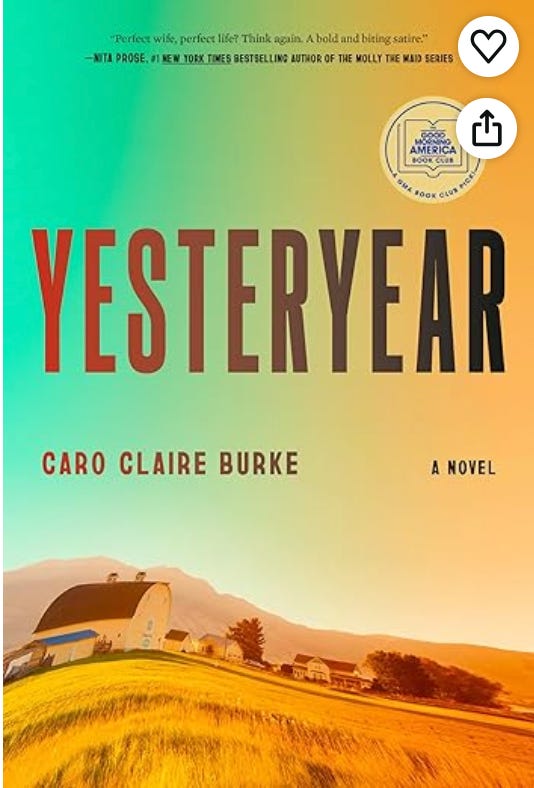
Caro Claire Burke’s debut novel Yesteryear is suddenly on almost every summer reading list. The book follows a “tradwife” influencer (clearly written in conversation with the likes of Hannah Neeleman—pictured above—of Ballerina Farm, with her 10.2 million followers) named Natalie, who builds a media empire selling images of a gorgeous family life on a picture-perfect farm. Then she wakes up in the 1800s and has to live the actual traditional life she’s been selling—but without her KitchenAid mixer, nannies, or Instagram audience.
It’s a terrific premise, and I wanted to love this novel. Despite some delicious barbs—aimed at Natalie and delivered by her—it ultimately fell flat for me.
I read Yesteryear quickly, almost compulsively. In places, it speaks with sparkling clarity about experiences often hidden beneath polished images of domestic happiness. It understands the loneliness that can accompany motherhood, the impossible expectations placed on women, and the temptation to imagine that another place or another time might finally make us whole.
The voice in Natalie’s head has been inside my own head:
“America hates angry women. The Lord hates angry women. You hate angry women. Do not be an angry woman.”
Natalie’s theology is wrong, but she captures something painfully real.
Later she drives home, thinking,
“Another long drive back home, through the mountains and past the farms and down the long dirt road to the nightmare—I mean dream—of my own making, the world I molded with my own bare hands. Playdough husband, playdough children, playdough life.”
I’m struck by that word, “Playdough.” It speaks to the modern promise that we can construct ourselves from scratch, molding our identities, families, and futures according to our own desires. But playdough hardens. It gets ground into the carpet. The kids mix all the bright colors together until everything turns a grungy gray. What begins as freedom becomes exhaustion.
Yesteryear understands this.
And yet I found myself increasingly unable to trust it.
My unease comes down to two things. First, I don’t think the novel loves its characters. Second, it is divorced from history and particulars. Those may seem like separate criticisms, but they are connected. Love and history are the two great correctives to escapist fantasy.
I believe novelists have a moral obligation to love their characters.
That doesn’t mean they have to like them. Great novels are filled with vain, selfish, cowardly, destructive people. Some characters deserve judgment. But judgment without love becomes something else. It becomes contempt.
Certainly, Natalie is unlikable, but that’s not my problem with her. All hail unlikable female characters. Give me Amy Dunne. Give me Catelyn Stark, Ellie from The Last of Us, and Yeong-hye from The Vegetarian. Good storytelling doesn’t require likability. It does require love.
Love means refusing to reduce another person to the worst thing about them. It means believing every human being possesses an interior life that exceeds our explanations.
I never felt that generosity toward Natalie.
Again and again, she appears as an object of contempt rather than attention. The women around her—the nannies who care for her children, the producer who judges her ambitions, even her sister—look at her with disdain. This could be a fine plot move; people judge each other all the time. What troubled me was that the novel seemed to share their perspective.
Natalie never quite becomes a person.
For me, this isn’t simply an aesthetic preference. It’s a theological conviction.
Christians confess that every human being bears the image of God. That image may be obscured, but it is never erased. No person can be exhausted by our judgments of them.
I think novelists have the privilege of practicing that kind of attention. To write fiction is, in a sense, to practice neighbor-love—not sentimental love, not indulgence, but patient attention that refuses to collapse a person into a stereotype.
My second reservation is about history.
I’m genuinely confused by Natalie’s religiosity. Is she Mormon? Baptist? Pentecostal? Catholic? Evangelical? I have no idea. It’s not clear whether she abstains from alcohol because of religious conviction or personal preference. It’s not clear whether wearing prairie dresses to Harvard is a theological commitment or branding. Little details kept pulling me out of the story. A lot of what’s wrong here could have been cleaned up with a editorial pass from someone who knows about Christianity. They could have changed the “priest” who baptizes Natalie just before she goes to college to a “pastor,” for instance, and I would have had one less thing to trip over. It’s a small thing, but love and history live or die by small things.
Natalie’s faith never coheres. Sometimes she is a sincere believer with profound experiences of God’s presence. Sometimes faith functions almost entirely as performance or marketing. Those two realities can absolutely coexist. They often do. But Natalie never becomes an integrated person. Instead, she is stitched together from assumptions about conservative religious women.
That impression is reinforced by Burke’s own description of the novel. In an interview with Ayesha Rascoe, Burke explained why she left Natalie’s religion unnamed:
“I think I was interested in the fundamentalist nature of Natalie’s interests, and that kind of transcends any specific religion.... The fundamentalist values that she upholds are about subservience. They’re about adhering to certain power dynamics. And it was important to me not to be focusing on any one religion so much as focusing on those power hierarchies, which I think are very consistent across a number of religions” (interview with Ayesha Rascoe, NEPM, April 12, 2026).
Fundamentalism is not an abstract thing, nor do power hierarchies exist in the abstract. They belong to particular communities, scriptures, liturgies, histories, and practices. Once Christianity is untethered from any recognizable church or theological tradition, it becomes impossible to distinguish between faith and its distortions.
Christianity, after all, is a stubbornly historical religion.
God calls Abraham, not humanity in general. Christ is born under Herod, not in mythic time. The church gathers around bread and wine in actual communities with names, failures, and memories. Grace comes to us in history.
The same difficulty appears in the novel’s nineteenth century.
Instead of immersing us in the lived realities of nineteenth-century life, the past in the novel is inconvenience and bad aesthetics, lye soap and dirt. But the novel’s central conceit promised something richer. It could have explored the legal realities of marriage, the economics of domestic labor, the texture of women’s friendships, or the social expectations that governed family life.
Most strikingly, race is almost absent. White motherhood in America has never existed apart from race. Enslaved women cared for white children. Black domestic workers raised generations of middle-class families. Immigrant women have long sustained American households through invisible labor. Even today’s tradwife influencers and the theologies behind them are entangled with ideas about whiteness, family, and nation. To imagine nineteenth-century motherhood without those realities is to imagine a past that never existed.
History, like love, resists fantasy.
For all my reservations, I’m glad Yesteryear is out there, creating conversation. It asks difficult questions about motherhood, freedom, resentment, domestic life, and longing. It refuses easy consolation. It names forms of female anger that many Christians—and many churches—have preferred not to hear.
I only wish the novel had trusted that truth becomes deeper, not shallower, when it is rooted in love and in history.

Grace & peace,
BFJ

This piece contains associate links. As always, I’m grateful if you choose to subscribe, forward, or share.
Check out streaming video courses on theology, church history, biblical studies, and more at Seminary Now. See my course and others from leading authors and professors.
And consider taking a class with me at Northern Seminary, where we talk about theology, doctrine, the bible, and many other wonderful topics.
Are you a writer? I love book writing software from Living Writer.
Comments
Nothing yet. Say the first thing.
Sign in to join the conversation.