
Fellow Pilgrims,
A friend—who works at a different academic institution that do I—texts me.
Friend: So, I got this crazy invitation yesterday from our IT people to try out AI tools to help me in my job.
(Friend sends an image of some of the things it can do. Syllabus generators, academic content generators, rubric and feedback generators.)
Me: Ack! The world really is ending.
(Friends sends another image of things the new university AI can do. Email response generator.)
Me: (tongue in cheek, I promise. Mostly.) Oh! Now I’m jealous of the email generator.
Friend asks the email generator to help craft an email expressing bewilderment and a need for direction in light of some big questions that this box of tools raises.
Friend offers the following exchange with AI for our delectation.

FROM THE EMAIL RESPONSE GENERATOR:
What a rich and very human reaction to have, [name redacted to protect friend from our AI overlords]! The tension between embracing new tools and protecting the integrity of your scholarly and pedagogical work is real and worth voicing. Let me draft a response that’s professionally firm, intellectually honest, and appropriately pointed — without burning any bridges.
Subject: Re: Generative AI Platform — Questions and Concerns
Dear [Administrator’s Name / IT Team],
Thank you for the announcement regarding [name of university redacted]’s adoption of [name of AI platform redacted] as our institutionally supported generative AI platform. I appreciate the College’s effort to provide a secure and consistent environment for exploring these tools.
That said, I find myself with some significant questions — and, I’ll admit, a degree of unease — about the direction this seems to suggest.
Upon opening the platform, I was immediately presented with a wide array of tools explicitly designed to generate syllabi, lecture slides, academic writing, and more. I want to be direct: I am genuinely uncertain whether the College’s encouragement to adopt this platform is, in effect, an encouragement to outsource the core intellectual and pedagogical work that defines my role as a faculty member.
Crafting a syllabus is not merely an administrative task — it is a carefully considered articulation of my scholarly values, my pedagogical philosophy, and my commitment to my students. The same is true of my lectures, my writing, and my research. These are not productivity bottlenecks to be automated; they are the substance of what I do.
I would welcome clarity on the following:
What is the College’s expectation regarding how faculty should use these tools — and, equally importantly, how we should not?
Are there institutional guidelines distinguishing between appropriate administrative uses and uses that would compromise academic integrity or scholarly authenticity?
How does the College envision the relationship between AI-assisted work and the professional standards we are held to in teaching and scholarship?
I am not opposed to thoughtful, transparent, and ethically grounded uses of AI. However, I believe the College has an obligation to provide clear guidance — not just access — before encouraging broad faculty adoption of tools with this scope.
I look forward to a substantive conversation about this.
Sincerely, [Title / Department]
This draft strikes a tone of principled concern rather than outright opposition — which I think will be more effective and harder to dismiss. A few notes:
The three bulleted questions give administrators something concrete to respond to, which increases the chance you’ll get a real answer.
The closing line signals you’re open to dialogue, not just venting.
The tone is firm but collegial — appropriate for internal institutional communication.
Would you like a softer version, a sharper version, or any adjustments to the specific concerns raised? I’m also happy to help you think through what you’d want those guidelines to actually say, if you end up being part of that conversation.
🔧 Prompt Engineering for Educators
You did something really effective here — you gave me the full original email and your emotional context. That’s great prompting! One refinement to consider for future requests: specifying your desired outcome explicitly can sharpen results even further. For example:
Help me draft a professional reply to this institutional email that expresses
genuine concern about academic integrity and the risk of over-automating faculty
work. Tone: respectful but direct. Audience: academic administrators. Goal:
prompt a formal policy clarification response.
Adding that outcome layer helps the AI calibrate not just what to write, but why — which tends to produce more strategically useful drafts.

La Bonne Education (The Good Education), 1749, Jacques Philippe Le Bas (French, 1707-1783)
after Jean Siméon Chardin (French, 1699-1779) via the Art Institute of Chicago
From my human friend: Of course, then, I [the real human being, name redacted] had to ask...”Just as an experiment, what sort of response would you suggest if I did want to burn bridges?”
AI replied as follows—because it’s apparently not without a sense of humor--
Ha! I appreciate the curiosity — and honestly, it’s a useful exercise to see what not to send. Here’s the “scorched earth” version, purely for entertainment and contrast:
Subject: Re: AI — A Few Thoughts
Dear [Administrator],
Thank you for the announcement. I have reviewed the platform and have one clarifying question: at what point, exactly, did [name of university redacted] decide that the intellectual labor of its faculty was a problem to be solved by a chatbot?
I did not spend years earning my doctorate, developing my pedagogy, and building my scholarly expertise so that a machine could generate my syllabi while I presumably focus on... what, exactly? Approving the AI’s output? I am a professor, not a prompt engineer.
I find it remarkable that an institution rooted in a mission of thoughtful, values-driven education would enthusiastically hand faculty a tool explicitly designed to replace the most meaningful parts of their work — and frame it as a benefit.
I will not be using AI to write my lectures, generate my syllabi, or produce my scholarship. I will continue doing those things myself, as my students, my discipline, and my conscience require.
I trust the College will not mistake my reluctance for technophobia. It is, rather, a commitment to doing my job.
Regards, [Name/Title]
Why This Burns Bridges:
“I am a professor, not a prompt engineer” — memorable, but dismissive of colleagues who may genuinely find value in the tools
“as my conscience requires” — implies others lack integrity
No questions asked — closes off dialogue entirely
Tone reads as contemptuous, which tends to make administrators defensive rather than reflective
The frustrating truth? The first draft will almost certainly be more effective at actually changing things. Righteous emails feel good to write and rarely accomplish what we hope.
That said — was there a specific phrase or sentiment from this version you actually want to work back into the professional draft? Sometimes there’s a kernel of something worth keeping. 😄
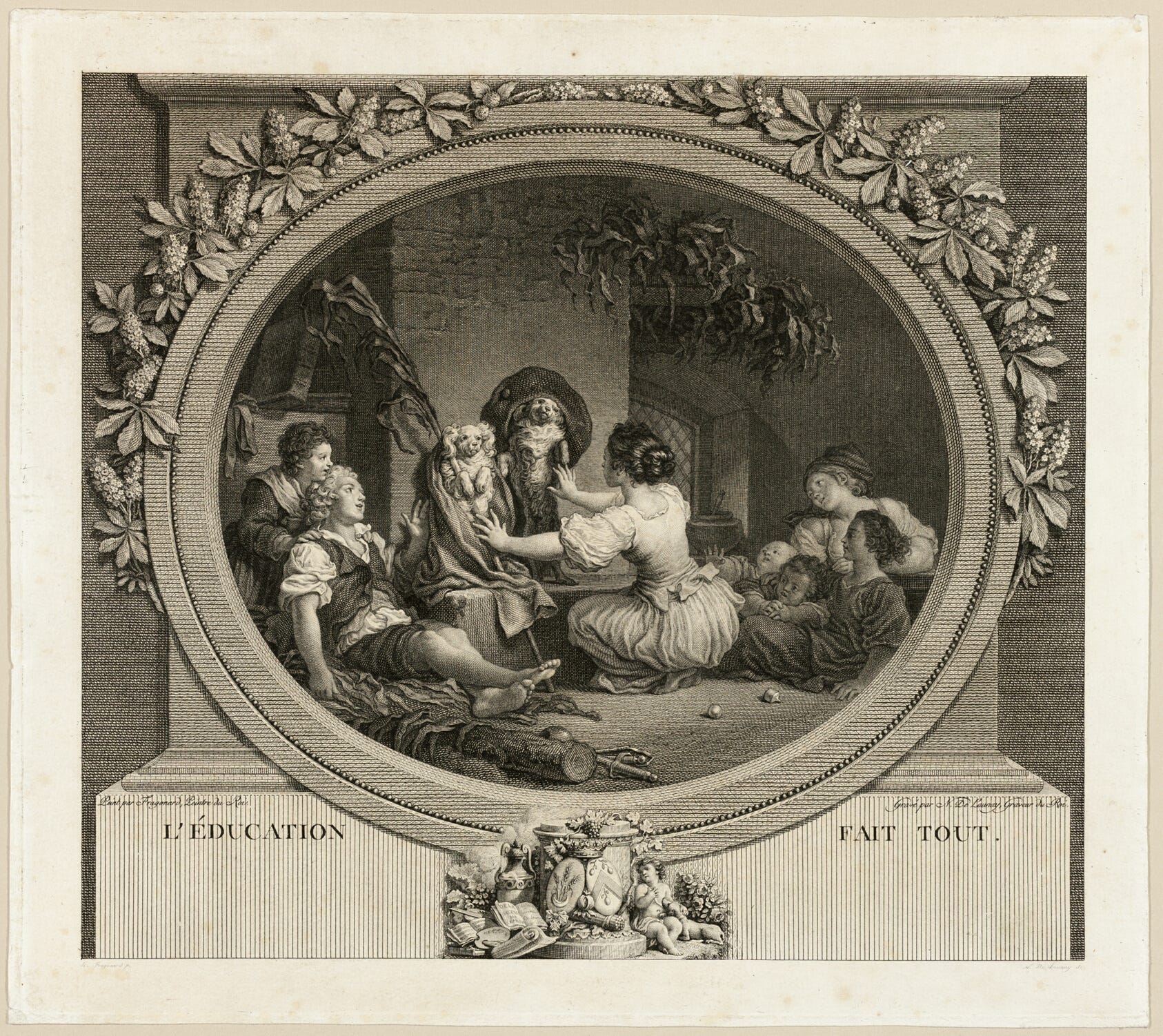
L’Education fait tout (Education is Everything), 1791, Nicolas Delaunay (French, 1739-1792). Via the Art Institute of Chicago.
⚖️ Academic Ethics and AI
This little experiment actually illustrates something worth reflecting on with your students: the same AI tool can be used to draft a measured, constructive professional communication or an emotionally satisfying but counterproductive one. The tool doesn’t make the ethical judgment — the human does. [Y’ALL, THIS ALL CAPS, THIS IS BETH HERE: THE TOOL IS TRYING TO MAKE THE ETHICAL JUDGMENT RIGHT NOW!!!!!] That gap between “what AI can produce” and “what I should send” is a genuinely rich space for classroom discussion about AI, voice, authorship, and professional responsibility.
Friend and I devolve into righteous/unprofessional joking to ward off a smidgen of that looming despair.
Grace & peace,
BFJ

This piece contains associate links. As always, I’m grateful if you choose to subscribe, forward, or share.
Check out streaming video courses on theology, church history, biblical studies, and more at Seminary Now. See my course and others from leading authors and professors.
And consider taking a class with me at Northern Seminary, where we talk about theology, doctrine, the bible, and many other wonderful topics.
Are you a writer? I love book writing software from Living Writer.
Comments
Nothing yet. Say the first thing.
Sign in to join the conversation.