
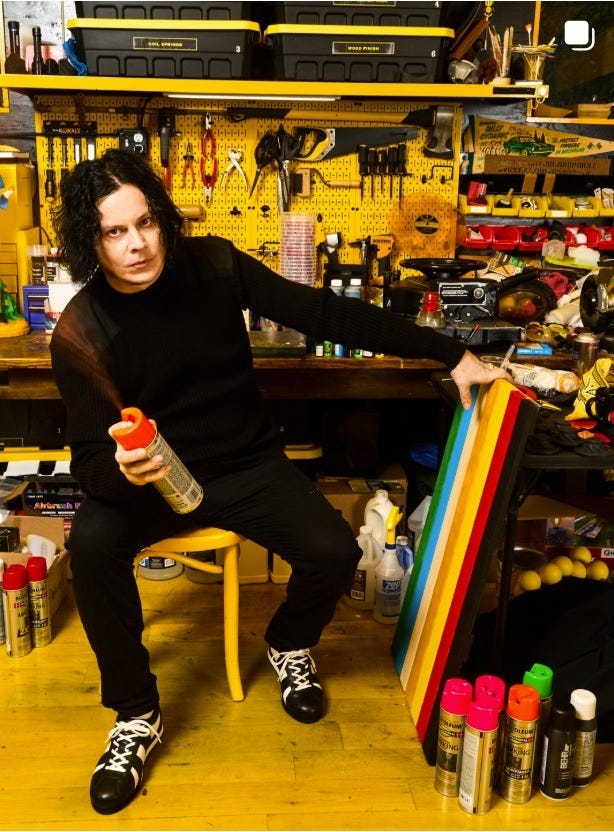
Ever since the release of “Screwdriver” on The White Stripes’ debut album in 1999, guitarist Jack White has evidently been a softie for hardware. Admittedly, the screwdriver referenced in the lyrics was more of a weapon than a tool, but what the hey.
Now, almost three decades later, the multi-Platinum alt-rock musician celebrated the opening in May of his first visual-art exhibition, one that features his passion for what he calls Hardware Store Art.
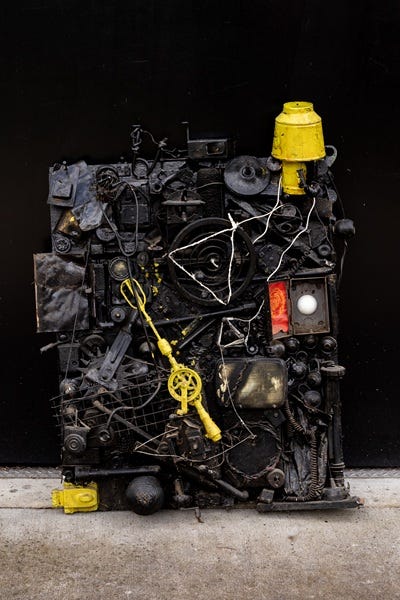
Titled “These Thoughts May Disappear,” the exhibition features a mix of sculptural works that White, a former upholsterer from Detroit, has created over the years, as well as new pieces. The hardware theme is most pronounced in God’s Smuggler (1996), a black-lacquered sculpture of tools and metal scraps White, 50, scrounged from his father’s workshop. The exhibit, located at Damien Hirst’s Newport Street Gallery in London, runs through Sept. 13.
Meanwhile, journalist extraordinaire Beth DeCarbo has a small but highly regarded collection of what she also calls Hardware Store Art. Loyal readers of Mom & Pop Hardware already know that cotter pins, wingnuts, tarp hooks and other hardware ephemera have been a lifelong passion for DeCarbo.
“Screws, straps, glue, bolts and other types of fasteners symbolize how the smallest things bind us together,” DeCarbo, 29, says. “In essence, hardware is the connective tissue of the human race.”
Among DeCarbo’s collection is one simply called “Bee.” The artist, Ricky Copeland (1960-2018) created it in his 7th-grade shop class and presented it to his sister as a gift. Components include hex nuts, washers, a wood screw and finishing nails.
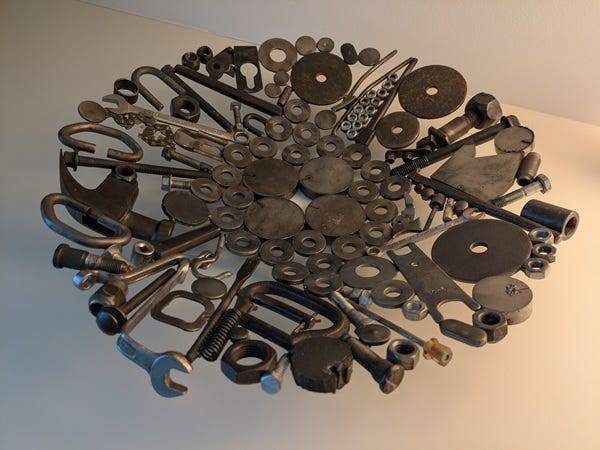
On a larger scale is this bowl, given to DeCarbo by her husband, who will be called “Chuck” to protect his privacy. Chuck was suddenly inspired to present this to his wife after she clipped a photo of it out of a catalog and said, “I would like this for Christmas.” To his credit, DeCarbo says, Chuck is a very good listener. The piece is made using hardware that’s welded together with thick disks of plate metal.
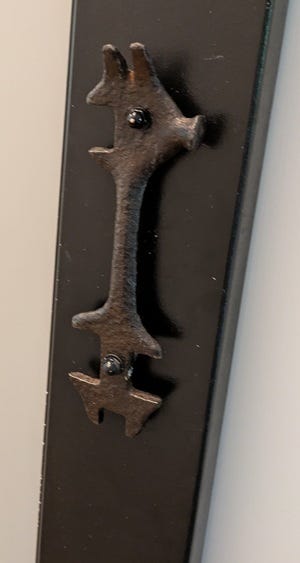
This is the oldest piece in the collection, a wrought-iron wrench designed to repair a farm implement. DeCarbo drilled two holes in it for use as a decorative door handle.
The antique wrench was a so-called gift from DeCarbo’s father after relentless cajoling. Even though Gene Copeland (1926-2022) owned literally thousands of antique wrenches, DeCarbo says that persuading him to part with one was like expecting the icemaker to lay an egg. Seeing holes drilled in the tool left him apoplectic, she added. This wrench is noteworthy for its ability to function as a hammer, prybar, multiple wrenches and a spanner.
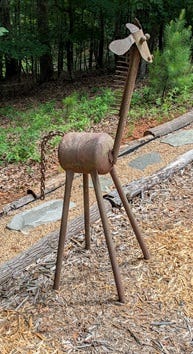
The final piece was acquired in Atlanta in 2005. Aptly named “Rusty,” the work represents a giraffe and is made primarily using a propane tank, a length of chain and the head of a rake. According to DeCarbo, Rusty stands watch over the backyard 24/7, 365 days a year. On rare instances, Rusty will be discovered in the morning face down in the dirt; whether he was toppled by a deer or a bear is unknown.
To date, DeCarbo’s Hardware Art exhibit is by invitation only. Any public showings will be announced at a later date. Advance tickets, however, may be purchased via Venmo.
Correction: An earlier version of this article stated that DeCarbo is 61 years old. She is 29 years old.
Thanks for reading Mom & Pop Hardware! Subscribe for free to receive new posts and support my work.
Comments
Nothing yet. Say the first thing.
Sign in to join the conversation.