
BEFORE I WAS even out of bed on Sunday morning, I read a message from my friend Ralph, who lives in Berlin and Paris, that Senator Lindsey Graham had died. It was one of those moments that drops from the sky that we don’t expect. It was shocking. And I don’t mean this without respect…it was also liberating.
Hear me out: When someone dies, we all feel for their family and friends. We may wish them peace…honestly. We may be sorry that they’ve lost their life, both in theory and authentically from the heart, though it still might not be for that particular version of the person who just drew his last breath. With Lindsey Graham, it may be more accurate to say we’re sorry about the old Lindsey, or the part of him who was a close friend of John McCain, or the friend Adam Kinzinger remembered, or the man who was willing to look at the suffering of Syrian refugee children up close and be affected by them—and not the Trump toady. Everyone has good and bad, yin and yang, shadows and light. Such is each of us. That’s the material we all have to work with. The question is what we do with it.
Retired policeman from Metropolitan Police Department of the District of Columbia Michael Fanone wrote on Instagram, “I will always remember my first and only encounter with him (Graham) when he looked the grieving mother of a dead police officer in the face and barked that he wasn’t going to listen to her blame Trump for January 6th. When I showed him the body cam footage from that day, he turned away and looked at his phone.” I’m not going to repeat what he said next. Fanone is bitter. From Wikipedia:
He was assaulted by rioters, dragged down the Capitol steps, beaten with pipes, stunned with a Taser, sprayed with chemical irritants, and threatened with his own gun after overt verbal abuse and physical assault from many attendees. Fanone suffered burns, a heart attack, a concussion, a traumatic brain injury, and was diagnosed with post-traumatic stress disorder as a result of the attack.
I was most impressed with Graham’s care of his sister Darline Graham Nordone and their close relationship. When both their parents died, he stepped up and did the right thing. He and Nordone were bonded by death as my brothers and I were with the death of our father, but they stayed close throughout their lives, which didn’t happen in our case. (Long Southern Gothic story.) I also kept reading that Senator Graham’s support of Ukraine was one of his shining moments, but Phillips P. O’Brien disabused me of that notion in his piece “Lindsey Graham On Ukraine and Trump, In His Own Words.” I recommend it.
I also see Lindsey Graham’s death as a crack in the Universe—a bolt from the blue that opens a clearer path to throw off Trump’s MAGA chokehold. Make no mistake, the entire GOP is rocked by Graham’s death. His Senate seniority, not to mention his constant cheerleading of Trump’s dangerous and regressive policies, humiliating behavior, and authoritarian march to destroy our democracy, was part of the glue that bound the GOP together. Graham’s sticky Southern good-ole-boy power and dubious purpose (especially since his alliance with Trump) were already being questioned by Dr. Annie Andrews, who was to be his Democratic opponent in the November election. Shortly before Graham died, this poll came out:
Impact Research put out a poll on June 30 that Graham held a narrow 3-point lead on Dr. Annie Andrews (D), which was within the survey’s expected margin of error. It’s a remarkably close number for a state that backed Donald Trump by 18 points in 2024.
I’ve met Andrews twice. Not only does she know the issues like they’re running through her blood, but she can speak about them with authority and vision. Like all good Southern politicians, she gives a strong and solid stump speech—and she says exactly what South Carolina and the country needs and what we Democrats want to hear. Her views match mine.

Andrews is warm, open, casual, and beautiful—a polished politician in all the best ways. She’s a natural—and that’s manna from heaven for any politician: I have confidence that Andrews can cinch this election. The GOP, both statewide and nationally, must be shaking in their boots while meeting at all hours to figure out who to throw at her.
The Universe hurled this opening down to us from the heavens above.
***
I ALSO SEE Senator Graham’s death in a bigger way.
On Tuesday, July 14, the French celebrated le 14 juillet, or la Fête nationale—Bastille Day—which commemorates the 1789 storming of the Bastille, a pivotal event that shattered the illusion of absolute royal power and became an enduring symbol of the French Revolution.
In 1789, the vast majority of French society felt completely locked out of power by a deeply entrenched ruling elite. But before we get into that, did you know that the French Revolution was partly a consequence of our own fight for independence? France had spent enormous sums helping the American colonies defeat the British. The monarchy supplied weapons, troops, ships, money, and military leadership to the American cause. But the French government did not do this simply because it believed in liberty. It wanted revenge against long-time enemy Britain and hoped to weaken its greatest rival. But helping to finance our revolution pushed an already indebted French state much closer to financial collapse. We Americans won our independence, but the French monarchy was left with the bill.
And money was only part of what crossed the Atlantic. French soldiers and officers returned home having fought beside Americans who spoke of natural rights, representative government, and freedom from arbitrary rule. The language of the American Revolution helped make the contradictions of French society harder to ignore. France had helped another people overthrow a king while remaining ruled by an absolute monarchy of its own.
France was formally divided into three classes or estates. The First Estate was the clergy. The Second Estate was the nobility. The Third Estate was everyone else—nearly the entire country. It included not only poor people, laborers, servants, tradespeople, and peasants, but also merchants, lawyers, doctors, writers, and members of the growing middle class. They produced the wealth, paid the taxes, did the work, and sustained France, yet they were largely locked out of meaningful power by a deeply entrenched ruling elite.
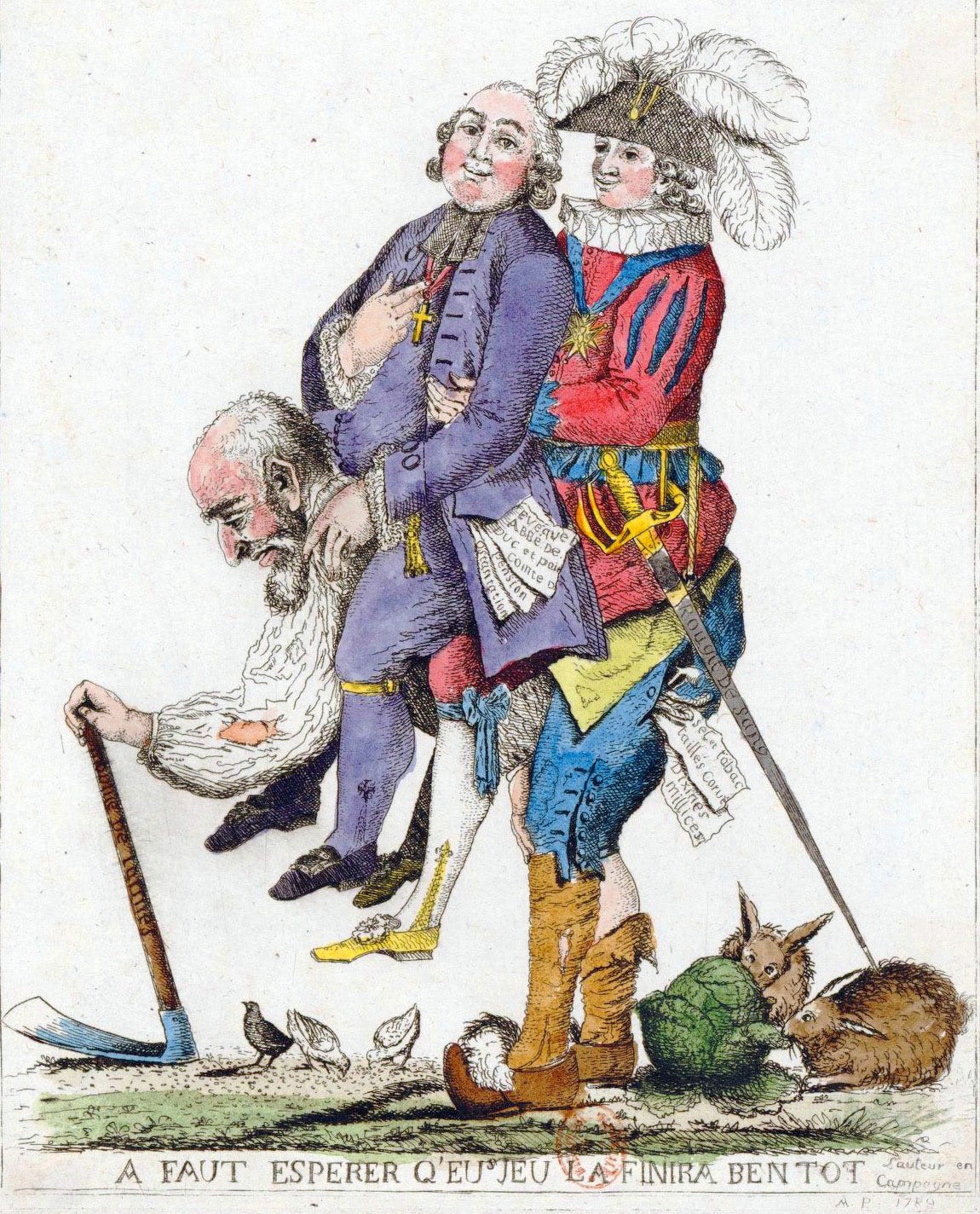
The system required sacrifice from the many while preserving privilege for the few. Sound familiar?
By 1789, the harvest in France had failed, grain was scarce, and bread—the basic food of the French people—had become so expensive that working families had to spend nearly everything they earned trying to buy it. Riots erupted. People were starving while the monarchy and the privileged classes remained protected from the suffering below them.
The Bastille was a fortress in the middle of Paris and a deeply despised symbol of royal tyranny and the Ancien Régime—the old order. People could be imprisoned there by the authority of the king without the protections we associate with due process, a public trial, or meaningful appeal. Its walls represented more than a prison. They represented a government in which power came from above, accountability barely existed, and ordinary people were expected to obey.
In the weeks before the Bastille fell, representatives of the Third Estate had already declared themselves the National Assembly. They insisted that political authority did not belong solely to the king, the aristocracy, or the institutions that protected them. It belonged to the nation.
When they feared being locked out of their meeting place, they gathered in an indoor tennis court and vowed not to disband until France had a constitution. Royal troops gathered around Paris, and the people believed the monarchy was preparing to crush the new assembly before it could change the balance of power.
On July 14, 1789, only seven prisoners were inside the Bastille, but angry Parisians stormed the citadel seeking gunpowder and weapons. And after hours of fighting, the fortress fell. The Bastille was not the whole monarchy, and its fall did not complete the Revolution. But it proved that a structure built to protect the privileged status quo could be breached, and a symbol of absolute power became a ruin. The people discovered that the walls surrounding arbitrary authority were not sacred, and they were not indestructible.
Even though the French Revolution descended into terrible violence, vengeance, and eventually another form of authoritarian rule, its history is both inspiration and warning. When a political system refuses reform, protects privilege, and leaves ordinary people feeling that peaceful change is impossible, the consequences can become dangerous and uncontrollable.
But that crack in the French universe on July 14, 1789, became the catalyst for a revolution already simmering. The French continue to celebrate the day as a victory of the people over systemic oppression. In 1880, it was officially established as a national holiday intended to represent French unity.
In our country today, the majority of our citizens—both Democrats and what’s left of the sane GOP—often feel that a loud and organized third of the country has hijacked our national agenda as well as our cowardly Congress. Under the Republican tax-and-spending law enacted in 2025, the top 10 percent are expected to gain about $13,600 a year, while the poorest 10 percent lose roughly $1,200 a year, principally because of reductions in Medicaid and food assistance. The Congressional Budget Office concluded that the law increases resources near the top while reducing them for households near the bottom. The government gives more to people who already possess enormous fortunes by taking food and healthcare from people who do not have enough.
How can we live with that?
And the oligarchy we face now may be even more dangerous than the aristocracy France confronted before the Revolution. The French nobility possessed land, wealth, political influence, and inherited privilege. They lived extravagantly while ordinary people carried the tax burden and struggled to afford bread. They were protected by a system arranged around their comfort and preservation.
America’s robber barons later owned the railroads, the mines, the steel mills, and the oil. They bought legislators, crushed unions, exploited workers, and accumulated fortunes so grotesque that their wealth became a public spectacle. But neither the French aristocracy nor the robber barons possessed what today’s oligarchs possess.
They did not control the systems through which millions of people receive their news, speak to one another, organize politically, conduct business, find work, and understand reality. They did not possess the personal data, private communications, movements, habits, fears, purchases, relationships, and political preferences of nearly the entire population.
They did not control artificial intelligence, global satellite networks, private space programs, digital currencies, payment systems, cloud computing, military technologies, and the algorithms that determine what hundreds of millions of people see—and what they do not see.
Today’s tech oligarchs do.
The French aristocracy controlled the old order. The robber barons controlled vast portions of the economy. Today’s oligarchs increasingly control the infrastructure of consciousness itself. They mediate reality.
They decide which voices rise and which disappear, which lies spread and which truths are buried, and which forms of anger can be converted into political power. They can alter an algorithm and change what an entire country sees before breakfast. They can purchase a communications platform and turn it into a propaganda machine. They can threaten to withdraw technologies on which governments, militaries, businesses, and ordinary people have come to depend.
And still it is not enough. That may be the most astonishing thing about extreme wealth: It does not satisfy greed. It magnifies it.
***
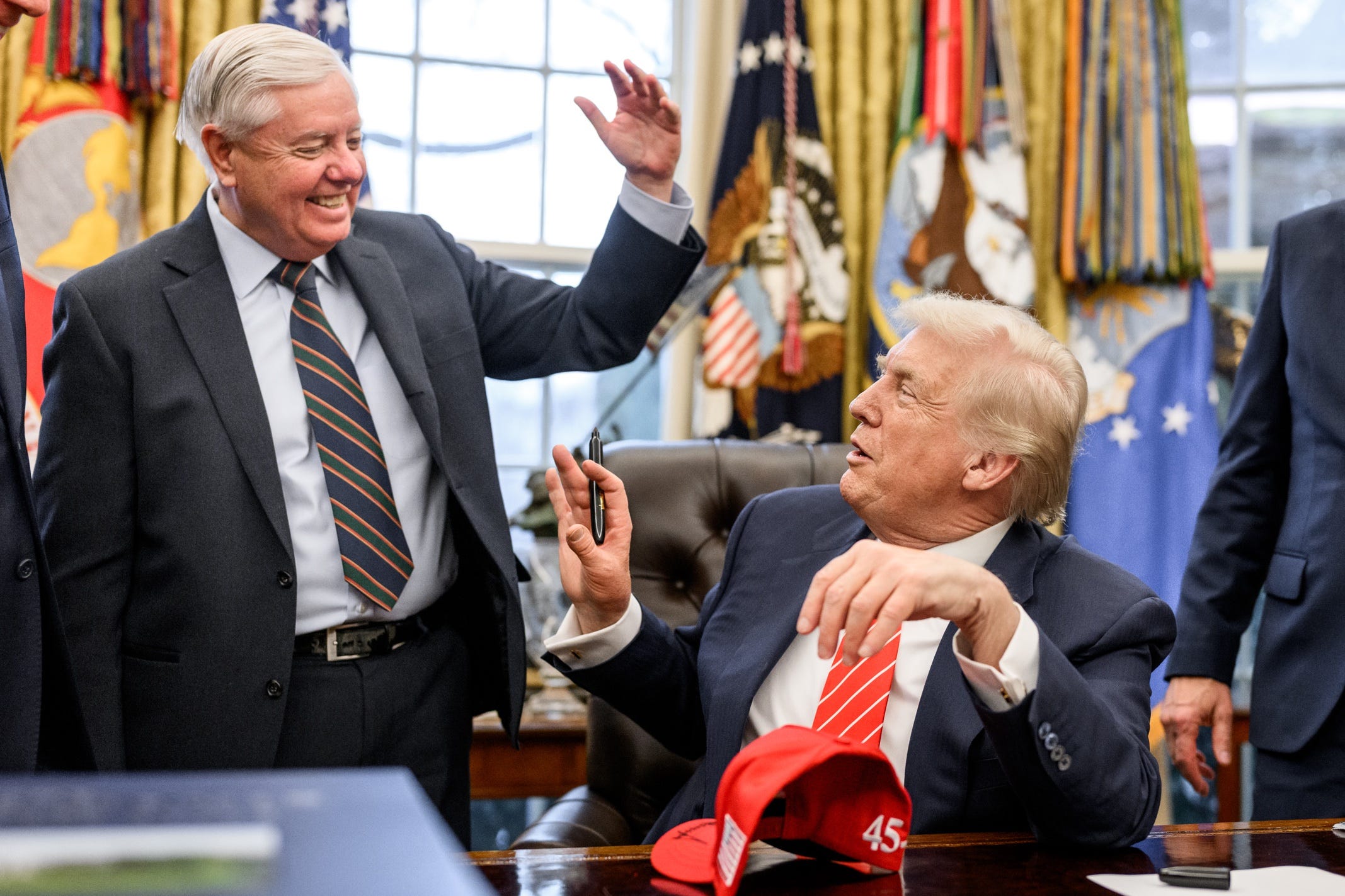
“DING DONG,” A friend of mine texted the morning Lindsey Graham died. “Let’s pop some Champagne,” said my husband, and this from a man who once truly regarded Graham as a responsible politician and a clever, caring man.
Graham’s sycophantic behavior towards Trump demeaned not only his personal integrity but also the trust that people once placed in him. Over and over again, he chose submission. And in the end, his surrender to Trump came for his legacy. In effect, Lindsey Graham ultimately defeated himself. Let that be a lesson to every member of Congress who continues to trade integrity for proximity to Trump.
Again, my hopeful prediction is that Democrat Dr. Annie Andrews will be the next senator from South Carolina. But this is bigger than any one race. Graham’s death has rattled the Republican Party in South Carolina and nationally. It has exposed weakness where the GOP depended on permanence, seniority, discipline, and fear. The wall has cracked. Now we move through it.
Thank you, as always, for reading—and for being part of this community. I never take your time, your attention, or your support for granted.
If this piece meant something to you, I hope you’ll share it.
If you’d like to support From the Inside Out, you can become a paid subscriber or leave a tip—buy me a cup of coffee. And if you’re not yet a subscriber, I’d be delighted to have you join us for free.
yes, please tip me a cup of coffee
However you choose to be here, I’m deeply grateful.
SECRET ENDING…
Comments
Nothing yet. Say the first thing.
Sign in to join the conversation.