
The 7th and 8th graders I work with were given a short story assignment by their classroom teacher: Write a historical fiction short story set in a colonized country. For weeks, these kids studied colonized countries spanning the globe and centuries. From Macedonia to the Democratic Republic of the Congo to the United States of America.
A few years ago, I left the classroom to become a literacy specialist, focusing on working with children with Dyslexia. Reading and writing go hand in hand, but even when a child reads “on grade level,” the application of writing often proves challenging. Enter—the short story assignment.
Working with children is interesting. There’s no such thing as a one-size-fits-all approach (no matter what basal programs and textbooks attempt to pass off).
One student wrote events (plot points) in a list—a good start for drafting, but much to his dismay, not exactly a story format. We spent our time stringing together sentences to form paragraphs, and talking about the importance of details. As I posed questions about characters, their motivations and actions, a puzzled expression painted my student’s face. “I feel like you’re trying to get details,” he said.
“Yes!” I answered. “You can’t expect your readers to know everything. You’ve got to tell a story.” He still appeared skeptical, so I added, “And, you have an entire page to fill up. If you don’t write enough, you won’t finish the assignment.”
Motivation activated.
As he continued to dictate and record events, he confessed, “I’m just making this up as I go along.”
Well, buddy, that’s pretty much what all writers do. (Even those of us who are published.)
My second student came to me with a few sentences and a loaded plot diagram. There was but one problem. He planned to set his story in Hawaiʻi in 1943. This mishap resulted in a mini-history lesson until we nailed down an appropriate year. Setting is more than just geography.
Once he settled on a timeline about 100 years earlier (when the British attempted to seize Hawaiʻi as a territory), his story took off. We handled the grammar and mechanics, rules for writing dialogue, and spelling. But, we had the most fun when we talked about visualization.
“Put the movie in your mind.” I closed my eyes and pointed to my head. “What do you see your characters doing? What’s the setting like? How do these things show what’s happening in your story?”
He got it. Of course he did. Isn’t it funny how the aspects of writing we adult writers overthink come so naturally to young people? I introduced this 8th-grader to One Stop for Writers, specifically the Emotion Thesaurus. Exploring character emotions helped him make his story come alive with action. He used vivid verbs and acted out dialogue beats, stomping, pretending to chuck a piece of wood at the ground, and “slamming” a door. The story came to life. His face lit up. He loved writing!
What’s the point of this story? If you’re a teacher, treat your kids like they are real writers…real creatives in whatever their endeavor. They may not grow up to be writers, but they just might be empowered to create.
You’re never too old to use your imagination. Writers do it all the time. Sometimes we think of it as work, but it’s really play, isn’t it? Especially, when you view it through the lens of a child’s perfect, creative intuition—imagination.
Writing Resources for Children
Below are some of my favorite resources for teaching writing craft to children. If you’re an educator (or have youngsters who love writing), feel free to share your favorites, too!
Super Sentences & Perfect Paragraphs
Scholastic's Teaching the Craft of Writing Series (There are more books than what’s shown here. You just have to dig around for them.)
The Great Books Foundation (A grade-level program chock-full of classic and quality short stories and writing resources to accompany each story.)
Incoming: The Teacher’s Second Publication
Feisty Deeds II: Historical Tales of Batches and Brews is available for pre-order from your favorite bookseller!
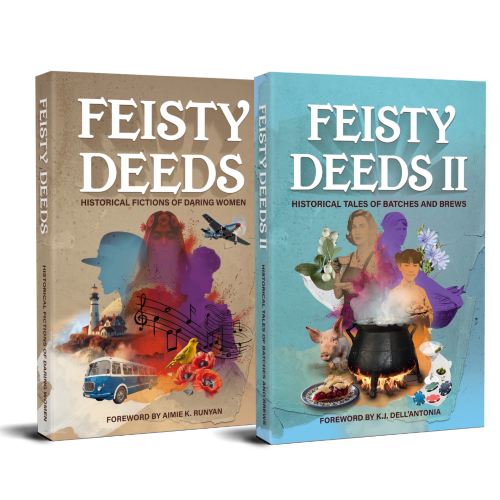
Release date for this follow-up to the award-winning anthology, Feisty Deeds: Historical Fictions of Daring Women, is set for Friday, December 12. I cannot wait for you read the 25 brand new tales cooked up by these Feisty Authors!
Sincerely,
Beth Anne Hill
A Little House Keeping: My newsletter is free. Never feel obligated to pledge or pay for my content.
If you’re interested in my library of stories or want to learn more about my writing, please check out my website.
No posts
Comments
Nothing yet. Say the first thing.
Sign in to join the conversation.