
Welcome to this week’s Beta Update 👋
*Note: You’re receiving this update because you previously registered for a Beta University–hosted or co-hosted event via our Luma calendar and opted in to receive communications from the hosts.
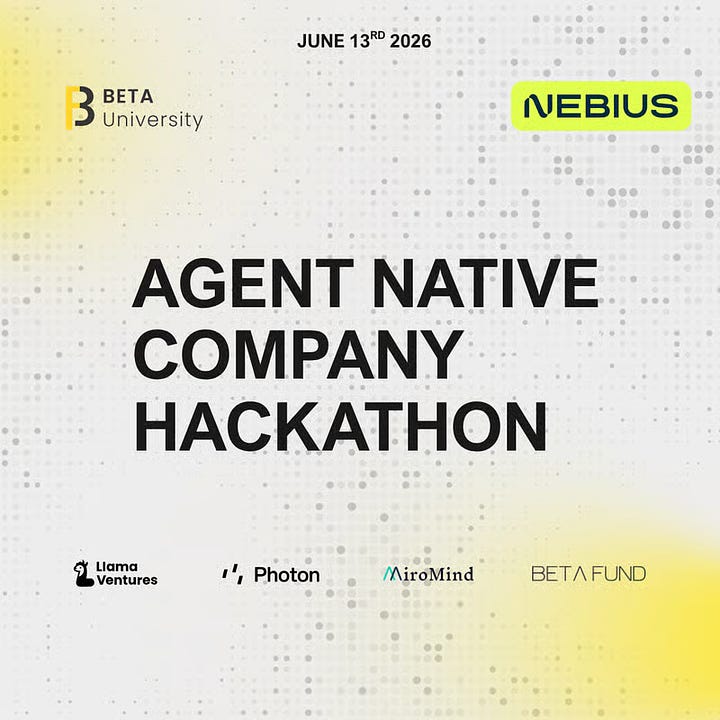

Saturday 6/13 Agent Native Company
Beta University is hosting a high-velocity one-day hackathon for builders, engineers, and founders ready to prototype and ship agent-native AI products in a single day. Working solo or in teams, participants will build across tracks spanning Autonomous GTM, MVP Speed-Run, Next-Gen Infrastructure, and an open Wildcard category — with venture judges and enterprise operators providing direct feedback.
Total $3,000 cash on the spot, plus a Beta Fellowship that fast-tracks standout teams into Beta University’s 8-week pre-accelerator with a $25K investment on completion.
The day runs two build sessions bookended by workshops and demos, closing with an audience vote and awards ceremony. Builders can register to compete; everyone else is welcome to watch, connect, and recruit.
Saturday 6/20 Beta Fund X Antler Hackathon
Build your Physical AI and win a cash prize from Beta Fund and a residency program opportunity from Antler
Insights from Jonathan Siddharth, founder & CEO of Turing
The company that quietly trains the models you use every day
You’ve probably used a coding model trained on Turing data without knowing it. Four of the top five coding models — Claude 3.5 Sonnet among them — rely on it. But Turing didn’t start there. It began in 2018 as a marketplace for hiring remote software engineers globally, growing fast as distributed work went mainstream during COVID.
The turning point came in 2022, when OpenAI approached the company to help train GPT-3 on code. Turing scaled from typical 10–100 person projects to over 1,000 engineers for model training — and discovered an entirely new business. Today it runs two engines at once: supplying frontier AI training data (competing with Scale AI, Surge, and Handshake) and deploying AI inside enterprises (competing with Palantir, Glean, and Distil). That dual position — sitting between cutting-edge research and real-world deployment — is rare. The numbers: a few hundred million in revenue, a few hundred employees, and a $2.2B valuation.
Lesson one: pick your battlefield carefully
Siddharth’s hardest-won lesson came from his first company, which competed directly with Google and lost. His rule now: choose big markets where the competition is weak or analog, and never go head-to-head with tech giants. He’s specific about the danger zone — a “no-fly zone” of nine frontier players (OpenAI, Anthropic, DeepMind, Meta, xAI, Apple, Amazon, and others). If your idea sits on their roadmap, find a different idea.
Lesson two: make big jumps, not small pivots
Be high-variance. When the data shows your current path isn’t working, don’t tweak — make a major change. Turing’s leap from staffing marketplace to AI data engine is the lesson in action.

Lesson three: run yourself as a multi-threaded CEO
His time allocation: 85% building the company, 10% always talking to investors, 5% cultivating strategic relationships. The framing that stuck with me — treat investors as “stock customers” who deserve the same continuous feedback loops as product customers. Build relationships before you need them.
He also thinks in terms of learning rate: stay three years ahead of what your company needs, and keep your company six months ahead of the frontier labs. Pair that with constant pre-mortems — actively naming what’s missing, who hasn’t been hired, and what could go wrong.
Where the world is heading
Siddharth’s bet is sweeping: nearly everything humans do on computers will be highly automated. The human role shifts from creating work to verifying what agents produce. Companies get smaller, entrepreneurship spreads, and instead of managing 5–8 direct reports, people will run 5–8 companies.
For founders, that splits the opportunity space in two: build the inputs to superintelligence (data, compute, energy, robotics) or build the things only possible once intelligence is cheap. The promising frontier is anything resistant to pure compute — physical-world problems, and domains requiring human taste, judgment, and warmth like healthcare, sales, and recruiting. He pegs the addressable market at $30 trillion across five dimensions: workflow × role × function × company × industry.
Join the Builders Club, the official Discord hub for future Beta Fund Hackathons.
We are centralizing a high-signal community of founders and engineers. This isn’t just another chat server—it is the direct pipeline to our investment team and ecosystem partners.
What’s on the line:
Direct Investment: On-the-spot investment checks for exceptional projects.
Hardware & Capital: High-tier prizes including Cash, Mac Minis, and more.
GTM Support: Direct access to Beta Fund’s resources to help you scale and move from hack to startup.
If you are building at the edge, join us to connect with mentors, find co-founders, and secure the backing your project needs.
Cheers,
Beta University Team
No posts
Comments
Nothing yet. Say the first thing.
Sign in to join the conversation.