
Then, over four pages, he walked through everything that has actually shifted.
Start with the one number that matters. Cash in the Parag Parikh Flexi Cap Fund peaked near 25%. It is now 14% to 15%, and he expects it to head toward single digits. A manager who tells you nothing changed, while deploying a third of his cash pile back into the market, is telling you something. The philosophy did not change. The opportunity set did. That gap is the whole note.
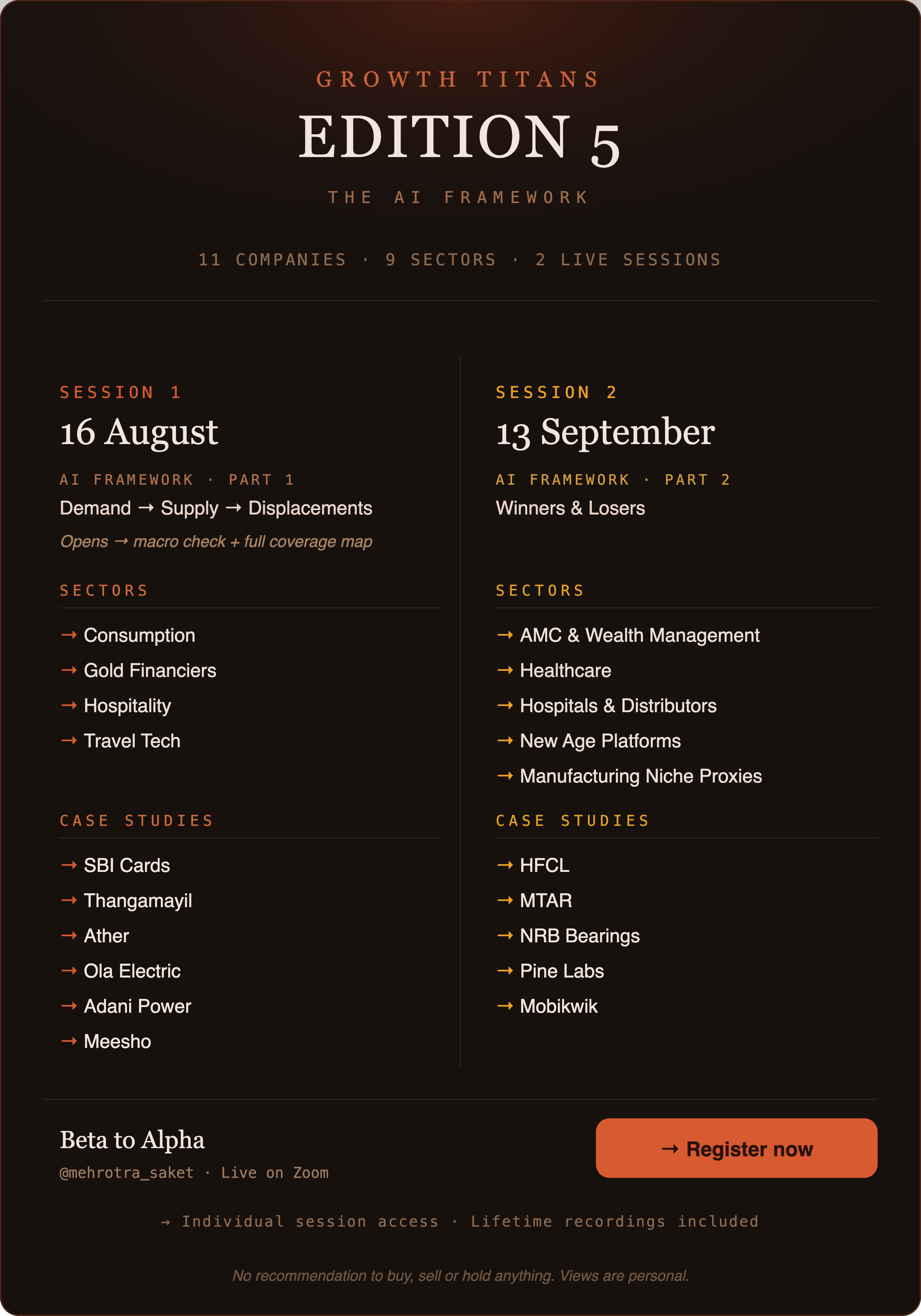
Before we dive deeper, Growth Titans of Q1 is just 48 hours away. Are you in?
I put this exact fund on a slide five months ago
At a college alumni session in March, I had a myth-busting section with one job: break the belief that the best funds always outperform. PPFAS Flexi Cap was Exhibit A. All the right ingredients. A rare 20% cash position. International exposure. A large-cap tilt built on quality. And it was underperforming its benchmark by double digits. Right strategy, wrong market window.
I made that point from the outside, reading a NAV series. Thakkar has now published the inside version of the same slide. It is worth reading not for what it defends, but for how a genuine long-term manager talks to his clients in the middle of a drawdown. There is a template in here for anyone sitting on a red portfolio right now.
Here is what stood out.

On “the fund didn’t even beat an FD”
The only way to guarantee a fixed deposit return is to buy a fixed deposit. Equity can potentially beat it precisely because of the volatility that people are now complaining about. You do not get the premium without the discomfort that pays for it. Two years of a sideways market is neither long nor deep by historical standards. It only feels historic because we lived through it.
On “it’s the large AUM”
This is the sharpest line in the note, and almost everyone will skim past it. Thakkar points out he ran a larger underperformance back in 2007, on a PMS book of just over ₹100 crore. Size is not the alibi. Concentrated, out-of-favour positioning looks wrong for long stretches. That is the cost of the strategy, not a defect in it. In his own words, the current underperformance is not noteworthy for either its length or its depth.
On cash being a drag
The caution that got PPFAS mocked in 2024, sitting on rising cash while the rest of the street was fully invested, did not hurt investors over these two years. At the margin it helped. The mockery aged badly. Worth remembering the next time a manager is ridiculed for holding cash into euphoria.
On the AI worry that has hijacked every India conversation
This is where the note earns its length. Four moves, and each one is a lesson in position sizing:
No direct exposure to pure-play model companies. He names OpenAI and Anthropic. The bet was never on which model wins the frontier. When the winner is genuinely unknowable, the discipline is to not need to know.
The hyperscalers he owns are not AI pure-plays. Microsoft still sells enterprise software. Amazon still runs e-commerce and legacy cloud. Google still prints ad revenue. The AI capex is large, but it is backed by enterprise demand and it sits on top of real, already-profitable businesses. Overcapacity, if it comes, gets consumed as workloads scale. It is not permanent.
On chips and memory, an honest admission: they missed the upside. Which is exactly why they carry little of the downside when those cyclical margins mean-revert. You cannot give back gains you never booked. Sometimes the trade you skipped is the risk you avoided.
On IT services, the contrarian read: the sell-off is an opportunity, not an obituary. His analogy is bank computerisation. Handwritten ledgers to core banking to internet banking to mobile banking, and banks employ more people today than in the 1990s. AI writes a chunk of the code. The implementation, and the new work it creates in areas like cyber security, does not vanish.
You do not have to agree with all of it. The point is that it is a reasoned position with a stated way to be proven wrong, which is more than most of the sell-side noise on IT is offering right now.
The valuation tell most people skipped
Thakkar drops three numbers, dated to the day, from screener.in on August 4:
Nifty 100 at 20.8x
Nifty Midcap 150 at 30.7x
Nifty Smallcap 250 at 34.6x
The large caps are the cheap part of this market. The reflex that “small always beats large” is not a law of physics. It is a bet on a valuation gap that currently runs the wrong way. He points to the US as the live example of what happens when that reflex breaks.
What the note is actually about
Strip it down and it is not really a defence of PPFAS. It is a manual for holding a position through the part of the cycle that tests you.
The underperformance is unremarkable. The cash is being deployed, not hoarded. The bear case on IT, on capex, on FPI flows, on the rupee, is available to every participant at the same instant, and priced in within seconds. The one edge that cannot be arbitraged away is the temperament to sit still while a good process looks wrong.
That is the line I keep coming back to. Everything in that note is public information. What is not evenly distributed is the willingness to look wrong for a while, on purpose, because the math says you will be right later.
A manager who tells you nothing changed, while quietly moving cash from 25% to 14%, is being about as bullish as a fiduciary is allowed to be. He just refused to say it loudly.
Growth Titans of Q1 starts in 2 days
Comments
Nothing yet. Say the first thing.
Sign in to join the conversation.