
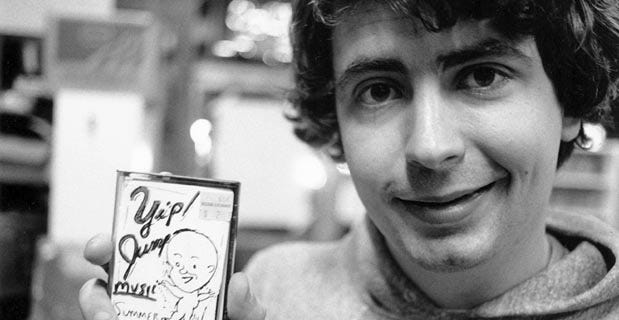
Daniel Johnston suggested something fundamental about art: that the first thought is often the truest, and that each layer of polish risks moving us further away from the thing itself.
Many people are familiar with the mythology. Kurt Cobain’s Hi, How Are You T-shirt, the homemade cassettes handed out around Austin, the psychiatric hospitals, the major-label bidding war, the kooky illustrations, and a disturbing, lifelong fear of the devil. For all this, I couldn’t recommend Jeff Feuerzeig’s documentary The Devil and Daniel Johnston (2005) more highly. It remains one of the most sensitive and illuminating portraits of one of the most authentic songwriters of his generation.
Johnston possessed a childlike expressiveness that felt both impossibly simple and utterly inexhaustible. He wrote intuitively, seemingly free from the self-consciousness and social constraint that affect the rest of us. That quality runs through his entire oeuvre, from the raw beauty of “Walking the Cow” to the indie standard “True Love Will Find You in the End”. It’s also worth seeking out his interview at Austin City Limits in 2009, where both he and the young interviewer start riffing on creativity and songwriting with heartwarming openness and vim.
The unadorned, uncompromising quality of Johnston’s early recordings transcended fame altogether. His is the kind of sound that could only emerge from someone sitting alone with a cassette player, a cheap microphone and his own thoughts. The songs have an almost unreal, unmediated connection to the truth.
His sensitivity, however, was also his greatest vulnerability. Notoriety, producers, labels and audiences could only ever distort what was already there. As such, his career resists the usual narrative of artistic progress. There is no steady climb to draw from, but more a tragically sharp decline in physical and mental health. Hi, How Are You remains the undeniable pinnacle and starting point, while much of what followed gradually lost the idiosyncrasy and innocence that made Johnston extraordinary.
This is the album immortalised by Kurt Cobain’s T-shirt, and the essential starting point for anyone discovering Daniel Johnston. Much of it sounds like a child alone in a room with a cassette recorder, absent-mindedly tapping, humming and singing as melodies emerge almost by accident. Tin Pan Alley sits somewhere in the background, along with McCartney, The Beatles, The Velvet Underground and The Stooges.
“Poor You” is closer to a poem than a conventional song, spoken quietly into the corner of a room, while “Big Business Monkey” speeds up and slows down according to feeling rather than tempo or premeditated structure, the tiny keyboard somehow becoming both percussion and pulse. “Walking the Cow” has the hypnosis of post-punk but none of its self-awareness.
The darker songs are arguably the finest. On “Despair Came Knocking”, a keyboard hauntingly imitates guitar strings while Johnston’s ghostly voice slips somewhere between tenderness and terror. Something in the muffled recording evokes the voice of the devil in The Exorcist; it is the sound of flaw, of somebody trying to transform overwhelming experience into song.
Indeed, the album’s strength lies in its complete fidelity to lived experience, devoid of polish or clever turns. The Velvet Underground come to mind, though they were perhaps never so endearingly unknowing. The songs mostly resemble demented nursery rhymes that twist in on themselves. The more time you spend with them, the stranger and more sophisticated they become.
1990 is generally considered to be Johnston’s masterpiece, largely because it was the first time he recorded in a proper recording studio with a producer, Mark Kramer, founder of Shimmy-Disc records, and contributions from Lee Ranaldo and Steve Shelley of Sonic Youth helped realise the songs in a proper studio. The production gently tweaks rather than overwhelms the quirks, while guitars bring a welcome, louder and punkier sound.
“True Love Will Find You in the End” and “Some Things Last a Long Time” are anthemic songs that would soon find a huge audience. The album finally brought Johnston much of the recognition he had always craved.
And it is true that the studio production allows the songs to breathe and stretch. For the first time, we hear traces of Nico, perhaps early Dylan, Randy Newman and, just as importantly, the countless artists Johnston would go on to influence. His teenage sensitivity acquires a new gravitas and authority.
The songs remain extraordinary, but the tape recorder is no longer part of the composition. The atmosphere changes. Sympathetic basslines and cleaner production subtly alter the gravity of Johnston’s strange little world.
The rawness still persists, however. The sustained chords at the end of “Lord, Give Me Hope” sound like a child discovering the sustain pedal for the first time, allowing the whole room to vibrate. These are the moments where Johnston momentarily escapes the studio and returns to his truest self.
Fun represents a tragic - if fascinating - decline. It was his first album to be released on a major label, with Atlantic Records winning a bidding war to sign Johnson and promptly dropping him after it was released due to disastrous sales figures. The enhanced production, session musicians and even the applause at the end of songs distract from Johnston’s singular gift. String arrangements swell where silence, tape hiss or static would have been far more devastating.
The opening tracks immediately reveal the problem. The drums are locked rigidly into time, smoothing away the wonderfully elastic rhythms that once gave Johnston’s recordings their emotional pulse. On “Life in Vain”, lush strings try to elevate what was already a heartbreaking song, but instead make it feel oddly sentimental. The rough edges carried the emotion; removing them removes the song’s centre of gravity.
“Crazy Love” is perhaps the exception. The song itself remains too eccentric to be fully contained, and the fuller production occasionally complements rather than overwhelms its oddness. Elsewhere, however, Johnston begins to sound strangely anonymous. The clean drums, polished guitars and reverberant vocals evoke the more conventional end of alternative rock, as though a singular artist has been squeezed into somebody else’s idea of what a Daniel Johnston record should sound like.
Tom Waits once spoke about the importance of preserving an amateur’s relationship with an instrument because that is where invention lies. Johnston understood this instinctively. His apparent “limitations” were never obstacles to the songs. They were the songs. His sound contained an irrepressible awkwardness that no amount of polish could ever hope to improve.
Though he spent much of his life longing for recognition, his greatest recordings seem almost unaware that anyone else is listening. There are many more polished records than Hi, How Are You. There are very few that feel more real.
Christian Wethered is a poet, songwriter and music journalist
No posts
Comments
Nothing yet. Say the first thing.
Sign in to join the conversation.