
A few weeks ago, I went to Tottenham Hotspur Stadium to see Dijon open for Zach Bryan. When Bryan first announced the tour last year, I raised an eyebrow at the generous list of support acts: MJ Lenderman (who has since pulled out for R&R purposes), Alabama Shakes, Kings of Leon, Gregory Alan Isakov, Ben Howard, Keenan O’Meara, Fey Fili, Gabriella Rose, J.R. Carroll, Trampled by Turtles, Caamp, and, as already mentioned, Dijon.
At a glance, I wondered if Bryan’s selections might have been a bit too ambitious. But if we’re not being pedantic, they all fit somewhere on a country-rock Venn diagram. Considering Bryan himself has said that he doesn’t want to categorise himself within one singular genre — so much so that he identifies himself as a non-descript “songwriter” — it’s appropriate that he would curate his live experience to reflect this openness.
So, when it comes to Dijon, who, despite being labelled as “alternative” or “experimental” R&B, still incorporates elements of folk and Americana that you’d think — or hope — that he might resonate with your modern-day country music aficionado. Unfortunately, this hasn’t been the case.
I caught Dijon on Bryan’s second and final night in London. He played early in the evening, to be followed by Filli. At the time, attendees were still gradually trickling into the stadium, but a substantial crowd had already formed directly in front of the stage to secure their spots for Bryan. Early on, I noticed a general air of inattentiveness when Dijon and his band came together. It was probably the first time I’d seen a crowd not clap or cheer for an artist’s entry. Moments later, a group would loudly sing “Happy Birthday” over “The Dress”. This appeared to break the seal for the floor to morph into a mixer.
Later on, I discovered that Bryan invited Dijon to join him on stage. It was a nice gesture and perhaps it provided a more direct resolution to the disparities in genre politics highlighted earlier, putting Dijon in a position to be regarded with the same respect that he should have been granted to begin with. But is there truly any consolation prize for blatant disrespect of that calibre?
What I witnessed was not an isolated incident. At different points throughout the tour, Dijon was subject to booing, heckling, and simply being drowned out in the chatter.
You can make a lot of excuses for poor audience behaviour in this instance, or any instance, really. Chalk it up to a mismatch in booking, the inherently conservative nature of country music, or even the fact that a gig is a social occasion… shouldn’t people be entitled to socialise?
Sure, but not with such flagrant disregard of a supporting artist. And this isn’t just a Dijon-specific issue. Last week, Ethel Cain shared an Instagram story addressing a similar situation that she’s observed at points in her Willoughby Tucker Forever Tour.
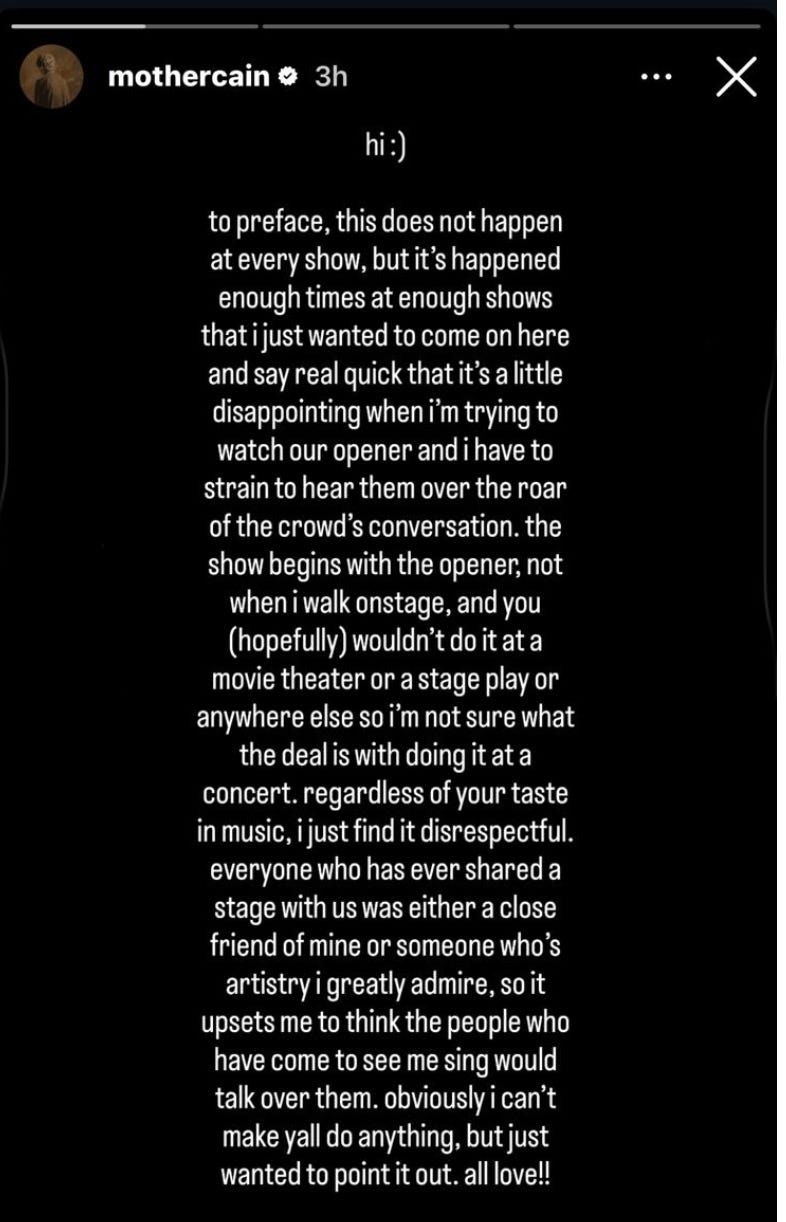
“To preface, this does not happen at every show,” Cain wrote in the post, “but it’s happened enough times at enough shows that I just wanted to come on here and say real quick that it’s a little disappointing when I’m trying to watch our opener, and I have to strain to hear them over the roar of the crowd’s conversation.
“The show begins with the opener, not when I walk onstage, and you (hopefully) wouldn’t do it at a movie theater or a stage play or anywhere else so I’m not sure what the deal is with doing it at a concert. Regardless of your taste in music, I just find it disrespectful. Everyone who has ever shared a stage with us was either a close friend of mine or someone who’s artistry I greatly admire, so it upsets me to think the people who have come to see me sing would talk over them…”
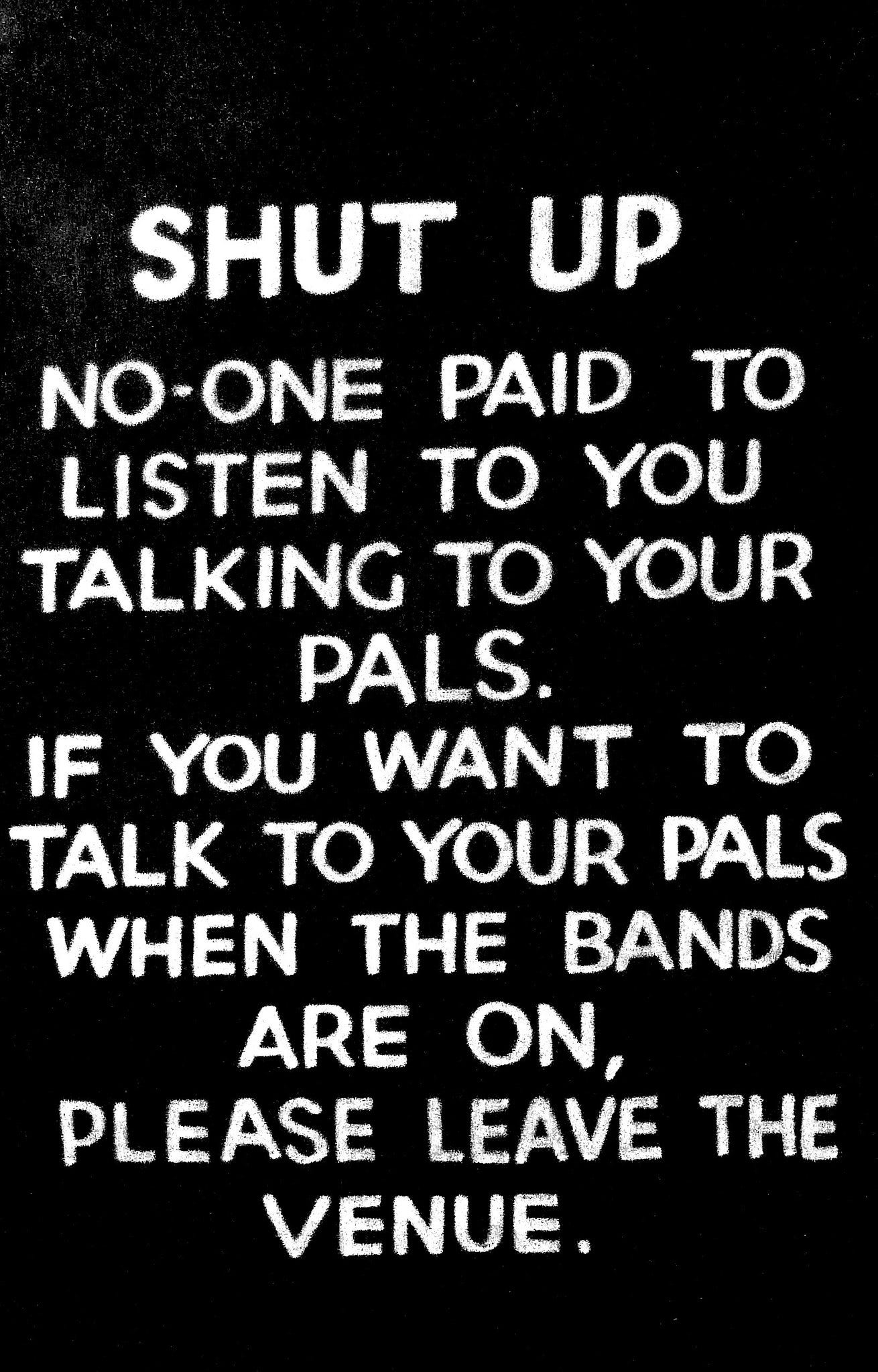
While this has been a passive, though mounting, inconvenience that at times is passed off as part of the “gig experience”, it’s concerning that artists now have to remind fans to be respectful. Much of the excitement of live music comes from trusting in the curation of the performance, which includes contributions from the openers. At times, you might find an annoyed audience member willing to take things into their own hands and shush the perpetrators of the noise. Even venues were willing to do their part, most famously the Luminaire in Kilburn, a music venue which shut down in 2010, but became known for its blunt signage that read, “no one paid to listen to you talking to your pals. If you want to talk to your pals when the bands are on, please leave the venue.” Shushing could also be expected for non-compliance, simply to prioritise a space for artists to be heard with intention rather than disruption. But now, it feels as though many people treat gigs as a free-for-all that emphasises their individual experience with minimal consideration for those around them.
And as Cain notes, that consideration reflects on the artist — and perhaps indicates a mistrust in their choice. It wouldn’t be a reach to say that often, the way that we engage with music and performance can come from an overly scrupulous place. We want to ensure that we are getting our money and time’s worth, because these are two resources that often feel glaringly limited. But it seems as though we have forgotten that we are investing in the artist’s vision, which has also become more apparent this past week as Lily Allen has had to step in and defend her West End Girl tour.
“I don’t want anyone to feel ripped off,” Allen said in a statement response to criticism around the price of her show, fifty-five minute runtime, lack of audience engagement throughout the performance, no support act, and the fact that she only performed songs from West End Girl, among other criticisms. “Everyone on this tour is really working very hard to give people the best show we possibly can, and I’m extremely proud of it.”
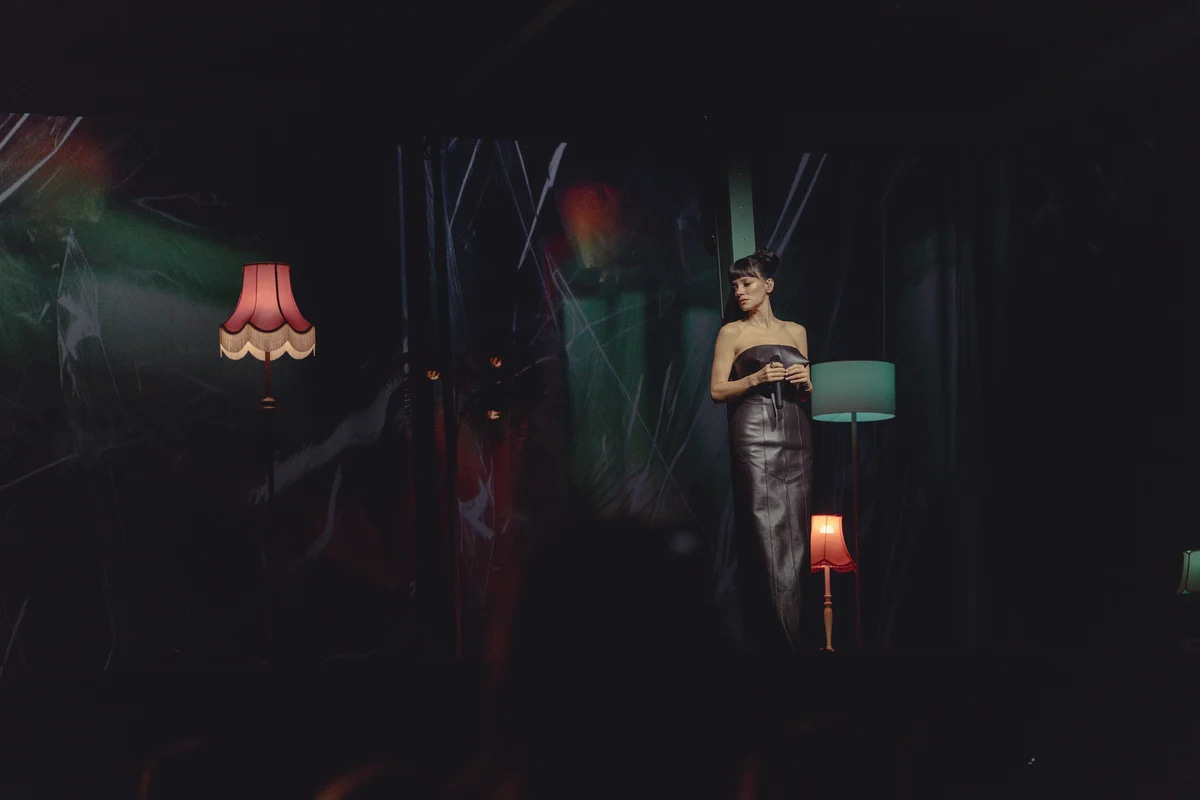
Elsewhere, her approach to performing the album has been heralded as theatre which, judging by how it was advertised, seems to align most appropriately. While you can’t please everyone, a greater question exists in the backlash: to what extent can an artist commit to delivering an onstage vision that feels true to them, while honouring the expectations and resources coming from their fanbase?
Now, more than ever, being able to trust in an artist’s curation feels crucial. Often, I find myself being asked how I go about discovering new music, primarily since more and more people have made the effort to distance themselves from the algorithmic drive of unethical streaming platforms or suggestions fuelled by AI. There is a keen desire to engage with music from a real human, discerning place. So, while my first answer to that question is usually some sort of music media, I always raise the point that odds are, the artists that you already love are likely to point you in the right direction — whether that be through radio shows, playlists, or who they choose to support them on a tour bill.
In equal measure, they present an opportunity to expand upon the art that they create in more unique, personal ways. In Allen’s case, rather than delivering a conventional run of “greatest hits” shows with West End Girl, she honours the album’s concept as a performance piece, offering more insight into her capabilities as an artist. Similarly, Bryan and Cain have invited friends and collaborators to share in their musical spaces, extending their platforms to the people who inspire them, and/or find themselves inspired by them. These are extensions of the artist’s tastes and values, and they ask you to maintain some level of faith in what they’re building towards.
But, I get it. Not every artist will lean into the idea of fan service, and there are some stylistic decisions that can feel difficult to overlook. But at the end of the day, even if you can’t will yourself to enjoy some part of a performance, the kindest thing you can do is keep your grievances quiet until the show is over, and try to invest in the wider picture of the artist’s choice.
No posts
Comments
Nothing yet. Say the first thing.
Sign in to join the conversation.