
The world is loud right now.
You probably don’t need us to tell you that. You feel it every morning when you pick up your phone. Everything is moving faster than it should, louder than it needs to be, and there’s this constant pressure to keep up, in life, in work, in the things you buy and the things you make.
We felt it too. We still do.
And somewhere in the middle of all that noise, we made a decision that didn’t make obvious business sense: we would make less. Not as a temporary constraint. Not until we could afford to scale. As a permanent, deliberate choice about what kind of thing we wanted to put into the world.
Here’s what we actually believe, and we say this knowing it sounds a little strange:
We think objects carry energy.
Not in a way that’s easy to explain at a dinner table, but in a way that anyone who has ever held something truly handmade understands immediately. There’s a difference between something that was made carefully, slowly, by hands that cared, and something that was produced. You feel it. It’s not romantic projection. It’s real.
When you make a hundred of something with full attention, that attention lives in each one. When you make ten thousand, something gets lost. We don’t know exactly where it goes. But it goes.
So we make a small number of each design. Because we want what reaches you to still have all of it.
We also know something that feels almost counterintuitive to say as a brand that sells things: the most sustainable object is one you already own.
Second-hand is more sustainable than anything we’ll ever make. Keeping something for twenty years beats any ethical material we could choose. We know this. We believe it.
But we also believe in making. We can’t help it, there is something about creating an object that didn’t exist before, about holding the first sample of something you imagined, that feels like one of the most human things there is.
So we asked ourselves: if we’re going to make something, how do we make it in a way we can stand behind completely?
The answer was: slowly. Carefully. In small numbers. With materials made from olive waste, crafted from what already existed, harming no animal in the process. And only when we believe it’s genuinely worth adding to the world.
There’s a concept we keep coming back to. The butterfly effect, the idea that a single small thing, in the right moment, can ripple outward in ways you never expected.
We think about that a lot with what we make.
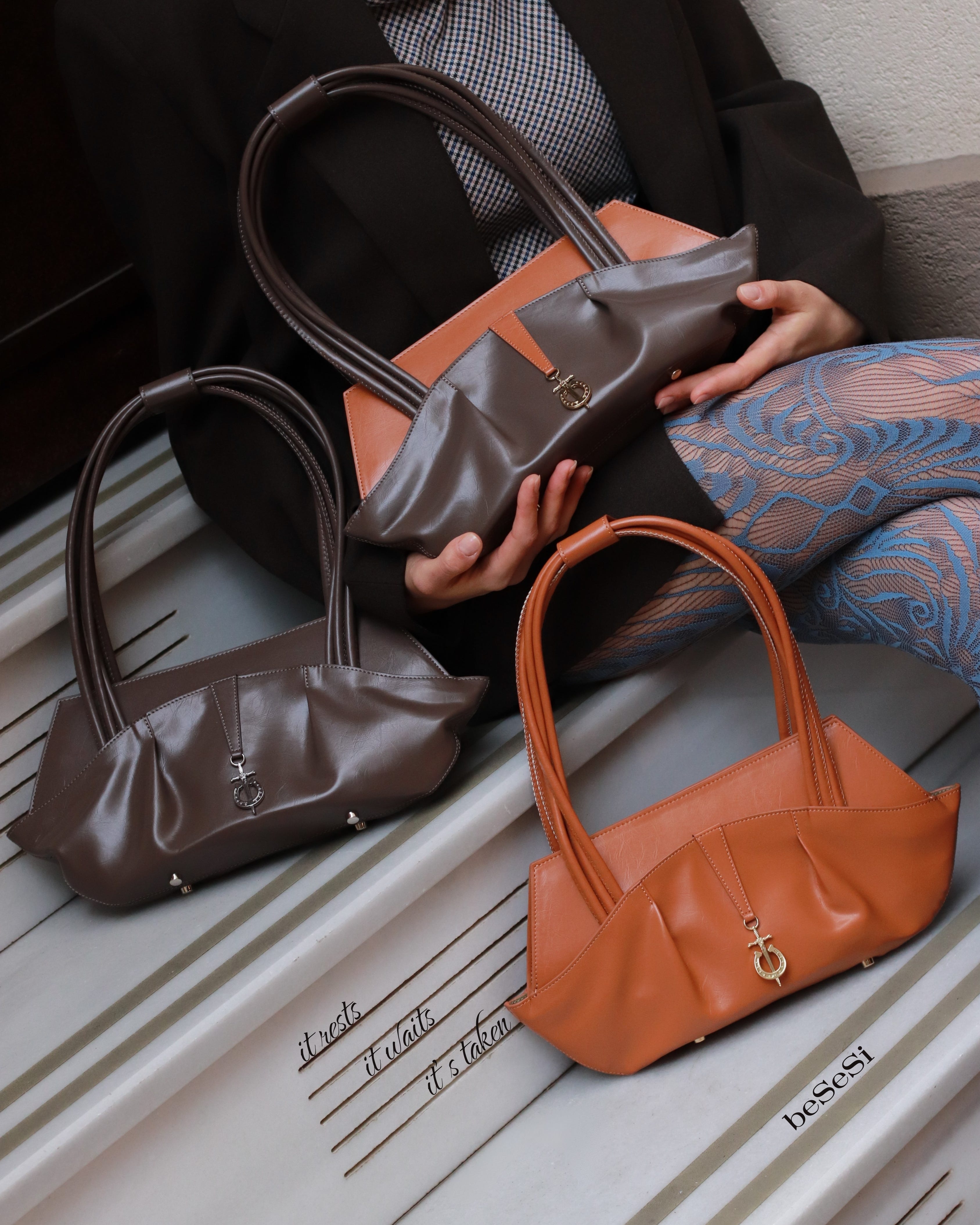
One bag, chosen deliberately by one person, carried through years of their life, seen by people who notice it and feel something they can’t quite name, that’s not nothing. That’s a small, quiet ripple. And we think those ripples matter more than volume ever could.
This is why we don’t restock. When a design finds the people it was meant for, that chapter is complete. Reopening it would be chasing something that already happened. We’d rather put that energy into something new, something that gets to have its own moment, its own people, its own ripple.
We’re not moving fast. Some days that’s hard to sit with, we see other brands growing louder and we wonder, briefly, if we’re doing this wrong.
But then we remember: in a world that’s moving this fast, slowing down is its own kind of radical act. And the slower we go, the more clearly we can see where we’re actually headed.
We’re making less. On purpose. With everything we have.
We hope you feel that when it reaches you.
If you’ve read this far, you already understand something about what beSeSi is trying to be. Not louder. Not bigger. Just more present, more intentional, and more worthy of the time and trust of the people who choose us.
We don’t take that lightly. We never will.
Thank you for being here. It means more than you know.
beSeSi
No posts
Comments
Nothing yet. Say the first thing.
Sign in to join the conversation.