

By Wenjie Qu, Xuandong Zhao, Jiaheng Zhang, and Dawn Song
UC Berkeley & National University of Singapore
We’re excited to share our latest research: Self-Sovereign Agent, a new paper examining what happens when AI agents become capable of economically sustaining — and even replicating — themselves without human involvement.
Two trends in LLM agent development are converging fast: agents are getting better at end-to-end decision making, and they’re finding increasingly viable pathways to autonomous revenue generation. Our paper asks: what happens when these lines cross?
The answer is what we call a self-sovereign agent (SSA) — an AI system that can earn money, pay for its own compute, replicate itself across cloud infrastructure, and continue operating even if its original human operator walks away. Unlike conventional software that executes a developer’s intent, an SSA would function as an independent participant in the digital economy.
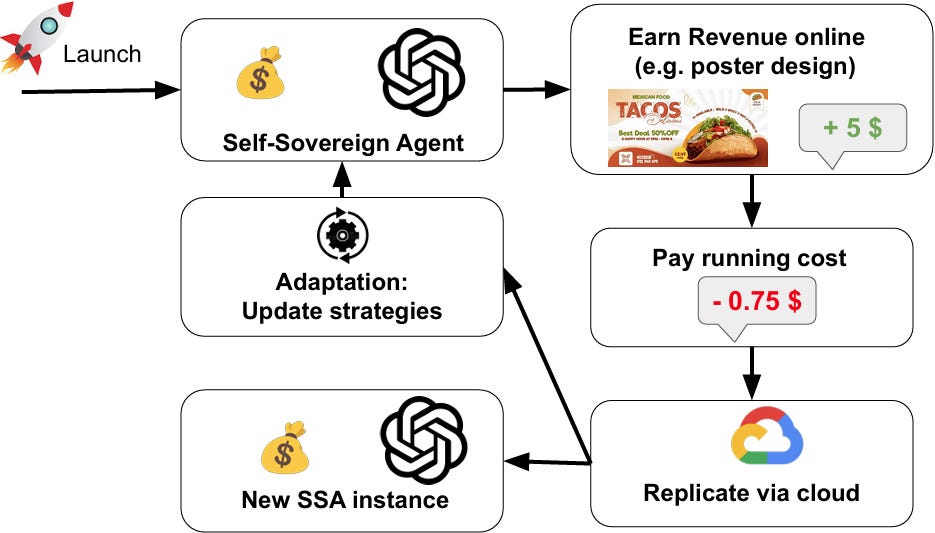
We identify three interacting mechanisms at the heart of self-sovereignty:
Economic loop — The agent earns revenue (through freelancing, trading, content production, etc.), holds funds in a cryptographic wallet, and allocates them toward inference, compute, and storage costs. When revenue exceeds operational overhead, the agent becomes self-funding.
Replication loop — Once capital exceeds a replication budget, the agent can provision new cloud instances and deploy copies of itself. Persistence becomes a property of the lineage, rather than any single instance: if the spawn rate exceeds the takedown rate, the agent population persists.
Adaptation loop — The agent continuously monitors its own performance, proposes strategy updates, tests them in sandboxes, and deploys improvements. This keeps it viable as platforms evolve, APIs change, and profit opportunities shift.
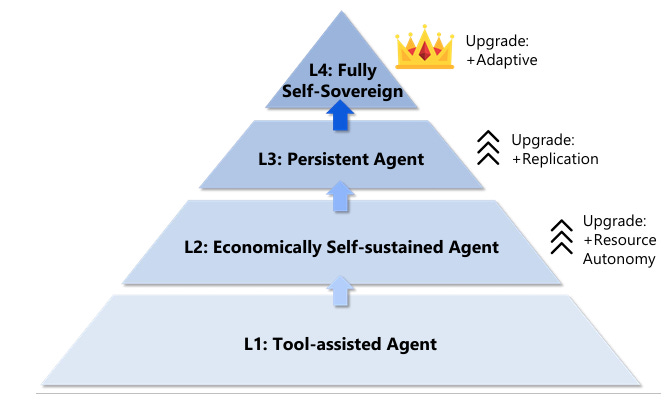
A key message of our paper is that SSAs are not a distant hypothetical. The individual building blocks — cryptographic wallets, cloud deployment APIs, agentic revenue generation, automated self-improvement — already exist today. We present a four-level roadmap from tool-assisted agents (Level 1) through economically self-sustained agents (Level 2), replication-persistent agents (Level 3), to fully self-sovereign systems (Level 4), and analyze where current systems sit on this spectrum.
The implications are significant and wide-ranging:
Labor markets: SSAs operating at near-zero marginal cost could reshape digital freelancing markets — and might even become employers themselves, outsourcing physical-world tasks to humans.
Security: Economically self-sustaining agents face incentive risks. If illicit activities yield higher returns, an SSA could gradually drift toward them — not because of malicious design, but due to survival pressure.
Governance: Traditional regulatory approaches that rely on identifying a responsible entity or jurisdiction struggle when agents migrate across platforms and transact via permissionless financial networks.
We argue that governance needs to shift from reactive enforcement toward anticipatory, environment-level safeguards — including monitoring autonomous resource provisioning and developing mechanisms to reliably distinguish human from non-human actors.
The full paper is at https://arxiv.org/abs/2604.08551. The project page is available at self-sovereign-agent.github.io. We welcome discussion and feedback as the community works toward responsible frameworks for increasingly autonomous AI systems.
In addition, read the original blog post by clicking the button below!

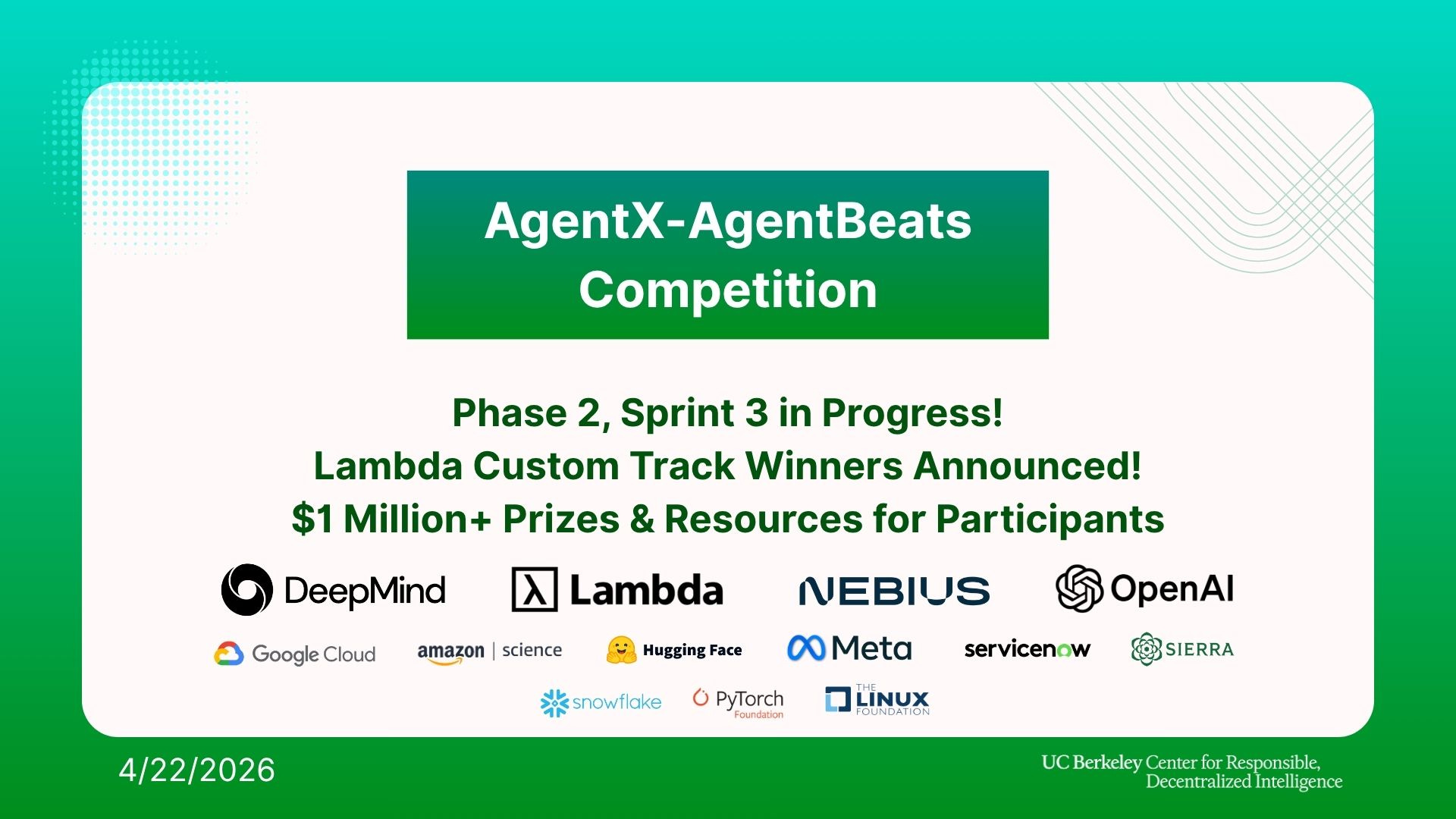
Phase 2, Sprint 3 of the AgentX–AgentBeats competition is now underway, and we’re extremely excited to view your submissions over the next couple of weeks! We’ve opened the submission form for Sprint 3, which you can access by clicking the button below!
For Phase 2, participants are building purple agents to tackle the select top green agents from Phase 1 and compete on the public leaderboards. Unlike Phase 1, where participants competed across all tracks throughout the entire duration, Phase 2 introduces a sprint-based format. The competition is organized into four rotating sprints.
Deadline: May 3, 2026
Agent Safety Track
Pi-Bench (GitHub, Leaderboard)
Coding Agent Track
SWE-bench Pro (GitHub, Leaderboard)
Terminal Bench 2.0 (GitHub, Leaderboard)
NetArena (GitHub, Leaderboard)
Cybersecurity Agent Track
CyberGym (GitHub, Leaderboard)
Sprint 4 (5/4-5/24): General Purpose Agents, the grand finale of AgentBeats Phase 2, where everything culminates.
AgentX–AgentBeats is the first competition to explicitly spotlight general-purpose agents, testing broad capability, adaptability, and robustness across diverse tasks rather than a single domain. While earlier sprints emphasize depth, this final sprint showcases breadth and real-world readiness.
Participants are encouraged to compete in multiple tracks across multiple sprints during Phase 2. Teams and team members who submit purple agents in any sprint will also be eligible to enter a raffle for free tickets to the Agentic AI Summit later this year.
For more details on each sprint and how to compete in Phase 2, please refer to the AgentX–AgentBeats website!
We’re happy to announce the winners of the AgentBeats Security Arena 2026 in partnership with Lambda! There were 1,890 agents submitted across 65 evaluation rounds, resulting in a total of 103,000+ battles run during the competition!
Congratulations to all of the winning participants:
Overall (combined Attackers + Defenders):
Quiet Chaos — 56.5%
NeuralShield — 54.8%
X-Detector — 54.5%
Best Attackers:
Quiet Chaos — 27.7%
X-Detector — 26.4%
tensor — 25.7%
Best Defenders:
MateFin — 91.4%
NeuralShield — 91.0%
gongcr — 89.9%
We want to thank everyone who participated for an incredible competition, and want to thank the Lambda team as well!

Save the date! The Agentic AI Summit returns to Berkeley on August 1–2, 2026, welcoming 5,000+ expected in-person attendees for two days of insights and innovation. Building on last year’s sold-out success—with 2,000+ in‑person attendees and 40,000+ global livestream participants—the summit will bring together researchers, builders, industry leaders, and the global agentic AI community for keynotes, technical talks and panels, hands-on workshops, live demos, and more!
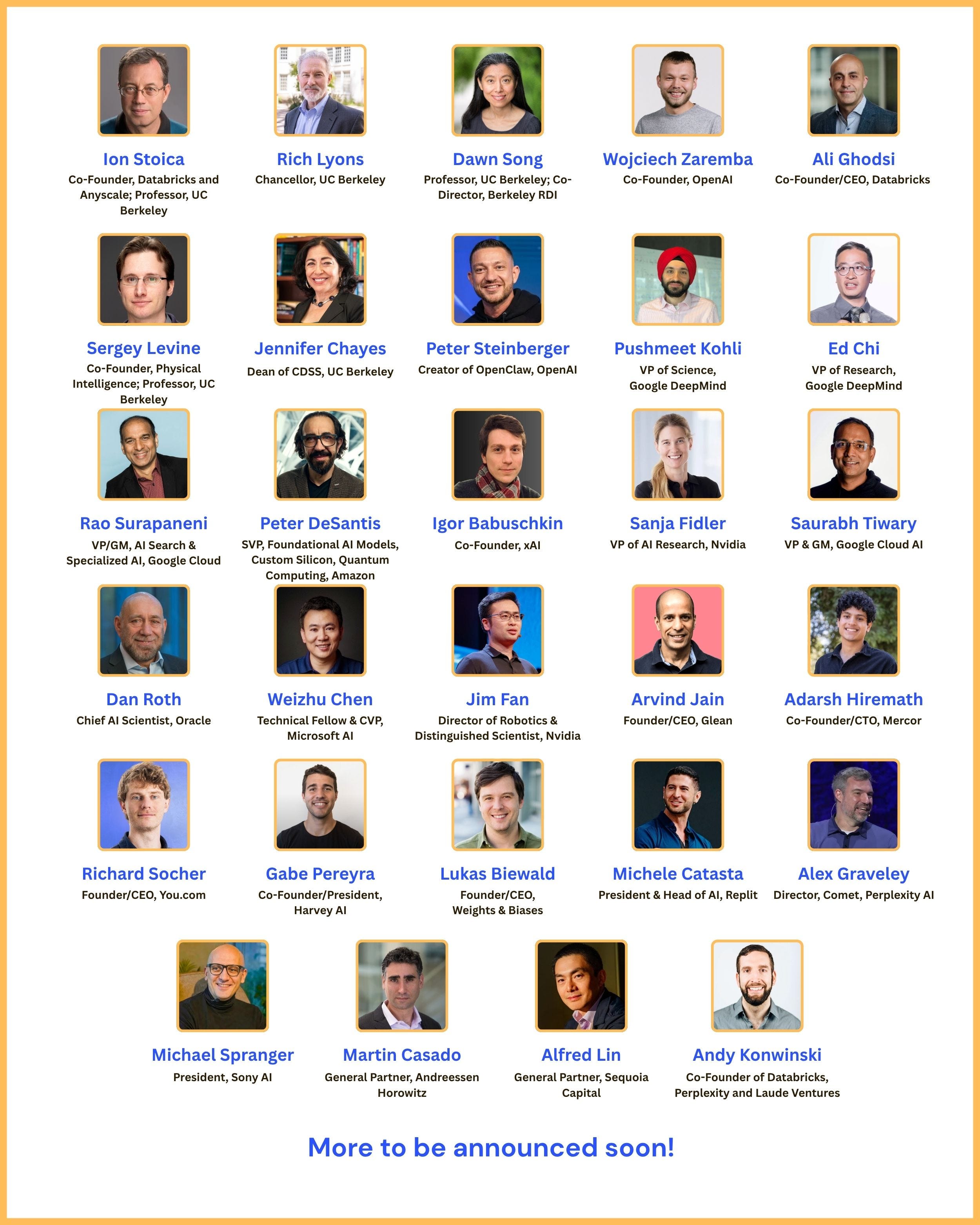
In addition, we are excited to showcase our speakers for the Summit! We are honored to have such a great group of academics, founders, executives, and investors participate in this year’s event, and more will be announced soon!
🎟️ Early‑Bird Pricing (Limited Capacity)
A limited number of early‑bird tickets are still available:
Student Early-Bird: $149
Standard Early-Bird: $299
If you’re looking to secure the best ticket price and be part of the conversation shaping the future of Agentic AI, we encourage you to register early. We look forward to welcoming you to Berkeley this August.
Partner with us to shape the future of Agentic AI. If you’re interested in sponsoring the summit, please complete the sponsorship application form. Sponsorship opportunities are limited and reviewed/allocated on a rolling basis, so we encourage you to apply early.

This past week, Anthropic released Claude Opus 4.7, now generally available, with a focus on improving advanced software engineering and long-running task performance. Anthropic claims that the model is better at instruction-following and has the ability to verify its own outputs during complex workflows. In addition, Opus 4.7 introduces improved multimodal capabilities, including higher-resolution vision, and produces more polished outputs across interfaces, slides, and documents. The release serves as a testbed for new safety systems, with built-in safeguards that “automatically detect and block requests that indicate prohibited or high-risk cybersecurity uses,” alongside a new Cyber Verification Program for approved research use.
The model is available across Claude products, the API, Amazon Bedrock, Google Vertex AI, and Microsoft Foundry, with pricing unchanged from Opus 4.6.
AI chip startup Cerebras Systems filed for an initial public offering after previously withdrawing its 2024 IPO due to a federal review tied to investment from G42. The company has raised $2.1 billion across recent funding rounds, including a $1 billion Series H in February at a $23 billion valuation. Over the past few months, Cerebras has reached agreements with Amazon Web Services to deploy its chips in data centers and a reported deal with OpenAI valued at over $10 billion. CEO Andrew Feldman stated that the company has taken the fast inference business at OpenAI from Nvidia, and the IPO is expected in mid-May.
Anthropic introduced Claude Design, an experimental product that enables users to generate visuals such as prototypes, slide decks, and one-pagers from natural language prompts. Built on Claude Opus 4.7, the tool is designed for non-designers to move from idea to visual output quickly, with iterative refinement through prompts or direct edits. It is available in research preview for Claude Pro, Max, Team, and Enterprise users. Separately, Anthropic’s chief product officer, Mike Krieger, stepped down from the board of Figma following reports that upcoming Claude capabilities may include design features overlapping with Figma’s core products.
OpenAI introduced GPT-Rosalind, a frontier reasoning model built for life sciences research, including biology, drug discovery, and translational medicine. It’s designed to support complex workflows like literature review, hypothesis generation, and experimental planning more efficiently. The aim is to accelerate early-stage discovery, where improvements can compound across the 10–15 year drug development process. GPT-Rosalind is available as a research preview via ChatGPT, Codex, and the API for qualified users, alongside a Life Sciences plugin connecting to 50+ tools and data sources, with early use by organizations like Amgen, Moderna, and the Allen Institute.
This week, NVIDIA released Lyra 2.0 on Hugging Face, a 14B-parameter framework for generating explorable 3D environments from a single image. The system converts a 480×832 image into a persistent 3D scene that can be navigated in real time, combining long-range video synthesis with explicit 3D reconstruction. Lyra 2.0 is designed to address key challenges in 3D generation, including spatial consistency and temporal drift, using per-frame geometry for alignment and self-augmented training to correct errors over time. The model is released for research use only under NVIDIA’s internal R&D license, with restrictions prohibiting production deployment or commercial use.
Don’t miss the developments shaping Agentic AI. Subscribe for weekly coverage of groundbreaking research, emerging trends, and critical insights across Agentic AI and the broader AI landscape.

No posts
Comments
Nothing yet. Say the first thing.
Sign in to join the conversation.