
“Why do we need a handbook on how to have a conversation?” Jaime asked. “It feels so artificial.”
A couple of weeks before our trip to Arkansas, our agency had sent us a glossy PDF titled Surrogacy Conversation Starter. On the cover was a stock image of a straight couple laughing at their laptop, as if they were both thinking, Oh boy, do we love having awkward online conversations about emotionally complicated topics.
“It’s meant to help us approach difficult subjects with Marina in a sensitive way,” I said. “So we’re all aligned ahead of the delivery. So nothing unexpected comes up in the moment.”
“That I get,” Jaime said. “But listen to this.”
He read from page two:
“If you plan to give a gift to your surrogate, be mindful. While a small gesture can be well received, surprise gifts such as hiring a videographer to record the birth can be overwhelming and unwelcome.”
I burst out laughing. “Can you imagine? You walk into the delivery room with a film crew and a boom mic?”
“Two director’s chairs in the corner,” Jaime added.
“Doctor, can we shift slightly to the left? We’re losing the light.”
“Well…it’s in the handbook for a reason,” Jaime said. “Someone must have done it.”
Some of the advice felt absurd. But what struck me more was how structured it all was — as if the bond we had built with Marina needed to be funneled into designated talking points and assigned turns. It felt slightly at odds with the ease we’d developed over the past few months.
Still, further down were questions worth discussing: Who would be allowed in the room? What happens if the baby arrives early and we don’t make it in time? Would someone hold him first? Would someone cut the umbilical cord?
So, on the morning of the anatomy scan, the three of us went to a local coffee shop Marina recommended to walk through the logistics.
From the outside, it looked like any other strip-mall storefront. But once inside, it felt surprisingly familiar — a chalkboard listing elaborate drink names, baristas in neatly pressed aprons, the smell of freshly ground espresso and warm pastries filling the air.
“It’s one of the newer places,” Marina said. “The university’s not far from here. This whole area is getting gentrified by the minute.”
We ordered hot drinks and shared a couple of scones.
“So I read the handbook,” Marina said once we sat down. “I gotta say — it’s weird.”
“Right?” Jaime said. “That’s exactly what I said.”
“Did you see the part about the videographer?” I asked.
“Oh my God,” she said, laughing. “Can you imagine? Although, to be honest, after the first couple I was paired with, I wouldn’t have been totally shocked.”
We all laughed.
“You know,” I said after a moment, wrapping my hands around my cup, “when we started this process, I assumed we’d build two relationships. One with our egg donor, and one with our surrogate. And in my mind, I thought the stronger connection would probably be with the egg donor, because of the genetic tie.”
I paused, suddenly aware that my voice had shifted.
“But I was wrong. I value so much the bond we’ve built with you. We can talk easily. We can laugh. And this whole process has brought us together in a way that feels… real. I don’t think that disappears after June.”
“Totally,” Marina said. “I feel so comfortable with you guys. You’re engaged but also laid back. After that first couple, I almost didn’t continue. I’m really glad I did.”
There was something grounding about hearing that. As anxious as I had been at different points, we had genuinely trusted her. We enjoyed texting, sharing photos, checking in — but we never felt the need to hover. Our connection felt rooted in mutual respect more than in obligation.
We moved through the questions naturally. Anything involving her body — whether she’d get an epidural, how she wanted labor to unfold — we deferred to her without hesitation. Questions about who would hold the baby first or cut the cord, she left to us. She also offered, without drama, to care for him in those first hours if he arrived before we did.
By the time we finished, it felt less like a formal exercise and more like a shared understanding.
We bundled up.
“Let’s go see this baby,” Marina said.
As we turned into the hospital entrance, the complex unfolded in front of us — modern buildings, wide glass doors, clean lines. It was nothing like the modest rural clinic we had privately imagined. If anything, it felt calmer and more spacious than many of the hospitals we’d visited in New York.
Inside the women’s health wing, the air carried that familiar sterile scent, softened by something floral. We passed pregnant women at various stages, older patients, a teenager with a cast.
“We are the only guys in this entire place,” I murmured to Jaime.
Marina checked in without hesitation. “We have an appointment. These two are the dads — I’m the surrogate.”
I found myself scanning the receptionist’s face out of habit, bracing for some reaction.
There wasn’t one. Just a nod and a polite smile.
After a short wait, a technician called Marina’s name and led us down a quiet hallway into a dim exam room. The lights were lowered. The machine hummed softly.
She spread gel across Marina’s belly — it looked cold, though Marina barely reacted — and then turned the screen toward us.
“There’s your baby,” she said.
I looked up.
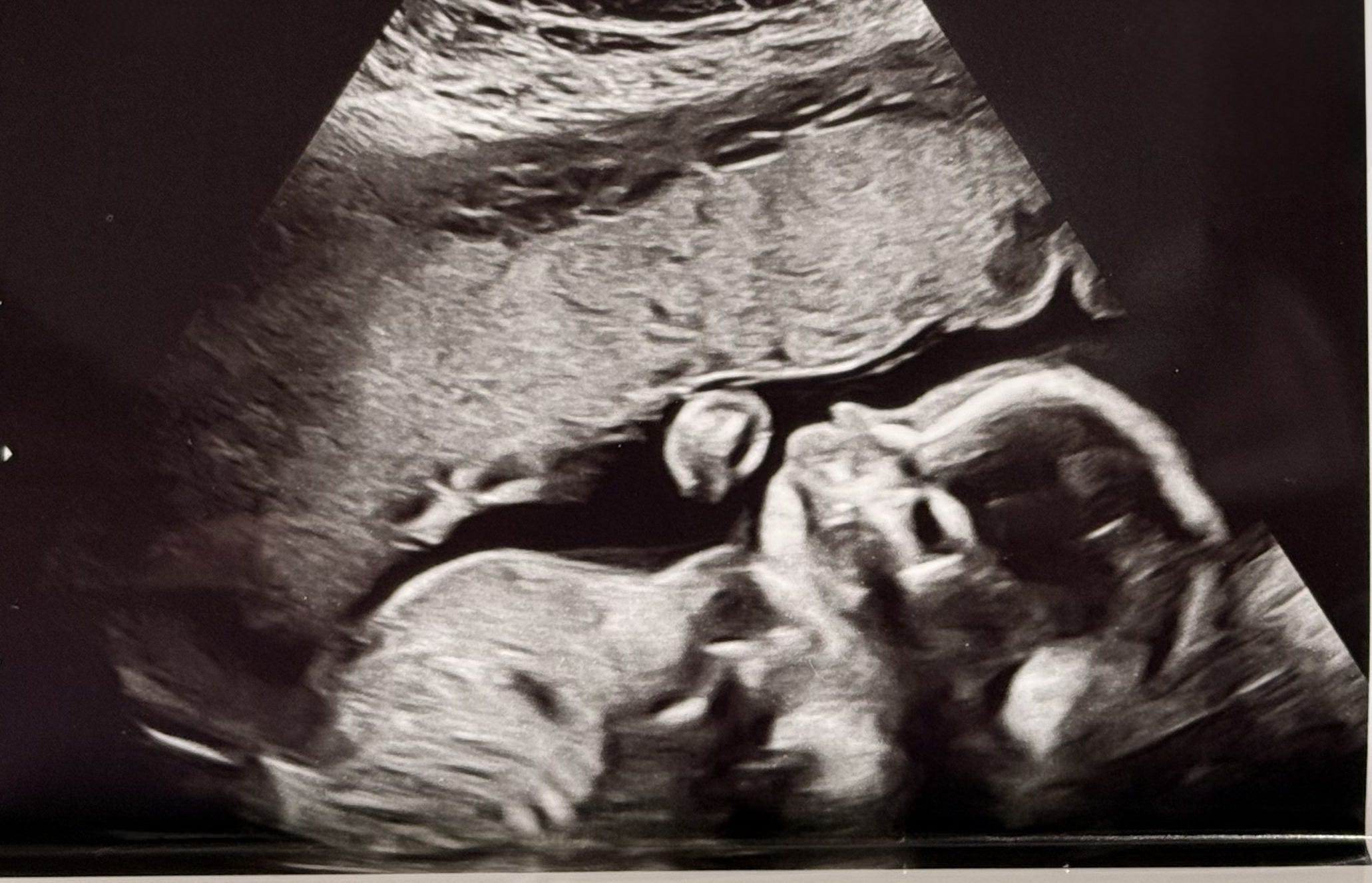
The image was startlingly clear. Jaidan lay there in profile, his head perfectly shaped, the outline of his nose and lips distinct. A small round belly. An arm bent inward. A leg shifting gently.
I squeezed Jaime’s hand, aware of warmth rising to my face and that familiar sting gathering behind my eyes.
“Shift a little to your left,” the technician said to Marina, adjusting the probe.
“Well,” she said a moment later, “you’ve definitely got a boy.”
We laughed softly. We already knew from the PGT testing, but hearing it in this room, while looking at him, felt different.
Over the next thirty minutes, she examined everything carefully — his brain, his spine, the chambers of his heart, each finger and toe. Watching her move from one measurement to the next, I felt something settle inside me. He wasn’t theoretical anymore. He wasn’t an embryo on a report. He was here, moving, existing. At one point, she captured an image of him sucking his thumb, and the sight of it made my chest tighten in a way I hadn’t anticipated.
By the end, she printed a long strip of images and handed them to us. We folded them carefully, almost ceremoniously.
A knock followed shortly after, and a doctor entered wearing a white coat. Her blond hair was pulled into a bun that managed to look both tidy and relaxed.
“Hello! You must be Jaime and Daniel. I’m Dr. Dawson.”
There was a warmth in her tone that put us at ease immediately. She greeted Marina like someone she knew well, asked how she’d been feeling, and reviewed the technician’s notes.
“Everything looks great,” she said. “He’s growing right in the middle of the curve. And you’ll have plenty of opportunities to want your kid to outperform everyone else. In here, average is exactly what you want.”
We laughed.
“Last time we’ll let you not outperform everyone else,” Jaime said toward the screen.
She answered our questions and reminded us that due dates are estimates at best.
“Babies come when they want to,” she said.
As she stood to leave, she added, “See you all in about twenty weeks.”
Twenty weeks. We were already halfway.
The realization carried both relief and a quiet surge of panic — there was still so much to do.
“Let’s go tour the hospital,” Marina said, cutting through my spiraling thoughts.
When we got to the third floor, a nurse greeted us. She looked like a young Lily Tomlin — her wavy gray hair fell on her shoulders, her glasses framed her nose. She looked like that quirky aunt who still has a Woodstock banner in her house.
“Oh good,” she said, eyes lighting up. “You’re here, my tour people.”
There was something in her tone that suggested we were not routine. More like a rare bird sighting.
“I’m Kathy.”
She held a clipboard close to her chest like it contained something classified.
“And you must be our dads.”
No hesitation. No testing.
“Yes,” I said. “I’m Danny. This is my husband, Jaime.”
“Danny,” she murmured. “Blue button-down.”
She looked up at me, studying my face for a moment longer than expected, then added something else in careful script.
“And I’m Marina, the oven!”
She smiled. “That’s great — one of our nurses was a surrogate a while ago too — you two should meet.”
“Jaime,” she continued.
Jaime cleared his throat. “Is this where we’ll check in on the day?”
Without looking up, she added to the page.
“Asks logistical questions.”
Jaime blinked.
She turned the clipboard slightly toward him.
“It helps me remember each of you,” she said. “Glasses,” she added, writing it beside Jaime’s name.
Then, satisfied, she clasped her hands behind her back and began walking down the hallway in small, deliberate steps. Not rushed. Not slow. Measured. Like an elderly Japanese man inspecting a garden path.
Every few yards she would stop abruptly, clasp her chin in deep reflection, and face us.
“This is triage,” she said. “This is where we determine whether Marina is in early labor or simply enthusiastic.”
She let that sit.
“If contractions are five minutes apart, lasting one minute, for one hour, what do you do?” she asked.
“We call?” Marina answered as if she were suddenly back in middle school trying not to fail a pop quiz.
Kathy nodded approvingly and resumed her quiet procession.
Inside an empty delivery room, she became even more focused. She stood at the center, surveying the bed, the monitors, the warmer — her hands still folded behind her back.
“When the time comes,” she said, “it will feel fast. It will feel coordinated. Everyone will know their position.”
She moved us gently with light touches to our elbows.
“You want to see,” she said. “But not hover. You want to be present. Not in the choreography.”
She stepped back and examined the room again, calculating angles.
I looked at the open space near the middle of the floor.
“So,” I said, “I’m guessing the center of the room is not the ideal place for me to pass out.”
There was the briefest pause.
She turned slowly, chin grasp engaged.
“No,” she said. “You’re supporting cast. Very important, but not center stage. We don’t want you stealing focus from our lead,” she added, pointing to Marina.
Jaime laughed.
She continued. “But on the day, advocate for yourselves. Unless there’s an emergency, there shouldn’t be a reason why both of you are not in the room.”
She paused.
“And if you feel faint, you sit. Preferably before becoming part of the choreography.”
We nodded.
Back in the hallway, we walked by the nurses’ station. Without lowering her voice, she announced:
“Say hello, ladies. They’re touring the hospital with me.”
A few heads lifted politely. Mild interest.
“These two are going to be dads. She is their surrogate. Twenty weeks.”
There was a small beat — something shifted. Faces softened. A couple of nurses stood. They all smiled. Someone said, “Oh wow, congratulations.” Another asked when he was due. The “two dads” seemed to shift something. Not only was being gay not a liability in this town — it suddenly felt like an asset.
Kathy gave one satisfied nod and resumed walking.
Near the elevators, she stopped again and quizzed us one last time to make sure we got the direction of the hallways right.
“Now wait here.”
She disappeared through a staff-only door.
When she returned, she was holding a hospital guide against her chest.
“I am technically not supposed to give this to you yet,” she said in a lowered voice.
She glanced down the hall.
“These are distributed after delivery. When you are sleep-deprived and emotionally scrambled.”
She placed it in my hands.
“You, however, are currently lucid. You’re sleeping more than two hours at a time and not trying to decode this with a crying newborn in your arms.”
A small smile flickered.
“Read it now. While your brains are still your own.”
I laughed.
“Thank you.”
She nodded once, pleased.
Then she folded her hands neatly behind her back again and walked away down the corridor — measured steps, quiet authority — as if overseeing not just a hospital floor, but a very important and slightly sacred operation.
“Nurse Kathy, ladies and gents,” I said.
“I want her in my life,” Marina said.
“I need her in mine,” Jaime added.
That afternoon, we went to an arts and crafts shop with Marina and her three-year-old, Alex. The room smelled faintly of paint and damp clay, and the sound of brushes tapping against ceramic echoed lightly in the background.
Jaime and Alex chose ponies. Marina and I picked coffee mugs. Mine had three letters etched across it: D-A-D. It was a perfect memento for the weekend.
“What color do you want for your horse?” Marina asked.
“Green!” Alex answered without hesitation.
“That’s an excellent choice,” Jaime said seriously.
Alex painted with intense concentration, her tongue peeking out slightly. Marina guided her gently, reminding her to put the lid back on the paint when she was done but letting her take the lead.
I snapped a photo of them together — an ordinary, intimate moment. Watching Marina with her daughter added another layer to everything we were experiencing. It was as if her role as our surrogate receded for a moment, and we were simply seeing her as a friend. A mom. A woman whose life moved forward in grocery lists and preschool drop-offs and small negotiations over paint lids — just like ours would soon.
That night we had dinner with Marina and Preston before she drove us back to the hotel. She suggested a few local pubs in case we wanted to go out, but we were both physically and emotionally spent.
Back in the room, we lay on our stomachs on the bed, the strip of sonograms unfolded between us.
“We’re so lucky,” I said quietly.
Jaime looked over at me.
“Of all the matches that could have happened, here we are — in a town we’d never heard of, with someone we almost didn’t choose, and a healthy twenty-week-old boy on the way.”
Jaime picked up the image of Jaidan sucking his thumb.
“I keep thinking about that moment on the subway,” I said. “When I felt like I couldn’t breathe trying to decide whether to move forward with Marina. How close we were to saying no — out of fear. Out of assumptions.”
He reached for my hand.
“Thank you for not letting that get in the way,” I said.
He squeezed my fingers.
“That wasn’t me,” he said gently. “That was us.”
“That was us.”
Continue reading…
Chapter 32. Square Footage
·
Mar 7

Coming home after the twenty-week scan felt like we had turned a corner. Suddenly, Jaidan was no longer a possibility — he was a countdown. The abstract had become scheduled. And if the first twenty weeks had flown by, the next twenty felt like they were already lacing up their running shoes.
No posts
Comments
Nothing yet. Say the first thing.
Sign in to join the conversation.