
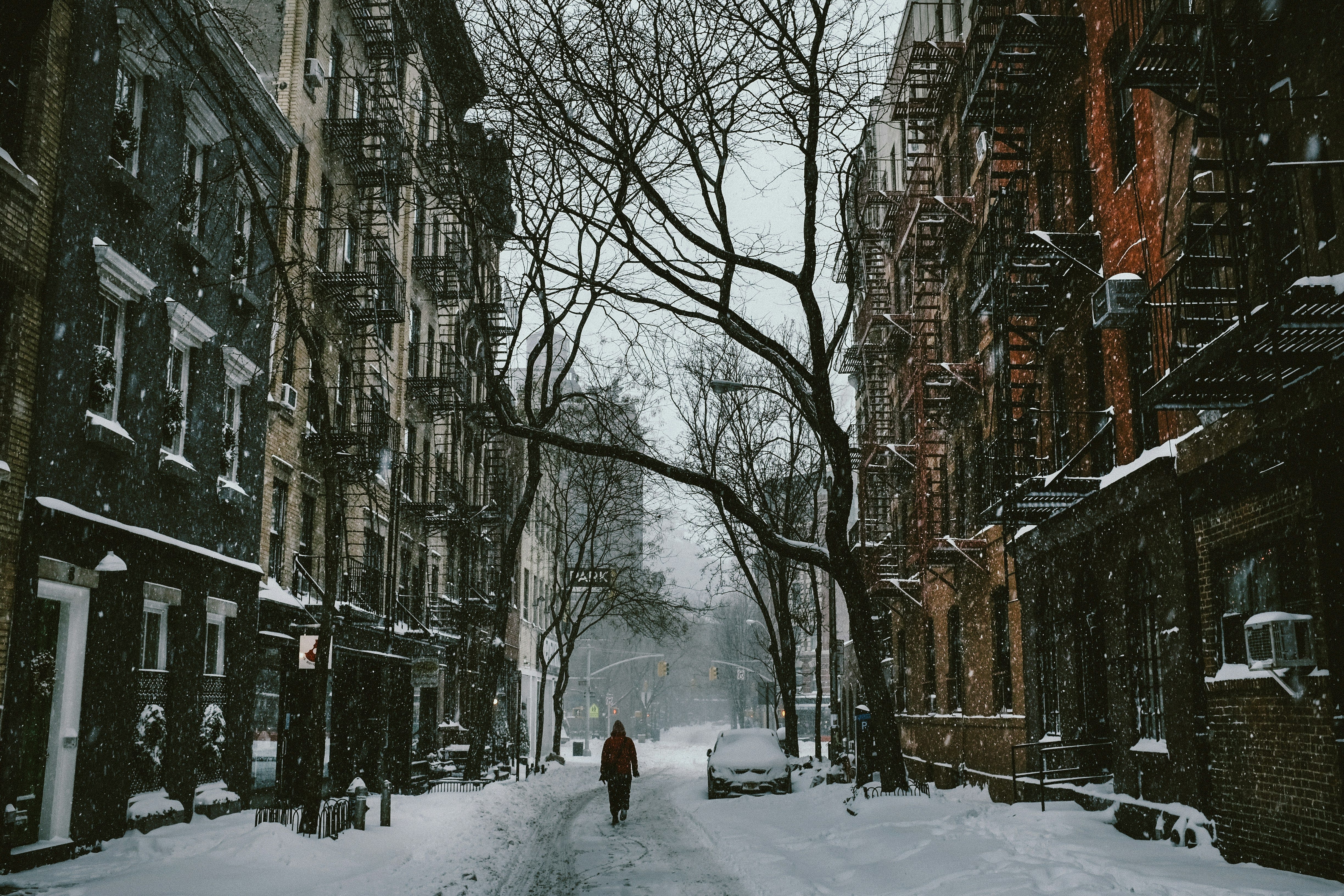
“We don’t need a Christmas tree this year,” Jaime said, hands buried deep in his coat pockets as we walked down Second Avenue.
The cold had teeth. Wind barreled in from the East River and slid straight through my scarf. Our breath came out in small, exhausted clouds. Every restaurant window we passed looked warmer than we felt.
“We’re flying on the twenty-third,” he continued. “We won’t even be home for Christmas.”
“First of all,” I said, squinting at building numbers as they blurred past, “nobody needs a Christmas tree.”
The numbers jumped from 398 to 402.
“You don’t put one up because you need it. You put one up because it makes you happy.” I stopped short. “Where the hell is 400?”
Jaime didn’t answer right away. He was watching the cross streets. Counting. Calculating. “You say that now,” he said finally. “But you won’t be very happy when we get back in January and you’re vacuuming pine needles for three hours.”
“That’s a January problem.”
“It’s a guaranteed January problem.”
A delivery truck roared past and pushed a wave of wind at us. Steam rose from a subway grate near the curb, briefly fogging my glasses. I pulled my coat tighter. It was December 5th, and winter had settled in for real. My fingers had gone numb inside my gloves.
“This is what we do,” I said, softer now. “We go to the stand. We argue about height. You insist on something ‘practical.’ I insist on something that brushes the ceiling. We carry it home like idiots. That’s December.”
Jaime smiled despite himself. “You mean I carry it for eight blocks, and you pretend to help while taking selfies.”
“I am documenting our family traditions.”
He laughed, then shook his head. “They’re almost three hundred dollars this year. Three hundred dollars for something that dies in two weeks.”
“It’s not about the tree,” I said. “It’s about what it represents.”
He looked at me then, and the joking thinned. Too many things were already shifting. The year had been one long recalibration—plans rearranged, futures redrawn. The tree wasn’t about pine needles or money. It was proof that something familiar still existed. That we could mark time the way we always had.
Rationally, I knew he was right. We’d be gone most of December.
Emotionally, I wanted something that smelled like continuity.
“Left on 50th,” Jaime said suddenly. “I think we needed to go left.”
“No, we came from—” I stopped. Reoriented. Looked back at the street sign half-hidden by scaffolding. “Wait. You’re right.”
We crossed against the light together.
“Okay,” I said. “If that’s 406…”
“Then 400 has to be this side,” he finished.
We scanned the buildings in sync now. I checked doorways; he checked the numbers above the awnings. He stepped closer to the curb. I ducked under scaffolding to see past a construction tarp.
“Three ninety-eight… four-oh-two…”
“Gap in the middle,” he said. “So it’s tucked in.”
“There,” I said, at the same moment he pointed.
Number 400. Half-concealed by metal poles and plywood. Invisible unless you were looking together.
We jaywalked again, horns flaring behind us, and stopped at the entrance to catch our breath.
“See?” I said. “We’re excellent at this.”
“At arguing about trees?”
“At finding what we’re looking for.”
And that was the thing. We could debate the symbolic value of a dying tree like opposing counsel. We could make closing arguments, defend our positions passionately.
But when it came to the things that actually mattered—getting where we were going, navigating something uncertain—we didn’t cancel each other out.
We adjusted. We recalculated. We built.
“Fine,” I said as the elevator doors closed. “Forget the tree.”
“For now?” he asked.
“For now,” I admitted.
We didn’t get a tree that year. Instead, we baked Christmas cookies and hung a couple of ornaments, just enough to make the apartment feel festive—for fourteen days.
Two weeks later, we zipped our suitcases shut and headed for the airport.
When we stepped into my parents’ apartment, the warmth hit first—thick and fragrant. The entire place smelled like homemade sourdough. My mom had been cooking for days. Before we’d even taken our coats off, she was opening the fridge and pointing proudly: jars of homemade jam lined up on the shelf, a container of salsa she’d prepared for breakfast, two or three desserts already set and waiting. On the counter sat homemade granola in a large glass jar, and beside it, two fresh loaves of sourdough cooling on a wooden board.
“I hope you brought your appetites,” she said, already reaching for plates.
Outside their windows, Stanley Park in all its majesty. Inside, everything felt warm and comforting —home.
We spent the next few days immersed in family life, setting aside the chaos of New York. My parents were eager to hear every detail about the pregnancy, and each conversation seemed to spark memories from when I was a baby. Listening to their stories, I began to see them through a new lens—not just as mum and dad, but as a couple once navigating the same uncertainties and small joys we were now discovering.
“You were very easy to care for,” my mom said. “Never gave any trouble—except that one time I was changing your diaper and you sprayed my entire face!” she laughed.
“I was probably cold!” I shot back, laughing too, suddenly aware of how much of parenting is endured quietly, without applause.
On Christmas Day, my sister and her partner came over, and we opened presents. We got Dad and Papa t-shirts, and even Jaidan—barely the size of an orange at the time—got a few onesies and a blanket from my brother and his family. It was our last Christmas as a family of two, but it already felt like we were two and a quarter.
A week later, we rang in the New Year. As we did every December 31st, we chose a word to carry us into 2026. This year had been about nesting—the new one stayed in the same theme, but carried more momentum.
In my journal, I wrote:
To hatch is to come into being—but also to leave something behind. Not because time has passed, but because growth has made the old shape too small.
Hatching cannot be rushed. It happens after a long season of waiting, when what is forming inside is ready to meet the air.
To hatch, something must give way—a shell that once protected us, a life that fit us perfectly until one day it didn’t. The cracking isn’t violent. It’s gradual. A thinning. A quiet pressure from within. Then light finds its way in.
When hatching happens, the line between before and after softens. What was once “someday” becomes now. The life of two does not remain unchanged.
And yet hatching is not destruction. It is emergence.
We are not early. We are not late. We are ready.
Somewhere close, a tiny life waited—still forming, still gathering strength—until the moment would come to open its own world.
We flew back to New York on Saturday night and spent Sunday resting instead of packing away Christmas ornaments. I let Jaime bask quietly in the pride of being right about the tree.
That night, we pulled up Expedia and booked the flight for our mid-pregnancy anatomy scan—January 16. We typed in an airport code we’d never imagined using: XNA—the Northwest Arkansas Regional Airport.
As we did, our phones pinged. Marina had just sent a selfie she’d taken in the bathroom mirror. “Look, you can start to see a baby bump!”
And there it was: a tiny curve, a hint of life. Proof that what had been abstract was steadily becoming real.
“That’s amazing!” I replied. “We were about to buy our plane tickets to come visit in a couple of weeks. Anything you need from New York?”
“Well…since you offer. I’ve been craaaaaving a real NYC bagel. If you happen to stumble upon an egg-everything bagel. Or a few. I wouldn’t be terribly mad!”
“Count on it” Jaime said.
In a few days, we would board a plane and fly to the town where our child would be born.
We had never been to Fayetteville. We didn’t know its streets, its rhythms, or whether it would make room for us. Arkansas was a red state —the South. Our imaginations, shaped by headlines and half-formed notions, filled in the blanks. Would we be welcomed? Would the doctor glance at us and see two fathers instead of a mom and a dad? Would we spend the week explaining ourselves?
And yet, we were eager. Marina would be there. The anatomy scan awaited—the moment we would see the steady architecture of a tiny heart. We would sit in a darkened room and watch our future take clearer shape.
We had typed in the airport code. We had booked the tickets. We had chosen our word.
We’d soon be flying toward whatever waited for us there.
Continue reading:
Chapter 30. The North of the South
·
Feb 21
The day before our flight, it snowed in New York City. From our window, we watched kids rush up the small slope in the park, their sleds dragging behind them, already eager for the ride down. Snow kept falling through the night, and by morning the Manhattan skyline had softened, partially swallowed by flurries. The city felt quieter than usual, paused.
No posts
Comments
Nothing yet. Say the first thing.
Sign in to join the conversation.