
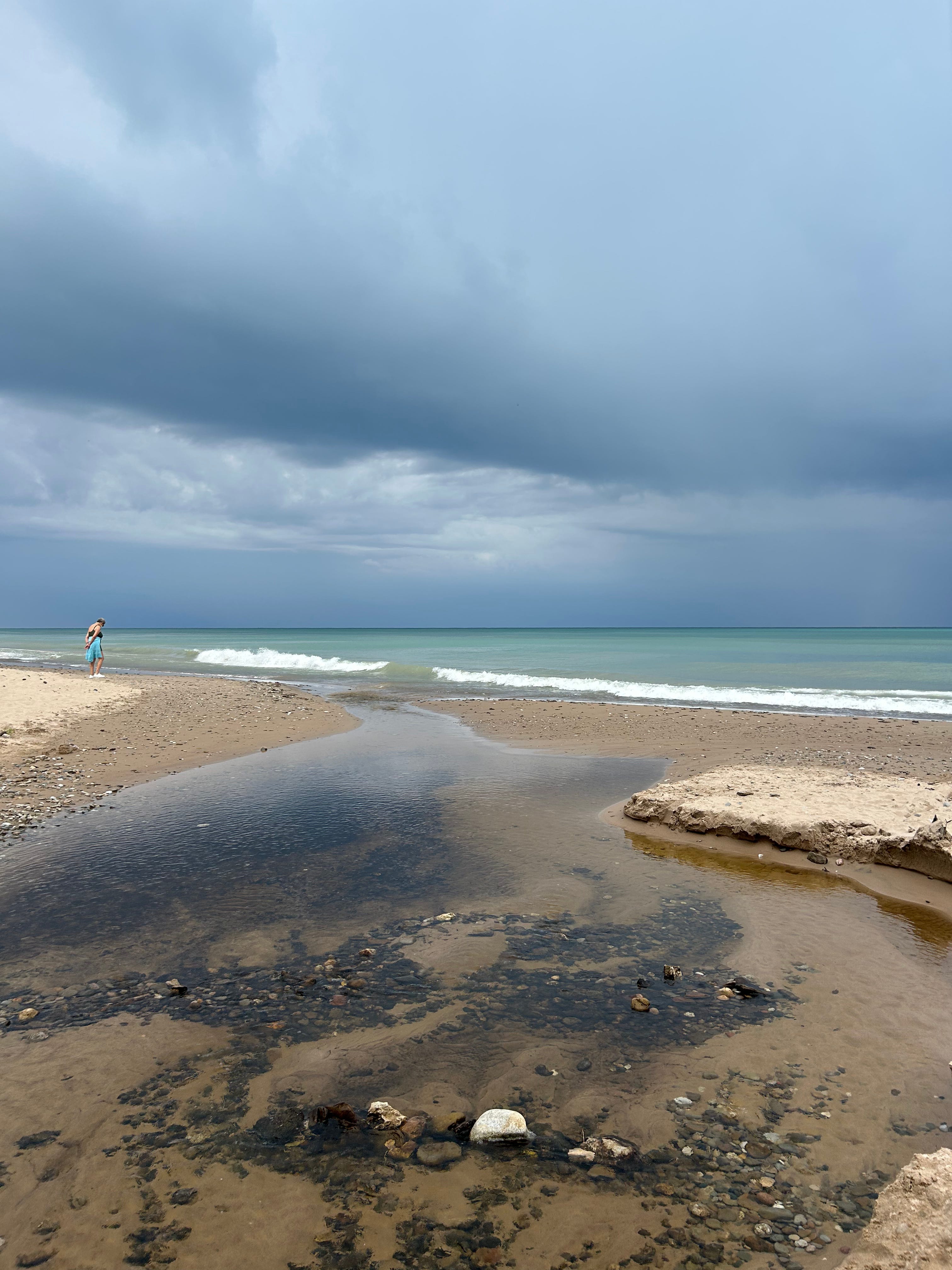
I wake up and go straight to the lake. Follow the sandy roads on foot a short way to the steep, sandy stairs, climb down the little ladder and onto the strip of beach—a compact cove hemmed in by deep green woods, sketched with high tide lines and animal tracks, and marked by the single dark vein of a creek running through the damp sand and into the vast lake.
The lake water is pure turquoise, stretching to the horizon, but edged in a deep gray which merges with the curtain of rain falling on it in the distance. In the sand, glowing in the last streak of gold light before a thunderstorm, are rocks of every shade of gray and green, run velvet-smooth by churning waves from storms stirred up by the lake itself.
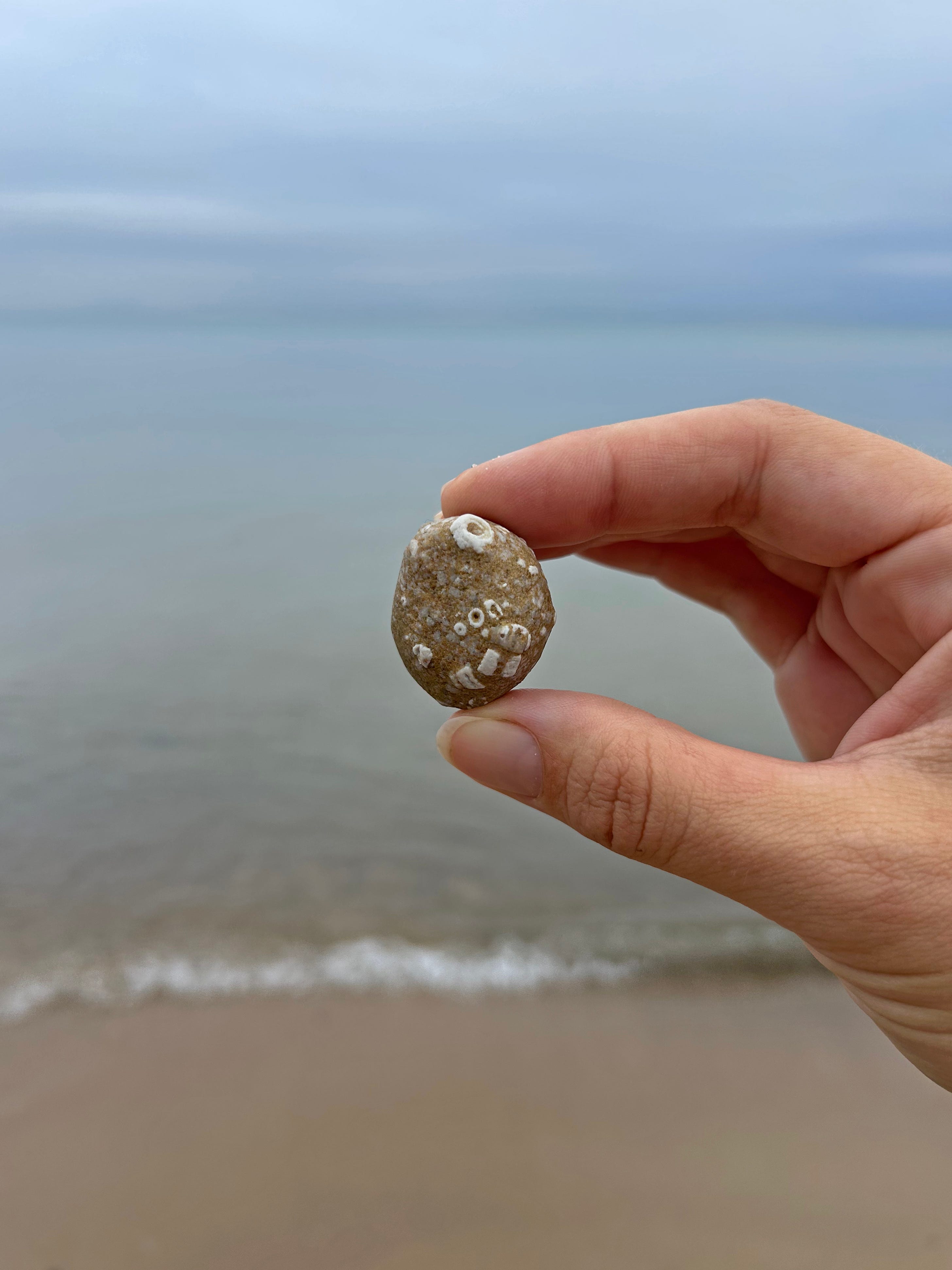
The stones gather in great numbers where the dancing river meets the stoic lake, where the stream deposits water and sediment like offerings at the end of its journey. It’s the texture of one stone near the stream’s mouth, rougher than the others, which catches my eye; with tiny white bits like bones jutting out from its moonlike surface.
Up close, the gray orb is embedded with circular and starlike shards, tiny rectangles and rhombi in relief. I roll it around in my palm, rinse it off in the running river water—maybe the shapes are somehow made of sand. But they don’t move from the stone; only seem to glow whiter as the sky darkens with incoming clouds.
Up the grass-embroidered dune, through the dark shade of the white oaks, back to the front porch to wait out the storm. Sand left by receding glaciers which carved the lake basin, brought ashore by eons of onshore winds; sand which built the dunes along the lakeshore—forested dunes, fossil dunes, two-hundred foot dunes actively forming and eroding—still clings to my feet. I wash it off in the yard before going inside.
The pale shapes in the gray rock are fossilized shards of ancient sea lilies. Crinoids which lived four hundred million years ago in the warm, shallow inland sea preceding today’s Lake Michigan. When melting glaciers carved out the basin thousands of years ago, they reached sediment buried deep down. Hundreds of millions of years encoded in old seabed. Bits and pieces of it wash up on the lakeshore at high tide each day.
Time tumbles the stone, reveals the past. Polished in places, rougher in others; the texture of one world ending so the next may be born. All the sea lilies in the Silurian sea died1—as did around eighty-five percent of marine species in the Silurian era. What comes next is always unimaginable, until it inevitably arrives. I wake up and go straight to the lake, to meet it.
Tinctoria is a reader-supported publication. To receive new posts and support my work, consider becoming a free or paid subscriber.
Read Part I:
Crinoids persist elsewhere on earth—there are around seven hundred species living on sea floors today—although they were more diverse and abundant in eras past.
Comments
Nothing yet. Say the first thing.
Sign in to join the conversation.