
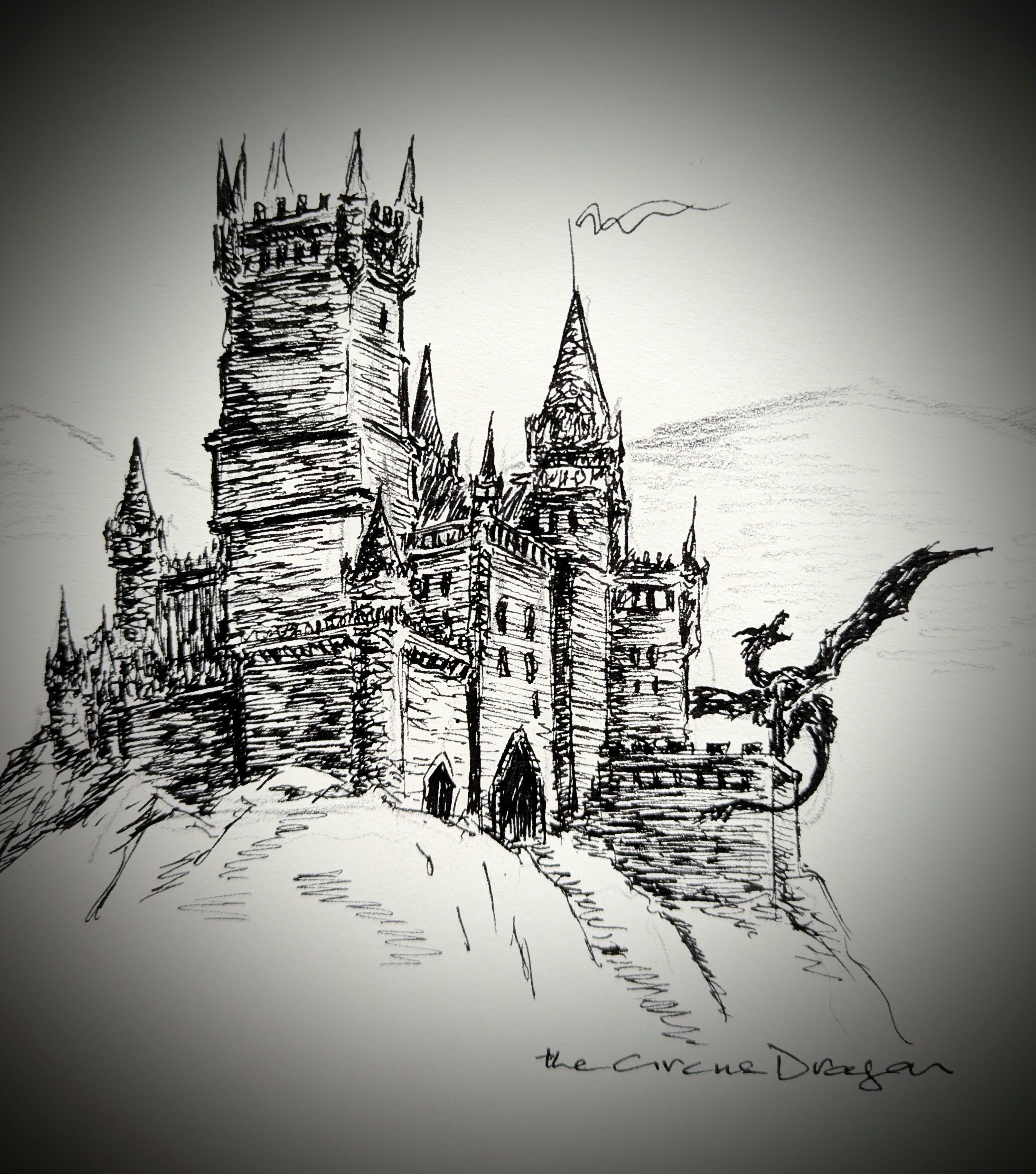
Written for the August 17 prompt in The Writer’s Journey’s Smaugust Story Hoard contest, inspired by “Real Estate Dragon,” original artwork by The Circus Dragon.
On the morning Victor turned five hundred and eighty, the Royal Guild of Estate Agents gave him a castle.
Not in the useful sense. There was no ceremonial key, no deed tied with a ribbon, and no gathering of minor nobles to congratulate him on finally establishing a permanent nest. The Guild gave him a listing agreement, three incomplete disclosure scrolls, and directions that ended with, If you reach the abandoned gallows, you have gone too far.
Victor had been many things during his long life. He had collected overdue tribute, ministered to wayward knights, sold objects other dragons had discarded, and delivered hot meals to people who inexplicably lived at the tops of towers. Real estate was simply his latest attempt to rebuild a treasure hoard diminished by emergencies, wandering, and the steadily rising price of everything except secondhand armor.
It was not his calling. His calling was writing stories, imagining impossible things, and beginning projects that required tools he did not yet own. Unfortunately, none of those paid consistently in gold.
The castle might.
“Castle on the edge of a mountain,” Victor read aloud. “Seven towers, great hall, formal dungeon, carriage house, established rookery, and sweeping views of the kingdom.”
Across the table, Tracy continued reviewing petitions from the Royal Department of Social Enchantments. Her deep teal scales caught the morning light, but she did not look up.
“How close to the edge?”
“It doesn’t say.”
“That means close.”
“It says sweeping views.”
“That means wind.”
“Historic stonework.”
“Cracks.”
“Original slate roof.”
“Leaks.”
A thin ribbon of smoke escaped Victor’s nostrils. The silver spreading through his black scales made him look distinguished, according to Tracy, although he suspected that was something one said to an aging dragon when weathered would have been more accurate.
“You make it very difficult to be excited about things.”
“I make it possible for you to survive the things you get excited about.”
Victor’s tail struck the table leg. Tracy glanced down at it.
“I am not excited,” he said.
“Your tail disagrees.”
By noon, they were climbing the mountain together. Victor said he had invited Tracy because he valued her judgment. Tracy said she had come because the last time he inspected a property alone, he returned with two goats and partial ownership of a haunted mill.
The castle emerged from the fog as the road narrowed to a ledge above a ravine. It rose from the mountainside in a confusion of towers, chimneys, battlements, and additions constructed during centuries when no two architects had apparently spoken to one another. Ravens circled the highest spire. Ivy consumed most of the eastern wall. The western tower leaned toward the valley with the dignity of a drunk refusing assistance.
Victor stopped in the road.
Something stirred deep in his chest.
It was older than reason and stronger than good financial judgment. Dragons called it the nesting pull: the instant recognition of a place where one might gather everything precious and defend it against the world. Victor had felt weaker versions before, usually inside bookshops or buildings with unnecessary outbuildings, but never like this.
“Oh,” he said.
Tracy looked at the castle and then at him. She knew that particular oh. It was the sound he made when reality disappeared beneath whatever he could see in its place.
“Don’t.”
“I didn’t say anything.”
“You’re imagining something.”
“I am standing here.”
“You can imagine six years of renovations while standing perfectly still.”
The seller, an elderly wizard named Bartholomew Crumb, met them beneath the portcullis wearing traveling robes and the nervous expression of a man hoping to leave before anyone examined the foundation.
“Fine property,” he said, handing Victor an iron ring burdened with keys. “Been in the family for nine generations.”
“Why are you selling?” Tracy asked.
“Downsizing.”
Something in the western tower groaned. A stone dropped from the battlement and vanished silently into the ravine.
Bartholomew glanced upward. “Too much house for one person.”
Inside, the great hall was cavernous and dark. Soot coated the walls, but tall windows faced the mountains, and enormous wooden beams crossed the ceiling. A fireplace large enough for two dragons occupied most of the far wall.
Victor turned slowly. In his mind, the soot had already been scrubbed from the stone. The beams were restored, the floors repaired, and the walls painted a green so deep they would feel like the forest at night.
“Don’t breathe fire indoors,” Tracy said.
“I wasn’t going to.”
“You’re smoking.”
“I’m thinking.”
“Think less combustibly.”
Jax, their elderly hellhound, had ignored instructions to remain with the wagon. He lumbered into the hall, circled twice before the fireplace, and collapsed with a sigh that stirred centuries of ash. His black tail thumped once against the floor.
Victor looked at Tracy.
“No.”
“I didn’t ask.”
“Your entire body asked. Your wings are halfway open.”
He folded them tightly against his back.
The library was worse.
Shelves climbed to clerestory windows, and a narrow alcove overlooked the valley. Hundreds of books remained, along with several rolling ladders and a fainting couch partially eaten by moths. Someone had installed a cheap sliding partition across one archway, presumably during the Age of Questionable Improvements.
Victor stood in the middle of the room, unable to speak. His nesting instinct, already awake, stretched luxuriously inside him and began arranging books.
Tracy sighed. “This is going to be a problem.”
“The partition would have to go.”
“That is not the problem.”
Beyond the kitchen lay an overgrown courtyard and a rotting carriage house built against the castle wall. Victor pushed open its swollen door. Dust drifted through shafts of light. The lower boards were nearly gone, but the roof appeared mostly intact.
“Workshop,” he said.
“Rot.”
“Workbench in the center. Tools along that wall. A growing room in the back.”
“The back has no ventilation.”
“We add ventilation.”
“With what money?”
“The workshop could help pay for itself.”
“How?”
“By making things.”
“What things?”
“That was a needlessly aggressive follow-up question.”
While Victor described shelves that did not exist, Tracy pressed one claw into a rotted board, studied the roofline, and paced the length of the wall.
“What are you doing?” he asked.
“Determining how much of it is unsalvageable.”
“I thought all of it was unsalvageable.”
“I didn’t say all of it.”
Outside, the courtyard was choked with weeds. Victor saw raised beds, unfamiliar vegetables, and four hens scratching beside the old gatehouse. The dungeon beneath the kitchen would be perfect for mushrooms once they confirmed that the dampness came from ordinary water and not an opening into another realm.
Tracy stood at the courtyard gate and stretched one wing from post to post.
“This would need to be fenced before Jax could stay out here,” she said.
Victor tried not to smile. “We are here to list it.”
“I know.”
“You’re measuring it.”
“I am assessing a defect. That is an important part of selling.”
They found the rookery above the library, accessible through a passage from a high window. Three translucent knights drifted through the wall as they entered. The last carried his own head beneath one arm.
“The disclosure says minor magical activity,” Tracy said.
“Three ghosts is minor for this square footage.”
“Only one is listed.”
“Perhaps the others are guests.”
The headless ghost raised two fingers.
“Fine. Long-term guests.”
By the time they returned to the great hall, afternoon light filled the mountain windows. Tracy paused beside one and looked down toward the distant valley. Their three grown hatchlings lived in three different kingdoms now. There would be room here for all of them to return, Victor thought, but he kept it to himself. If he said it aloud, the dream might become embarrassing.
They had spent years going wherever they were needed. Every nest had been temporary, even when they pretended otherwise. Victor had stopped unpacking certain crates because there seemed little point in deciding where things belonged when another departure always waited beyond the next season.
Yet he had already decided where his writing table would stand.
That frightened him more than the leaning tower.
They listed the castle the following morning.
Victor described it as a rare restoration opportunity offering privacy, historic character, flexible workspaces, and dramatic mountain views. Tracy removed the phrase ready for its next great adventure because she said it sounded like a warning issued before battle.
The first buyer was a prince who planned to demolish the castle and construct luxury chalets. He complained that the ravens obstructed the view and asked whether the mountain could be lowered.
The second was an enchantment influencer who adored the dungeon but wanted to paint every stone white.
The third was a knight who toured the grounds, looked directly at Victor, and asked whether the area had “a dragon problem.”
“There is one standing in front of you,” Victor said.
The knight withdrew his offer.
After two weeks without serious interest, Bartholomew began sending messages suggesting that the western tower be described as “intentionally asymmetrical.” Victor refused. He might use generous language, but he would not ask a tower to participate in its own deception.
To determine why the castle was not selling, Bartholomew reluctantly authorized an inspection and formal valuation.
The inspector was a dwarf named Mr. Plumb, who arrived with three measuring rods, a magnifying lens, and no detectable sense of wonder. He spent six hours tapping stones, examining beams, and recording findings on an increasingly long scroll.
“The roof has sustained fire damage,” he told Victor.
“I’m a dragon.”
“The cause does not alter the finding.”
“The roof was like that when I arrived.”
“I will note that the dragon denies responsibility.”
Mr. Plumb found rot beneath the carriage house, water intrusion in the east tower, an improperly secured portcullis, and sprites nesting inside the chimney. Several battlements had been built before the invention of building permits, which did not prevent the kingdom from requiring them now.
In a passage beneath the western tower, his measuring rod struck something solid. Excavation revealed that one corner of the castle rested upon the fossilized shoulder of an ancient giant.
Mr. Plumb stared into the hole.
“Is that bad?” Victor asked.
“It is unusual.”
“Could we describe it as historic character?”
Mr. Plumb stared at him until a nervous puff of smoke escaped Victor’s nose.
“I’ll put it in the report,” the dwarf said.
The appraisal was worse. The royal appraiser valued the castle well below Bartholomew’s asking price because no comparable mountaintop fortresses had sold within reasonable flying distance. Apparently, seven towers added little value when one of them was attempting to leave.
That evening, Victor found Tracy at their table with the inspection report, the appraisal, and several columns of figures.
“No,” she said.
Victor nodded. He had expected it. The roof, fence, and carriage house would consume what remained of their hoard. The gate needed immediate repair, and neither of them knew what it cost to reinforce a giant.
He gathered the drawings he had made when he was supposed to be preparing advertisements. There was the courtyard garden, the workshop, the enclosed rookery, and the library with its restored shelves. In one corner of the library drawing, almost without thinking, he had sketched three smaller sleeping alcoves for visiting hatchlings.
He began rolling it closed.
“You’re taking this remarkably well,” Tracy said.
“It is a bad investment.”
“It is several bad investments stacked together on the edge of a mountain.”
“Exactly.”
“You’ve gone quiet.”
“I can be practical.”
“No. You can become quiet when you think wanting something has become inconvenient for everyone else.”
The words struck more accurately than he wanted to admit. Smoke curled from his nostrils, but it carried no heat.
“We can’t afford it.”
“The fence comes first,” Tracy said.
Victor looked up.
“For Jax. Temporary wire now, permanent fencing later. Then the carriage-house wall before winter. The library partition can wait.”
He stared at her. “Are you saying we should buy it?”
“I’m saying we should determine whether buying it is possible.”
“That is not the same thing.”
“No,” Tracy said, gathering the reports. “It is the sentence that comes before it.”
Bartholomew refused their first offer.
He refused their second as well, insisting the castle was worth considerably more because of its ancestral significance, irreplaceable stonework, and unobstructed view of six sovereign territories.
Victor felt the old shame settle beneath his scales. Proper dragons had vaults filled with gold. Their ancestors had slept upon gemstones and woken whenever someone disturbed a single coin. Victor’s hoard consisted of fourteen gold pieces, a jar of foreign currency, several crates of books, and three cats who considered his body communal furniture.
He had expected the commission from the castle to make him feel like a proper dragon again. Waiving it to buy the castle seemed like proof that he had learned nothing.
Then Tracy rested one teal claw over his black one.
“Show him the report,” she said.
Victor looked from her to Bartholomew and unrolled Mr. Plumb’s findings across the wizard’s desk.
“If we walk away,” Victor said, “every one of these defects must be disclosed to the next buyer. Not one ghost. Three. The active portal beneath the dungeon. The unpermitted battlements. The sprites. The western tower. The giant.”
Bartholomew went pale.
“The portal has never harmed anyone.”
“It has eaten two measuring rods.”
“Old houses have peculiarities.”
“Old houses have drafts. This one has an undocumented gateway to somewhere Mr. Plumb describes only as ‘screaming adjacent.’”
A spark jumped between Victor’s teeth. For once, Tracy did not tell him to calm down.
Victor placed his listing agreement beside the report.
“I will waive my commission. You will reduce the price to the appraised value, credit us for the carriage-house repair, and secure the portcullis before closing. In return, you leave this mountain without explaining three ghosts, a hungry portal, and a load-bearing giant to another buyer.”
Bartholomew looked toward the window. The headless knight drifted past outside and waved.
“Half the carriage-house credit,” the wizard said.
“All of it,” Tracy replied.
Bartholomew looked into her narrowed sea-green eyes.
“All of it,” he agreed.
The goblin lender demanded enough documents to reconstruct Victor’s financial history from the invention of currency onward, but the loan was eventually approved. They signed the final contract beneath a paragraph acknowledging that ancient castles might contain undiscovered passages, dormant curses, unexploded siege weapons, or ordinary mice.
On their first night, they sat on cushions before the great fireplace because most of the furniture remained in wagons somewhere below the mountain. Rain entered through two sections of roof. The ghosts argued in the eastern corridor. One cat had climbed inside the walls, another occupied the highest library shelf, and the third lay across Victor’s tail, absorbing its warmth as if dragons had been created for that purpose.
Jax snored beside the fire.
Tracy leaned against Victor and surveyed the soot-darkened hall.
“We have made a terrible mistake,” she said.
“Probably.”
“The fence still comes first.”
“I know.”
“And you cannot start twelve projects at once.”
“Of course not.”
“Your tail is drawing plans in the dust.”
Victor looked behind him. Without his noticing, its pointed tip had sketched the outline of the workshop floor.
“I can explain.”
“I’m sure you can.”
Tracy watched the rain move across the windows. “Deep green might work in here.”
Victor turned toward her, but she continued studying the walls as though she had merely commented on the weather.
Outside, the mountain disappeared behind the storm. The old castle settled around them, groaning softly in its ancient bones. Victor felt Tracy’s warmth against his scales, the cat curled across his tail, and Jax dreaming beside the hearth. Somewhere above them, the ravens had returned to their tower.
The Guild had called it the listing of a lifetime. Victor had assumed they meant the gold. Looking around the cracked and drafty hall, he understood that they had been right for entirely the wrong reason.
A hoard was simply everything a dragon could not bear to leave behind.
No posts
Comments
Nothing yet. Say the first thing.
Sign in to join the conversation.