
Every office has rooms that mean more than whatever somebody printed on the little plaque beside the door.
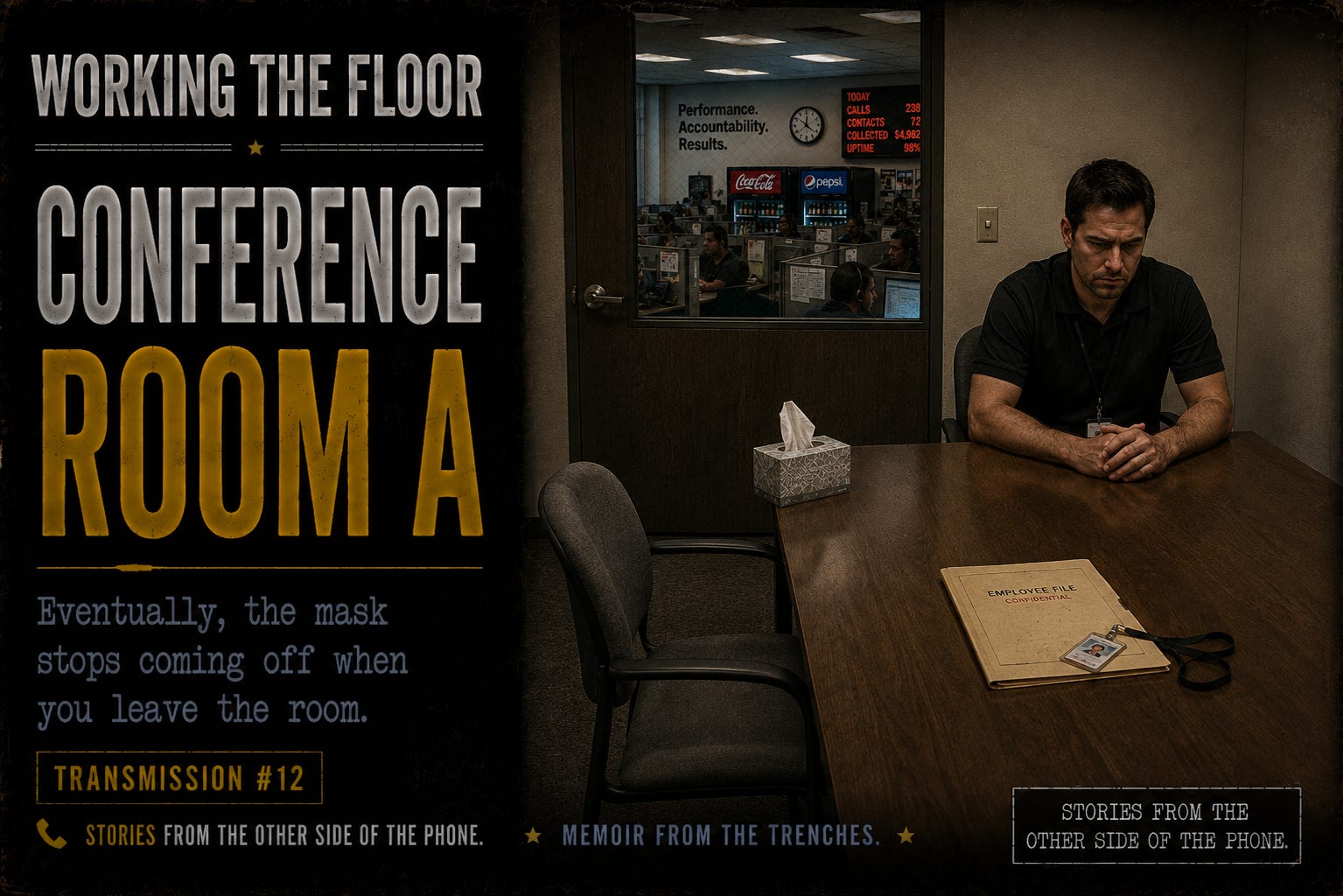
Conference Room A wasn’t impressive. No windows. No executive chairs. No giant table where important decisions got made.
The important decisions had already been made somewhere else.
Conference Room A was where I delivered them.
After a while, people knew what it meant when I asked them to walk with me.
So did I.
**Names, locations, institutions, and identifying details have been changed or fictionalized to protect privacy. Some characters may be composites. These pieces are creative nonfiction based on lived experience, memory, and reflection.**

Conference Room A never had a window. Just a table, two chairs, and the kind of silence that makes your ears ring.
It wasn’t special. Nothing about it stood out. Not the walls. Not the carpet. Not the off-brand tissues they stuck on the corner of the desk like that was gonna fix anything.
But if you worked there long enough, you knew exactly what that room was.
It was the place where people disappeared.
I didn’t use it at first. Back when things were still duct-taped together and hope was something I pretended to believe in. But eventually, you start playing the role long enough, they hand you the script. You’re not a manager anymore. You’re the exit wound.
Walk them down the long hallway. Close the door behind you. Sit across from someone who probably already knows. And then look them in the eye—real calm—and say the line.
“Unfortunately… today is your last day.”
Not, “You were great but the bank’s tightening up.”
Not, “I wish I had a say in this.”
Definitely not, “This isn’t fair.”
Because you’re not allowed to say any of that. Legal risk. Chain of command. Protect the company. Keep the brand clean.
So you say nothing. No empathy. No comfort. Just the script.
You lie by omission.
And you do it over and over again.
The ones who cried? I couldn’t help them.
The ones who stared straight through me? I didn’t blame them.
The ones who thanked me? Those were the worst.
What they didn’t know—what they couldn’t know—was that every single one of those terminations took something out of me. Not in a poetic way. Not in a “I hated doing this” kind of way.
No. I mean it literally.
They took pieces of me.
Because I was never built for this part. I wasn’t the guy who loved power. I wasn’t trying to climb anything. I was just someone who believed in people. I wanted to see them win. I wanted to fix broken shit. I thought if I worked hard enough—fought long enough—I could change how it all worked.
But that was never the job.
The job was always the same.
Dollars over people.
It didn’t matter how hard someone worked.
It didn’t matter if they just buried their sister.
It didn’t matter if they were finally starting to hit their goals.
If they were expensive? Gone.
If they questioned things? Gone.
If the bank wanted a headcount reduction and your name was on the list?
Gone.
And me?
I became the usher to the slaughter.
Conference Room A was where my face went cold.
Where my voice stopped sounding like mine.
Where I learned how to fire someone without flinching—because if I flinched, they might see it.
And if they saw it?
They might think I cared.
Which I did.
Which made it worse.
But I couldn’t show that. Couldn’t say it. Couldn’t even nod in solidarity.
Because in that moment, I wasn’t their ally. I wasn’t their manager. I was the messenger with the knife in his hand and the lock already turning on the door behind them.
And after enough of those?
You stop asking who you are.
You just try not to choke on the silence.
They walked out of Conference Room A without their jobs.
I kept walking back in.

I don’t know how many people I fired in that room.
Enough that eventually I learned how to do it well, which may be one of the saddest skills I’ve ever acquired.
Keep your voice steady. Don’t overexplain. Don’t apologize for a decision you aren’t allowed to criticize. Don’t let your face tell them what you’re thinking.
Then open the door, walk back onto the floor, and keep working.
That’s the part nobody puts in the management training.
You don’t leave everything in Conference Room A when you walk out.
Sometimes the room leaves with you.
Working the Floor is an ongoing Bent But True memoir series about collections, survival, dark humor, and what happens to the people on both sides of the desk.
No posts
Comments
Nothing yet. Say the first thing.
Sign in to join the conversation.