
For years, the Great Wealth Transfer was discussed like a weather system forming somewhere over the horizon. Advisors built presentations around it. Wealth managers published forecasts about it. Families acknowledged that, someday, assets would move from one generation to the next. Someday has arrived.
“The next generation may inherit the assets of the accumulation era. It will not inherit the same buyer base that priced them.”
—Ben Reinberg
This is the first installment in a 10-part Alliance Intelligence series examining The Great Rotation: the movement of wealth, control and investment authority from the generation that accumulated an extraordinary pool of assets to the spouses, heirs, charities and institutions that will decide what those assets should accomplish next.
The Great Wealth Transfer is no longer merely a long-range estate-planning projection. It is already changing who controls capital, which institutions retain it, how families structure it and where future owners may choose to allocate it.
Cerulli Associates estimates that approximately $124 trillion will transfer through 2048. About $105 trillion is expected to flow to heirs, while approximately $18 trillion may ultimately move to charitable organizations. Nearly $100 trillion of the projected amount is expected to come from Baby Boomers and older generations.
That is an extraordinary number. But the number itself is not the complete investment thesis.
The larger thesis is that control over an enormous pool of capital is moving from one group of decision-makers to another—and that the incoming owners will not necessarily preserve the portfolios, advisors, institutions, financing assumptions, or definitions of prudence used by the people who accumulated it.
At the same time, another transition is taking place inside the global capital markets.
Some of the large institutional buyers that helped support long-duration bonds and suppress the cost of capital are stepping back, changing direction or demanding a different return.
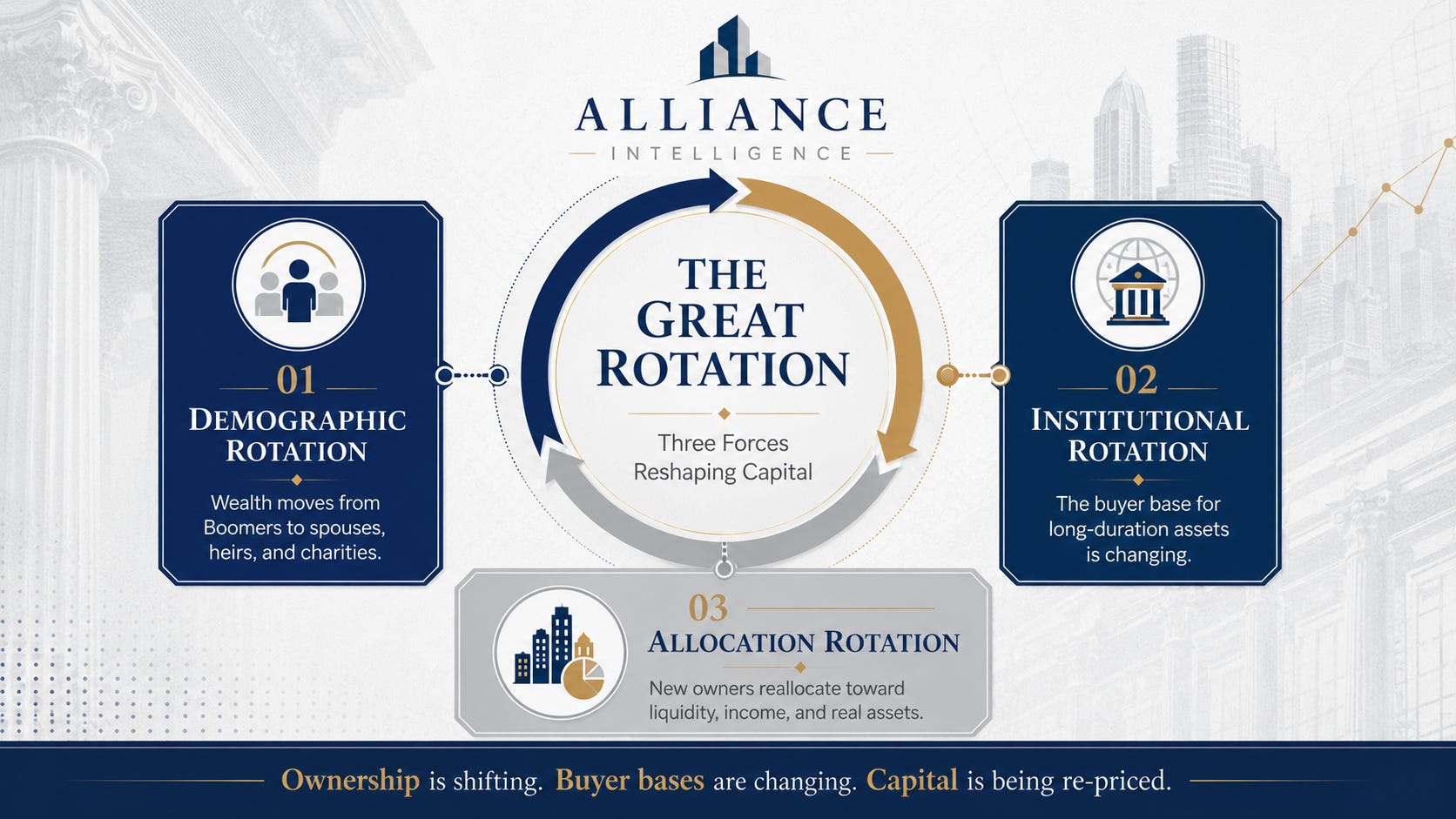
The Great Rotation is therefore not one movement.
It is three movements happening together:
A demographic rotation in who owns and controls private wealth.
An institutional rotation in who buys long-duration financial assets.
An allocation rotation in where the next owners decide capital should go.
Each of these rotations matters independently. Together, they may reshape the investment environment for decades.
The $124 Trillion Number Is Powerful—and Imperfect
No one can open a dashboard in August 2026 and determine that the Great Wealth Transfer is exactly 7.8% complete.
This is not a construction project with a fixed budget and completion schedule. The $124 trillion estimate covers more than two decades and includes lifetime gifts, estate settlements, transfers between spouses, inheritances received by later generations, charitable gifts and assets whose values may rise, decline or be consumed before they move.
That makes it difficult to determine whether the forecast is “tracking” in the same way we would assess quarterly revenue.
It does not make the estimate meaningless.
It tells us the scale of the capital potentially being repositioned. It helps identify the generations most likely to receive it. It also provides a framework for understanding economic consequences that may appear gradually and then suddenly become obvious.
The United States entered 2026 with an enormous household balance sheet. According to the Federal Reserve, the net worth of U.S. households and nonprofit organizations stood at approximately $183 trillion at the end of the first quarter of 2026. Household wealth remained far above its long-term relationship with disposable personal income, even after first-quarter equity losses were offset by gains in real estate and other assets.
The wealth exists.
It is held through retirement plans, brokerage accounts, private businesses, commercial real estate, family homes, insurance contracts, trusts, partnerships, charitable vehicles and family holding companies.
The question is not whether there are assets to transfer. The questions are:
Who receives them?
Who controls them first?
What must be sold or refinanced?
Which relationships survive the handoff?
What assumptions were embedded in their valuation?
And what will the next owner choose to do with them?
The Great Wealth Transfer Is Already Underway
The phrase “Great Wealth Transfer” can make the process sound like a single future event.
It is not.
Wealth is already moving through gifts, inheritances, spousal transfers, business sales, trust distributions and charitable contributions. The demographic conditions driving the process are not approaching. They are present.
The U.S. population aged 65 and older reached approximately 61.2 million in 2024, an increase of 13% from 2020. Nearly half of American counties had as many or more older adults than children. In 2025, the country’s median age climbed to 39.4, with the Baby Boomer bulge clearly visible among Americans in their sixties and seventies.
This is the generation that spent four decades accumulating assets through:
Peak earning years.
Employer-sponsored retirement contributions.
Public-equity ownership.
Declining interest rates.
Rising home values.
Commercial real estate.
Privately owned businesses.
Expanding access to financial markets.
Now that generation is moving further into retirement. ERISA Act-required minimum distributions must be taken. Healthcare and longevity expenses must be funded. Businesses must be sold, succeeded, or shut down. Trusts must be administered. Charitable intentions must become actual gifts. One spouse may become the sole financial decision-maker. Eventually, children and grandchildren must decide whether to preserve or redesign the financial architecture they receive.
The transfer is not waiting for a ceremonial starting gun. It has started without a broadcast package, balloon arch, and red carpet.
The Accumulation Machine Is Becoming a Distribution Machine
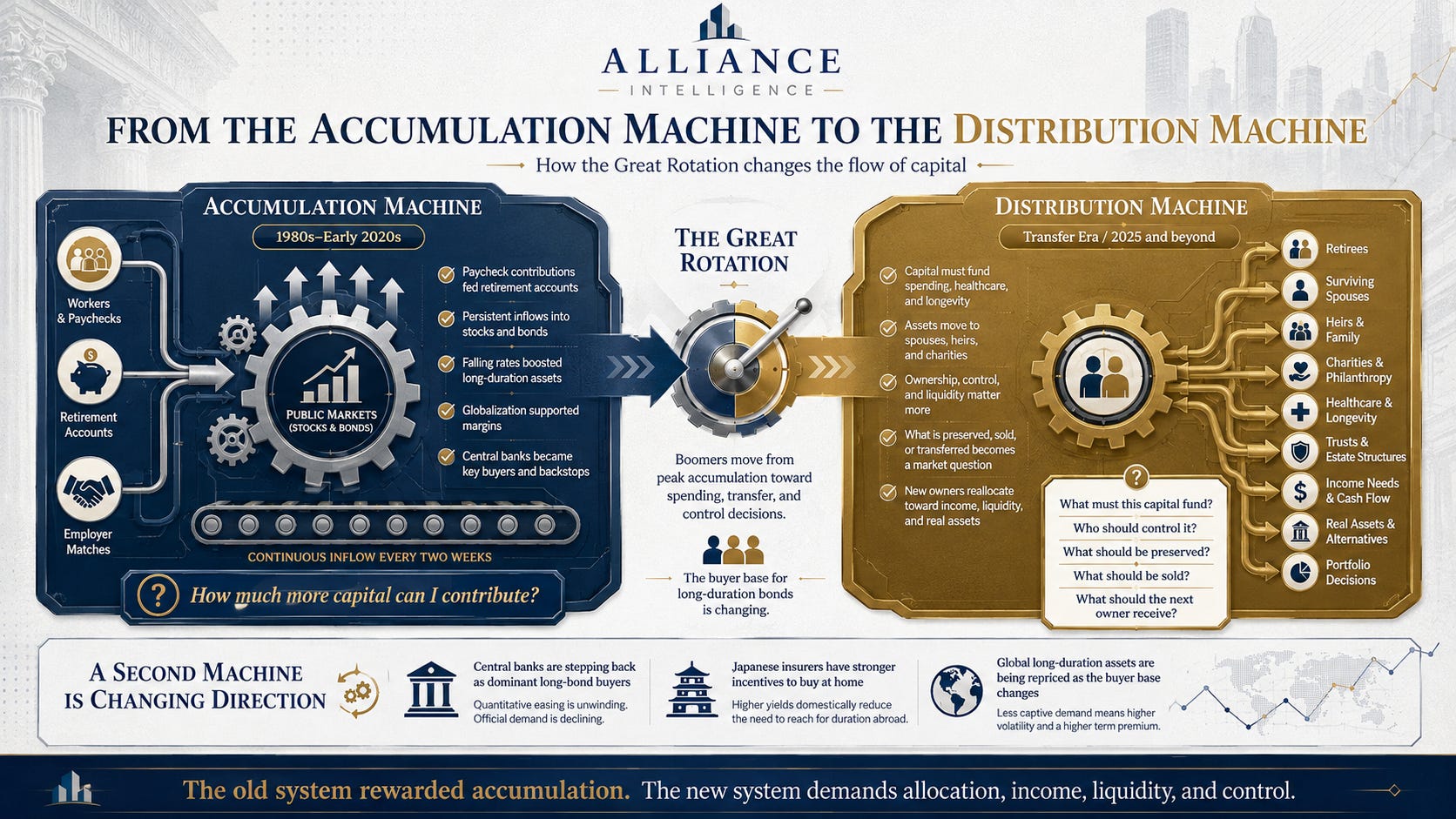
From roughly 1980 through the early 2020s, the dominant American investment story was accumulation.
Millions of workers directed part of every paycheck into retirement accounts. Baby Boomers moved through their peak earning years. Employer matches and automatic contributions created a nearly continuous bid for public stocks and bonds.
The system had a powerful built-in buyer. Capital entered the markets every two weeks. At the same time, interest rates generally declined over a period of approximately four decades. Falling yields increased the value of existing bonds and lowered the discount rates applied to equities, real estate and other long-duration assets.
That regime was not free of crises. Investors experienced the savings-and-loan crisis, the dot-com collapse, the global financial crisis, the pandemic shock and multiple periods of geopolitical and market volatility.
But the underlying structure rewarded the owners of financial duration.
The retirement system created persistent inflows. Declining rates provided a valuation tailwind.
Globalization supported margins.
Central banks became increasingly important buyers and backstops.
The Baby Boomer generation spent decades on the accumulation side of that system.
It is now moving toward the distribution side. The central financial question changes with it. During the accumulation era, the question was:
How much more capital can I contribute?
During the transfer era, the questions become:
What must this capital fund?
Who should control it?
What should be preserved?
What should be sold?
What should the next owner receive?
Those are not merely estate-planning questions. They are market questions.
A Second Machine Is Changing Direction
The demographic rotation is not occurring in isolation. A second machine is changing direction inside the global bond market.
For much of the past two decades, long-duration sovereign bonds relied in part on buyers whose decisions were not motivated exclusively by maximizing return.
Central banks bought bonds to implement monetary policy.
Japanese life insurers bought long-duration foreign bonds to help match yen-denominated liabilities during a period when Japanese government bonds offered little or no meaningful yield.
These institutions became dependable sources of demand for U.S. Treasuries, German bunds, British gilts and other developed-market sovereign debt.
They helped occupy the long-duration seats.
That seating chart is changing.
In his July 2026 essay, “Maid in Japan,” highlighted a striking synchronization across the global bond markets.
Germany’s 10-year bund reached its highest yield since 2011. Japan’s 10-year government bond reached its highest yield since 1996, while the Japanese 30-year yield set a record and moved above 4%. British 10- and 30-year gilt yields reached levels not seen since 2008 and 1998. Australia’s 10-year yield crossed 5% for the first time since 2011. The U.S. 30-year Treasury repeatedly closed above 5% and ended July at approximately 5.27%.
These countries do not share one domestic economic story.
The United States is spending heavily and investing extraordinary sums in AI-related infrastructure.
Japan is older and slower-growing.
Germany entered the year with a stronger fiscal position than several of its peers.
Britain and France face their own questions about fiscal credibility.
Australia is deeply connected to Chinese commodity demand.
Local growth, inflation, fiscal supply and policy decisions all matter. But the markets share access to the same global pool of long-term capital. That creates the possibility of a common amplifier.
Green’s argument is not that one single force completely explains every rise in long-term yields. It is that the buyer base for long-duration bonds is changing at the same time across multiple markets.
Why the Marginal Buyer Matters
Japan remains the largest foreign holder of U.S. Treasury securities.
Treasury data showed Japanese holdings at approximately $1.14 trillion in May 2026, although the monthly figure has fluctuated significantly and represents custodial country-level data rather than a clean breakdown by institution or maturity.
That caveat matters.
We cannot look at the aggregate number and conclude that Japanese life insurers have sold a particular amount of 30-year Treasuries.
What we can observe is that their incentive structure has changed.
During the period of Japanese yield-curve control, a life insurer might have carried legacy liabilities requiring a return of roughly 2% while receiving close to zero from a 10-year Japanese government bond.
The capital had to go somewhere. Foreign sovereign debt offered higher nominal yields and the duration required to help match long-term liabilities. Japan consequently became a critical source of cross-border, liability-driven demand. But a Japanese insurer evaluating its choices in 2026 no longer sees the same domestic market. Japanese government-bond yields have risen substantially. Long-dated domestic bonds now offer returns that would have been almost unimaginable during the years of aggressive yield suppression.
Capital does not have to flee foreign markets for that development to matter. A dependable buyer can simply become less aggressive at the next auction. That is enough to affect price.
Markets are set by the marginal buyer—the investor willing to purchase the next bond at the current yield—not only by the holders who accumulated the bonds issued over the previous decade.
A market can have trillions of dollars of stable existing ownership and still reprice sharply when one large, repeat buyer changes its required return or directs more capital somewhere else.
The issue is not necessarily liquidation. It is replacement.
Who occupies the seat when the previous buyer steps away?
And what yield will the replacement buyer require?
The New Asset Owners Will Inherit a Different Discount Rate
The next generation may inherit many of the same securities, properties and businesses that created the family’s wealth.
It will not inherit the same discount rate.
That distinction reaches across the entire balance sheet. When long-term sovereign yields rise:
Government bonds become more competitive with other income-producing assets.
Borrowing becomes more expensive.
Refinancing becomes less automatic.
Real estate capitalization rates face upward pressure.
Leveraged private investments require stronger operating performance.
Growth companies must justify valuations against a higher risk-free return.
Businesses with floating-rate debt may produce less free cash flow.
Private-market exits become more dependent on operating results than multiple expansion.
The $124 trillion should therefore not be imagined as a fixed inventory waiting to be passed intact from one generation to another. The inventory itself is being repriced.
Some assets will appreciate. Some will be consumed. Some will be impaired by leverage. Some will become more valuable because they produce essential, contractually supported cash flows. Some will discover that their apparent return depended more on falling interest rates than on operational value creation.
This is where the Great Wealth Transfer and the global buyer-base reset meet. The assets are moving at the same time the market is reconsidering what those assets are worth.
Most Wealth Will Not Move Directly to the Children
One of the largest misconceptions about the Great Wealth Transfer is that the money will move neatly from Baby Boomer parents to their children.
A substantial amount is expected to move horizontally first.
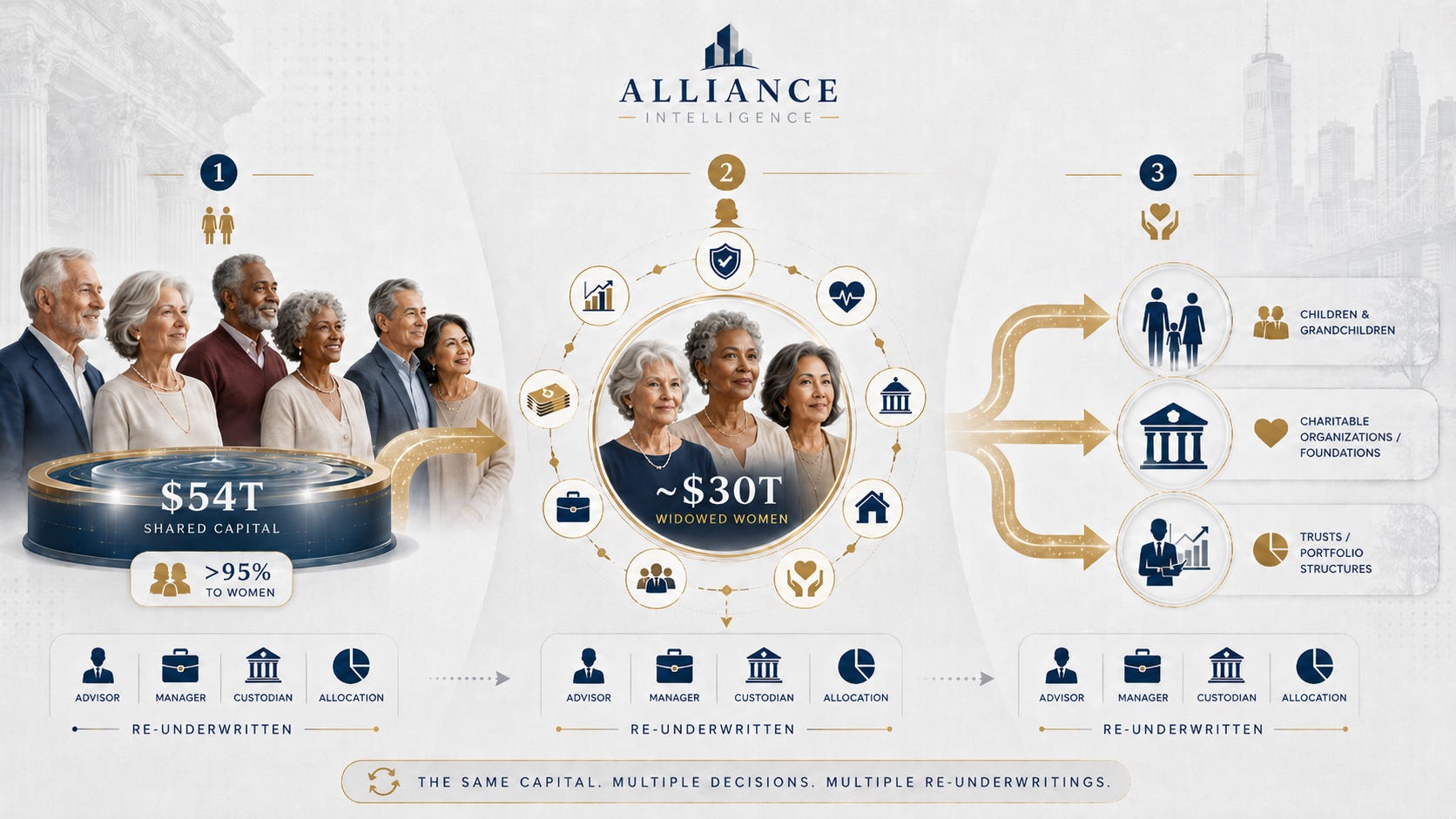
Cerulli projects that approximately $54 trillion will initially transfer between spouses, with more than 95% of that amount expected to go to women. Nearly $40 trillion may come under the control of widowed women from Baby Boomer and older generations before it eventually reaches children, grandchildren or charitable institutions.
That sequencing matters.
The first allocator after a death may not be a 35-year-old heir seeking private equity, venture capital or digital assets.
It may be a 68-year-old widow evaluating:
Income reliability.
Healthcare expenses.
Tax liabilities.
Real estate obligations.
Charitable goals.
Liquidity.
Family support.
Business ownership.
The eventual transfer to children.
The same pool of wealth may therefore be re-underwritten several times.
First, when one spouse becomes the primary or sole decision-maker.
Second, when assets move to children or grandchildren.
Third, when charitable organizations or family foundations receive capital.
Each transition creates a new decision point.
Each decision point can produce a new advisor, manager, custodian, investment structure, or allocation. When you account for likely leaks, distributions, and losses, this amounts to $30T in potential horizontal wealth transfer that will be re-underwritten over the next 5 years.
Wealth Transfer Is Also Platform Transfer
The financial industry often talks about retaining “the assets” as though assets move independently from people.
They do not.
Inherited capital frequently leaves the institution that served the previous owner. Natixis reported in 2026 that 55% of spouses and next-generation heirs who had received or expected to receive an inheritance believed they would leave their benefactor’s advisor.
A separate Natixis survey of U.S. financial advisors found that advisors reported retaining approximately 75% of assets after a spousal transition, but only 56% when assets passed to next-generation heirs.
That drop is not explained solely by investment performance. Incoming owners may want:
A different communication style.
Greater visibility into fees and conflicts.
Better technology.
More direct access to decision-makers.
A broader investment menu.
Private-market opportunities.
Values-based mandates.
More participation in portfolio construction.
Coordination across tax, estate and family-governance matters.
The transfer is therefore simultaneously:
An ownership event.
A custody event.
A relationship event.
A portfolio event.
A technology event.
A governance event.
A trust event.
The firms that treat it as a simple inheritance transaction will misunderstand what is taking place.
Markets are repricing around a historic transfer of ownership, but the next allocation decisions will not be made in the abstract.
They will be made by investors, operators, surviving spouses, heirs, family offices, and advisors deciding where capital should go next—and what it should accomplish when it gets there.
Join Alliance Intelligence online on August 20, 2026, at 12 noon EDT for:
The $30 Trillion Reset
This investor webinar will examine the structural rotation now unfolding across private markets, income strategies, and real assets.

The New Owner May Want a Different Portfolio
The most consequential part of the Great Wealth Transfer is not the legal transfer of title. It is the transfer of authority. The new owner receives the right to determine what gets sold, retained, refinanced, donated, or acquired.
Comments
Nothing yet. Say the first thing.
Sign in to join the conversation.