
The core question every one of our investor readers must answer today is not:
“Will boomers transfer wealth?”
That is already known. The question is:
“What happens when the largest buyer in financial history becomes the largest seller?”
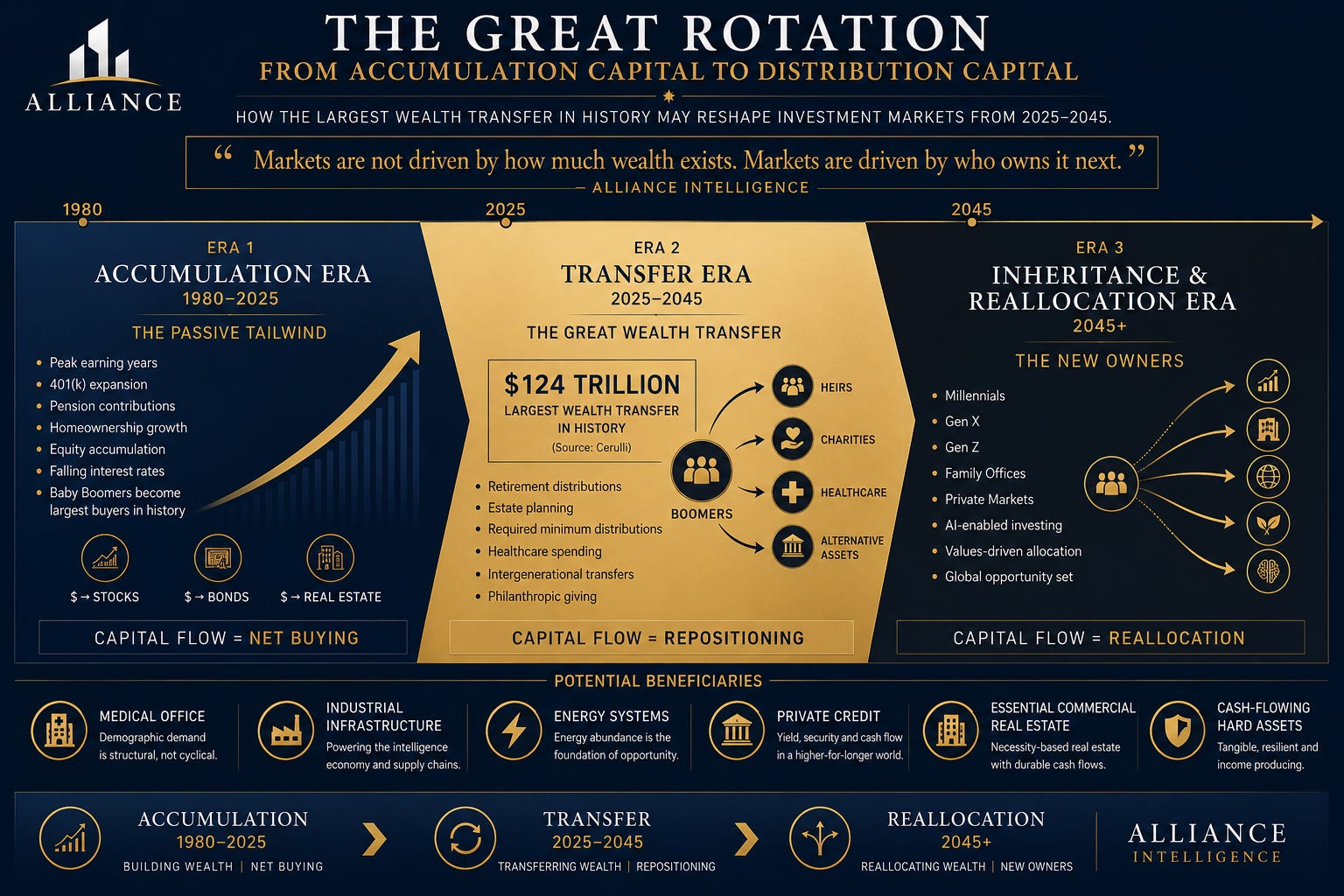
For nearly forty years, investors have benefited from an invisible force. It wasn’t Federal Reserve policy. It wasn’t globalization. It wasn’t technology. It wasn’t even passive investing. Those were accelerants. The fuel was demographics.
The largest generation in American history entered its peak earning years, accumulated assets for four decades, and systematically bought stocks, bonds, mutual funds, ETFs, and real estate through retirement plans, pensions, brokerage accounts, and housing purchases.
Now that same generation is entering a completely different phase. For the first time in modern financial history, the largest concentration of wealth ever assembled is beginning the transition from accumulation to distribution.
Most investors continue to analyze markets through the lens of rates, inflation, earnings, and policy. Few are asking the more important question:
What happens when the marginal buyer becomes the marginal seller?
Every bull market creates a story.
The 1980s had deregulation. The 1990s had the internet. The 2010s had quantitative easing. The 2020s have artificial intelligence. But beneath all of those narratives sat something much more powerful.
Demographics.
Baby Boomers, born between 1946 and 1964, entered adulthood during one of the greatest periods of economic expansion in human history.
They bought homes when housing was affordable. They entered the workforce when pensions were still common. They accumulated wealth during a forty-year decline in interest rates. They invested through one of the greatest stock market runs ever recorded.
Today, despite representing less than one-fifth of the U.S. population, Baby Boomers control more than half of all household wealth. Estimates place their collective assets north of $80 trillion. (The Washington Post)
This concentration of wealth has quietly acted as a structural bid beneath financial markets for decades. Every paycheck. Every 401(k) contribution. Every pension allocation. Every IRA deposit. Every target-date fund.
The flow was largely one-directional. Buy=>Buy=> Buy=>Then buy some more.
A fundamental truth of investing is often forgotten.
Prices are not determined by how much wealth exists. Prices are determined by who is buying next.
For decades, markets benefited from a demographic machine that continually added capital. That machine is changing.
More than 11,000 Americans are turning 65 every day. This pace continues through the remainder of the decade as the final wave of Baby Boomers enters retirement. (SeniorLiving.org)
Retirement changes behavior. Investors who spent forty years maximizing growth begin prioritizing income. Volatility feels different at age 75 than it does at age 45.
The risk of loss matters more than the opportunity for gain. The conversation shifts from accumulation to preservation. Then, eventually, from preservation to distribution.
The portfolio that once funded retirement becomes the portfolio that must now finance healthcare expenses, long-term care, lifestyle spending, gifting, and legacy planning.
That shift may be the single most underappreciated structural change in markets today.
This is where many analysts get the thesis wrong. The Boomer Unwind is not a prediction of market collapse. It is a prediction of changing flows.
There is a difference.
Markets rarely move because everyone sells at once. Markets move because the balance between buyers and sellers changes.
For the last four decades, the demographic forces favored financial assets.
The question now becomes:
Will future generations replace that demand?
Perhaps. Or Perhaps not.
But the answer is not obvious. Gen X is significantly smaller than the Baby Boomer generation. Millennials are larger but entered adulthood facing dramatically different economic conditions:
Higher housing costs
Higher education costs
Greater debt burdens
Lower homeownership rates
Less pension participation
The result is that replacing the Boomer bid may prove more difficult than many assume.
At the same time, the largest wealth transfer in history is underway.
Cerulli projects that approximately $124 trillion will transfer through 2048, with nearly $100 trillion coming from Baby Boomers and older generations. Roughly $105 trillion is expected to flow to heirs, while another $18 trillion will flow to charities. (Cerulli Associates)
Most commentary focuses on inheritance. That misses the bigger story. The transfer itself creates a massive portfolio reallocation event.
A 75-year-old and a 45-year-old do not invest the same way.
A widow does not invest the same way as a founder.
A physician does not invest the same way as an entrepreneur.
A Millennial technology executive does not invest the same way as a retired manufacturing executive.
Capital is not merely changing ownership. It is changing preferences. That means entire asset classes could experience meaningful repricing over the next decade.
Comments
Nothing yet. Say the first thing.
Sign in to join the conversation.