
The following is an excerpt from The Unfinished Metropolis. It is one of a series of excerpts running in Planetizen, all of which are being republished here.
In other book news, on Tuesday, January 13, I’ll be participating in a virtual conversation with Laura Tolkoff of SPUR about urban policy in the Bay Area. The event will run from 12:30-1:30 Pacific Time. Register here.
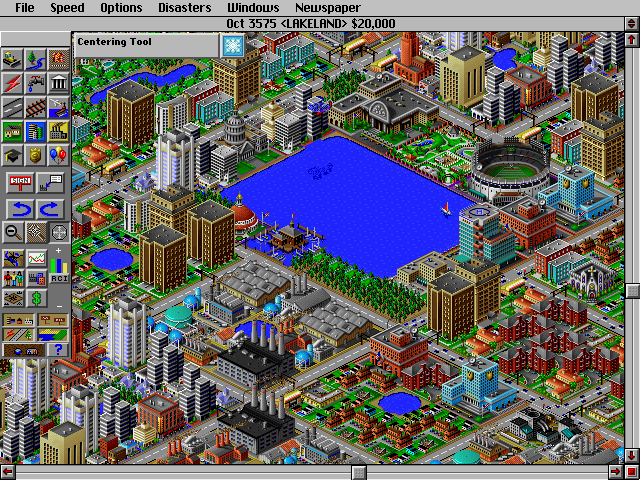
Many Millennials were first introduced to urban planning through SimCity, a remarkably realistic city-building game complete with municipal budgets, zoning ordinances, and utilities. But there’s one aspect of city planning the creators were forced to fudge.
“We were originally just going to model real cities, but we quickly realized there were way too many parking lots in the real world,” SimCity creator Stone Librande admitted in an interview. “Our game was going to be really boring if it was proportional in terms of parking lots.”
Stone’s interviewer joked that if the parking facilities in SimCity were rendered at their actual size the game would’ve become “SimParkingLot.” It would be a funny quip if it didn’t describe the cityscape most Americans inhabit every day.
Sunset Road intersects Las Vegas Boulevard at the bitter end of the Strip. This is where the ersatz fantasy world of Las Vegas meets the workaday reality of Clark County, Nevada. There are no Parisian shopping arcades or Roman fora on Sunset Road. This is America. Every store, every warehouse, every apartment complex is surrounded by a moat of parking.
Getting to the building from the sidewalk requires a journey across the blazing asphalt, and a delicate negotiation with the well-armored Rogues and Renegades rolling in and out. Along the boulevards of Clark County, it can look as if the overarching urban design guideline was a petulant toddler yelling, “More parking!” In fact, here and in nearly every American city, there are very specific prescriptions for how much parking different types of development require.
To see how Clark County’s built environment became, in effect, a parked environment, consult planning code section 30.60.030. These regulations require places of worship and adult theater cabarets to have 10 spaces per thousand square feet. Bowling alleys must have four and a half spaces per lane, and mini golf courses need three spaces per hole.
When it comes to office buildings, Clark County follows the “golden rule” of four spaces per thousand square feet that has become standard for suburban office parks around the country. A typical parking spot in a lot, including the space necessary to pull in and out, takes up about 300 square feet. That means the gold standard for office development in America is a campus with more square footage dedicated to parking than to offices. But at least spaces per square feet is a comprehensible metric.
In 2002, UCLA economist and parking policy expert Donald Shoup surveyed parking requirements across the country and found more than 662 land use or institution types and 216 distinct metrics for calculating parking requirements. Those metrics include the number of fuel nozzles, drying racks, or nuns in a given establishment.
Funeral parlors in different cities are the subject of more than 30 different metrics for determining “parking requirements for the afterlife,” accounting, variously, for the number of seats, chapels, and hearses.
These rules can also have mortal consequences for the living. Arlington, Texas, requires bars and nightclubs to provide 14 off-street parking spots for every 1,000 square feet. That means these alcohol-fueled businesses must dedicate at least four times more space to parking than they do to partying. Y’all drive safe now.
These very precise numbers imply that parking requirements are the product of rigorous scientific research. In reality, parking requirements are “little more than a collective hunch,” Shoup writes.
Many cities pull their parking requirements from other jurisdictions, which may or may not have based them on real data, creating a repeating cycle of ignorance. When they are the product of actual empirical study, parking minimums are typically set to reflect the highest possible parking demand, like a church on Easter Sunday, or a big box store on Black Friday.
In other cases, parking requirements serve as a de-facto zoning ordinance intended to shape what kinds of development are welcome, where. Arlington’s super-sized parking requirements for bars discourage the creation of drinking establishments, or at the very least ensure that they can never cluster in anything resembling a walkable nightlife district, since each one must be isolated in its parking cocoon.
“Parking is probably the most extensive infrastructure that we have, yet we have almost zero vision of how much of it there really is,” Mikhail Chester, a professor of environmental engineering at Arizona State University, told me.
Chester and his colleagues sought to put a number to America’s parking supply, undertaking the first ever nationwide survey of parking spaces in 2010. Chester’s team ultimately determined there are as many as 2 billion on- and off-street parking spaces in the U.S., up to eight for each car. That adds up to an area larger than Maryland and Massachusetts combined.
There are even more spots per car in many cities. Some of the worst offenders are Des Moines, Iowa, with 10 parking spaces per car, and Jackson, Wyoming, with 14 potential homes for each vehicle.
With just 3.3 spaces per car, Los Angeles County would seem to be a relative parking laggard. Yet even here, parking takes up an astonishing amount of space. If laid out as one continuous lot, the county’s 200 square miles of parking would form a tar pit stretching from Pasadena to Santa Monica, and from the Hollywood Hills to South Central.
There’s no need to play SimParkingLot. We’re living in it.
Thanks for reading The Urban Condition! Subscribe for free to receive new posts and support my work.
Comments
Nothing yet. Say the first thing.
Sign in to join the conversation.