
My home state of Texas was briefly the center of the political-news universe last week as the primary runoffs concluded. For those who don’t know, a primary runoff is what happens when no candidate in the spring primary gets over 50% of the votes and the top two finishers compete twelve weeks later to win a larger share of a much smaller and crazier electorate. Because nonpartisan spring municipal elections intervene between the two rounds, Texans are asked to go to the polls three times in as many months, and because not every race goes to a runoff, you have to be a bit of a political obsessive to even know you have a reason drag yourself back for that third time. I love elections but even I got tired of it. It’s not good to have people winning primaries with small pluralities, but this is a bad solution.1
But everyone knew it was happening this year, because incumbent Republican senator John Cornyn was in a fantastically expensive and vitriolic runoff against state Attorney General Ken Paxton for the fall nomination.2 I read somewhere that $130 million was spent on this runoff, which, if true, would be more than $100 per vote cast. There had been some Kremlinological reporting on whether and how the president would weigh in on the race, with many people convincing themselves that if he did, it would be on the side of the reliably partisan and much more electable incumbent. But Cornyn had voted to certify the 2020 election results and to convict in the post-January 6 impeachment, and nothing he did after, no amount of toadying, could wash the stink of normalcy from him. Chekhov’s kazoo went off just as early voting got underway, with Trump endorsing Paxton in a race that, it turned out, he probably already had in the bag. Cornyn, who had served in the senate for four terms, been Attorney General for a term before that, and a member of the state Supreme Court before that, and whose last legislative act before the vote was to introduce a measure renaming some stretch of Texas interstate the Donald Trump Highway, lost by some thirty points.
A lot of progressives enjoyed this, and understandably so, just as they enjoyed the undignified defenestration of Bill Cassidy in Louisiana the week before. But while I didn’t vote for Cornyn last time, disagreed with him about most things, and found his sycophancy during the Trump revival unappealing, there was very little freude in my reaction to his schade. He, like Cassidy, was so obviously being punished for his virtues—one big campaign issue was his effective work in passing a very milquetoast gun law after 21 of his constituents, 19 of them elementary school children, were massacred in Uvalde, for which certain segments of Texas’s firearms community would never forgive him—rather than his vices. But it was more than that.
I have a weakness for veteran politicians. This probably comes of growing up around electoral politics; my uncle served two terms in the Wisconsin legislature in the 1990’s, my grandfather served ten from the late 1950's through the 1970s, and my great-grandfather served three, until his untimely death, in the 1930s, all representing basically the same district. My father was elected mayor of my hometown in a recall vote, and he took us to meet all the candidates and office holders around. You can’t get by in that business without understanding people, and until recently you couldn’t get by without at least some sympathy for whatever makes them tick, however odd or irregular the sound. I didn’t like Cornyn’s politics, but I found him impossible to hate. He seemed to think his job had some vague relationship to governing, passing bills and so forth, rather than podcasting or suing churches for being woke. He has the soul of a ward-heeler, and I live in his ward.
And so his defeat was obviously the passing of a certain political type. Cornyn belonged to the Texas conservatism of the Bush and Perry-era Republican Party, which arose in a period of actual partisan competition. Whatever progressives want to say about that politics, it allowed a lot of housing and renewable energy to be built and was relatively easygoing about immigration, driving Texas’s employment and population growth higher than any Democratic-led states could claim.3 It had a hard edge on many issues, and acceded to a lot of demagoguery during the gay and “Sharia” panics of the early aughts. But it was much more optimistic and open than the paranoid, despairing, and aggressive style that subsequently emerged—oddly enough, in a period of single-party Republican domination of the state. No matter what Cornyn did or didn’t do, he could only ever be yesterday’s man. He looked old, however genial he appeared. He lost to a guy whose last big move was suing makers of Tylenol because of an RFK Jr. news conference and who, in every photograph, looks like Chevy Chase playing Chancellor Palpatine.
A lot of yesterday’s men were on display this primary season, most of them of a much newer vintage than Cornyn.4 Dan Crenshaw, only recently at the militaristic leading edge of conservatism, was stomped in the first round primary, again because he was not loyal enough in the wake of January 6. A standard conservative Railroad Commissioner was beaten, shockingly, by a guy named Bo French who wants to expel 100 million American citizens because he doesn’t like the countries their ancestors came from and who launched himself to prominence by posting an online poll asking who was a bigger threat to America, Muslims or Jews. Chip Roy, a burly, bearded, theatrically extreme right-wing congressman, was handily beaten in the Attorney General race by an oil heir named Mayes Middleton, who made an issue of Roy’s post-January 6 deviations. Ted Cruz, once the great paladin of every coming right-wing fixation, himself elected in 2012 over an establishment candidate, cut an earnest ad for Roy. It didn’t help. Cruz has been spotless in his obedience to Trump, toeing the line on the 2020 election though he most certainly knew it wasn’t stolen, and voting to acquit in the aftermath of January 6.5 But I couldn’t help but wonder, had he been up this year instead of 2024, whether he’d have drawn a challenger backed by Trump as a punishment for running against him in 2016.
Cruz fascinates me even more than Cornyn, if I’m being honest. I think I’d probably enjoy Cornyn’s company and would be interested to hear his stories, in an imaginary scenario where he’d be willing to share them with someone like me. I find Cruz’s persona much more off-putting. But that in itself is a fascination. He was so unpopular among even his fellow Republican senators that it had to be, on some level, hard to bear. But he was always out in front of every issue, being the truest, most principled conservative around, until he ran for president and it turned out that the proverbial puck wasn’t going to where he’d skated. His Ivy League honor roll-traitor routine was eclipsed by guileless idiots, your Tommy Tubervilles and Markwayne Mullinses. He’s clearly a very smart guy, he absolutely bodied Colin Allred in the 2024 debate, and I’ve heard he’s more friendly and serious behind the scenes than his public persona suggests. He used to be the future of the Republican Party. A former future, what a thing to be. I’d probably cross the street to avoid Ken Paxton, but if I could get an hour of honest conversation from Ted Cruz, I’m sure I would learn a lot.
I wrote about the weird appeal of Yesterday’s Men during the 2024 campaign, right after the Democratic Convention. It’s one of my favorite posts here:
The Long Goodbye
·
August 21, 2024
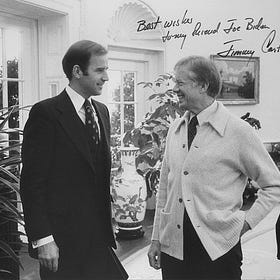
Joe Biden’s campaign for the 1988 Democratic presidential nomination flamed out after the revelation that he had cribbed lines from Neil Kinnock, then leader of the British Labor Party. He passed on the 1992, 2000, and 2004 races, becoming instead what is both generously and condescendingly called “an institution.” He presided over the disastrous Claren…
Part of my thesis was that Biden and Trump represented public styles that people had some measure of nostalgia for, and that as long as they were on the scene, the world of “central casting” and “malarkey” and all those other grandpa-isms wasn’t quite gone. Now we’re watching Trump lose his grip on his own style, fading before our eyes as Biden did, even as his whole party becomes simply a collection of his broken avatars. It must be strange for him, watching all these unfunny court jesters and knowing, more clearly than he knows the terms on offer from Iran, that none of them has the juice. One used to be able to have one opinion of Ted Cruz and another opinion of Richard Lugar but now there’s no point, they’re all just different extensions and embodiments of one guy’s ego (Democrats, if anything, seem to have the opposite problem, grasping at retreads in a vacuum of leadership). Nancy Mace appears to be next for the chop, like Kentucky’s defeated Thomas Massie, guilty of pushing too hard for the Epstein files.
Cruz will probably run for president in 2028 and lose, and in 2030 he’ll be defeated in the primary by an illiterate 30-year-old with jaw implants, the board of Palantir, or a robot running Grok. He’ll give a sober, sympathetic concession speech, which if I’m alive and not hoovered into the Singularity and can find whatever stream it’s on in the sea of AI-generated slop, I’ll probably watch. I may want to hear that helium-huffing Joe McCarthy voice once more. Time comes for all of us. It won’t make me happy.
You can just do instant runoffs for primaries, which efficiently aggregate the opinions of a more representative group of voters. That said, the loony-tunes candidate in the 35th U.S. House district finished the first round narrowly ahead and the anti-semitic rants that sank her candidacy only happened after the first round was over. She lost, but probably only because there was a second round.
The third-place finisher, House member Wesley Hunt, was plausibly a stronger general election candidate than either the past-it Cornyn or the scandal-tarred Paxton.
This is a model with its own limits, to be sure. If the problem with socialism is that eventually you run out of other people’s money, the problem with capitalism is that eventually you run out of other people’s commons, and that is going to happen in Texas sooner or later, as water runs out in some places and insurance markets buckle.
While it didn’t really come up this year, the Democrats have their own discarded models in the relative conservatives who were once the backbone of the party in Texas (and other states) and who attempted a comeback—and, in total fairness, did indeed get the statewide nomination—in 2022 in the form of an ex-Republican challenging lieutenant governor Dan Patrick. He lost by ten points, as I recall.
It’s possible that Cruz was just seeing around a political corner that Cornyn and the others couldn’t, and had they suspected that things would play out as they did, they’d have done exactly what Cruz did. But I think it’s likelier that Cornyn just thought Trump was in the wrong and didn’t want to be a part of it.
No posts
Comments
Nothing yet. Say the first thing.
Sign in to join the conversation.