
I previously wrote dispatches from Rome, Naples, Munich, Vienna, Berlin, and Darmstadt. For more on Pieter Bruegel the Elder and the background of this project, see Six Chapters on Becoming Insatiable, Blood in the Snow, and Obsessions in Review: Brueghel. The travel depicted here was generously supported by the congregation I serve, Christ Lutheran Church in Dallas, Texas.
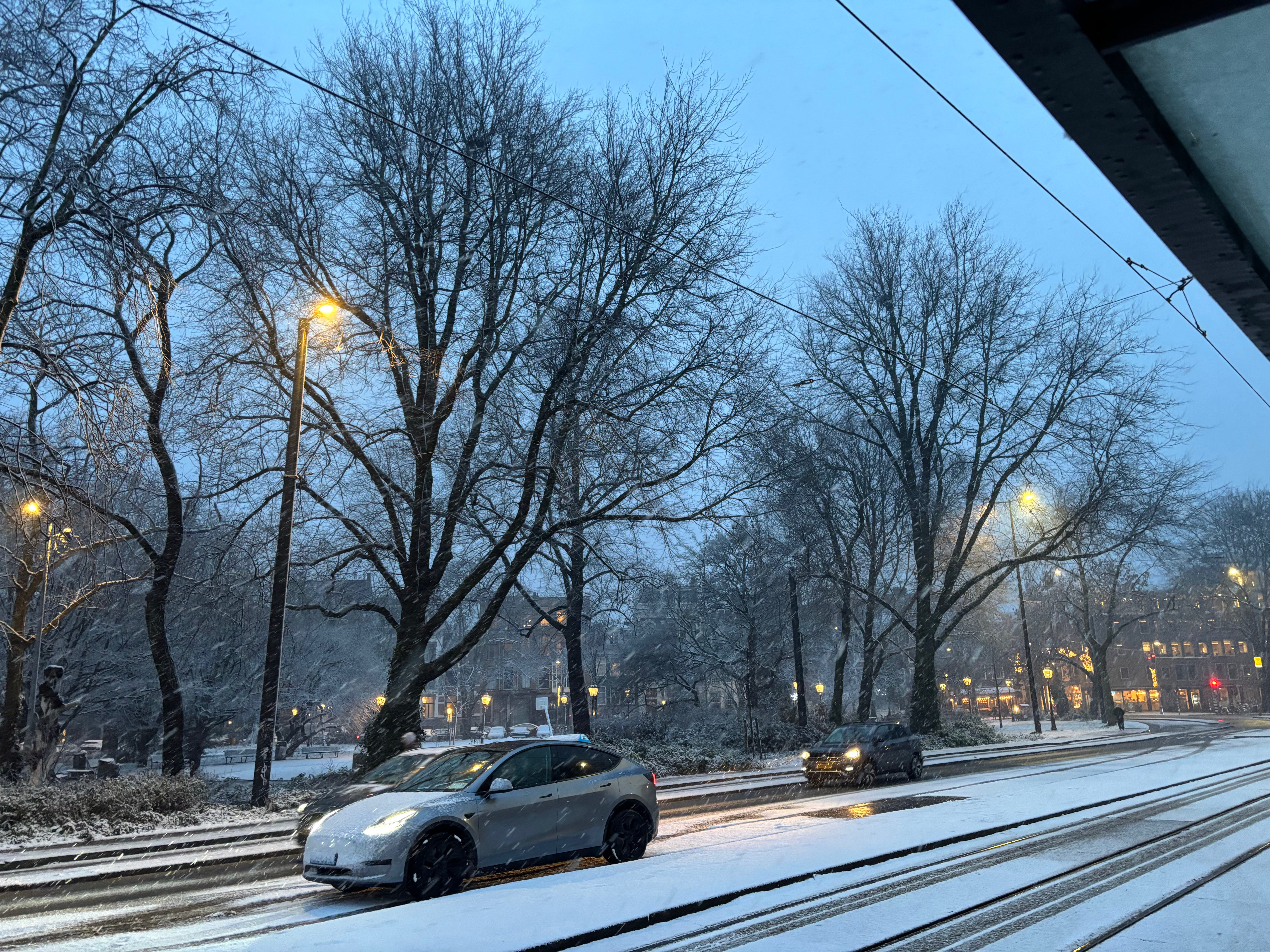
The cold didn’t deter the bicyclists of Amsterdam, and it wouldn’t deter me. The streets were treacherously icy, especially on the bridges over the canals, and a charmless freezing drizzle blanketed the city all morning. I was, for the first and last time in my travels, weary from the road. I’d been shooting awake in the middle of every night for hours, sometimes making notes in surrender to sleeplessness and sometimes just letting the scroll of short-form worries run through my head until time and boredom won the battle. I had even begun to wonder if I were falling ill or if, given too many more nights of insomnia, I might stumble into a minor nervous breakdown. But I had only one full day in this city which had fought the water to a draw and looked all the better for the battle, and let the streets or my brain freeze how they may, I was going to make the most of it. That seemed to be what everyone else was doing, anyway. The closest I came to mimetic desire in Amsterdam was watching a woman, seemingly older than I, pedaling hatless into the sleet and frigid air. I am from a cold part of the world and even I wondered if she’d lost her mind. Perhaps if I ended up slipping the moors of sanity here, no one would notice.
While politely asking me to drain the few ounces of water in my bottle, the guard explained that it was a precaution against people smuggling acid into the Rijksmuseum. I had heard of this being done, but whether it is a credit to my good sense or a debit against my advancing lameness, it hadn’t even occurred to me to try. There are no paintings by Pieter Bruegel the Elder, the particular focus of my travels, in Amsterdam but in the Rijksmuseum I could explore a great web of his influences, his contemporaries, his sons and successors, tracing motifs and elements from the early 16th century through the Reformation and its aftermath. It was sometime a shock and disappointment to discover that my painterly hero was less original and distinctive in his compositions than I had thought, but by the time I reached the Rijksmuseum’s northern Renaissance galleries I was excited for the family reunion. Look, there’s the Habsburg double eagle on a standard right behind Christ staggering under his cross in a painting by Quentin Massys, a half century before Bruegel brought the anachronism to full and devastating flower in The Procession to Calvary. There are the tiny gallows on the edge of a bird’s-eye view of Amsterdam. A delightful series on the works of mercy features a Where’s Waldo-style anonymous Christ. Let’s see what the images of ice skating and peasant festivals got up to in the decades after his death. The obscure names in the books I’d read got their museum-wall due here. Peeter Baltens, a close friend of Bruegel, has a straightforward homage to the master’s work here. Bruegel’s former employer and father-in-law has a sketch of the marriage of Tobias and Sarah. I hadn’t even known to expect the works of Jan van Scorel, whose disquietingly modern Mary Magdalene I put haphazardly into an essay last year, but they have a place of honor.
The popular heart of the collection is upstairs from the warren of 16th-century galleries in a grand central hall. That’s where you find the Rembrandts and the Vermeers. The Night Watch is undergoing long-term restoration, but the museum has cleverly designed its space to allow visitors to watch the work as it happens. It was like an art zoo. I paid my homage to the Vermeers but could not find a way into them. That would have to wait for The Hague.
Amsterdam is a cosmopolitan city in a famously cosmopolitan country, but the Rijksmuseum was the first place I had felt a national identity being constructed through an art collection. It was not chauvinistic, at least not by my (no doubt skewed) American standards, and the space is studded with alcoves displaying the history of the theft of Jewish art. The historical touchstones are modest but memorable. You can see the crate (of, as I understand it, disputed authenticity) in which Hugo Grotius, the great theorist of international law and religious toleration, was smuggled out of captivity. A roguish painted allegory shows Protestants and Catholics fishing, literally, for men with their various techniques. And from the medieval panels to the post-Enlightenment canvases you can trace the development of a refined culture in its limpid, restrained, quintessentially “bourgeois” style. By the end of my tour, I was a bit burned out on all the Apollonian sobriety.
Thankfully, the Van Gogh Museum was a short walk away, and while my remaining day had already shrunk far below the list of ambitions I had set for it, this would have been an inexcusable omission. I felt a loyalty not so much to Van Gogh himself but to Lou Reed who, since 2000’s Ecstasy, had been my inescapable reference point for the whole city. “Maybe I should go and live in Amsterdam / On a side street, near the big canal / Spend my evenings in the Van Gogh Museum / What a dream, Van Gogh Museum.” It was expensive by the standards of my journey, and my morning burst of caffeine and intentionality was already long faded, but I pushed myself through and found myself almost instantly unstrung by the opening gallery of self-portraits.
A year of immersion in the art of early modernity had only, I thought, turned me further against the Romantic cult of the artist. Bruegel the person is hiding in his work, something he has in common with Shakespeare, and I find myself drawn toward these self-concealing artists on an impulse far deeper than mere aesthetics. But here the face of the artist was not the brand, the icon, it had become. It was a profound iterative study, yet charged with tragedy. I looked at Van Gogh’s bandaged head, the result of an explosive argument with Gaugin, and thought of a friend, ten years dead, who had cut his forehead with a kitchen knife during an argument with his father. I find myself, these days, distressingly sound and stable as the hum of car battery, but at my porous edge there are experiences of madness, suicidal ideation, and dissolution that I had not seen so willfully, movingly objectified. Madness is only ever a short step off a steep cliff. I wanted so badly for Van Gogh to survive.
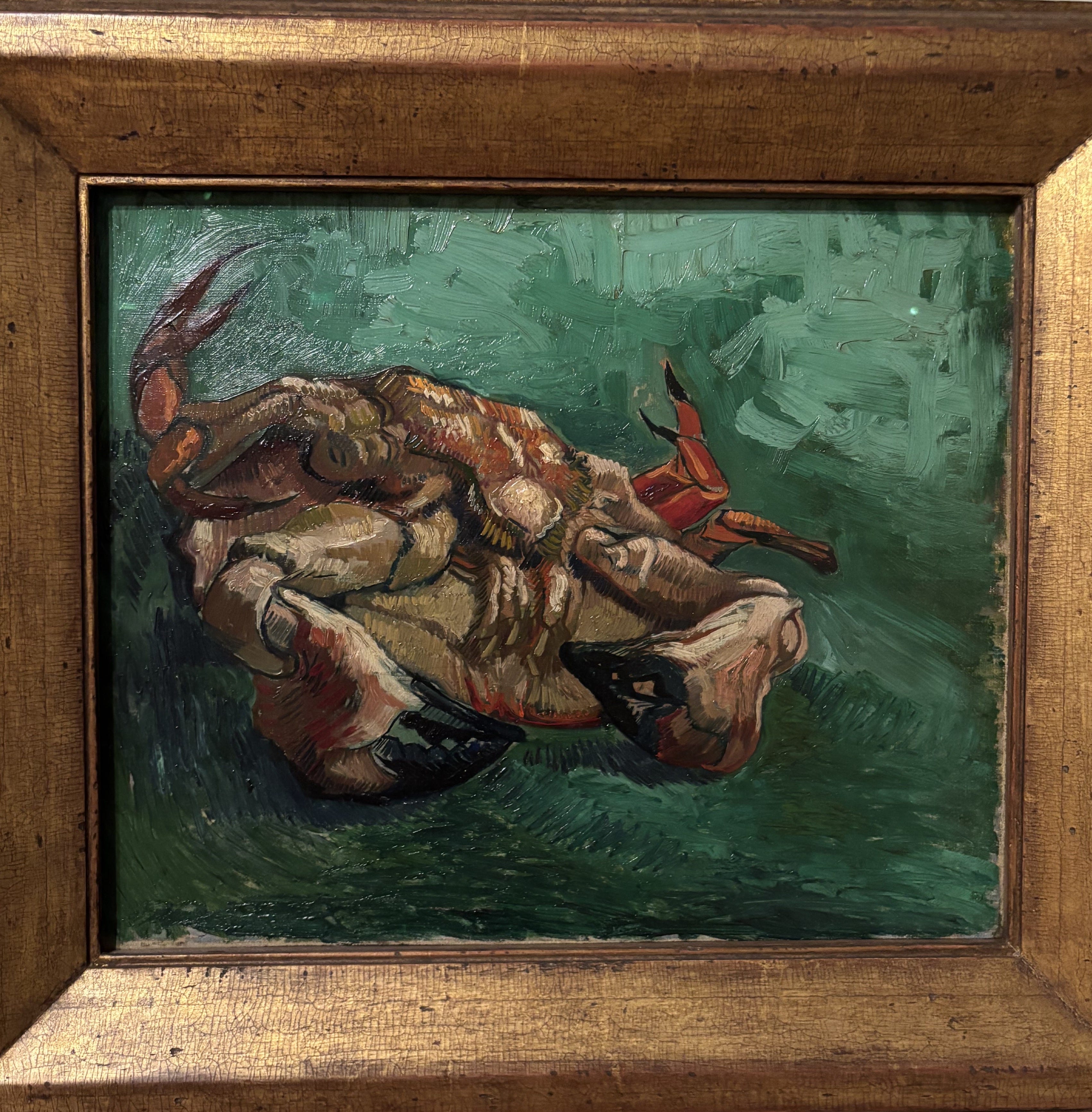
Lou stayed with me, and as I became vaguely aware that “Wheatfield with Crows” was here, the soundtrack switched from “Modern Dance” to “Riptide,” an address to an institutionalized friend: “I was thinking of Van Gogh’s last painting / The Wheatfield and the Crows / Is that perhaps what you’ve been feeling / When you see the ground as you fall from the sky.” I discovered, contra Reed, that this was not in fact his last painting, that between it and his suicide, Van Gogh produced several cheerier pieces. But in front of the painting, I could see the attraction of the myth–again the tortured artist defying the pathetic fallacy and projecting his inner turmoil into an ordinary country scene. My favorite, though, was a sleeper, the small and easily neglected “Crab on its Back.” Its ugliness was astringent. The animal is bristled and clawed, but helpless on its back. As a study it is technically impressive, but I mostly saw agony in it, maybe even an allegory for the armored futility of mental illness. See the ground as you fall from the sky.
I retreated to my underground hotel room, put one of the superfluous pillows over my head, and tried to sleep. After my timer went off–we are in a bourgeois city, our mode of experiential production obeys the clock–I looked at the rapidly advancing closing times of the city’s sites and opted to slip into the last hour at Our Lord in the Attic. This was the home of the city’s Catholic faithful after a bloodless Protestant coup established Reformed Christianity as the only public form of worship. I haven’t seen anything like it, a classic prosperous townhouse whose uppermost level was converted to a nave with a chancel, an organ, a small balcony, and a pulpit that folds out of the altar like a Swiss army knife. True to its reputation, Amsterdam was tolerant inasmuch as everyone seemed to know about this crypto-parish and there was no repression, but its worship had to be genuinely “private.” Like drinking your wine out of a brown paper bag. I was reminded of one of the Netherlandish proverbs Bruegel painted, “to look between one’s fingers,” to pretend not to see.
Those of us who arrived late in the day had less than a low mass’s worth of time in the actual sanctuary. The staff swept up behind us, in a manner just this side of brusque, to prepare for a very much on time closure. I felt an urge to kick against their burgherish goads, having paid my fee in good faith and wishing to linger a bit in the liturgical flotsam of the dark sacristies and vestries. None of it was aesthetically striking or impressive apart from the adaptations forced by discretion. Our Lord in the Attic fell out of use after official toleration led to the construction of a big proper church structure for the city’s Catholics. But I could not help but think of the generations who were born into its semi-hidden community and died out of it, and in particular of those who must have made the transition from the constraints of privacy to the grandeur of a public space. Some of them, at least, presumably looked back on it fondly, when the codified hypocrisy of an incomplete liberalism meant that a minority community could have experiences that full toleration would not grant.
Having gone to a church on its edge, a brisk circuit of the city’s red light district seemed in order, no less essential in its way than the Van Gogh Museum (though if Lou Reed ever sang about it, I don’t remember). I was there in the evening caesura between the museums and historic sites closing and the nightlife taking off, and the scene was subdued. The famous glass kiosks were mostly empty, many with “to rent” signs. For all I know, apps have killed storefront prostitution like they have every other kind of brick-and-mortar commerce. Signs threatening severe penalties for outdoor urination no doubt bid up the market-clearing price of the “Sexy Toilet,” which was doing some business. I did not go in. “We live here,” a sign showing a family pleaded from more than one storefront. This is your vacation from morality, your private entrance to a world of vice glimpsed between the world’s fingers, but it’s our home. No doubt it was a thought that had occurred to the Catholic householders who lived under the hidden church when someone came drunkenly or rudely to Mass through their unmarked doors.
I rode the tram back past my hotel and the girdle of canals to an Indo-Guyanese restaurant recommended by a Dutch friend. They squeezed me into a two-top between larger parties and I ordered something that sounded good. Before me sat three dishes of sauces, which, being unfamiliar with Indo-Guyanese cuisine, I set out to sample in small doses on my rice. One was some kind of hot chili, which was delicious. Another was a syrupy tamarind. A third looked like mango chutney. I got rather too much of that one on my forkful of rice but I thought what’s the bother, it’s mango chutney.
It was not mango chutney.
As the burn engulfed my throat and my head, I became jittery. I like hot food, but I was not prepared for this, which had me moving my body quite pointlessly on the deluded hope that standing up or leaning this way or that might help. Here you might try anything. Convert to Rome, cut off your ear, hire a sex worker, jump in the canal, drop acid and stare at “The Milkmaid,” bike defiantly into the onrushing snow like a professional-class King Lear. The actual food was, I think, good, but tasting it with my sandblasted mouth was like turning the pages of a book with a snowshovel. “Maybe I should go and live in Amsterdam, on a side street, near the big canal.” Maybe, Lou. Maybe. It does seem nice. But just off the soothing grid lies the madness, the gallows, the restless sea, and the inner heat that can’t be quenched.
Comments
Nothing yet. Say the first thing.
Sign in to join the conversation.