
I previously wrote dispatches from Rome and Naples. For more on Pieter Bruegel the Elder and the background of this project, see Six Chapters on Becoming Insatiable, Blood in the Snow, and Obsessions in Review: Brueghel. The travel depicted here was generously supported by the congregation I serve, Christ Lutheran Church in Dallas, Texas.
The standing-room section of the Golden Hall was starting to flag. On my right, two young women, one of them in a rippling white dress, the other seemingly costumed as an anime character, were squatting on the floor by the rear wall. Against the fluted column to my left, an older woman was leaning back on the floor, legs splayed. I was still standing, but leaning against the wall to take some pressure off my seizing lower back. It had been bothering me since I woke up that morning, the first Sunday of Advent. That was in Munich, where we’d skipped church—my search for a house of worship had been desultory—for breakfast at a splendid local bakery. I’d gotten myself by train to Vienna, by tram to the chipped-tile pension where a wolfish clerk out of a Thomas Mann story had directed me to a sad but functional single room, and by tram again to the Musikverein for the night’s concert by the Vienna Symphony.1 The orchestra was playing Mozart’s Symphony #40 with precision and restraint. The hall lived up to its sumptuous reputation, adorned with more gold and naked statuary than I have seen in any American concert venue. But I had begun to curse the false economy for which people from my part of the country are famed. For ten or fifteen Euros more, I could have been in a proper chair next to the organ, behind the ensemble, instead of here where the surly, Rufus Sewell-looking staff member paraded a placard with a phone crossed out pointed toward some of us and where the back pain caucus was organizing in the rear.
On the train, I’d researched the latest Mass times in the city. The Cathedral had one at 9 p.m. And it became apparent that the concert would not end in time for me to get there. The second half of the program was Haydn’s Nelsonmesse, which I was eager to hear but would have been an ironic substitute for missing church on the first Sunday of the church year. So at the interval, I made the decision to leave. Immediately, the stabbing pain in my back reduced to a dull ache (some bodies keep the score, mine takes church attendance). I sallied out into a packed lounge, pushing my way like a medieval pikeman through a crowd bristling with champagne flutes. In moments I was at the U station, where headways seem to top out at four minutes, and in only a few moments more I was emerging into the heart of the Innerstadt, under the upthrust spire of the Stephansdom and the mammoth lighted globes fretted across the streets. I was early for church.2
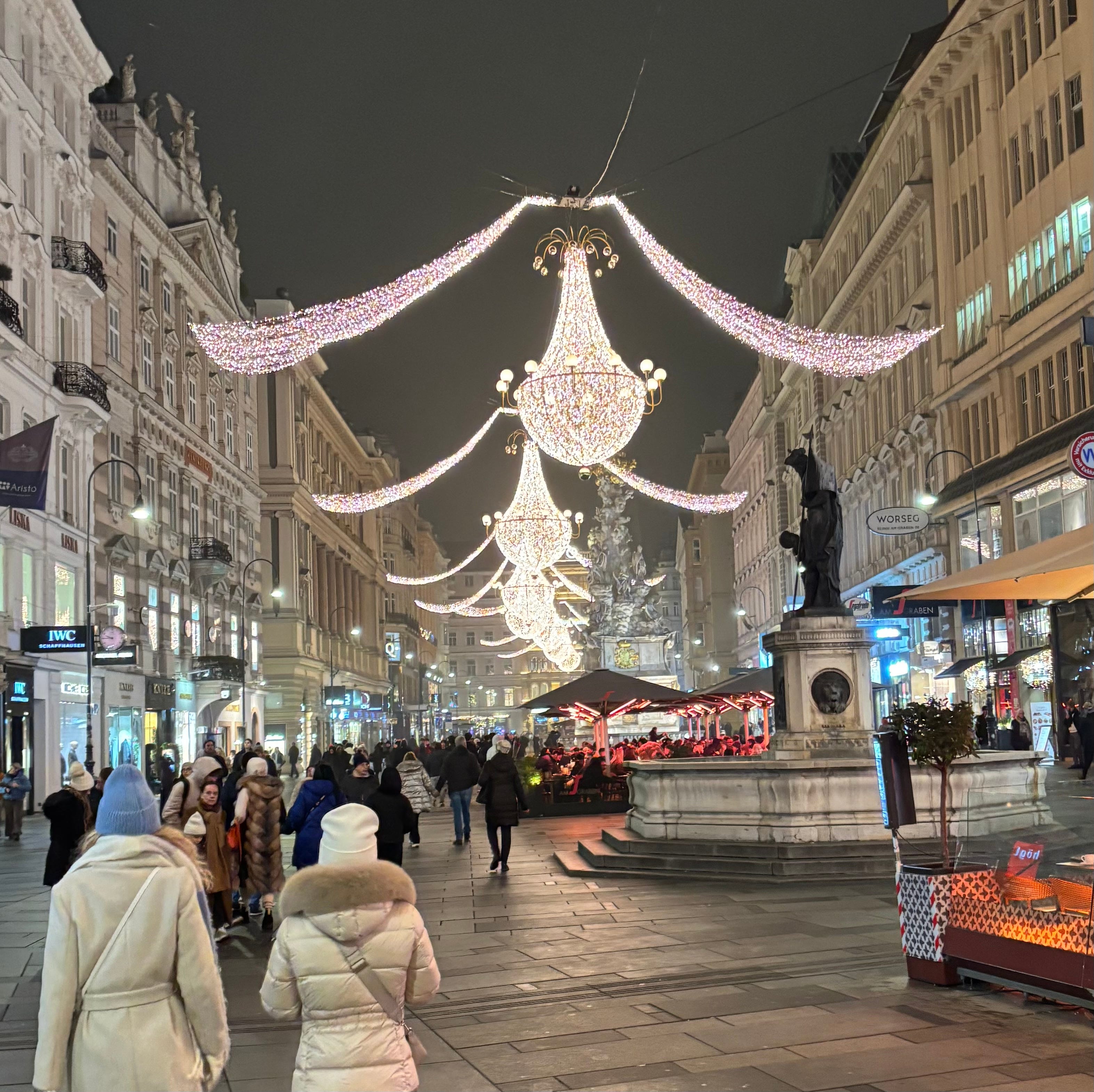
They’ve stopped making cities as legendary as Vienna. Pick an era, or an art, or a theme, and a great composite appears that breaks down into vivid particulars. A host of droop-lipped Karls, Rudolfs, and Josefs for the Emperor; Mozart, Beethoven, Brahms, and Mahler among the avatars of the Great Composer; legendary sieges resolved to cannonballs in the masonry and sacks of coffee abandoned by the Ottomans and fortuitously spread through a whole continent; dour psychoanalysts, waltzing aristocrats, louche poets and dramatists, Seceding artists, and a flamboyant array of Sachers, Schwartzenbergs, and Linzers descending from a platonic Torte—all of it feels achingly within reach. Roman Vindobona is more obscurely present, a neglected child of the Danube frontier and its watches against the Marcomanni. Marcus Aurelius is said by some to have died there; the city embraces him with a Marc-Aurel-Straße and I choose to believe it. For a Stoic emperor, any place of death is as good as the next, but for me, as a sentimental bourgeois, it feels fitting that a boundary figure of the old pagan empire should have dropped to earth at what would eventually become the heart of its self-proclaimed Christian revival. It’s not the oldest, the biggest, or the most stunning city in Europe. But it was, for a long time, an unofficial capital of the abstracted, patchwork commonwealth of pathos and pathologies, crosses, stars, and swords, blood and water and oil paint, printing and images and half-abandoned cults that used to be called “Western civilization” and still is so called by people who don’t know or care about what it was.
My earliest mental images of Vienna are of that great room at the Musikverein, which was on the cover of a Strauss or Mahler LP my mother owned. The next thing I remembered was The Third Man (1949), a movie about foolishness and cynicism flourishing in the convocation of shadows and ruins after the Second World War, tied together with a surprisingly jaunty zither theme. Not long after, I filled in the decades between the waltzes and the rubble with Frederic Morton’s A Nervous Splendor, on the last brilliant, ominous decade of the Viennese Century that stretched from the suicide of the Crown Prince Rudolf to the rise of Karl Luger, the pioneer of anti-Semitic populism. Federico Garcia Lorca, via Leonard Cohen, added to the stock. In Vienna there are ten pretty women, a piece torn from the morning hanging in a gallery of frost, a concert hall where your mouth had a thousand reviews, and “this waltz with its very own breath of brandy and death.” In Berlin, it was said, things were serious but not hopeless. In Vienna, things were hopeless but not serious.
That tumultuous era of the city’s history hasn’t gone away, either. There is still a famous Karl Marx Hof and a Friedrich-Engels-Platz in witness to the city’s socialist uprising, harshly suppressed in 1934. I did not see any markers to Dr. Dolfuss, the highbrow Fascist who executed the Social Democrats but was himself felled by proper Nazis not long after. But the vestibule to the church of St. Ulrich holds markers to many “gefallen für Gott, Kaiser, und Vaterland” in 1914 and 1915, as well as some who died at Stalingrad in the next Great War. “Ruhe in Freiden!” says one marker. Rest in peace. “Auf Wiedersehen!” I only stopped to read those markers after saying my prayers in the chapel off to its left on my first morning in the city. I shook off a brief chill and went out to the Museum.
I was in Vienna to revisit the core of what Toby Ferris, in his fascinating travelogue Short Life in a Strange World: Birth to Death in Forty-Two Panels calls “the Bruegel Object.” I did not know when I made my plans that I was shadowing an author who had undertaken the same project for the same reasons at the same time in his life. But first grudgingly, then appreciatively, I accepted the comradeship, and I remain grateful for the conceptualization of Pieter Bruegel the Elder’s work as a single disaggregated whole. Why else would I be trying to put it together in the frame of my own experience? Twelve Bruegel the Elder panels reside at the Kunsthistorisches Museum, more than double the next largest holding, all of them brought to Vienna by one of those imperial Rudolfs. He’d gotten them from Antwerp, then under Habsburg rule, after the city had taken them in default of a debt by their first owner, a friend and patron of the artist. You can see the unlucky fellow in Peasant Wedding, an urban gentleman in black enjoying a visit to the rustics. And the number of paintings actually understates the collection’s size. As Ferris points out in his method of calculating each location as a share of the total surface area of all the paintings, it makes an even larger share of the whole.3
They are monumental in conception, too. The biggest is The Procession to Calvary, a vast yet ordinary tableau of a whole city going out with, collaborating in, bumming around, or sorrowing at the progress of Christ toward the cross. I believe it’s his largest painting. The larger of Bruegel’s two attempts at The Tower of Babel is there. An obscure and indirect Conversion of Paul, the raucous Fight Between Carnival and Lent and the enigmatic Children’s Games are all there, along with some of his most influential scenes of seasonal and festive rural life.
I have a knack for accidentally taking the longest possible route to any available Bruegels, but at the KHM I managed to turn straight from the staircase into the room dedicated to these twelve. I pivoted my attention between the Procession and a group of students on an English-language tour, whose guide was pointing out the details of Peasant Wedding on the opposite wall. This group, like every crowd, had resolved itself into a Bruegel crowd. A few were straining close and answering the guide’s questions. Off to her right was another cluster, paying attention but keeping its distance. Another three clung together on a banquette, orthogonal to the painting. A boy sat with his arm around a girl, who was herself languidly stroking the arm of another girl. Everyone is in their own world, which is structured but not determined by the action in the center.
After immersing myself in the Bruegel Object for so long, I had begun to see the world in Bruegel’s terms. Every bundled-up child could have stepped out of one of his winter scenes, especially the child in Munich who was attempting to eat a slice of pizza off a table in a Christmas market using only his teeth. Almost any face can appear as a Bruegel face in the right mood or moment, contorted, unguarded, exaggerated, lined with hard use. I thought back to my column-supported fellow concertgoer the night before, looking for all the world like she was taking a break at the edge of a wheat field in harvest time. I can’t claim that the object of my obsession is the greatest painter, even of his age or his region. But there are things he got that no one has done better: Winter, children, groups of people, physical pain. He doesn’t show the screaming torment of a Marsyas being flayed alive by Apollo in a Mannerist painting, but the gravitational pull of too much work on a human body. In a moment, the suburban dad with bad posture and an abnormally high step count can feel himself connected to a pre-modern farm worker, not in the objects of their worship or even in their earthy comforts but in the universal droop toward the earth.
I spent some six hours in the museum, all in the second-floor painting galleries. I looped back to the Bruegels after seeing the whole floor, virtually each piece in which rewarded its own moment of time and attention. At first I dodged the clusters of influencers posing in front of a Spanish infanta or at the top of a marble staircase, but before long I was just walking through their shots. That’s what you get for trying to privatize a public space. I hadn’t seen any influencers in Munich.
As this journey continued, I found it harder and harder to leave these places. The ice of middle age forms around my heart when I ask whether I will ever see them again. But it’s more than that; there’s something about the presence and gravity of these objects that holds me. They’re wood and oil; prolonged through care, preserved from the sun and rain, and kept free of the soot of centuries of church candles, they are nevertheless mortal. At least in Vienna they have each other’s company and the throngs of art lovers and Bruegelian school kids. When I took an impulsive train trip to Budapest the next day to see The Preaching of St. John the Baptist, the crowd was sparse and the fragment of the Bruegel object was alone with the work of contemporaries and sons. I sat with it three times before having to drag myself away, casting a last forlorn glance over my shoulder as I made for my return train.
At a critical moment J.M. Coetzee’s Waiting for the Barbarians, the narrator finds himself cursing the effects of Empire on his and humanity’s soul:
Empire has located its existence not in the smooth recurrent spinning time of the cycle of the seasons but in the jagged time of rise and fall, of beginning and end, of catastrophe. Empire dooms itself to live in history and plot against history.
Its soldiers hunt “the barbarians,” pitilessly seeking to cut down whichever nameless one of them is fated “to climb the bronze gateway to the Summer Palace and topple the globe surmounted by the tiger rampant that symbolizes eternal domination.” Be as serious as you wish, it’s still a hopeless task. They were already there waiting on the far side of Marcus Aurelius’s Danube when the ground that would become Vienna was just a fortified army camp. We know now that it didn’t work that way, not even for Rome. The barbarians were as likely as not to want land and a place in the commonwealth rather than fire and blood, so that when the end came it took generations for anyone to really notice. Perhaps everyone was entranced by the zither playing. Vienna’s last emperor abdicated without much of a fight, after his regime had been driven into the ground by an inept, image-obsessed ruling class that managed decaying institutions in part by indulging in militaristic fantasies (hard as that may be to imagine). The ruler of the pretended successor to the Holy Roman Empire’s first “reich” despised the city so much that he spared it the manic visions of Albert Speer. The toppling came from within.
But there’s life after Empire. Of all the places I had been, Vienna inhabited the expanse of its legend with the most style. Even the concrete modern buildings have a panache that I would not find later in Berlin. At the same time, I did not find Vienna memorializing the worst moments in its history to anything like the same degree. You can, however, see The Third Man whenever you want to slip back into the shadows and the rubble.
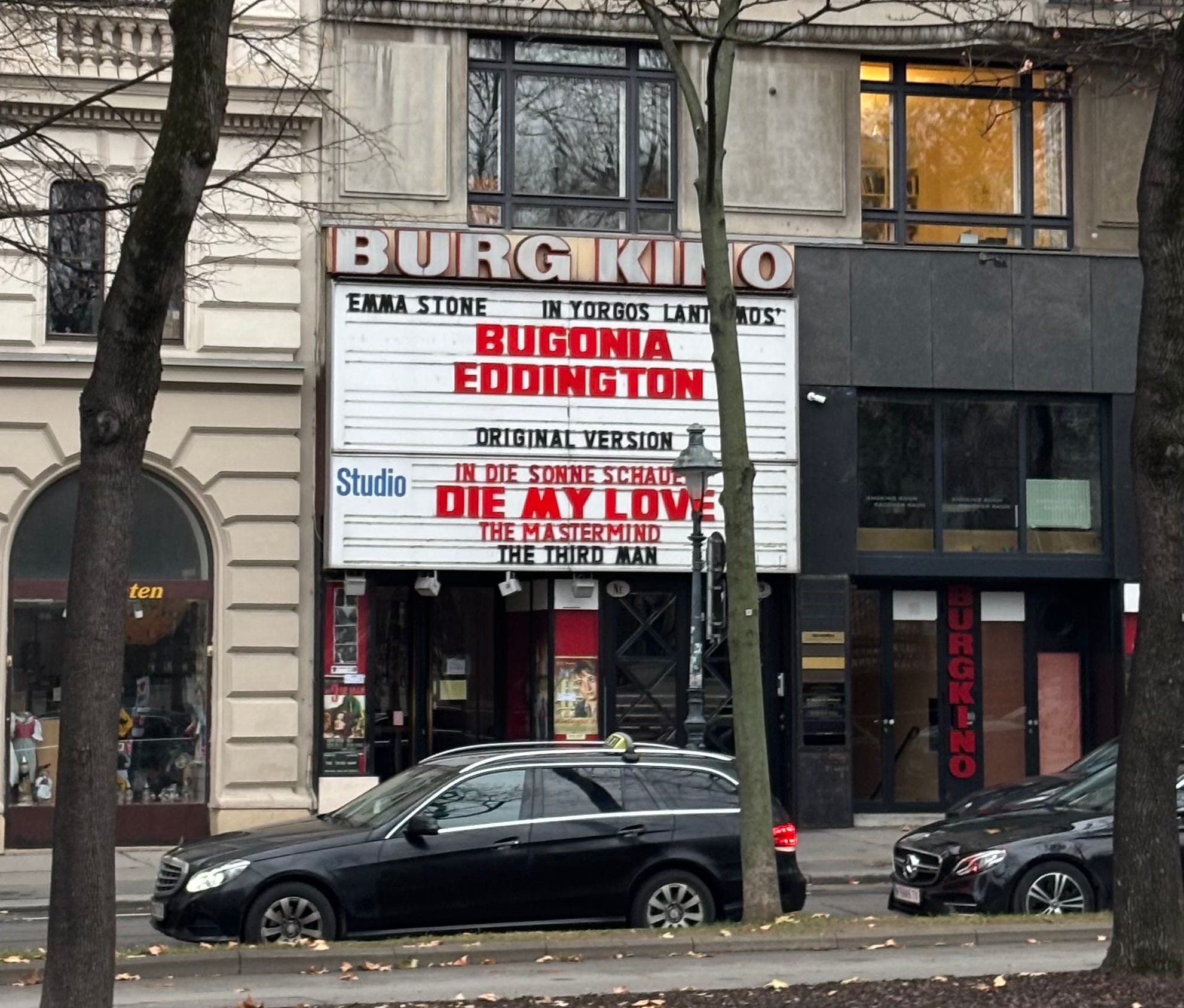
I dug myself out of the 16th century for my last day in Vienna. I spun through the Artists’ House, which had an exhibition of religiously-inflected contemporary art that ran the gamut from surprising and insightful to crude and tacky. The same building houses the Albertina Modern, which had a career retrospective of the work of Marina Abramović. I was new to this artist, whose performances and happenings are the sort of thing that is easy enough to wave off as ridiculous when you read them described or see a snippet of video. But immersing myself in the exhibition showed me the danger of the projects and the daring engagement of audiences (one 1974 performance included a loaded revolver that a gallery-goer picked up and held to her head). She was experimenting with pain and endurance, exploring the bystander mentality, and ultimately dragging an essential role for presence and dynamism into an artistic process that had consigned meditations on human extremity to the walls of a museum or the pages of history. The most frightening installation was a video of her and her then-partner leaning backward on the opposite sides of a bow and arrow, only an error or cruel impulse away from tragedy. The arrow was pointed at her, not him. The most beautiful was two facing walls of screens showing video recorded during a performance in which she sat still and silent for days while the “audience” was invited to come up one at a time to sit in a chair opposite her. The faces were smiling ironically, staring impassively, or openly weeping. “In Italy for thirty years under the Borgias, they had warfare, terror, murder, and bloodshed, but they produced Michelangelo, Leonardo da Vinci, and the Renaissance,” as the third man himself says. “In Switzerland, they had brotherly love, they had five hundred years of democracy and peace, and what did that produce? The cuckoo clock.”
That night I decided to take a tram up to a neighborhood in the Vienna woods, subject of one of the waltzes from that childhood record. The Weingut I had read about in advance was closed, so I went to the next one down the street. It was nearly empty. The waitress was dressed like Heidi and, for the first time in my Vienna sojourn, did not switch to English at the sound of my deplorable German but persisted in the lilting language of the city. She placed me at the Stammtisch, one man among eight seats. An older couple came in and was seated nearby. With enough of the local wine, it might have appeared as a German-American restaurant in northeastern Wisconsin my grandparents would have patronized. It even had a Chicago-style “wall of fame,” but instead of Dennis Farina and local news personalities praising the hot dogs and beef, it was pictures of Mikhail Gorbachev and Pope Benedict. Twenty minutes on a tram from the beating heart of a cosmopolitan modern city, the sort of place that has a bar named after Charles Bukowski, and I was in Donald Trump’s Austria.
Later on, a big group came in and took up residence in the next room, perhaps old friends from school. I was still the youngest diner by two decades. But with a respectable crowd now in place, a duo in Tyrolean hats appeared and started playing in that second room, one on accordion and one on violin. They played “The Blue Danube.” They played the theme from The Third Man, which started out as a ragtime melody from Kansas City in 1899, found its way to the city of dancing ghosts, and was overheard in a wine cellar by Carol Reed and Orson Wells during the filming. Thus piped back west, it became a hit, both in Anton Karas’s soundtrack version and in covers by, among others, Guy Lombardo (whom my grandmother preferred to Lawrence Welk). At the set break, one of the musicians strode through my room to smoke outside. “Der Dritten Mann!” I called out to him. “Das ist mein lieblingsfilm!”4 A quick nod, not even breaking stride. He already knew it.
Thanks for reading The Parish Bulletin! This post is public so feel free to share it with any lovers of The Third Man in your life
Not to be confused with the more famous Vienna Philharmonic, which was not playing in town during my visit.
I would cite the percentage but I seem to have lost the book. If anyone from the Richardson Public Library happens to read this, I apologize and promise I’m looking for it. I think it was over 40%.
The Third Man is not actually my favorite movie but I do not know how to say “one of my favorite movies” in German.
No posts
Comments
Nothing yet. Say the first thing.
Sign in to join the conversation.