
The Doria Pamphilj Gallery in Rome is a perfect instance of an old aristocratic home that functions as a public art museum. It is in the middle of everything, inasmuch as the cluttered historical “everything” of Rome can have a middle. It’s right on the Corso, a short walk from the edge of the Forum park, the Victor Emmanuel monument, the Pantheon, and the Trevi fountain. The staff are sharply dressed, the tickets have the breadth and sheen of some bygone diplomatic credential, and both the collection of paintings and the halls in which they hang are profuse to the point of opulence. The paintings are marked with a last name and a year, nothing more. Even to see a title you must consult a laminated key placed on one of the credenzas. This splendid indifference to the museum-goer’s edification is balanced by a charming and often in-depth audio guide narrated by a scion of the Doria Pamphilj family. I adored the whole thing, even after my search for Pieter Bruegel the Elder’s Naval Battle in the Gulf of Naples was gratified.1
In hindsight, however, it was a less than perfect place to bring three jet-lagged children fresh off a sleepless flight from Dallas.
I could have been more sympathetic. I can remember in my bones the feeling of forcing myself through the National Gallery in London because I didn’t want to fall asleep and be pulled back toward North America’s circadian pole. I saw marvels: not only the first of what would turn into my eight-years-and-counting Bruegel journey (The Adoration of the Kings) but van Eyck’s Arnolfini portrait and Vermeer’s young woman. And no doubt many more, which I have completely forgotten, even as I have forgotten anything of what it was like to be in the presence of those. A photo of my wife taken with the van Eyck proves we were there, but nothing more. It was just a crossed-off item on an imaginary list, the experience of travel I most scorn and yet recklessly court.
I was fresh and relatively rested from a few days in Naples. They were riding the first wave of temporal misery. Nevertheless, dazed moments and lost stretches notwithstanding, my daughter ran up to me: “Dad, I found one of the paintings you’re looking for!” She led me deep into the gallery, to a room at the dead end of a hall. There was a copy of Winter Landscape with Bird Trap made by Pieter Brueghel the Younger2. I’d been documenting the Bruegel the Elder paintings I was visiting. But I started a parallel photographic collection, then and there, of the numerous budding offshoots, of nearer and further resemblance, in the work of the sons.
I spent a lot of time looking for things in Rome. Having a goal, or even an orientation toward an era, a style, a theme, is like looking for a needle in a needle stack. I’d been there thirty years before, when churches interested me only for the height to which they’d allow me to climb, and the glories of the pagan past were all I cared to seek out. Though we sought many of those glories out, and though I can remember the awe they inspired, in my memory they were somewhat isolated islands in a medieval and early-modern stream. Either my memory failed me, or excavations have continued at an impressive pace, or both, because the ancient-ness of Rome was impossible to miss this time. What is one to do with a temple to Hercules just sitting by the street in a little park? “Wow, that’s old” becomes a leaden refrain if one takes these places on the trot. And yet it is hard to choose and to slow down. There are too many items on too many imaginary lists to cross off.
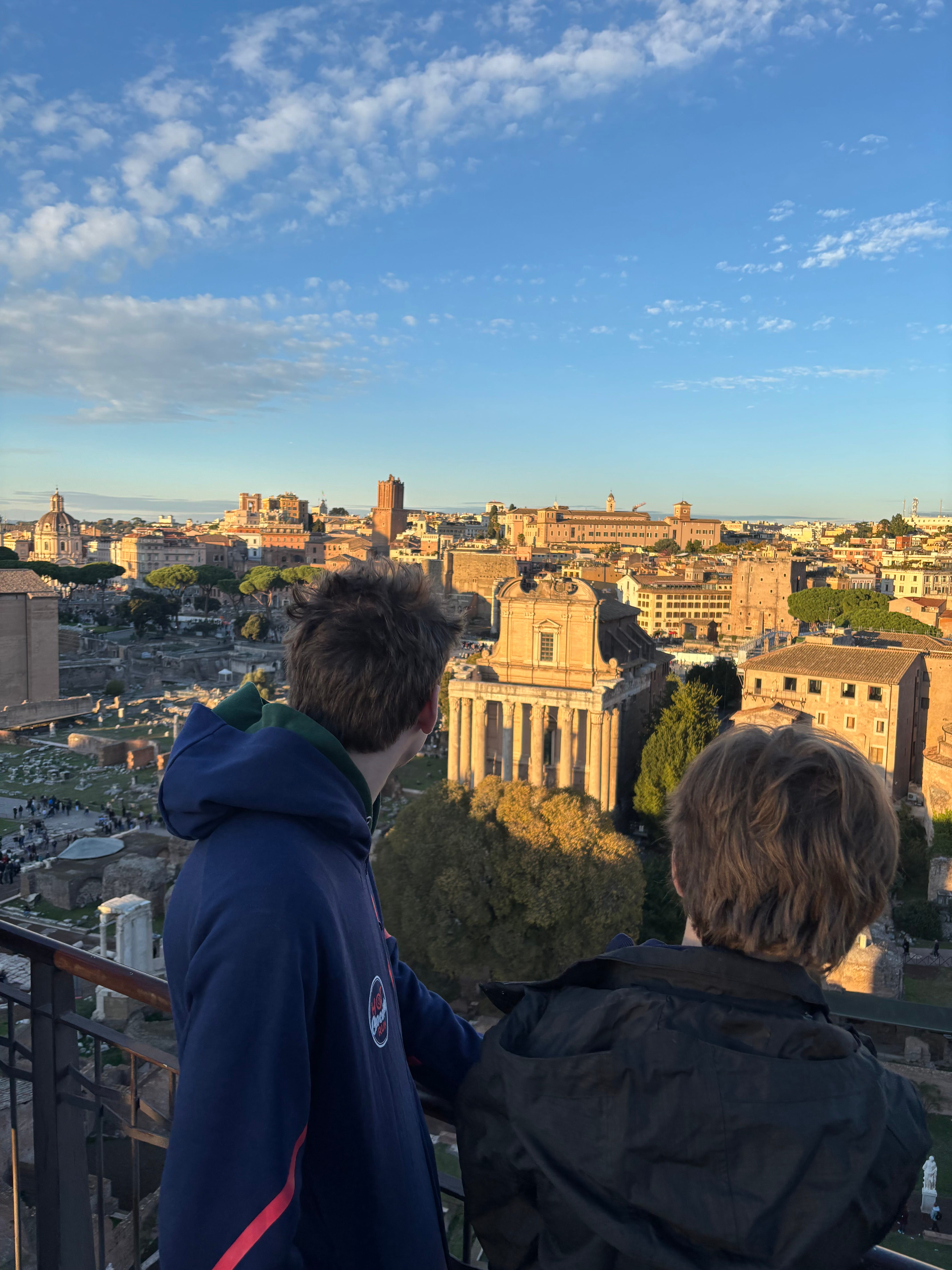
We had to hit the Colosseum and the Forum of course; one of the irritants of Rome is that its apex-predator tourist sites are legitimately great and shouldn’t be missed. Even within its footprint, the Forum park is too much to really take in. I couldn’t make a unity of them in my mind’s eye (maybe the museum, which we skipped, helps with this). Instead it was one fascination after another in a sequence that branched in every direction. Eventually we climbed to the Farnese palace on the Palatine, reaching the highest vantage point on the sheer side of the hill just as the evening light set the whole Forum aglow. Finally it all looked like a unity, even if it was only an aesthetic one. It was the hour of the influencers, whose omnipresence I would increasingly resent over the following days. But just then I barely noticed and didn’t mind.
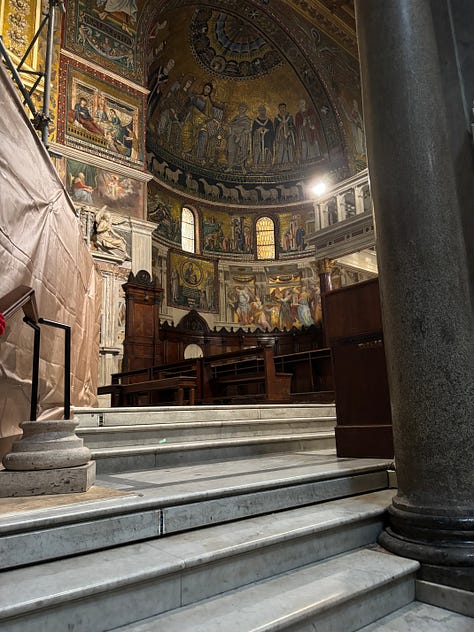
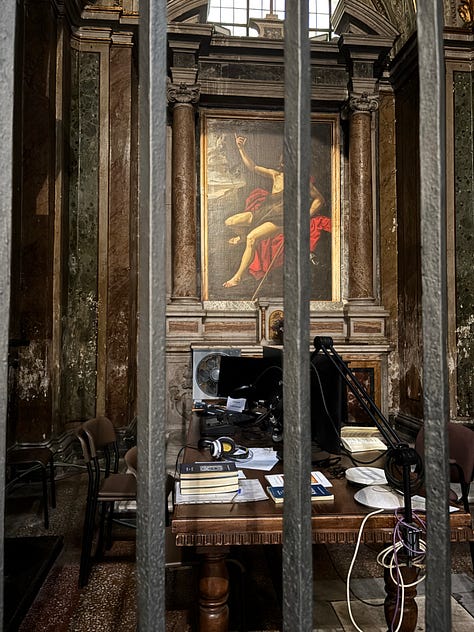
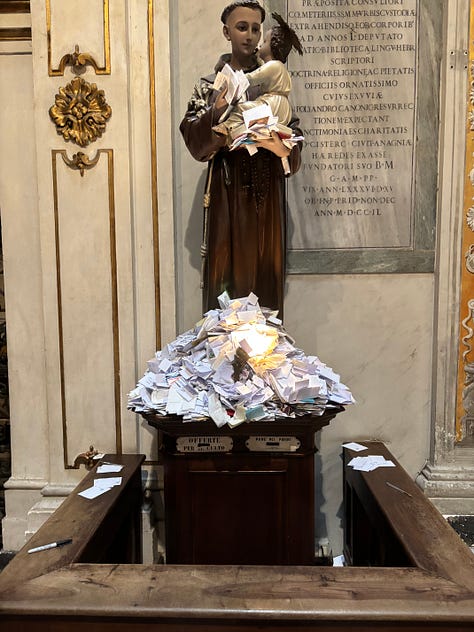
I had, at least, learned the lesson of crashing from church to church in Naples: in a landscape so crammed with sacred architecture, you have to narrow your focus. Skip the baroque piles and go for the older stuff. Santa Maria in Trastevere, west of the Tiber, offered a graciously proportioned space for me to say my morning prayers while kids on a school trip skittered boisterously here and there. The rather stern Byzantism of the mosaic behind the altar of Christ with—apostles? the number doesn’t look right but I didn’t check who it is—counterpoints the ring of sheep below them. A statuary saint was snowed in with written requests. One of the unused side chapels has evidently been converted into a workspace of some kind. I thought of this as the Chapel of St. Josh the Podcast Producer. Signs of life. Which may not be signs of holiness. But there’s no holiness without life.
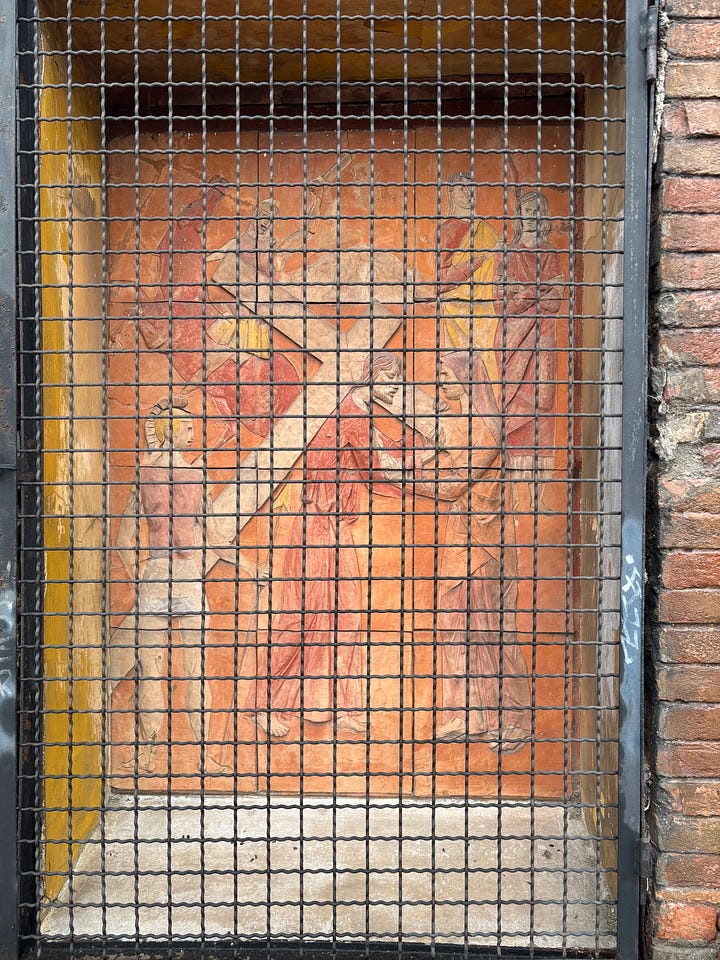
My oldest had walked far north and up into the forest of the Janiculum Hill by the time I was ready to leave. We arranged a meeting spot, and my phone suggested a fairly direct route up a side street from Trastevere's main drag. This route took me by a spiritual-sounding brass plate that could have fronted for a lovely lay apostolate or a total cult or something else and a local headquarters of the Rome streets and sanitation department. Unfortunately, there the road stopped, with not even an informal footpath through or around the walled-in dead end. No matter. There was a parallel street with quite clear paths leading up the hill from its end. When I arrived, however, these paths turned out to be behind a gate in a…university research facility? My Italian allowed me to ask the question but not to understand the answer. The three young people—it seemed that every closed door and every ticket booth in Italy had a minimum staff of three—were friendly about refusing me passage up the hill, directing me to another street. The third and final dead end of my journey was very much my own fault, as I deviated from their suggested course for one that seemed more direct but brought me into a fully closed street. At last I picked my way around the hill’s southern flank and up a stair lined with the Stations of the Cross and crowned with a little, seemingly abandoned church building.
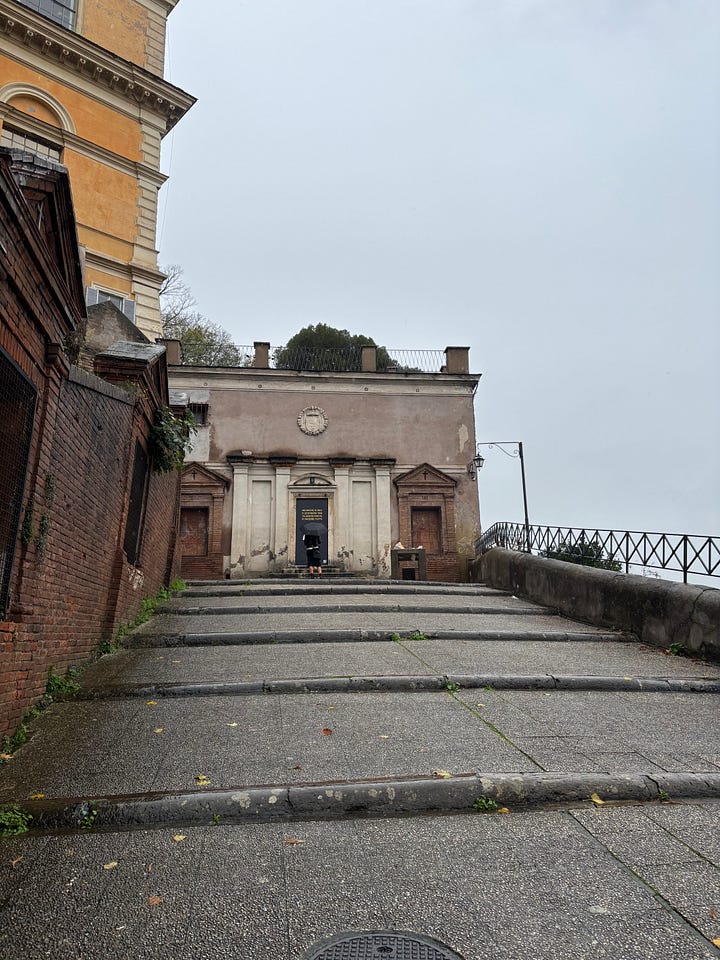
Around another corner, up a few more steps, and there I was, at the fountain we’d agreed upon. Now we just had to make our way back down the way we’d come to meet the rest of the family at the Pantheon. It was 11:30 a.m. All of this looks a lot easier in Roman Holiday.
One gets inveigled a lot in Rome, especially around the Termini station and the Forum. I can hardly object to begging, not that it would matter if I did, but I will admit to a resentment of being hustled. A Senegalese man tried French with me, which worked well enough that he switched to English, told me about his wife, and in a transparently false gesture of friendship, offered me a bracelet. Having some sense of how hard it might be to extract myself from the social and emotional morass of such a gift, I resolutely refused it and kept moving. This proved to be useful practice. Some say the universal language is music, some say it is laughter, but I know the truth: the universal human language is the way my face says, to all people in every culture, “try to get this guy’s money.” The tavola touts who front every tourist-district establishment have an eye for me, too, and likewise trigger my unhappy mix of pity and resentment at being appealed to.
This became an unconscious template for my experience of Rome. I loved the caged-in stations of the cross and the diffident tile-faced Christ but was resistant to the religious and civil monuments that were at once materially rich and emotionally mendicant. “How can you resist this?” the Baroque visual aesthetic asks, and I’ve only gotten more practiced at rejecting it.
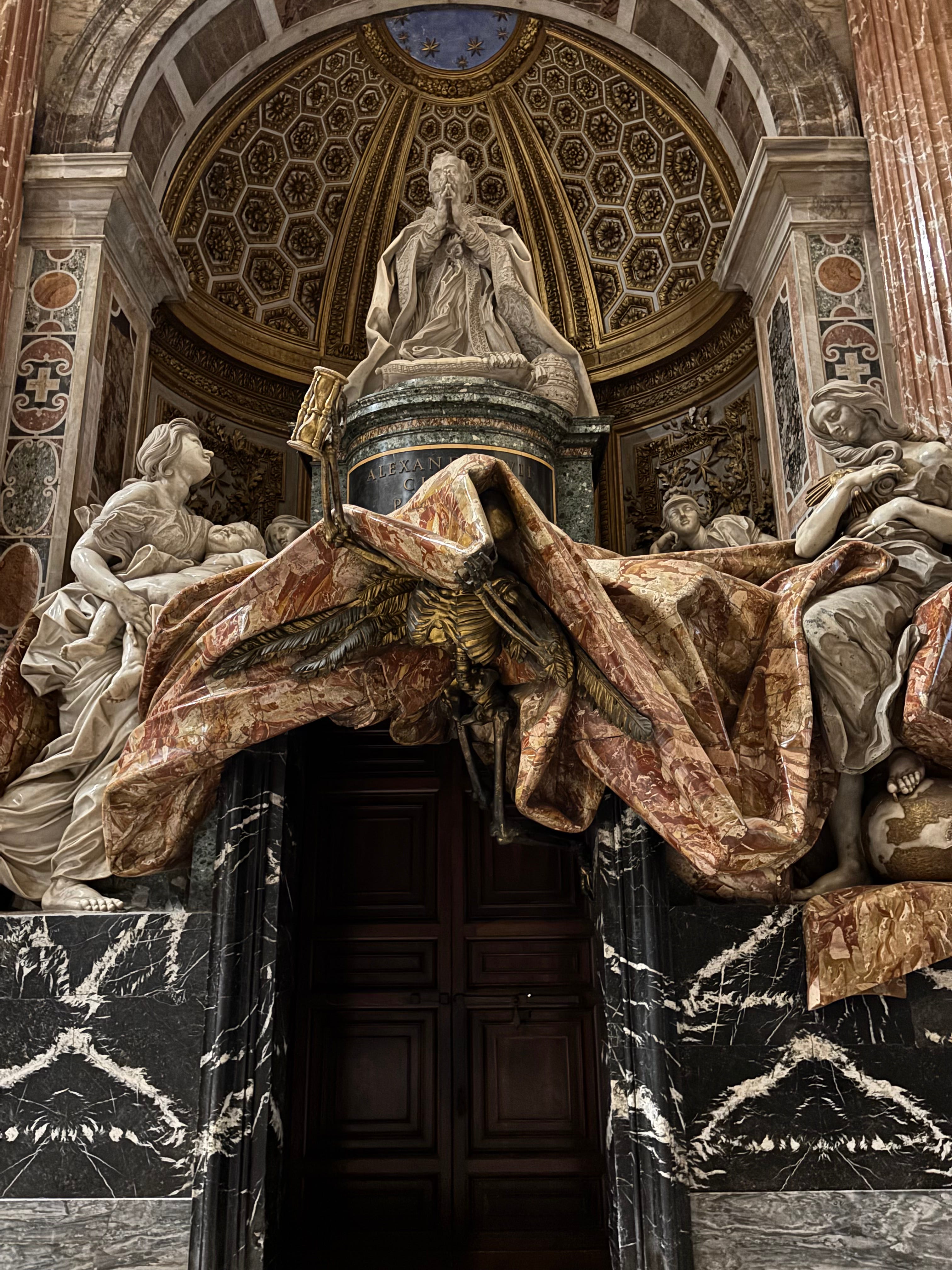
We did make it to St. Peter’s, and while I could not for love or money manage to book a ticket to the Vatican museums online (which sell out even in the November drizzle), we toured the interior and climbed the dome. That the whole experience feels a bit Disneyish is the fault of people like me, of course; the groups of pilgrims with their crosses deserve to have the place to themselves. But apart from them, I struggled to feel any draft of sanctity. If, at noon, instead of an Angelus, the sound system played “Friends in Low Places,” it wouldn’t have felt out of place to me. Even marble reaches a point of diminishing marginal aesthetic returns. Though the papal tomb with the skeleton and the hourglass reaching out from the marble shroud is pretty metal:
Ascending the dome is another matter. At the first landing, you have to go halfway around the dome’s interior, and even at that point, probably less than halfway to the top, the clergy, worshipers, and tourists below are reduced to abstract dots. I am not great with heights but before I turned my eyes toward the space in front of my feet, I had to try to take it in. From there, the walls of the stairwell start following the curve of the dome, and you’re walking at an awkward angle, higher, ever higher, a temporally negligible visitor not just to a four-hundred-year-old mother church of the largest communion of Christians in the world, but to the ziggurat-climbing impulse that’s as old as civilization itself. When you reach the cupola at last, the whole city opens below you at a stupefying distance. Its greatest treasures are all hidden—its underground fourth-century basilica atop a first-century city block, its tense and muscular Caravaggios, its gracious courtyards and unused shrines—but you know that they’re down there.
The February issue of the Christian Century has my review of this book, which was written before the 2024 election but directly addresses some of the questions it raised among progressives.
In fairness, Williams offers an answer: the problem is that Democrats embraced something called “neoliberalism”….
This is, fortunately or not, wrong. The postwar economy is an illusion of retrospect. Union power peaked early after the war and went into decline thanks to legislation passed over the veto of Harry Truman. Most people didn’t work in factories, and factory jobs would have changed, ended, and moved around the country because of new technology and wage differences even if no trade deals had ever been signed. What people left and right like to disparage today as neoliberalism was not a coherent policy program but a set of emergent adaptations to the inevitable unwinding of the conditions that prevailed between the end of the Second World War and the 1973 oil crisis….
“People want, and deserve, family-sustaining jobs near where they grew up,” Williams argues. But consider what it would mean for an economy never to require mobility, or new or more advanced skills. This is the conservatism of stasis and slow decay offered by figures like Wallace and Buchanan, who leveraged the inevitability of social and economic change against people who disliked it. And if you concede that populist conservatives are fundamentally correct about the economic problem, you’ve already lost.
I think the book (and, if I may say so, my own largely critical review of it) are relevant to the debates among liberals and leftists. But I read the book and wrote the review back in June, and seeing it in print now felt like opening a time capsule. From the election campaign through the “Liberation Day” tariffs, there were competing but somewhat plausible claims about what the administration could or would do to reorient economic policy. Oren Cass and other anti-trade economists wanted us to repatriate toaster-assembly jobs, moving the American workforce down the value chain and making the economy as a whole smaller but providing the kinds of jobs people think Americans all had before the 1980s. People in the administration talked about a “Mar-a-Lago Accord” (remember that?), a hazy program of exchanging security guarantees to other countries for market access and dollar depreciation. There was a lot of talk about re-shoring and manufacturing jobs and so forth.
All of that appears to be over. No one in that world seems particularly concerned that manufacturing employment is declining or that China is moving into a dominant position in green energy, batteries, and advanced manufacturing. The tariffs and trade wars have been used arbitrarily, often as part of minor diplomatic or even personal spats rather than as part of any real plan to revive declining industrial sectors. There’s a lot of rent-seeking and policy graft (forcing the military to buy coal, for instance) but the only bet our country’s leaders seem to be making is on AI advancement and deployment. That and the intense, and on the margin economically destructive, immigration crackdown is really all there is. Even at Davos they couldn’t articulate a goal or emergent order beyond threats and dominance plays for short-term concessions. It’s like watching a mafia boss with short-term memory loss.
It’s usually a mistake to seize on recent trends or rhetorical choices and build a whole approach to politics around them. And it’s especially a mistake to do that in this moment, when both policy making (such as it is) and political communications are built by the administration as though they are episodes in a television series or ideas in an online discourse cycle. Things never go as the victors plan, and that’s especially true when the victors haven’t really planned. Ross Douthat wrote a column recently explaining that liberalism can’t really manage the vice economy, which is true enough, and claiming further that “post-liberalism” of the trad Catholic or “Christian Nationalist” variety had resources to do so, which is patently false. The post-liberal regime is here, and it’s run by the most degenerate people who’ve ever governed the U.S. The vice economy, especially in the gambling and financial fraud space, is stronger than it’s ever been, and it’s never been more obvious that the people responsible for pushing a re-moralization of American life simply don’t believe in any of what Douthat wants them to sell. Christian “post-liberalism” is just branding, a sin license for people who want the capacity for punishment but not for virtue.
All that remains of the 2024 collage is the tech elite and the white supremacists. Their priorities are protected at all costs. Everyone who daydreamed about anything else—toaster factory jobs, a smaller trade deficit, an improving fiscal position, a Catholic theocracy, whatever—is left holding a bag.
The Velasquez portrait of Pope Innocent X has its own little room and is awesome to see up close.
Yes, the sons (Pieter the Younger and Jan) spelled the last name differently than the father, who himself changed the spelling of his name by removing the h. Early modern naming conventions are maddening.
No posts
Comments
Nothing yet. Say the first thing.
Sign in to join the conversation.