
Introduction
hasManyThrough lets a Laravel model access many related records through an intermediate model.
The cleanest example is:
- a project has many environments
- an environment has many deployments
- so a project has many deployments through environments
That is exactly the kind of relationship hasManyThrough is for.
If you try to learn this from abstract examples alone, it feels harder than it is. So this guide sticks to one concrete schema from start to finish.
When hasManyThrough is the right relationship
Use hasManyThrough when:
- model A has many model B
- model B has many model C
- you want model A to access many model C records directly
That means:
Project -> Environment -> Deployment
Here is the relationship visually before we get into the code:
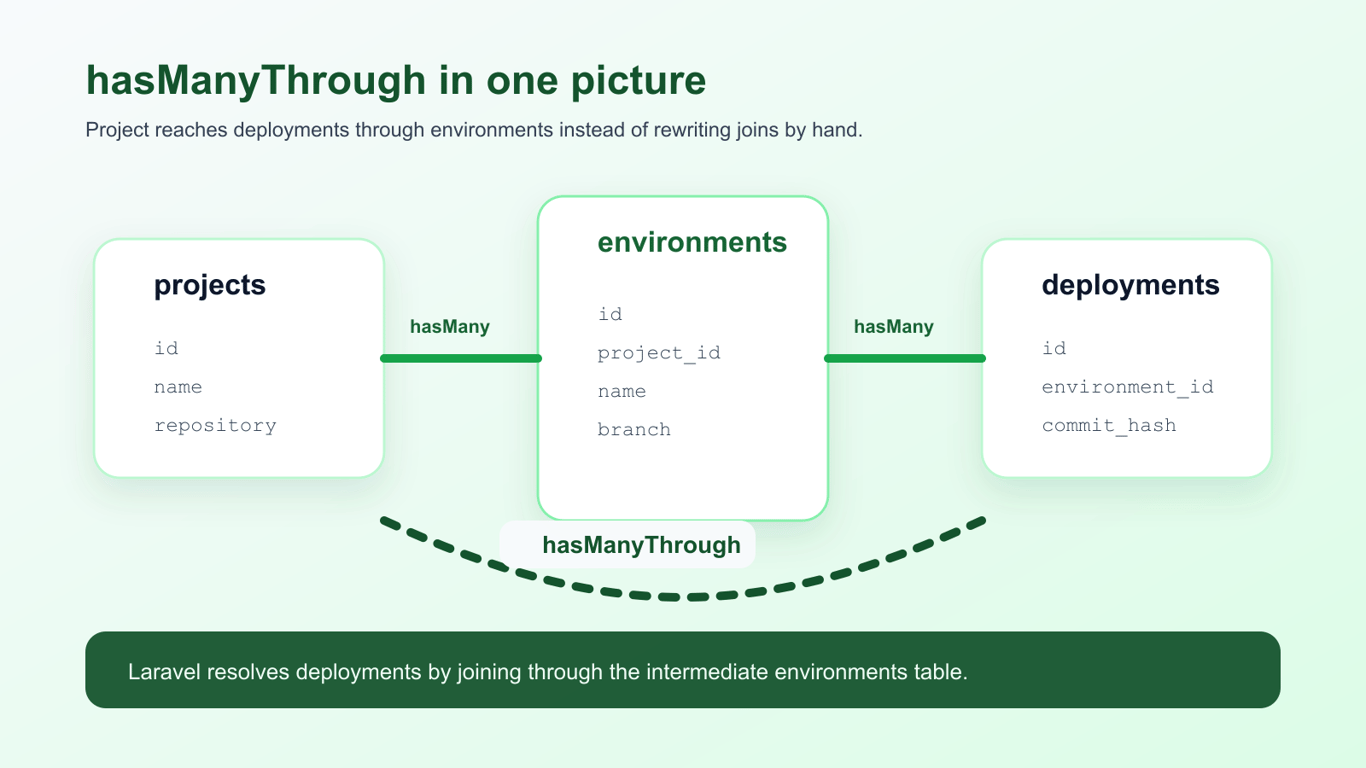
So from Project, you want:
$project->deployments
without manually joining tables every time.
The example schema
Here is the mental model:
projects
- id
- name
environments
- id
- project_id
- name
deployments
- id
- environment_id
- commit_hash
- created_at
Relationships:
- one project has many environments
- one environment has many deployments
- one project has many deployments through environments
Define the base relationships first
Before adding hasManyThrough, define the two simpler relationships normally.
Project has many Environment
use Illuminate\Database\Eloquent\Model;
use Illuminate\Database\Eloquent\Relations\HasMany;
class Project extends Model
{
    public function environments(): HasMany
    {
        return $this->hasMany(Environment::class);
    }
}
Environment has many Deployment
use Illuminate\Database\Eloquent\Model;
use Illuminate\Database\Eloquent\Relations\HasMany;
class Environment extends Model
{
    public function deployments(): HasMany
    {
        return $this->hasMany(Deployment::class);
    }
}
Define hasManyThrough
Now add the through relationship on Project:
use Illuminate\Database\Eloquent\Relations\HasManyThrough;
class Project extends Model
{
    public function deployments(): HasManyThrough
    {
        return $this->hasManyThrough(
            Deployment::class,
            Environment::class,
        );
    }
}
That is the simplest version.
Laravel can infer the conventional foreign keys here:
environments.project_iddeployments.environment_id
Query through the relationship
Once the relationship exists, you can query deployments straight from the project:
$project = Project::findOrFail(1);
$deployments = $project->deployments;
You can also keep chaining query conditions:
$deployments = $project->deployments()
    ->latest()
    ->limit(10)
    ->get();
That is the main benefit of the relationship: you stop rewriting the same join logic by hand.
What SQL idea is Laravel representing?
Conceptually, Laravel is doing the equivalent of:
select deployments.*
from deployments
inner join environments on environments.id = deployments.environment_id
where environments.project_id = ?
You do not need to write that SQL yourself every time because the relationship already captures it.
Custom keys in hasManyThrough
If your schema does not follow Laravel’s default naming convention, pass the keys explicitly.
The full signature looks like this:
return $this->hasManyThrough(
    Deployment::class,   // final model
    Environment::class,  // intermediate model
    'project_uuid',      // foreign key on environments
    'environment_uuid',  // foreign key on deployments
    'uuid',              // local key on projects
    'uuid',              // local key on environments
);
That is the version to use when:
- your foreign keys are non-standard
- you use UUID columns
- you inherited a schema Laravel cannot infer cleanly
For conventional schemas, keep the simpler version. It is easier to read.
The newer through()->has() syntax
Laravel also supports a fluent way to define this relationship when the intermediate relationships already exist.
Example:
return $this->through('environments')->has('deployments');
Or using the dynamic syntax:
return $this->throughEnvironments()->hasDeployments();
This is nice when the base relationships are already clear and you want the through relationship to read more declaratively.
If your team is not familiar with that syntax yet, the classic hasManyThrough() call is still perfectly fine.
Common pitfalls
Skipping the intermediate mental model
If the relationship does not make sense as:
A has many B
B has many C
therefore A has many C through B
then hasManyThrough is probably not the right relationship.
Using it when you really need many-to-many
If the middle table is a pivot table and both sides can belong to many records, this is not a hasManyThrough problem. That is usually a belongsToMany() relationship instead.
If that is the actual shape, this Laravel pivot table guide is the right article.
Getting custom keys wrong
Once you leave Laravel’s naming conventions, the argument order matters. This is the main place people trip up.
When that happens, go back to the schema and write down:
- foreign key on the intermediate table
- foreign key on the final table
- local key on the parent table
- local key on the intermediate table
Then map each one carefully.
A practical use case
Here is the relationship in action for a deployment screen:
$deployments = Project::query()
    ->with(['deployments' => fn ($query) => $query->latest()])
    ->findOrFail($projectId)
    ->deployments;
That gives you the project’s deployments without loading environments separately in your controller code.
This is the kind of place where hasManyThrough improves clarity: the relationship belongs in the model, not scattered across query code.
When not to use hasManyThrough
Do not force it when:
- a plain join is clearer for one-off reporting
- the relationship is actually many-to-many
- the chain between models is more complex than one intermediate model
The goal is maintainable code, not using the fanciest relationship type available.
Conclusion
hasManyThrough is easier than it looks once the example is concrete. If a project has many environments and each environment has many deployments, then a project has many deployments through environments. That is the whole idea.
Start with the base relationships, add the through relationship, and only reach for custom keys when the schema truly needs them.
If you are still tightening model relationships after this, these are the next reads I would keep open:
Comments
Nothing yet. Say the first thing.
Sign in to join the conversation.