
When people tell me they hate chocolate cake, I can’t help but look at them sideways. What’s not to like? Chocolate cake comes in all sorts of varieties and there’s something to suit every occasion or mood. You could go more rich and intense, or opt for something sweeter and lighter. Or flourless and fudgy or layered up with buttercream. Chocolate can be paired with what feels like an infinite number of other ingredients; anything from hazelnuts, cherries or coffee to cardamom, custard, passionfruit and vanilla. The list truly goes on and I think there’s a chocolate cake for everyone out there.
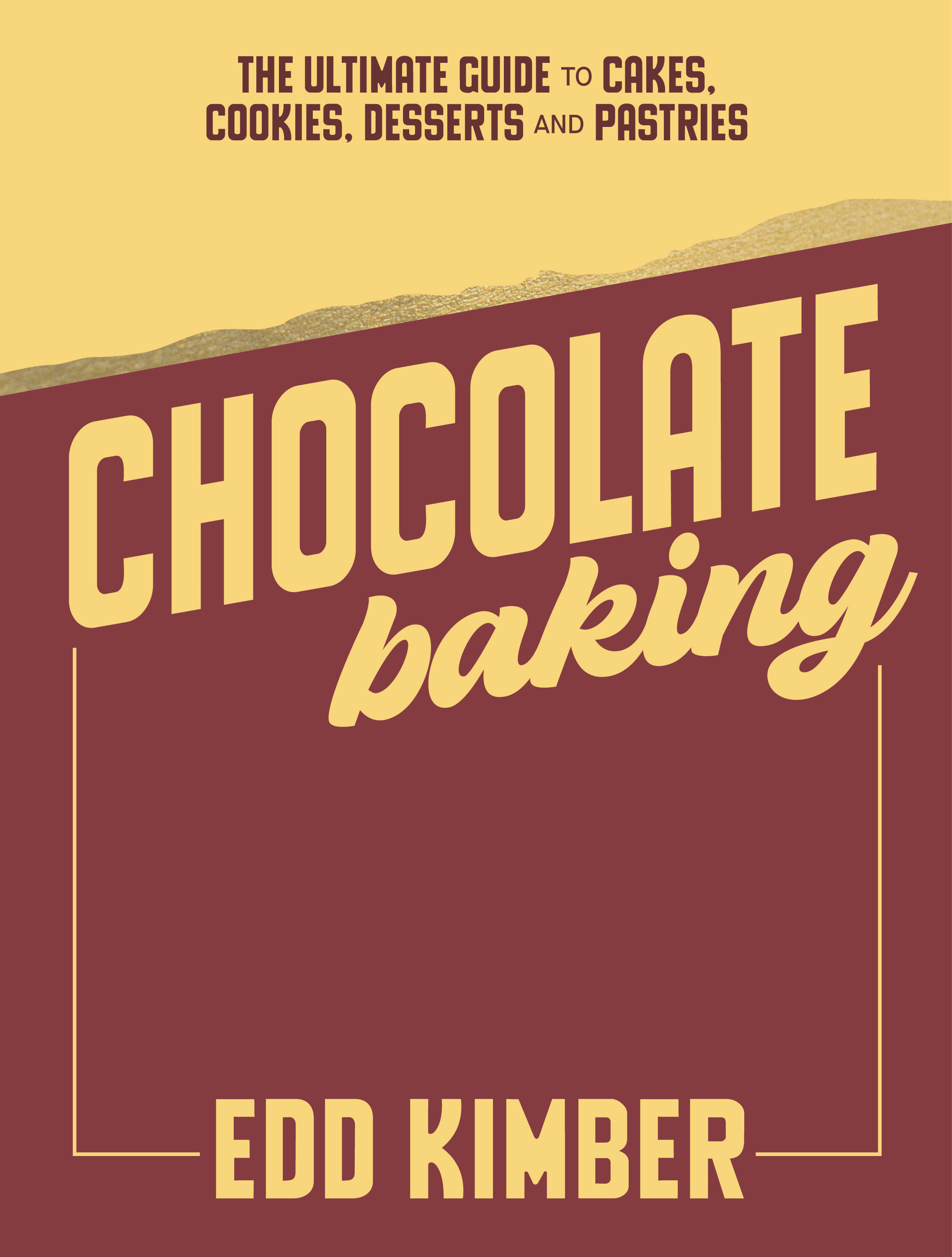
Few people might enjoy baking with chocolate more than Edd Kimber and he’s back with his 8th (!) cookbook, Chocolate Baking to show you all the wonderful things you can do with it. If you’ve ever baked one of Edd’s recipes, you’ll know that they always just work. It’s not often I get the time to bake other peoples recipes for fun but when I do, Edd’s Instagram, Substack or cookbooks are ones that I’d turn to.
Edd has kindly shared one of his new recipes with us here at Sweet Things. It’s a real classic that I think you’ll all enjoy, chocolate lover or not.
Benjamina x
I caught up with Edd to ask him a few questions about his latest book!
I actually wanted to write this book for many years. I even pitched it around town a few years ago but it was rejected, one publisher even told me told me ‘baking is over’ but I always believed the concept had legs so I put the idea to the back of my head and knew I’d revisit it one day. Chocolate is my all time favourite ingredient to work with and I wanted to share that love and obsession with a bigger audience. I’ve also thought of my books as answering a question or helping with a problem and so with chocolate I didn’t want to simply write some delicious recipes I wanted home bakers to understand chocolate and learn to use it with confidence.
From a purely technical point of view this was different because I wrote it over a longer period of time and unlike my last few books I decided not to photograph or style it myself but to work with a brilliantly creative team. Because the subject of the book is a single ingredient I tried extremely hard to make sure the balance of flavours is interesting and varied but also covers everything that makes chocolate special. I think a lot of times when people heard I was working on a chocolate book they expected recipes that were simply dark chocolate, like a chocolate cake, a chocolate cookie, a brownie etc but I wanted to show chocolate is a broad and expansive topic. Like with all of my books I also try to include recipes of all skill level so that you can enjoy it no matter your experience level.
Firstly, it is important you are actually buying real chocolate and not a ‘coating’ or a ‘melt’. These products are often made with ingredients not found in chocolate like oils and flavourings that will affect how a recipe works but most importantly how it tastes. Unfortunately, in some countries, there is confusion in the market and these products are considered to be actual chocolate.
Dark chocolate should only ever include a few basic ingredients; cocoa (cocoa mass/cocoa liquor/cocoa butter) and sugar. Additionally, many larger chocolate manufacturers use an emulsification ingredient such as soy or sunflower lecithin. When it comes to milk chocolate you’ll also see milk powder listed. White chocolate is different in that there is no cocoa solids just cocoa butter mixed with sugar, milk powder and very commonly vanilla. If your chocolate is made with ingredients like palm oil or hydrogenated oils this is not actually chocolate and shouldn’t really be a part of your baking arsenal.
My preferred way to buy chocolate for baking is to buy it in bulk either direct from a chocolate company or from a chocolate wholesaler. Generally you get a much higher quality product and it is cheaper than buying bars of chocolate in the supermarket.
But, most important is that you enjoy the taste of the chocolate. Adding it to a cake batter wont magically transform the flavour; if it tastes good going in it’ll taste good baked into a cake. This is especially true when the chocolate is a ‘mix-in’ and the flavour is pure, like in a cookie or in a ganache. In these cases you really want to use a chocolate you absolutely adore. We are lucky that any supermarkets now have pretty decent bars of chocolate on their shelves and have leaped ahead of the baking brands you might once have favoured.
In terms of brands that you’ll most commonly find in my kitchen;
Guittard - this is my go to chocolate brand for baking, especially their wafers which I bake with extensively
Pump St Chocolate - a brilliant British bean to bar chocolate maker. Their pastilles are brilliant in all manner of baking recipes.
Islands Chocolate - another British chocolate maker, the chocolate spread they make is particularly good and a great alternative to to Nutella
Valrhona - the go-to French chocolate brand, it’s expensive but they make some amazing chocolates, I’m a big fan of their caramelised white chocolate Dulcey
Milk, Dark or White Chocolate? All of the above!
Favourite Bakery? That’s like asking me to choose a favourite child. I just did a pop-up at Lannan Bakery in Edinurgh so that beautiful bakery is front of mind right now. If you’re asking for London bakeries then the list would include Quince, Populations Bakery, Dusty Knuckle, Toad, Finks (and the list goes on and on)
Go to chocolate bar? If we are talking just to eat, I would say the 43% milk chocolate with cocoa nibs and smoked salt from Duffy’s Chocolate is a definite favourite. If it’s to bake with one of my favourite milk chocolate’s is Soleil D’Or from Guittard.
Favourite ingredient to pair with chocolate? Milk chocolate and tonka bean is a favourite as is milk chocolate and passion fruit.
If you had to eat one recipe from Chocolate Baking everyday for a year, what would it be? Probably the chocolate and whipped caramel cake, it’s an absolute favourite to make and to eat.
Chocolate Baking by Edd Kimber (Quadrille, £28) is out now.
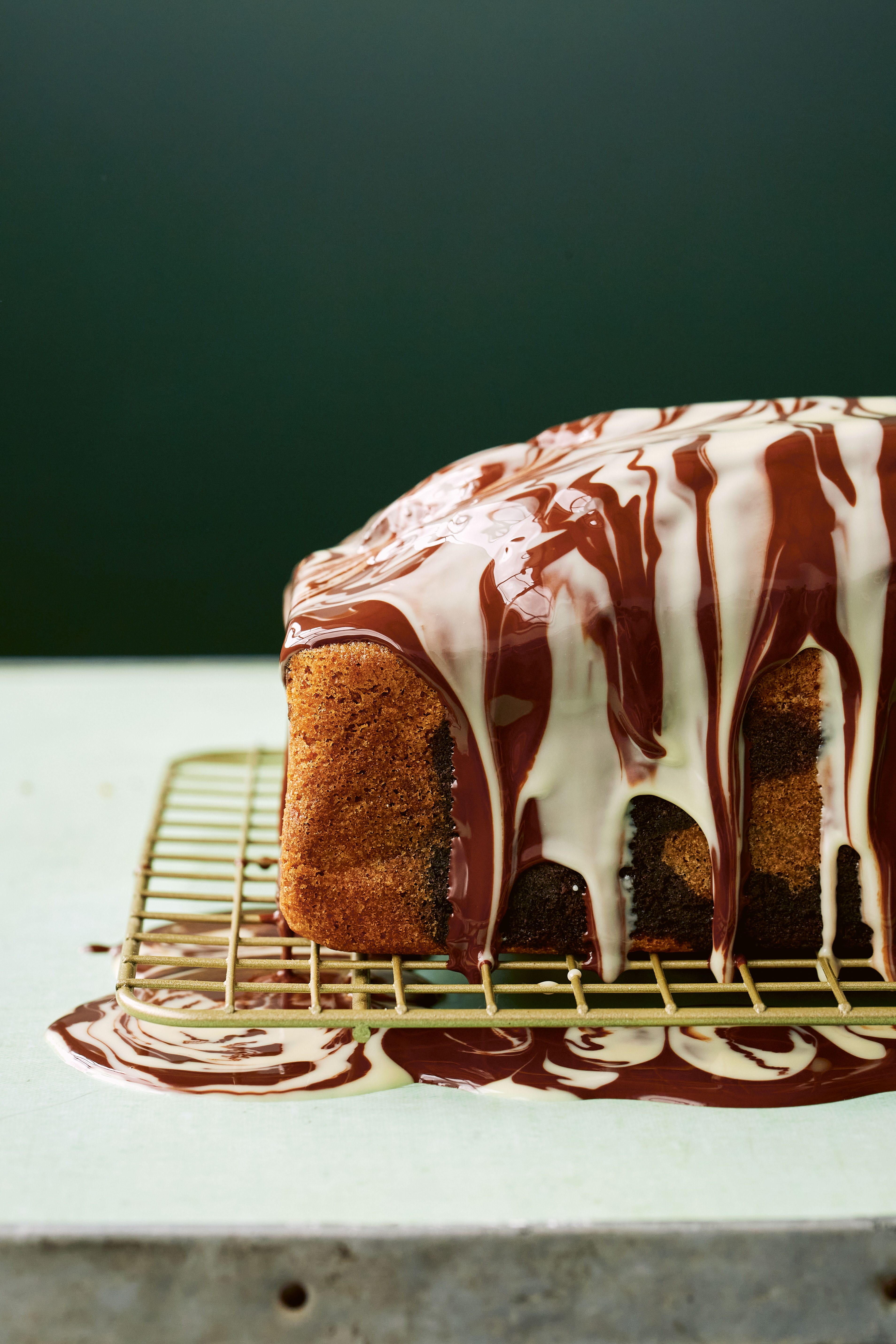
A marble cake with a bonus marble glaze, as beautiful in flavour as it is in appearance. The cake itself is very straightforward, a one-bowl batter that is then split in two so that cocoa powder can be added to half. Once baked, it needs nothing more than melted chocolate, mixed with a little oil, poured randomly over to create an almost zebra-like effect.
serves 10
2 tablespoons cocoa powder (dutched or black)
2 tablespoons boiling water
170 g (1½ sticks) unsalted butter, room temperature
175 g (¾ cup + 2 tablespoons) caster (superfine) sugar
2 large eggs, lightly whisked
220 g (1¾ cups) plain (all-purpose) flour
1+ ½ teaspoons baking powder
¼ teaspoon bicarbonate of soda (baking soda)
½ teaspoon fine sea salt
100 ml (⅓ cup + 1 tablespoon) buttermilk
1 teaspoon vanilla extract
For the Marble Chocolate Glaze:
125 g dark chocolate (65–75% cocoa solids), roughly chopped
100 g white chocolate, roughly chopped
30 ml (2 tablespoons) vegetable oil, divided equally
(Note: I often bake this in a 23 x 10 x 10 cm (9 x 4 x 4 in) pullman loaf tin (pan), which has straight sides, which gives the cake an even more polished look.)
Preheat the oven to 180°C/160°C Fan. Lightly grease a 450 g (1 lb) loaf tin and line with a single long strip of parchment so that the excess paper hangs over the long sides of the pan, securing in place with a couple of metal binder clips.
To make the cake, in a small bowl whisk together the cocoa powder and boiling water until a smooth paste is formed. Set aside. Place the butter and sugar in a large bowl and use an electric mixer to beat together until light and fluffy, about 5 minutes. Add the eggs to the butter mixture a little at a time, beating until fully combined before adding more. In a separate bowl whisk together the flour, baking powder, bicarbonate of soda and salt.
With the mixer on low/medium speed, add the flour mixture to the butter mixture in three additions, alternating with the buttermilk and vanilla – starting and finishing with the flour mixture. Divide the batter evenly into two bowls and to one mixture, briefly beat in the cocoa paste.
Spoon both batters into the loaf tin, in a random pattern, then use a skewer to briefly swirl to create a marble effect. When swirling together, less is always more, too much swirling creates a less defined marbled pattern.
Bake in the preheated oven for about 45 minutes or until a skewer inserted into the cake comes out clean. Leave to cool in the tin for 15 minutes before using the parchment to lift the cake onto a wire rack to cool completely. Once the cake is at room temperature wrap in cling film and freeze for 30–60 minutes.
For the glaze, place the chocolates in separate small heatproof jugs and melt, using a microwave, then stir half the vegetable oil into each chocolate. Remove the cake from the freezer, unwrap, and place on a cooling rack set over a baking tray. Pour over about three-quarters of the dark chocolate glaze, covering as much of the cake as possible. Before it has a chance to set, drizzle over the white chocolate glaze, trying to create a marbled effect. Use the reserved dark chocolate glaze to create extra definition in the marbling and to fill in any uncoated spots on the cake. Lift the cake from the rack and set onto a platter. Allow the glaze to set and the cake to come to room temperature before serving.
Kept covered, the cake will keep for 3–4 days.
*This post contains affiliate links which means I earn a small commission when you purchase something, at no extra cost to you.
Follow me on Instagram and TikTok. Copies of all my cookbooks can be purchased here.
No posts
Comments
Nothing yet. Say the first thing.
Sign in to join the conversation.