
Time feels like an immutable fact of nature, but most of how we experience it is as a shared cultural hallucination. The ground truth may be tied to biology and the sun’s orbit, but the representations - clocks, calendars, daily planners - are manmade and how we actually structure our lives. Mine for instance is measured in thirty-minute chunks, oscillating between the dual tyrannical hands of Calendly and Pomodoros.
While it’s nearly impossible for me to imagine a world that doesn’t default to a twenty-four-hour clock, our current system - equinoctial hours of fixed, equal length - is relatively new. For a long time, medieval Europe ran on canonical hours, named blocks of times, each dedicated to a particular activity.
The custom has its roots in Judaism, where Jews prayed at the Second Temple at fixed times of days. Early Christians continued the habit, praying at the third, sixth, and ninth hours (roughly 9am, noon, and 3pm), and then later added prayers at rising and before sleep.
The decisive codification of canonical hours came with St. Benedict of Nursia, whose Rule (c. 540 AD) laid out a schedule that would run monastic Europe for a thousand years. Matins in the night, Lauds at dawn, then four “little hours” of Prime, Terce, Sext, and Nones through the working day, Vespers at sunset, and Compline before bed.
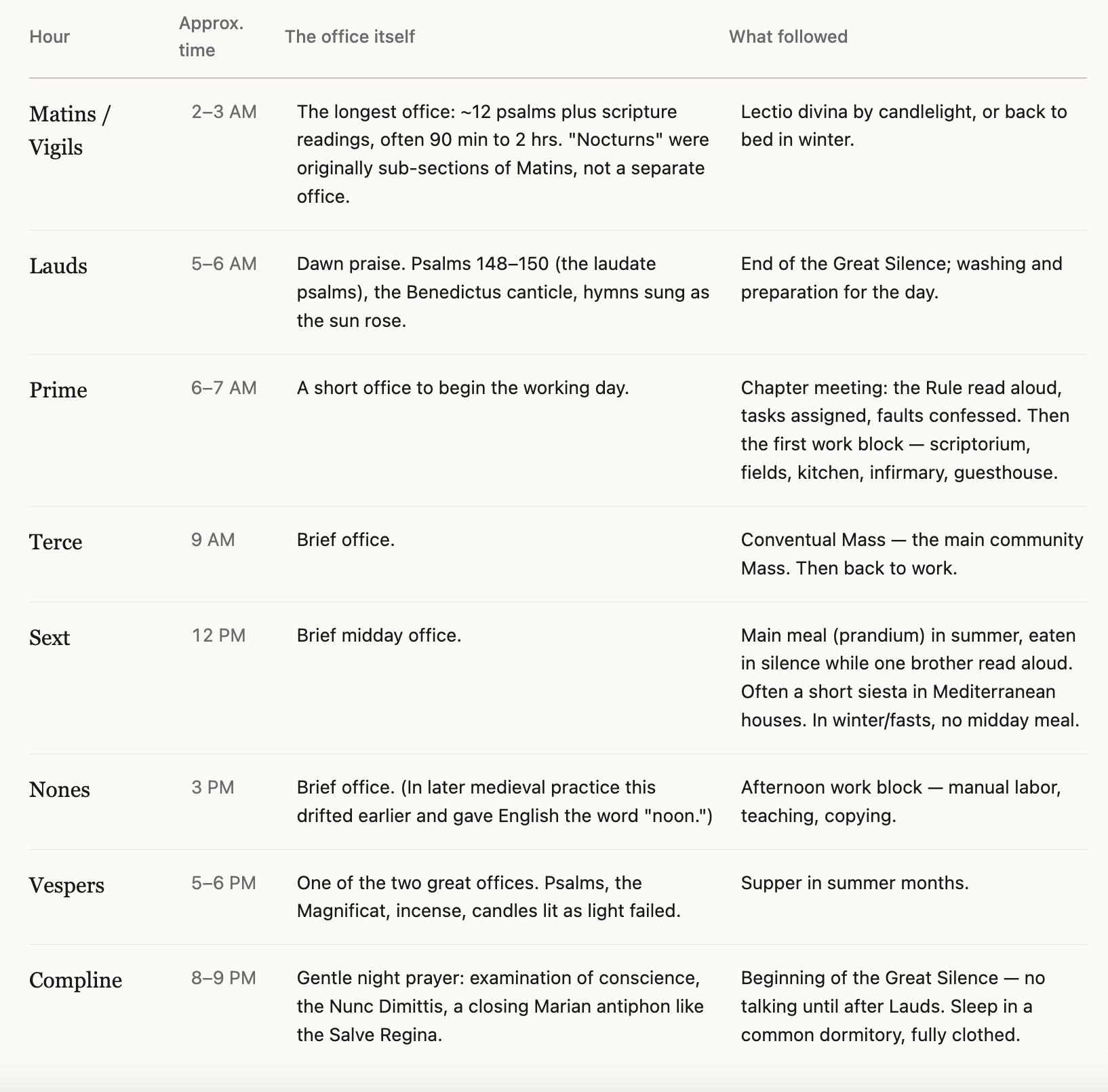
Benedict derived the schedule from Psalm 119 - “seven times a day I praise you” and “at midnight I rise to praise you”. This was popularized beyond monasteries via books of hours, personalized medieval prayer books designed for laypeople, which were bestsellers1 in the late Middle Ages.
It's easy to forget what an achievement this was: a shared rhythm of life running across a continent coordinated by bells and sun and repetition.
I learned about canonical hours as I learned about most medieval facts - through video games.2
Pentiment is a role playing game where you play as a medieval illustrator in 16th century Bavaria. . You play Andreas Maler, a journeyman painter working in the scriptorium of a rural abbey, reproducing illustrated manuscripts and creating the work which will obtain you the rank of master, aka a ‘masterpiece’.
To mark the passage of time the game uses a clock based on the canonical hours.
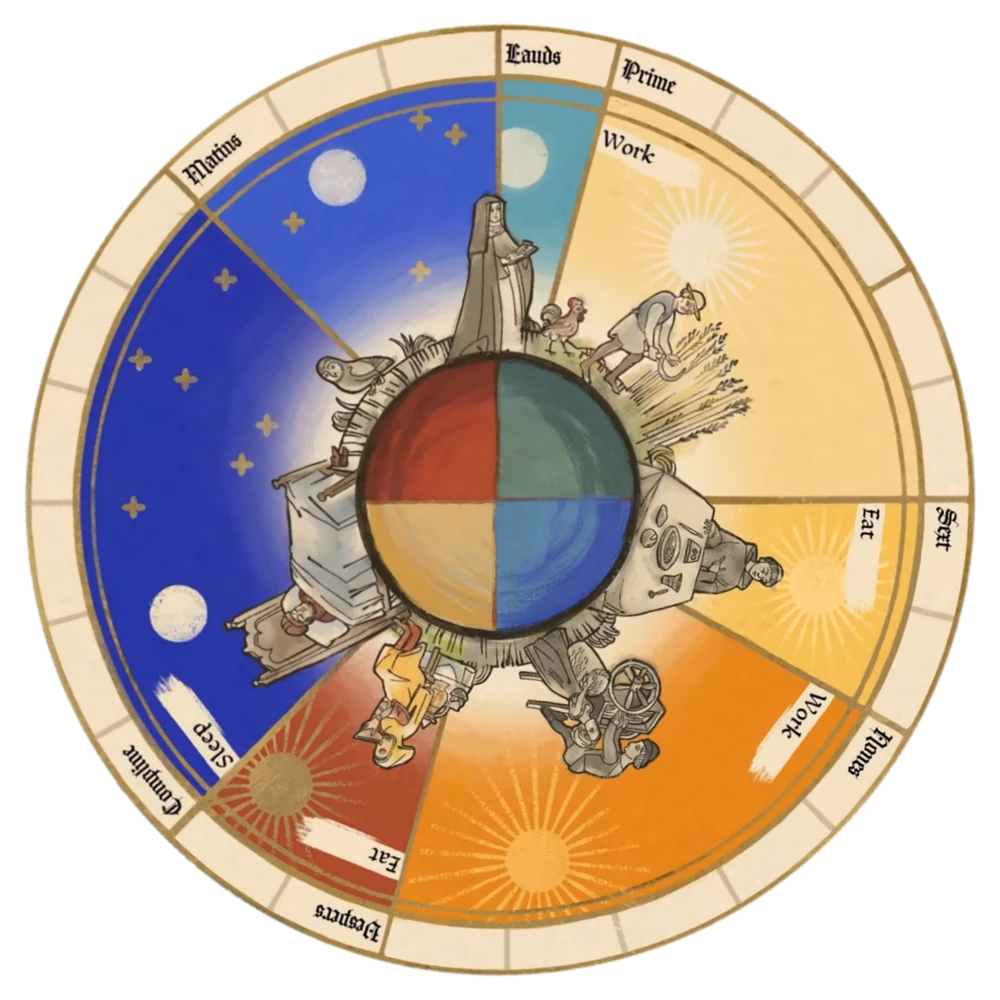
This visual has really stuck with me; I appreciate a schedule that reflects the true rhythm of a day, paired with a collective orientation towards the work that matters most. My cultural milieu has yet to develop a defined rule of hours for holy work - maker schedule, manager schedule comes close - so instead I made my own3.
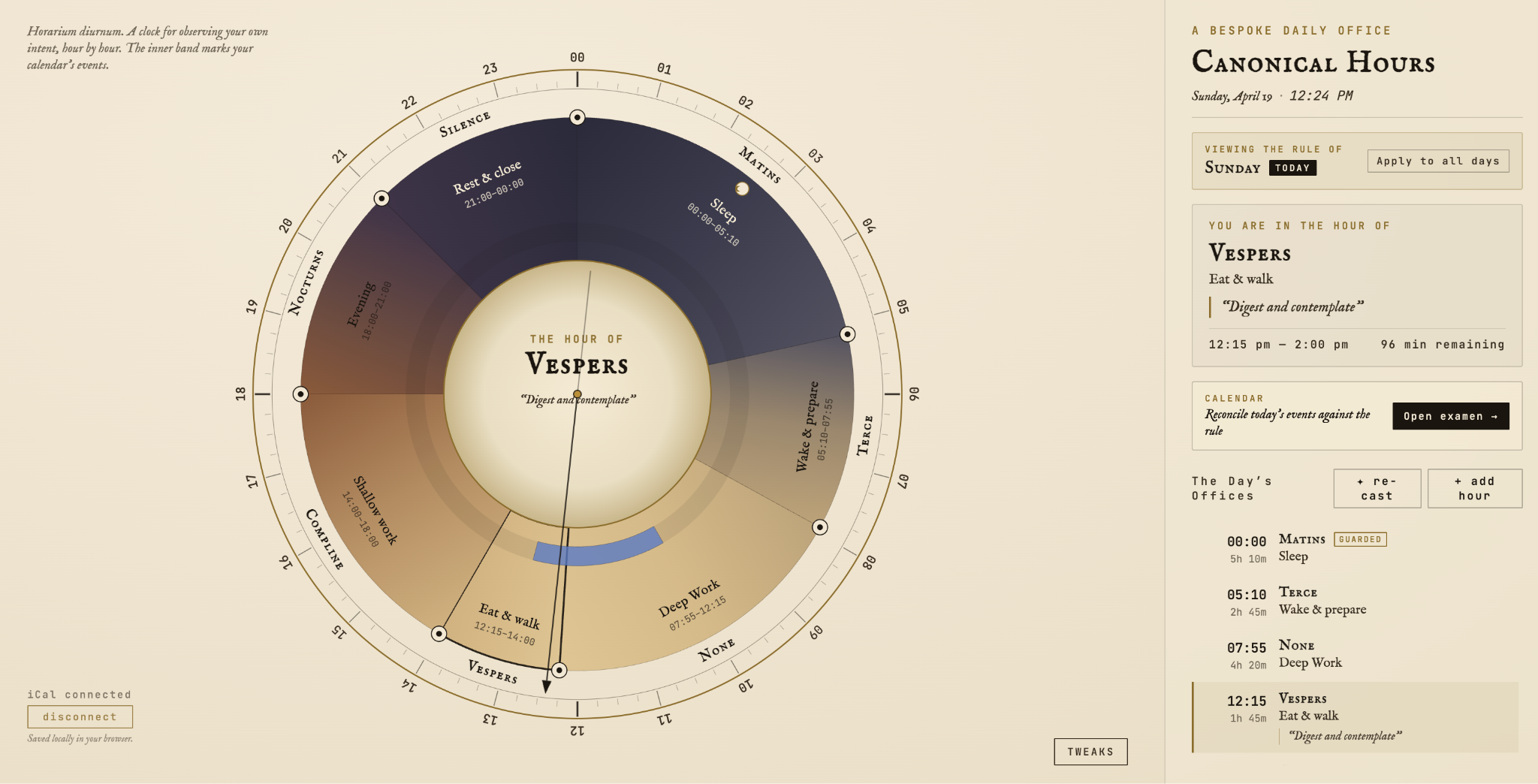
I spent Friday vibecoding an app which creates a personal Rule of hours - in the Benedictine sense - for how to spend your time.
It opens with a reflective examen, a Jesuit practice of reviewing your day for where attention and intention diverged, and then generates an initial six to eight blocks of time. You can customize them, adding or removing rules and dragging the boundaries, and also set your intention or prayer for the block.
Adding your calendar connection will pull your events and display them on the interior ring; you can then consult an oracle (Claude Haiku) to discern whether the events are aligned with your rule’s intention.
Find that you are being distracted by ungodly influences? You can guard your time during the rule which will create a recurring weekly calendar event to block other events from being scheduled.
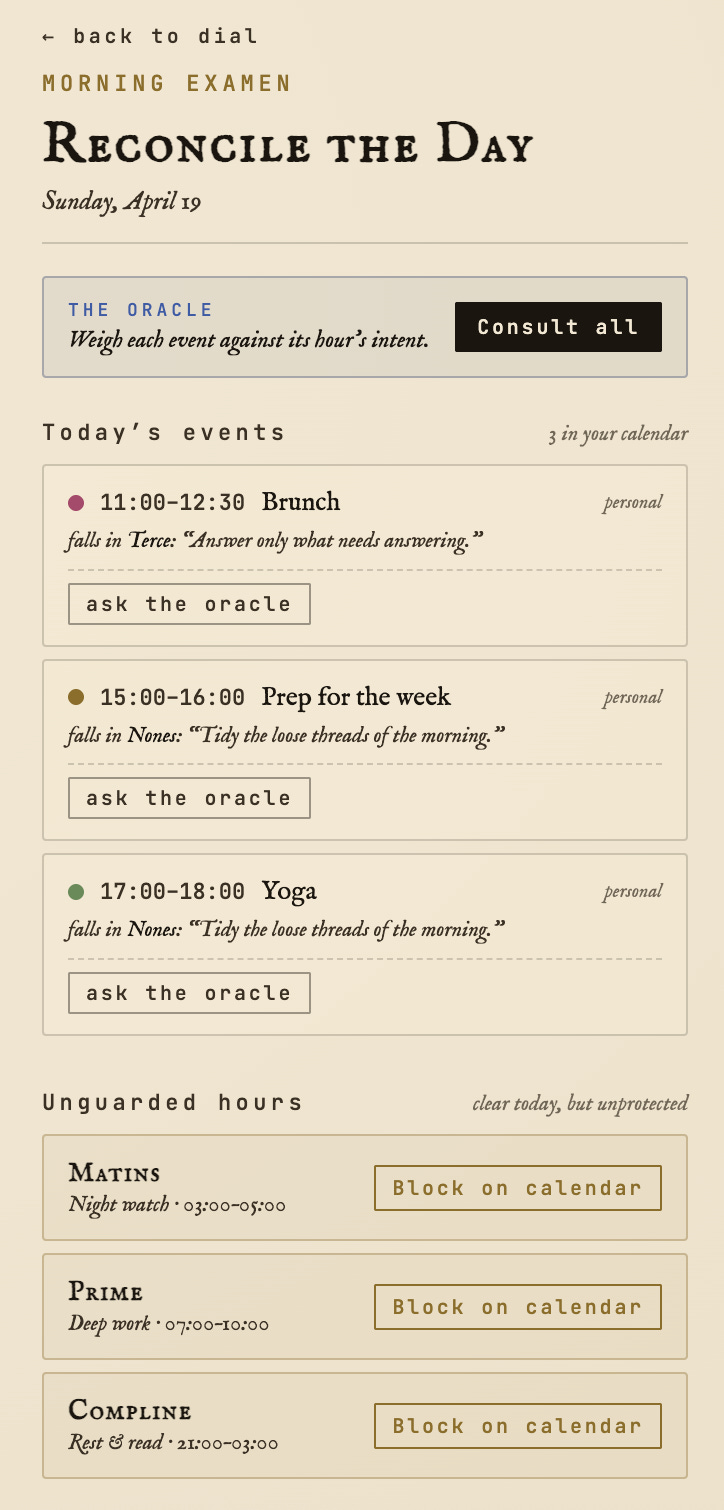
Brunch is of the Divine
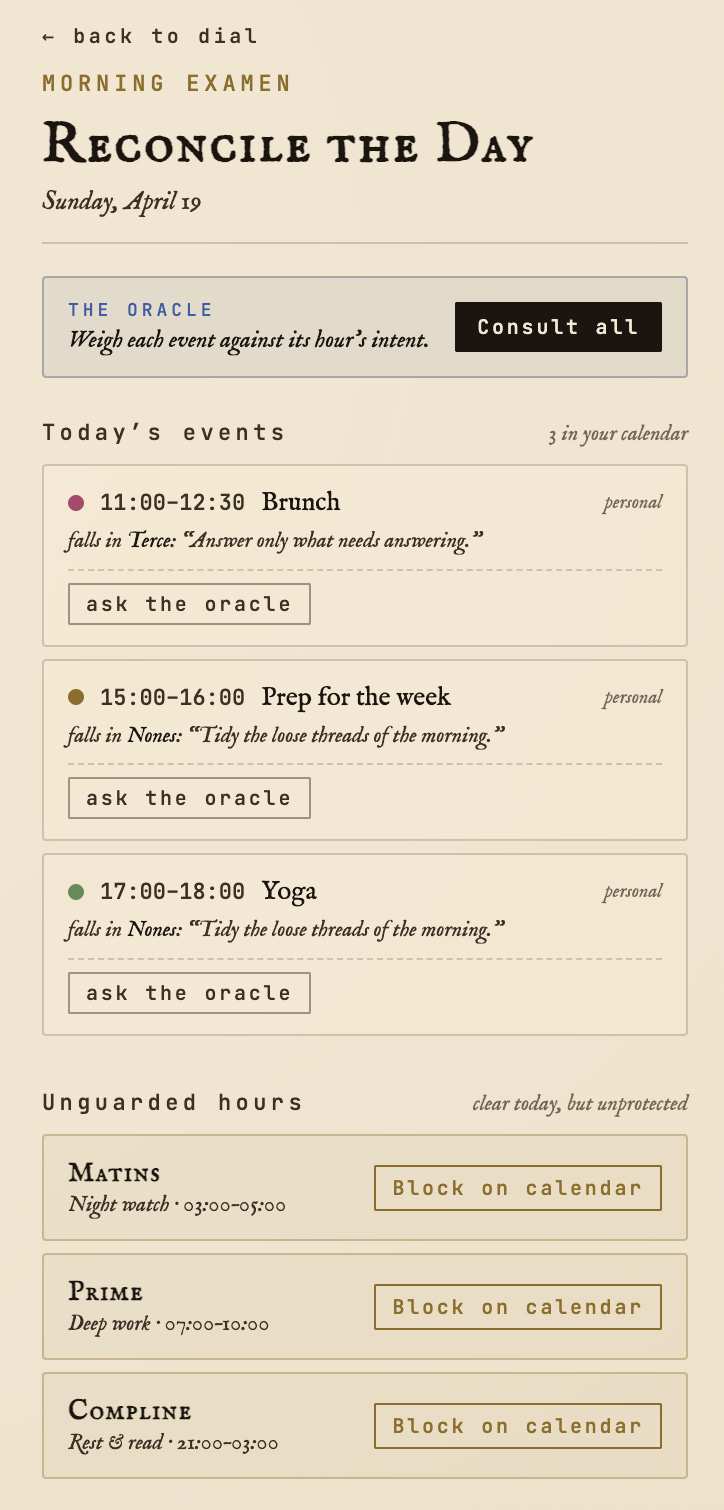
Besides the API calls to Anthropic it’s all local storage, running client side on your browser. It also has additional options like setting rules for different days of the week, and customized styles like a more florid illuminated pattern and an astronomical mode, aka dark mode.
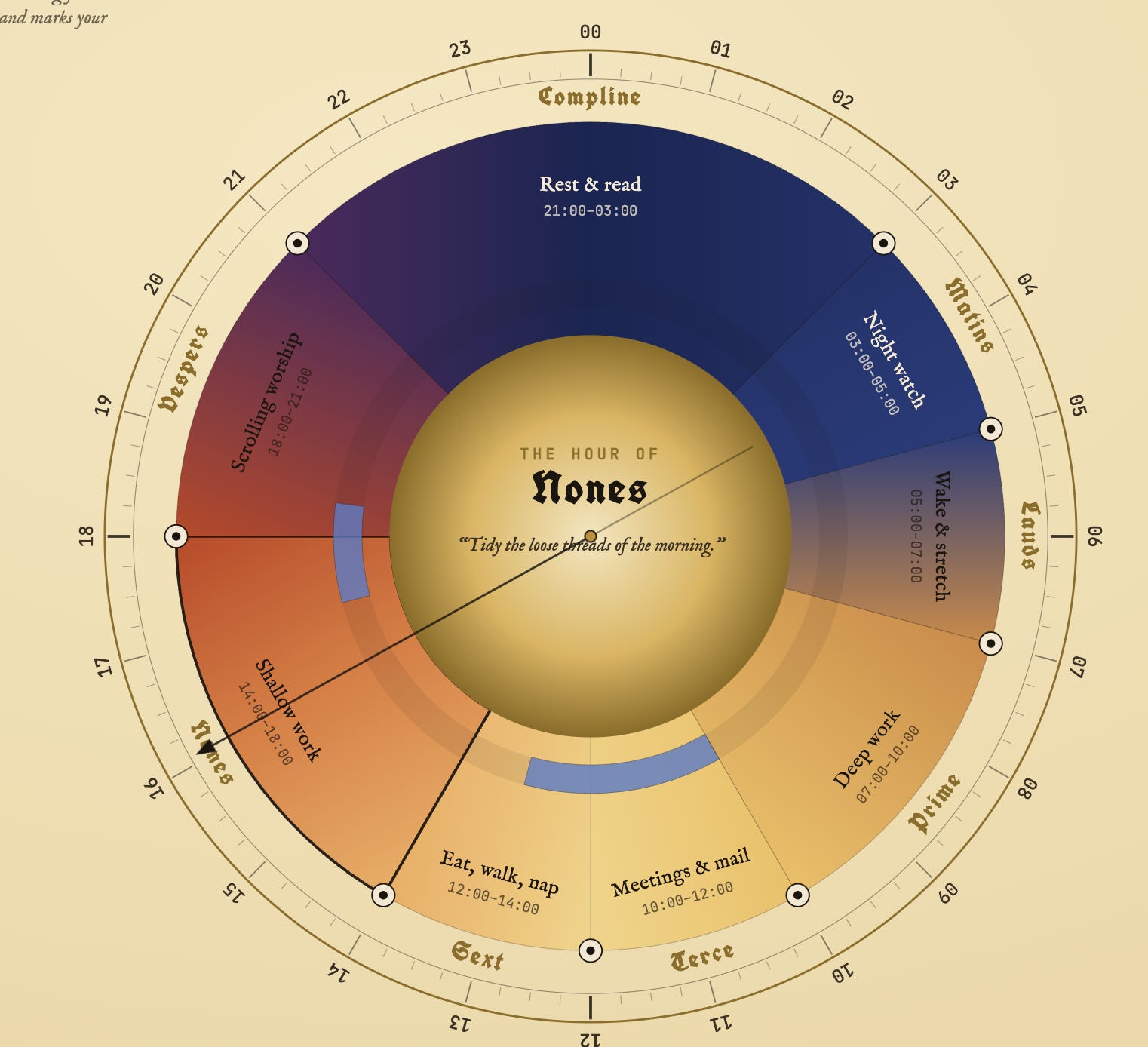
There’s tons of tweaks I can imagine for personal preference or to hew closer to the concept - for instance the monk’s hours varied with the seasons, compressing and expanding with the available daylight, as could this clock.
But this type of customization should almost certainly be done per user, and so if you like the concept you’re probably best off forking it and running it locally, making any kinds of crazy changes you want.
Perhaps you’d rather follow traditional Chinese and Japanese customs with hours named after zodiac animals; the Hour of the Rat, Hour of the Ox, and so on. Grab it from github and have your own software agent redesign it.
The whole experience makes me wonder whether the extreme personalization afforded by agentic software will cause a blossoming of bespoke practices. Everyone could choose their preferred rhythm of life to follow, while behind the scenes daemons4 intermediate. You adopt ship’s bells timekeeping, your colleague uses Zoroastrian Gāhs, and your AI schedulers negotiate via Robert’s Rules of Order to add a 15 minute standup to your respective ‘calendars’.
Fanciful? Sure. But the codification and adoption of the Canonical Hours happened because the Church was a source of truth and cultural authority across many countries, and because they controlled the technological means of media production through monasteries. In 1883 the railroads unilaterally imposed four time zones, downstream of their need for tight schedules and reliability. “The Day of Two Noons” came from their economic and technological might. 30-minute meetings came from… well I’m not sure, but maybe Microsoft Outlook’s defaults.
In Pentiment itself, the third act drops the canonical hours for the twenty-four-hour clock, quietly marking the town’s secularization and the arrival of mechanical timekeeping. How the villagers counted their days was shaped by who had power and what technology allowed. If the cost of building your own hours drops to zero, maybe a shared single rhythm moves towards a thousand different ones.
Something new under the sun.
Anthropic released Claude Design, a design tool which lets you create visual mockups and prototypes, two days ago. I knew it must be good because Figma stock was down 7%.
I was eager to try it and had the day off and used it to create this app, and found it that in fact it was really good. It one-shot about 80% of it based on my description and a screenshot from the game.
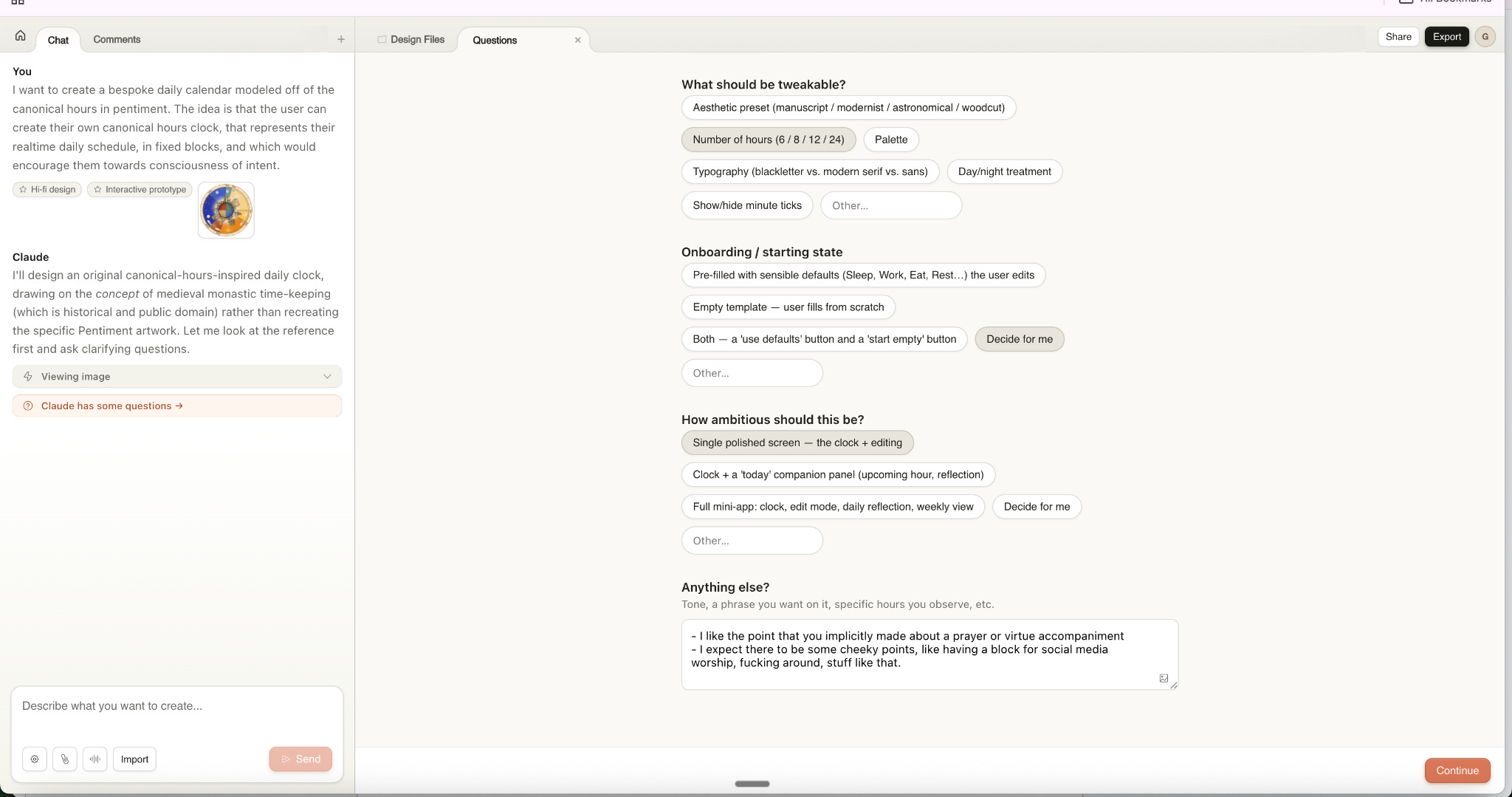
It’s extremely token hungry. After messing around with it for about thirty minutes I hit my daily token limit. I bumped my plan to keep going, which is some evidence that in fact Anthropic’s going to get that trillion dollar valuation.
It was very versatile and had lots of design power - like I will definitely start every front end project with this from here on out - or until the next better AI tool is released in a few weeks. It did seem to get a little buggy later on, not responding to certain requests. Maybe like most human designers it just didn’t like my ideas.
I also appreciated the great handoff to Claude Code feature, which exports the project in a spec that your local Claude Code can easily re-implement.
The github repo is here, if you download it and use your favorite AI software agent I think it’ll be a straightforward process to modify and run your own.
I won a spelling bee in the fourth grade by knowing the word ‘wharves’ because I was inspired to learn more naval military history from Age of Empires II: Dawn of Kings.
The irony of making an individual custom implementation of a collective practice is not lost on me.
aka Unix daemons, a background process that runs without direct user interaction, named after Maxwell’s demon
No posts
Comments
Nothing yet. Say the first thing.
Sign in to join the conversation.