
We were on vacation in the Dominican Republic a couple weeks ago. Carole was busy with a class, Gaia was in the kids club, we had perfect weather, and nothing to worry about. Yet, I found myself writing about rejection.
Sidenote: I wrote about why it was very hard for me to fully relax during this vacation here (per comments, turns out this is very common). I’m working on it.
What made me write about rejection was one of our Insider Loops customers emailing us that they’d gone through a full interview process at one of the companies we cover, it didn’t go their way, and in response to me saying they shouldn’t take it personally, they replied: “It’s hard not to take this personally.”
I’ve heard that before too many times. After years of coaching hundreds of PMs through interviews and job searches, I’ve come to see that how someone handles rejection is one of the most important signals I can get about their long-term potential.
Not because resilient people aren’t hurt by rejection. They for sure are. But resilient people get stronger after rejection.

My rejection-filled path to Facebook
After being laid off in early 2020, I was rejected by 20+ companies before landing at Facebook. FB itself had rejected me multiple times in the preceding years. By the time their offer came through, I had a long history with NO.
Every NO hurt. What changed over time was how fast I got back up, and what I chose to do next. I just kept taking swings.
The textbook definition of resilience is the ability to bounce back, recover, and adapt positively when faced with adversity. That feels right and I’d take it a step further: highly resilient people don’t just return to the baseline pre-rejection. They come back stronger.
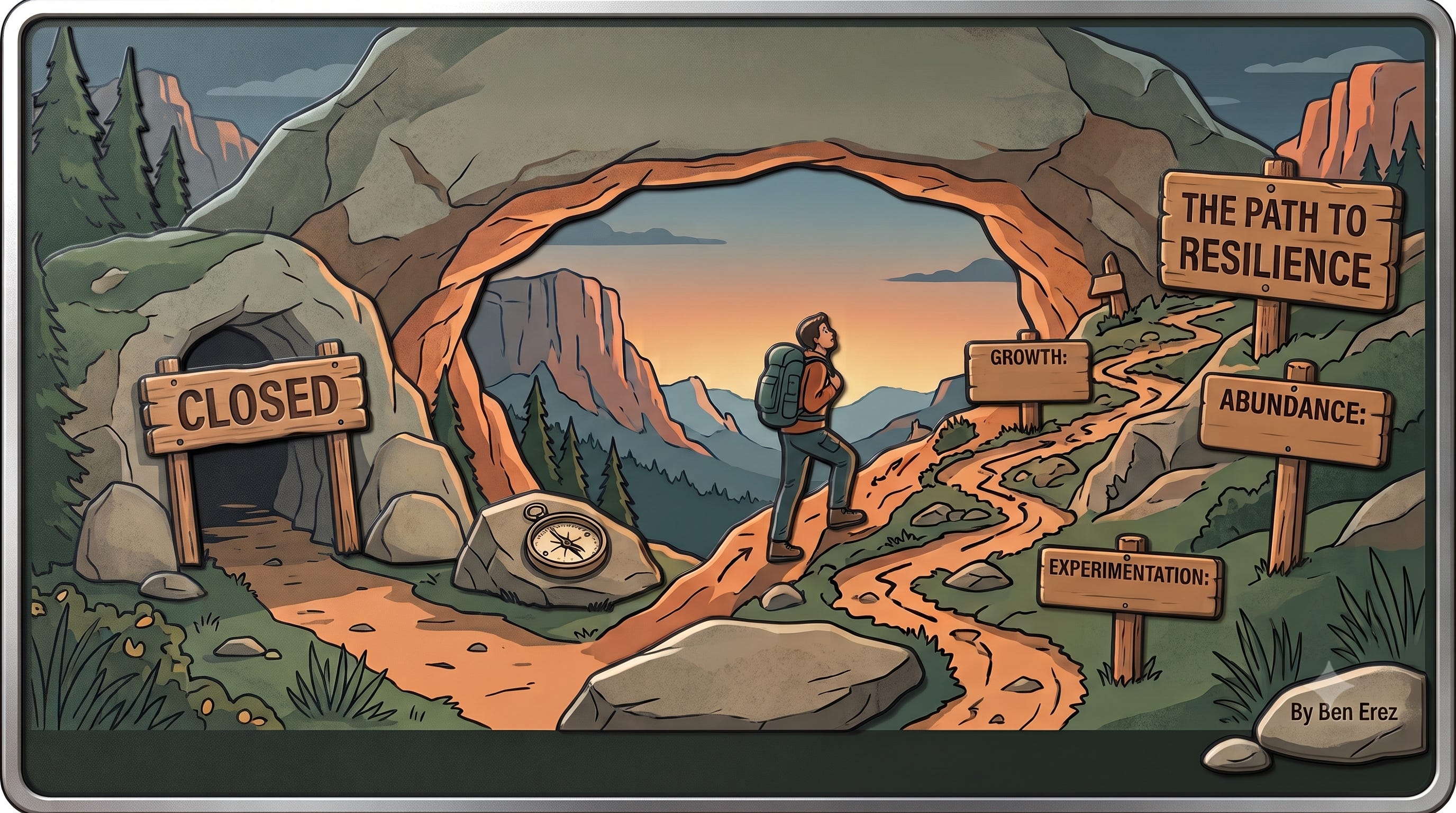
Three mindsets for handling rejection well
1. Abundance over scarcity
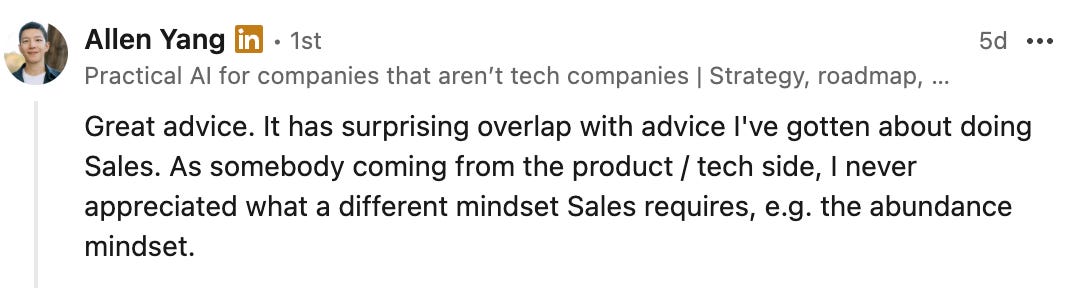
✅ Abundance mindset: each rejection is just crossing off one path among an infinite number of opportunities to be explored.
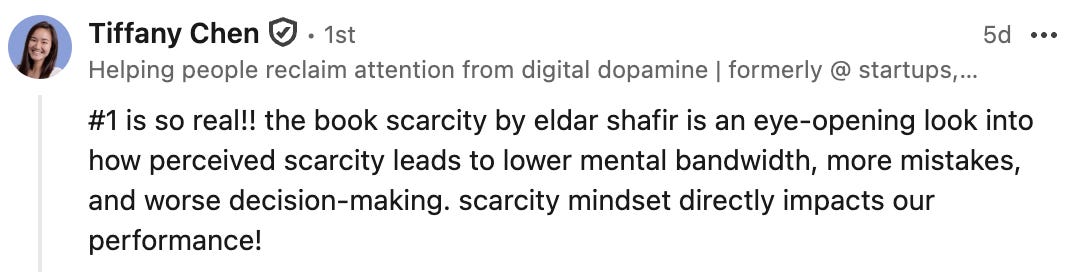
❌ Scarcity mindset: each rejection is brutal because it feels like a door is closing and there aren't that many doors available.
Same event. Completely different experience.
When you’re operating from scarcity, you go into what I think of as “I’m screwed” mode. And here’s the thing about that mode: fear is the mind killer. You cannot make good decisions from a place of fear. The moment you start operating there, you’re in a negative spiral and the rejection has already beaten you.
2. Growth over fixed
✅ Growth mindset: life is not a linear journey up and to the right, but rather an adventure with a lot of zigging and zagging along the way.
❌ Fixed mindset: any setback is a bad thing and every success just keeps the line on its trajectory.
A fixed mindset treats setbacks as failures. The line is supposed to go up. If it goes down, something’s wrong. The growth mindset says: this happened for a reason. My options are different now. I’ll make the best decision with what I have and learn from this experience.
3. Experimentation over waterfall
✅ Experimentation mindset: every rejection contains a very important set of signals to learn from.
❌ Waterfall mindset: life is a game to be “won” by achieving goals, and rejection is evidence that you're losing. It's an extremely fragile mindset.
With an experimentation mindset, life is a series of experiments. You double down on what’s working, kill what isn’t, and go into every high-stakes initiative knowing you’re going to learn something regardless of the outcome.
The 4th ingredient: high agency
The people I see struggle most give their agency away to things outside their control.
“The market is brutal.”
“There just aren’t that many openings.”
“The hiring manager didn’t understand my background.”
The people who bounce back fastest turn inward.
“What’s the actual gap and what can I do about it?”
“What story am I telling myself that might not be true?”
“What are the controllable variables, and am I actually working them?”
Agency is the meta-skill underneath all of this. Your mindset, what you go after, how you prepare, how you reflect on your performance: all of these are your levers. The key to resilience is staying mindful that these levers exist and you have permission to act.
Before I tell you how I handle rejection, a quick plug for something I’m very excited about: Insider Loops.
Want company-specific interview intel?
If you’re preparing for PM interviews at Anthropic, OpenAI, Google, Stripe, DoorDash, Uber, Figma, or Meta… I think you’re going to find Insider Loops super helpful. We’ve shipped almost 50 rounds of updates based on real candidate debriefs - these are the most updated guides for PM interview intel at the companies we cover.
In case you're considering purchasing one of our guides, I want to let you know that on July 20th, our guide prices will increase from $300 to $400. Until then, you can still get any guide for $300.
Since each purchase includes lifetime access to future updates, this is a great time to lock in the current price even if you're not yet actively interviewing.

How I handle rejection (and other setbacks)
Here’s the sequence that’s worked for me across job rejections, layoffs, and most recently, tearing my ACL playing soccer:
Accept what actually happened
Get my story right
Explore my options
Do something kind for myself
Try decisions on before I pick one
Let’s go one by one:
Step 1: Accept what actually happened
I tend to accept things rationally before I accept them emotionally. When I tore my ACL, I knew immediately something serious had happened. I accepted the fact of it pretty quickly. But the emotional weight hit me two or three days later, in waves. Realizing I couldn’t pick up my daughter from daycare for months. What it was going to mean for Carole. The burden I was about to put on her. 10-12 months of rehab.
Acceptance isn’t a single moment. It’s a process. The mistake I see people make is skipping straight to “what’s next” before they’ve actually come to terms with what happened. That unprocessed emotional load doesn’t disappear. It becomes baggage.
Step 2: Get my story right
Before you can move forward, you need an accurate account of what actually transpired. Not a version colored by emotion - as close to an objective story as you can manage.
I can’t tell you how many times I’ve asked candidates to walk me through what actually happened in an interview and they’re all over the place. The memory is a complete mess. This is one of the reasons I encourage people to transcribe their interviews with a tool like Granola.
You just can’t count on your memory as a highly accurate record of high-stakes conversations. I’ve done hundreds of debriefs and would estimate that about a third of the time, someone gives me maybe 10 minutes of content from a 45-minute interview. Memory is unreliable under pressure.
When processing a major setback, write it down to the best of your ability and potentially work with a coach like me to help you get your story straight.
Step 3: Explore my options
Once you’ve accepted your situation and have a clear story about what happened, it’s time to start thinking about your options.
The first question: is this actually final?
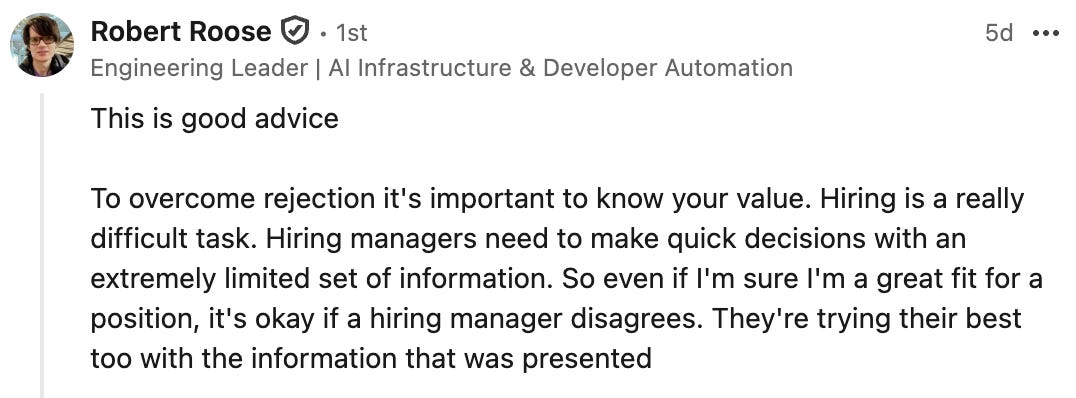
With a job rejection, “we went with someone else for this role but really like you” is different from “you’re not a good fit for the company.” You can almost always find out whether you’re on a cooldown or whether there could be another conversation. If it’s final, put a reminder on your calendar for when you’ll be eligible to re-engage, and then stop thinking about that company. It’s just not in the cards for you right now. Move on.
With my ACL injury, I met with three different surgeons and asked them what my options were. This helped me narrow the ambiguity into concrete possible paths.
Step 4: Do something kind for myself
This might be the most underrated step of my process.
I try to do something kind for myself when something doesn’t go my way. It can be small like going for a walk (easier said than done with a freshly torn ACL unfortunately), getting a haircut, catching up with a friend. Whatever gets me out of my negative headspace.
When I was laid off from Abstract, I went for a hike in Marin. It was a treat.
Then I sleep it off. I genuinely believe in the importance of sleeping on the options before deciding what you want to do next. If you’ve actually processed what happened and have a clear story in your head and a set of options laid out, you’ll sleep better.
Why do something nice for yourself after rejection vs punish yourself?
I believe in rewarding myself for putting in the work and betting on myself. If I got everything I reached for, life would be boring as hell. The fact that I tried for something hard and didn’t get it means life is interesting. We each have the choice to view life as a game to be played. Celebrate the fact that you take swings, even if you miss and do something nice for yourself, and then come up with the next thing to try.
Step 5: Try decisions on before I pick one
Don’t rush into your next move.
When I was deciding whether to get surgery on my ACL, I originally leaned against it. Then I sat with what my life would actually look like on that path and found myself way more excited about getting surgery than not (more on that here). That’s when I knew.
Once you make a decision, life has a way of reorganizing around it. But you have to actually commit. Try on a decision, see how it feels, then commit.
Choosing to start interviewing for a new job is a decision. Choosing to pivot your strategy is a decision. Choosing to take a break from your search to regroup is a decision.
Even choosing not to make a decision is a decision : )
One more thing I want to be clear about: resilience is a skill, not a fixed trait.
You can move from a low-resilience state to a high-resilience one. The more you work this muscle, the stronger it gets and the easier it becomes to handle the next setback. The goal is just to spend more and more time operating from that high-resilience place.
If there’s one thing I’ve learned from the layoffs, the 20+ rejections, the ACL, and the years of watching candidates navigate brutal stretches:
You can’t defeat someone who’s resilient. They just keep getting stronger with every no. I strive to be the kind of person who gets stronger after every setback.
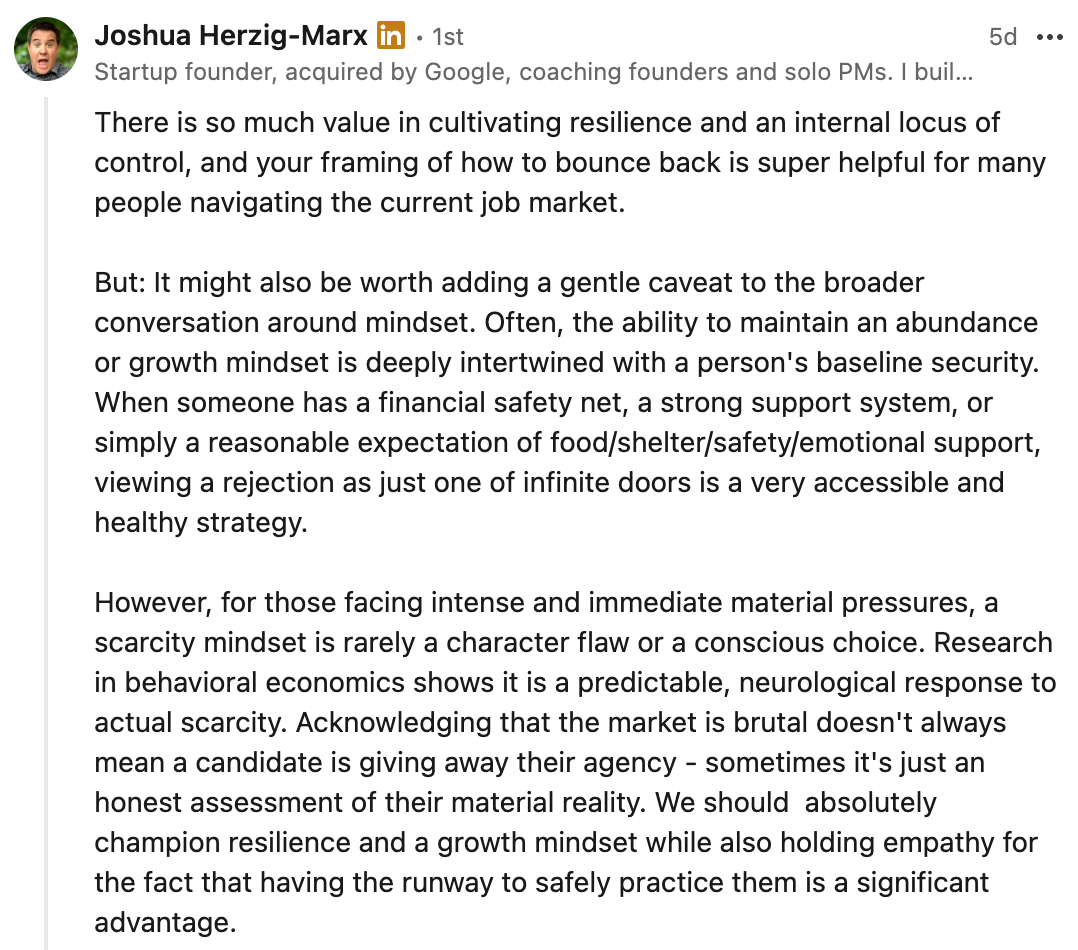
I published a much shorter LinkedIn post about this and want to highlight some of my favorite comments (the last one from my friend Josh has a super valid POV):
Comments
Nothing yet. Say the first thing.
Sign in to join the conversation.