
Hello from France! Those of you who have been following my newsletter for a while will know I’ve visited Europe almost every summer for the 10+ years, usually a combination of visits to my wife Carole’s family and some fun travel mixed in. You can read a bit more about last year here:
This summer we’ll be in Europe for a little over a month. We landed in Paris last Sunday, are now visiting Carole’s mom in Lorraine with Gaia for two weeks, heading to Bari (Italy) for a week, then finishing with a week in Bretagne to visit Carole’s dad. Back in NYC first week of September.
My calendar has exactly zero calls scheduled for August, which is awesome. Spending a month in Europe with no meetings is a huge privilege and one of the biggest perks of being my own boss. I don’t take it for granted and am very grateful 😍

My ACL recovery is coming along well and I’ve been able to mostly keep up with the girls. Scar is fading, knee is feeling solid, muscles are getting stronger and I’m starting to see the light at the end of this very long tunnel. Still, another 8-9 months of rehab to go to 100%. My physio tells me I’ll be able to jog by November.
I’m a bit behind on sharing here so today’s post will feature a curated mix of ideas I’m thinking about, things I recently shipped and content I’ve enjoyed. Thanks for reading!
Ben
We recently got this email from an Insider Loops customer who bought our Stripe guide and it made me so happy.

This one from an OpenAI customer was a bit calmer but still put a smile on my face.
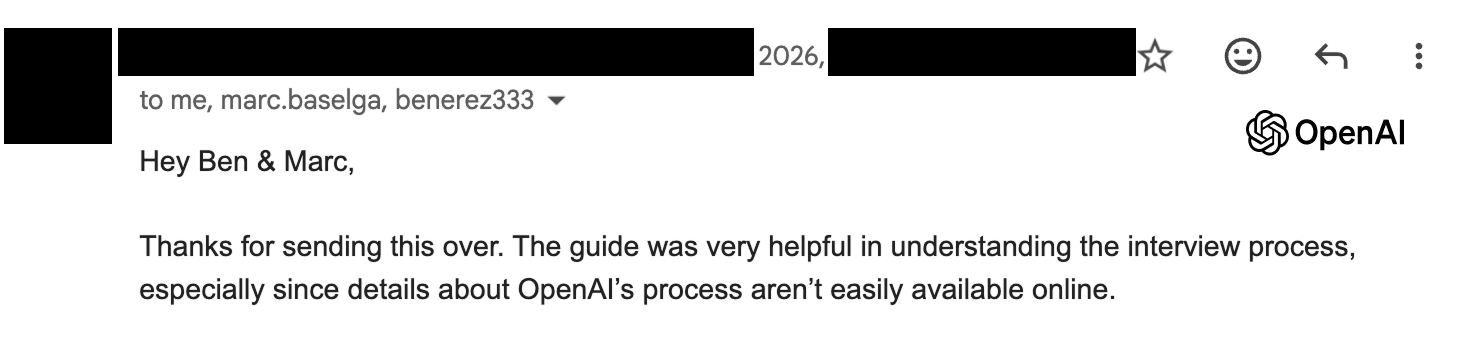
In a market where employers seemingly hold all the cards, I find it very meaningful to help level the playing field by giving candidates a peek behind the curtains. To hear more about Insider Loops, keep reading further down in this post.
Let me start by acknowledging that no job is perfect. There's always something that can be improved. This means the best talent is always in flux, looking for better opportunity. I’ve coached hundreds of people through big career decisions. If you’re stuck thinking about what’s next in your career, this next part might bring clarity.
One problem I often see is high caliber people making career decisions driven by subconscious wiring. They're sleepwalking. To wake them up, we need to make their decision-making heuristics conscious. My favorite way to do this is to tell them THEIR story in MY OWN words.
Specifically, this looks like me reviewing their LinkedIn work experience, talking through each role and narrating what I think happened in each transition point. If I'm ever confused, we talk about it. They often correct me at multiple points, leading to a very actionable list of updates they need to make to their LinkedIn so that others who read their profile don’t make the same mistake.
This makes them conscious by holding a mirror to their past decisions and forcing them to tell me, in a safe space, what actually happened in each chapter. Then, we transition to what they're looking for next.
The majority of people get split across two buckets:
Those who know exactly what they want next
Those who aren't sure at all what they want next
Each of these buckets has its own challenges and while I show up differently for people based on which bucket they fall into, my goal is always to get the person to invest their time on the highest leverage activities to reach their goals.
People in bucket 1 generally need help opening doors, preparing for interviews, etc. I enjoy helping these people because the clarity they bring sharpens how I can be useful. My course, copilot, and Insider Loops are examples of resources I’ve created for people in this bucket.
Helping people in bucket 2 is a completely different ball game, usually more meaningful to me on a human level. The reason is that this bucket gives me permission to go into discovery mode and map the landscape this person's occupies more completely because the exploration is more open-ended. They’re suggestible.
In exploratory conversations with people in bucket 2, I like to ask questions like:
☀️ "Tell me about the last time you were really energized by work. What do you remember about the people, context, role, etc?"
Why I like that question: Understanding the "pull conditions" in which someone is super energized and engaged is key to listing the most important factors they should weigh in their next role.
⛈️ "What is it about your present role that's making you explore a change?"
Why I like that question: Unpacking the "push conditions" that are moving someone away from their current situation is critical for ensuring they don't subconsciously sleepwalk into another role where they won't be set up for success or happy.
🛣️ "Where are you getting stuck?"
Why I like that question: This is when we finally begin to pinpoint the blockers preventing this person from making progress. Smart people are very good at risk mitigation and have a tendency to analyze decisions to death before taking any action.
Next, I asked them to start listing the options they’re considering. My goal is to identify the ones that feel both realistic from my POV and exciting from their POV. Then, we scope initial tests with the goal of increasing or decreasing conviction on each option based on learnings. High-agency people love this approach.

I love shipping useful resources, but if I don’t bring attention to the things I’m shipping, nobody will know about them. And then the things I’m shipping will have no impact, which would make me a sad panda. Here are some recent favorites.
When people historically asked us, "What do I actually get when I buy an Insider Loops guide?" we didn’t have a precise answer. So I finally recorded the 5-min video below walking through it.
Each of our guides includes a table of contents, detailed guidance for each interview round, notes and insights gathered directly from insiders, date the guide was last updated, and a complete changelog showing what changed and why.
One year ago, when someone pinged me with questions about the eight companies we cover, I was only confident helping them with Meta (which my course and copilot are optimized for). For the other seven companies, I felt pretty useless.
Today, when someone pings me with questions about the eight companies we cover, I confidently point them to our Insider Loops guides because they’re designed to be foundational resources for navigating each company’s PM interview process.
But what makes me most bullish on Insider Loops is what happens after someone buys a guide. We have multiple follow-up touch points with every customer to learn how their interview experience differed, if at all, from the guide:
Which interview rounds they actually encountered, who interviewed them, how long the interviews were, what was asked, what they think was being evaluated
How our guide could be more actionable for future candidates, any mistakes they made in the interview, things they wished they had done differently in preparation
We receive a surprising amount of intel from our customers. Many people seem to genuinely want to help other candidates, which is beautiful at a human level (I suspect they might also want to keep a warm relationship with us for the future).
We’ve built a very efficient system for logging new intel and turning it into updates. I personally review every change we make, drawing on my experience as an interview coach, course instructor, former PM, and someone who has spent years studying how product interviews work.
When new evidence conflicts with something in a guide, we investigate it and resolve the discrepancy ASAP with a guide update. Once a month, customers receive an email summarizing everything that has changed in the guide they purchased.
We believe transparency builds trust with prospective customers so now anyone can view the public changelogs for all eight guides directly from our homepage.
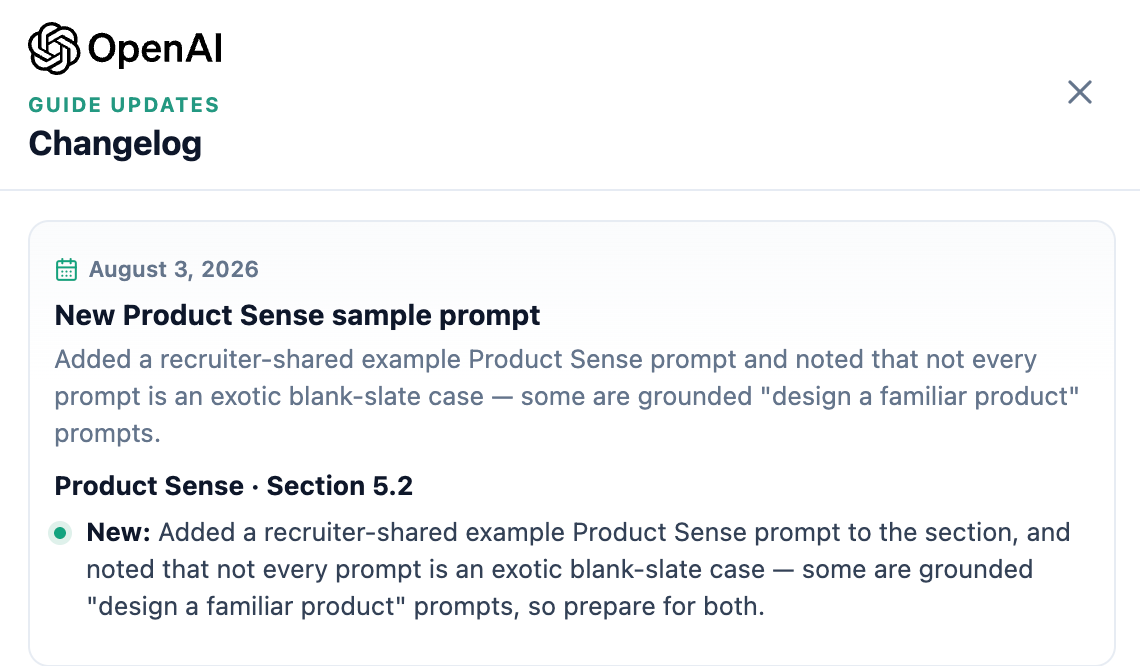
A couple months ago, our friend Michael gave us some excellent ideas about improving conversion on our website, leading to a full refresh of our homepage and it’ll always evolve but I love where we landed for this chapter:
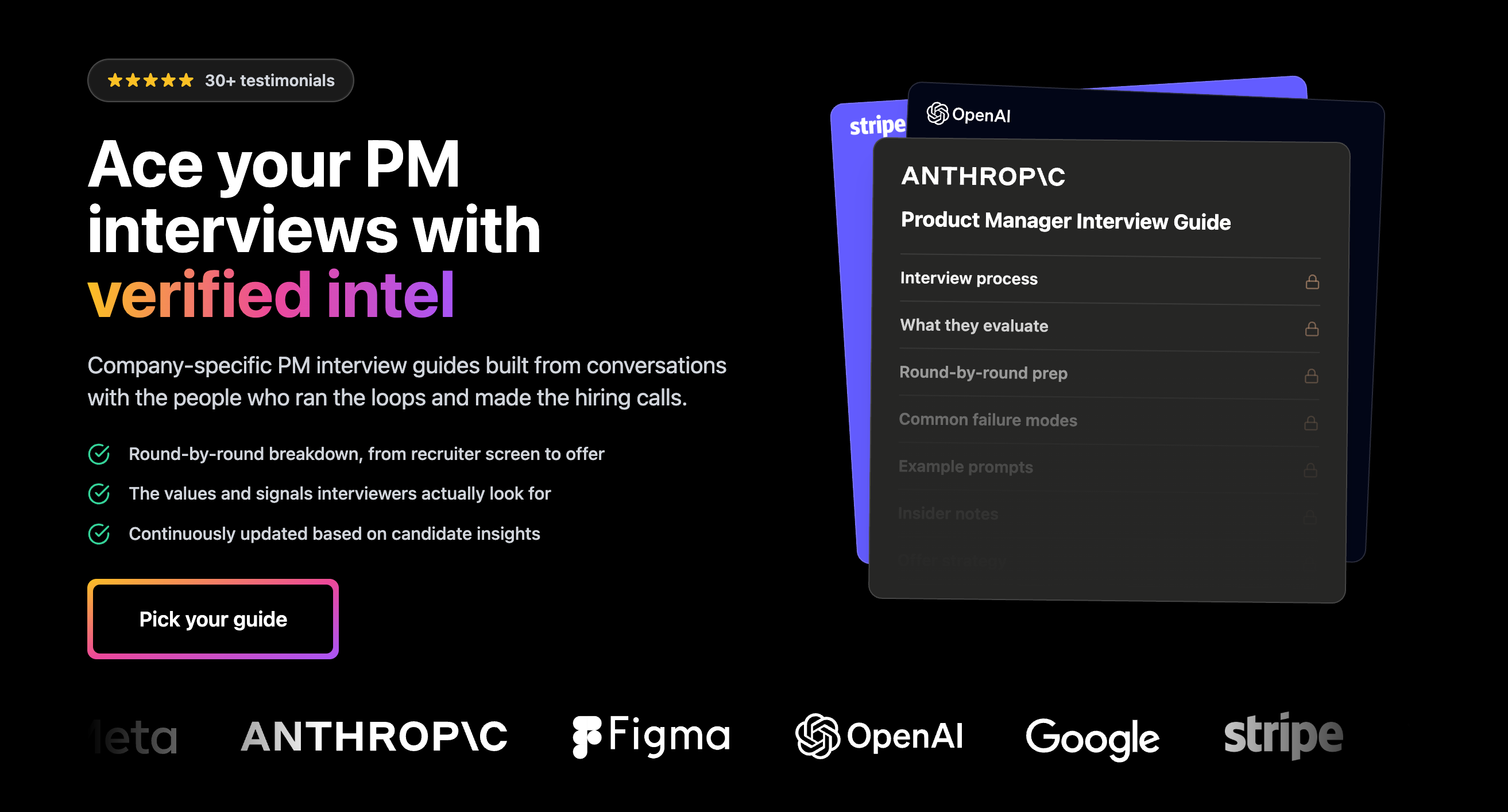
We also accelerated the development of company-specific pages and now have a destination for every company (e.g. our Stripe page) that we can beef up in the coming weeks and months to create a definitive hub for each guide.
People who know how to ask for more tend to get more. In the last few weeks, our customers have secured comp packages ranging from $500k to ~$3mm for senior product roles at the companies we cover (although it seems Anthropic truly does NOT negotiate).
Marc and I love the way Colin Lernell and his team at Valued help talented product leaders maximize their total comp packages so we partnered to offer Insider Loops customers access to their premium comp negotiation services at a discounted rate. We’ll continue exploring partnerships to maximize the value we deliver our customers.
Marc and I spend many hours every week making Insider Loops guides the most accurate and actionable resources on the market. I genuinely wish this existed when I was preparing for interviews. If you’re preparing for PM interviews at Anthropic, OpenAI, Stripe, DoorDash, Google, Figma, Uber, or Meta, you can get $50 off any of our guides with promo code BENSNEWSLETTER50
Leading up to August, Marc and I recorded a backlog for our podcast, Supra Insider. This means I don’t need to worry about recording slots while I’m in Europe.
We’re 2.5 years into the podcast and we’ve never had more fun with it, especially now that we’re gravitating towards more interview and hiring related topics. It’s just where our interest has flowed as we’ve gotten deeper into building Insider Loops together.
Here are some of my favorite episodes we published since May. Subscribe here to have episodes delivered to your inbox every week 👇
What does it actually mean to bet on yourself, and how do you know if the game you’re playing is really the one you want to be in?
What if the thing holding you back from posting isn’t laziness or a lack of ideas, it’s that nobody ever told you the cringe feeling goes away, and what it actually looks like to build trust with an audience without burning it?
What does it take to walk away from a decade in product, and a job most people would envy, to bet on yourself?
Chris Gomes set out to hire four AI product managers. Seven months later, his biggest lesson was not about AI at all.
After an unexpected layoff, Eric Posen went from day-one outreach to three offers and a director role at Super.com in six weeks.
What separates the people who get stronger after a rejection from the people who stay stuck on it?
Inside Anthropic’s $100 Billion Al Compute Commitment | CFO Krishna Rao
how to enter side doors: a field guide to jobs, cold emails, and making yourself legible to the right people
Rick Rubin interviews Tobias Lütke (Shopify founder & CEO)
That’s all for now, have a great week everyone!
No posts
Comments
Nothing yet. Say the first thing.
Sign in to join the conversation.