
We’re exactly nine weeks from the nation’s 250th birthday (“semiquincentennial,” for those looking to impress). And it’s safe to say the old U.S.A. is in a bit of a funk.
In many respects, the nation was hardly riding high during the last big landmark celebration either. By all accounts, the Bicentennial year arrived in a time of turmoil: economic hardship, outbreaks of domestic terrorism, and an unfamiliar, humiliating sense of retreat on the world stage.
I wasn’t quite around in 1976, but Robert Pondiscio’s first-person assessment at Commentary resonates:
The fragmented, partisan media and culture of 2026 offer few comparable moments of collective attention, and those that do break through tend to be disasters—9/11 rather than July 4th. A nation that comes together only in trauma will struggle to cultivate attachment in a moment of joy. The three-network world of 1976 mattered not because it was orderly or enlightened, but because it created a shared stage—one on which the nation could briefly appear to itself as a collective rather than a coalition of warring factions. When the Bicentennial unfolded, it did so before a national audience that, however divided on policy and politics, still recognized certain civic rituals as belonging to everyone.
Today, that shared stage has vanished—and worse, its disappearance has coincided with and arguably midwifed a political culture of perpetual dissatisfaction. Alarm is not a byproduct of politics; it is the fuel. Outrage drives attention. Grievance mobilizes voters. Shared reflection and pride, by contrast, are politically inert. They do not activate donors, juice turnout, or sustain engagement. As a result, we are encouraged—by media incentives, by partisan messaging, by the logic of modern politics itself—to remain in a constant state of agitation. Contentment becomes complacency. Gratitude feels like surrender. We have trained ourselves to ask “Who benefits?” That reflex makes shared celebration nearly impossible.
All insightful, with more than a ring of truth. Compared with 50 years ago, our level of material abundance is off the charts. But the spiritual indicators are dismal. And that has something to do with our nation’s obsession with politics, which as Pondiscio argues, contributes to our nation’s inability to “celebrate itself at all.”
That obsession might not be so detrimental, if our politics were dedicated to solving serious problems rather than reveling in a high-stakes form of destructive entertainment. Here’s a significant bit of news readers may have missed: the national debt is now larger than the total size of our robust economy.
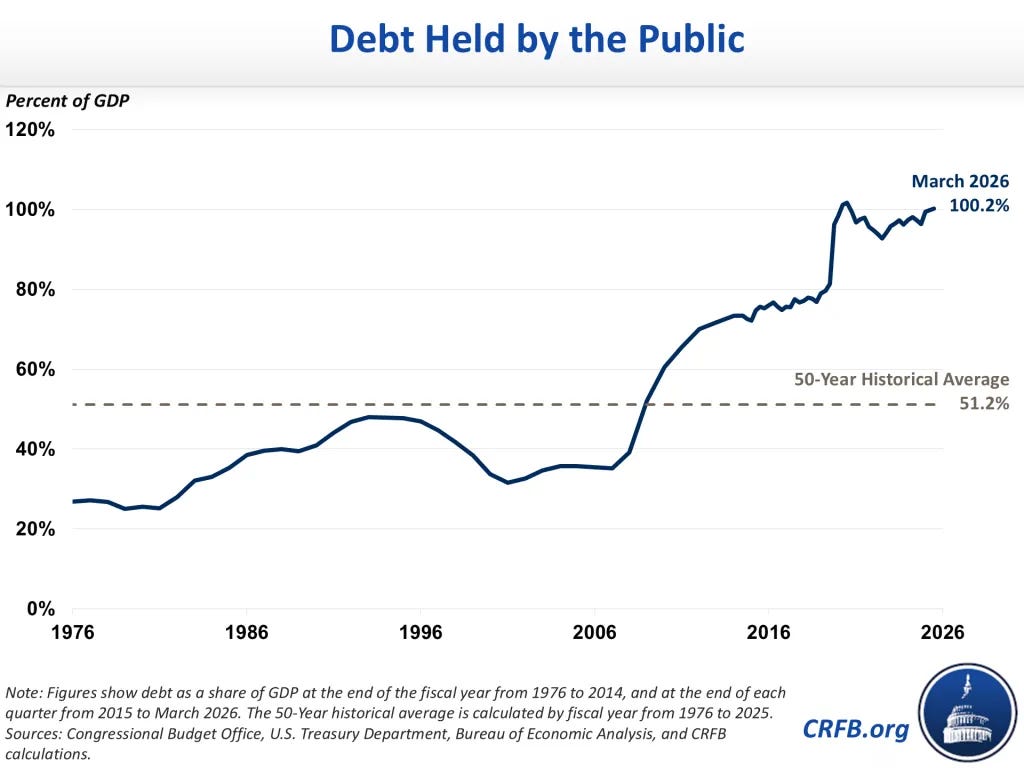
Take a glance at the chart, and see where the ratio of debt to economy was during the otherwise bleak Bicentennial. It was in the range of 25 to 30 percent. The destructive pace of borrowing and spending accelerated in response to two major events: the financial crisis of 2008-09 and the COVID pandemic starting in 2020. How in the world does one think we will tame inflation and all its accompanying effects while ignoring this ticking time bomb? It’s beyond me.
Back in the days of my younger adulthood, when I served so many hours as a local Republican Party volunteer, there was a vague semblance of dedication to fiscal restraint. (There also was a nominally pro-life platform, which has since disappeared, but that’s another story for another day.)
Now whatever limited backbone the GOP possessed has been dissolved. Whatever halfhearted energy inspired policies to avoid the fiscal train wreck has been sapped away. And not because the Progressive Left has relented in its drive to grow the intrusive and oppressive state apparatus. Quite the opposite.
These days we have a quiet consensus to protect the power of D.C. while squabbling over which irresponsible team will pull the levers for its own ends. And this, ironically, has been made worse by the impulsive exertions of populism, which screams at us to invest more of our energies in the costly battles between narcissistic characters that demand loyalty at the expense of our own sound judgment and integrity.
Neither side has much motivation to back down, and not nearly enough people are invested in changing the incentives behind the destructive game the political class is playing. In fact, many grifters on the Right and Left have built their gravy trains by twisting reality to gin up fear and angst. None of that gives me great hope or confidence.
What does? Foremost would be faith in Christ, time spent serving within a loving family, and the embodied fellowship of a church community. (We’ll talk more later about the need for intimate friendship.) As much as I enjoy writing about things, you can’t beat these lived experiences that seem so fragile in our two-dimensional, disconnected social media age.
I’ve also been encouraged by:
The remarkable courage, wisdom, honesty, and humility of former Senator Ben Sasse, as he faces a heavy terminal cancer diagnosis
The response of many conservative leaders to put their Christian faith ahead of partisan loyalty and criticize the President for elevating a blasphemous image
The opportunity to lead a fall-semester class on civics and the Constitution with a group of engaged homeschoolers getting ready to face the world
A similar opportunity to help facilitate a Sunday evening class on Biblical citizenship
My emphasis to readers here is the same I shared with these classes: Let’s go and make a difference at the local level. There are many ways we can do so, using our God-given gifts and callings — watching school board meetings, running for (or helping good people run for) city council, investing evening or weekend time in worthy volunteer organizations, breaking bread and sharing your faith with your neighbors, etc.
Many out there are already focusing on and working on these things. But collectively, We the People can do better.
Even looking at the national level, not all is lost. Some elements of the Constitutional order are still intact. And prominent voices like Supreme Court Justice Clarence Thomas (truly one of the nation’s living treasures) are eloquently calling for us to find courage in the fight to restore our Founding principles:
So by all means, celebrate the Declaration of Independence. It is the most important act in American history, the foundation of our Constitution and, as Lincoln said, “the sheet anchor” of our republic. But, I implore you to celebrate it by standing up for it, by defending it, and by recommitting yourselves to living up to its ideals. Channel the courage of the men who faced down a king and signed it and, or of a President who led the nation in a Civil War rather than permit this house to be divided by the great contradiction of slavery. Take increased devotion to that cause for which they gave their last full measure of devotion.
If we are stuck as passive spectators merely gazing at the political and spiritual mess around us, then this 250th anniversary will prove all the more hollow and bitter. But if we hope in God, pray for revival, love and serve our neighbors (and celebrate Independence Day with them), and heed Justice Thomas’s call, generations to come may yet find reason to thank us.
No posts
Comments
Nothing yet. Say the first thing.
Sign in to join the conversation.