
Two months ago, I used this space to highlight not only my concern for the state of the republic on the eve of its 250th anniversary but also my admonition to find a hopeful path in the midst of it. Apathy is not an option (I preach to myself).
Well, tomorrow is the big day, a quarter-millennium since the nation’s lofty Founding, and the struggle here is as great as ever. Yesterday, the libertarian Cato Institute released some dispiriting results from their new national survey: “Nearly Half of Americans Don’t Know What America’s 250th Is Celebrating.” Yes, it’s true:
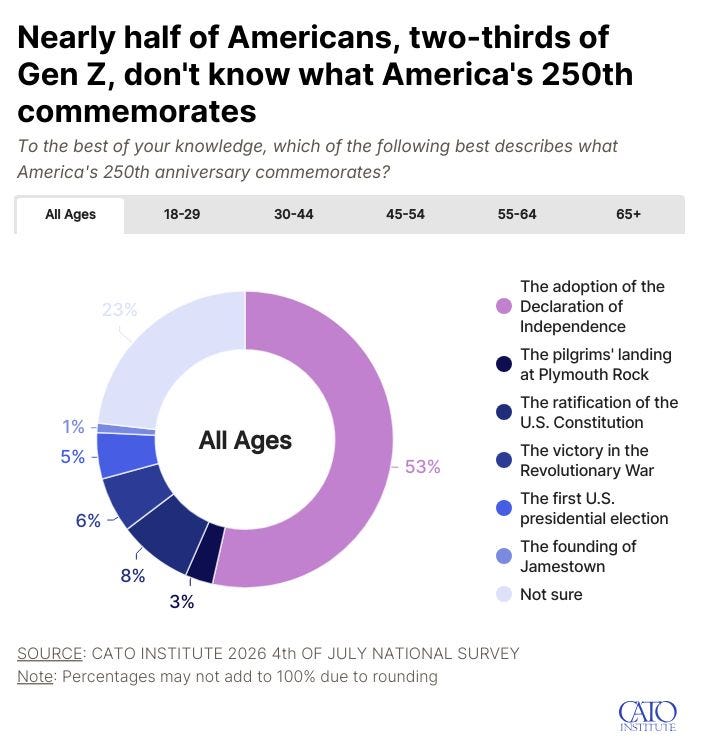
In my estimation, the staggering numbers of the misinformed represent one more piece of evidence that should set off alarm bells. But I’m not writing here for the purpose of fueling angst. No doubt, there are many causal explanations behind this finding. I can only begin to scratch the surface here.
If you observe the age distributions in the Cato survey, you’ll quickly see this pattern for the % of respondents who recognize that—yes—it is the Declaration of Independence that we celebrate on July 4, 1776:
Ages 65 and older: 72%
Ages 55-64: 63%
Ages 45-54 (my own demographic): 45%
Ages 30-44: 46%
Ages 18-29: 39%
The pattern is similar in whether survey respondents more closely align the nation’s Founders as “courageous leaders” rather than “self-interested elites”:
Ages 65 and older: 89%
Ages 55-64: 75%
Ages 45-54: 63%
Ages 30-44: 58%
Ages 18-29: 49%
Failure to understand what the Founders were fighting for—the expansion of human freedom, the consent of the governed, the rule of law, the source of natural rights and equality under the law, the purpose of government to protect those rights—will naturally manifest itself in all sort of unhelpful ways.
Using the above breakdowns, there’s an evident drop-off in basic understanding and appreciation for the genesis of American ideals, starting with those born after about 1970. Make of it what you will, but I dare say both institutional and cultural factors are at play here. Primary and secondary school would be the place where most Americans would be equipped with this basic foundation of knowledge.
When exactly did the New Left and its infatuation with critical theories take widespread root in schools of education and, by extension, in classrooms across the land? The 1980 publication of Howard Zinn’s wildly overrated but highly influential A People’s History of the United States has to be considered one key milestone, but others who have done the scholarly work can more effectively point to earlier occurrences.
Though American K-12 education had experienced dramatic shifts before through the influence of Horace Mann in the 1830s and John Dewey in the early 20th century, the amount of drift from the Founders’ vision for education was vast by the 1970s. As the American Enterprise Institute’s Rick Hess reminds us in a recent Education Next article:
[C]ivic virtue was a huge part of what our nation’s founders thought schools were for. Keen students of Greek and Roman history, they believed the key lesson of those early democracies was the crucial role of restraint and responsibility. Absent those virtues, they feared that democracy would unspool in a clash of appetites. It was John Adams, after all, who cautioned, “Democracy never lasts long. It soon wastes, exhausts and murders itself. There was never a democracy that did not commit suicide.”
How far is the need for greater civic virtue from the discussions at your local school board meeting, not to mention state and national political debates?
Meanwhile, some of the results of the new Cato survey buck the New Left worldview and its disregard for the exception importance of America’s Founding principles. Though we should wish the number were even higher, 76% (!) of adults have a favorable view of the nation’s founding.
(That’s even more encouraging than the finding from the last Annenberg Constitution Day Civics Survey—namely, that the share of U.S. adults who can name all three branches of government increased from 65% to 70%.)
That figure is something to work with and hold onto in the midst of widespread ignorance and frustration with the contemporary state of affairs in national (and often state) politics. As Hess’s AEI colleague Robert Pondiscio sagely observes in his essay “How to Raise a Grateful American”:
Schools have never been solely responsible for forming citizens. Families, churches, scouting organizations, libraries, youth sports leagues, civic associations, and countless other institutions helped cultivate a sense of belonging and obligation. They still can, and, indeed, they may have to.
Indeed. It resonates with the consistent research finding that expanding educational choice for families leads to greater civic knowledge and participation, as well as respectful tolerance of different political views.
It also leads me back to the call I issued for myself and us all not to submit to being “passive spectators” in the current political mess. Hope and pray and love our neighbors. Get involved in our local communities. For me, it means in part renewing my resolve to continue seizing opportunities to teach history and civics in our local homeschool community.
At a larger scale, there are groups like the Bill of Rights Institute doing important work to strengthen civic education and deepen appreciation for America’s Founding principles. Not to mention the Institute of American Civics (University of Tennessee), since it was a posting by the institute’s executive director Josh Dunn that brought my attention to the Cato Institute survey.
Consider supporting, or at least more closely following, groups like these — or add links to your own recommendations in the comments. There are many others doing good work.
And join me in celebrating the nation’s 250th anniversary sincerely, gratefully and heartily! God Bless the USA!!
No posts
Comments
Nothing yet. Say the first thing.
Sign in to join the conversation.