
If your team isn’t performing, even after training, frameworks, pep talks and pastries, it’s tempting to think “they just don’t get it.” But that’s usually only half the story.
In this post:
What managers often miss about performance
Enter the Performance Canvas
Why visualising this matters
Try it yourself
When I work with leaders and teams on performance and change, one tool I keep returning to is something I call the Performance Canvas. It’s a simple way to see all of the real barriers as a system that might be in the way of your people (or in your own way).
The curious thing I find is this: most organisations fixate on skill, but performance rarely comes down to skill alone. Yeah, I know, that’s super Captain Obvious to say, but there’s often still a gap between the knowing and the doing.
I was recently with a client who was struggling with getting OKRs rolling in their organisation. Leaders assumed that people simply didn’t know how to ‘do’ OKRs, so they wanted me to do some training with their staff. But when we looked closer, something else was going on:
There was a wide spectrum of knowledge and experience about OKRs
Previous attempts at training hadn’t gone that well
Outputs (i.e. sets of OKRs per project and tracking reports against them) were still weak
So what was missing?
To see it clearly, we need more than a skill check. We need a fuller picture of performance, to see this as symptom within a system, one that accounts not just for individual ability, but also motivation, environment, tools, and goals.
The Performance Canvas is a simple diagnostic template I’ve made, based on the Skill/Will Matrix by Paul Hersey and Ken Blanchard, from their book Situational Leadership Model. I’ve adapted it to include five prompts:
SKILL: Do the people involved have the right knowledge and capability?
WILL: Are they motivated and incentivised to perform?
HILL: What environmental friction or obstacles make performance harder?
PILL: What day-to-day tools and supports help them perform?
GOAL: What outcome are they actually being asked to deliver?
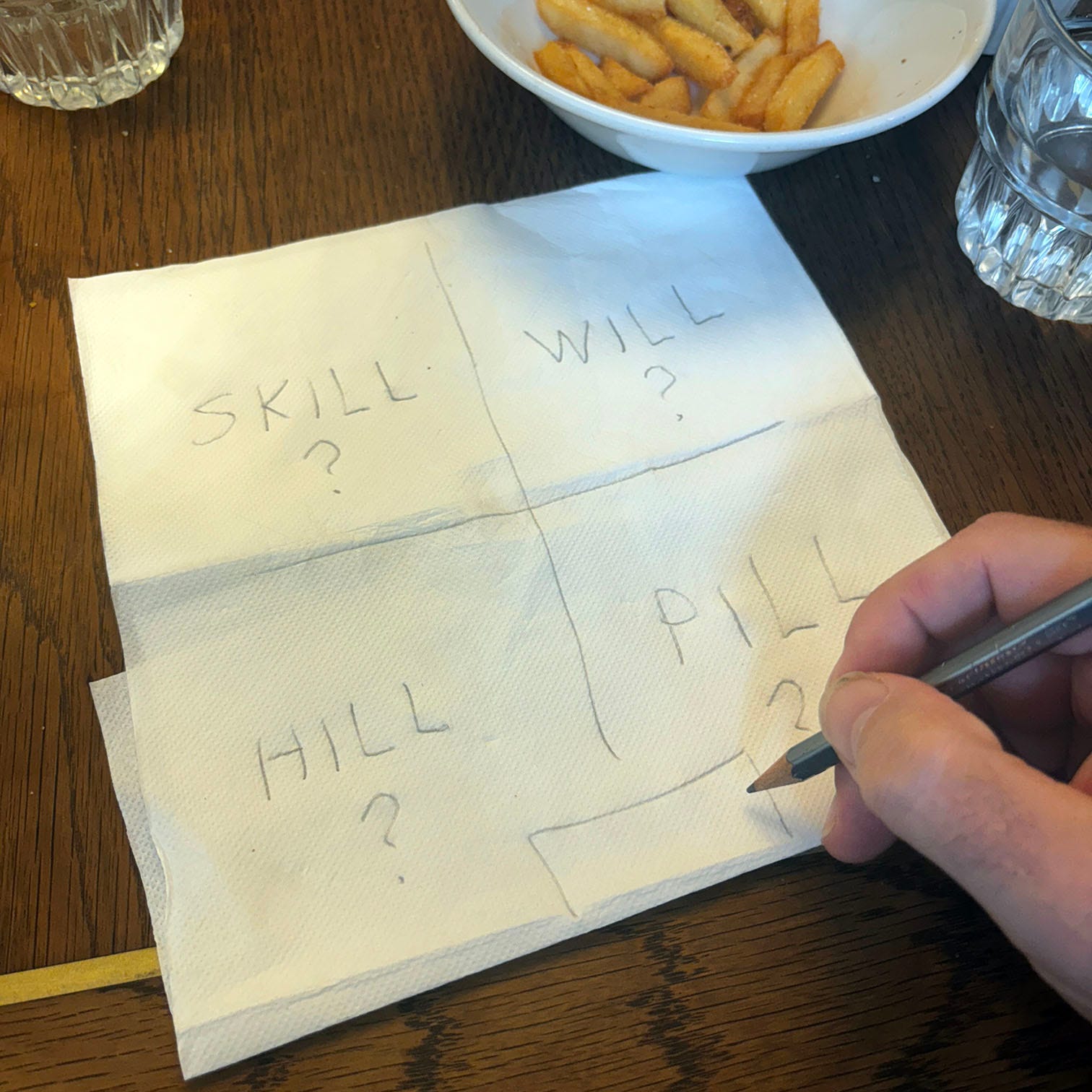
This forces you to ask: If it’s not the skills, then what else explains the gap? Sometimes the biggest barrier isn’t ability at all; it’s the environment your people are in, the systems they have to use, the supports they have to hand, or ambiguous instructions and expectations.
For instance, with the OKR team above, the bigger blockers turned out to be inconsistent processes across teams (a Hill issue) and inadequate support tools (Pill), and not lack of skill or will. Once we saw that, the solutions changed entirely.
Most common approaches – from workshops to playbooks to online learning – tend to deal with one thing at a time. But performance is inherently multidimensional. Unless you diagnose the real bottlenecks and factors, your solutions will keep circling back to the same problems.
The Performance Canvas helps you:
Surface assumptions you didn’t know you were making
See obstacles you’ve been overlooking
Reframe performance gaps in ways that generate action
And here’s the part I get most excited about. Because it’s visual, it becomes so much easier for everyone to compare and contrast multiple ideas together, because it’s right there visibly in front of them (on a whiteboard, flipchart or online collaboration space). They don’t have to hold all those ideas in their head at once.
In this way, it’s a great way to have a more insightful authentic conversation, for leadership and team sessions alike.
In this week’s paid edition of Making Sense Together, I’m sharing Performance Canvas PDF templates (including a fillable one), plus a step-by-step guide to using it with your team, including example scenarios and facilitation tips.
If you’ve ever wondered why performance initiatives don’t land even when talent and effort are present, this might be the missing piece.
Next post: 2 PDF template variations, plus how to run your first Performance Canvas session with the template.
No posts
Comments
Nothing yet. Say the first thing.
Sign in to join the conversation.