
This article is provided for educational purposes only and should not be considered medical advice. The scientific information referenced is based on published, peer-reviewed research. Any decisions regarding personal treatment or care should be made with a qualified healthcare professional who can evaluate your individual health needs and circumstances.
When we think about prevention and healthy living, we usually focus on nutrition, exercise, sleep, and reducing our exposure to environmental toxins.
Yet there is one daily habit that rarely enters the conversation: What we put on our skin.
Our skin is our largest organ. It protects us from the outside world, constantly repairing and renewing itself while serving as our first line of defense against countless environmental stressors.
And yet, many of us spend more time reading the ingredients on a box of cereal than on the moisturizer we apply every morning.
Perhaps prevention should include both.
Over the years, I’ve come to believe that prevention is less about avoiding disease than about creating the best possible environment for health.
We cannot control every environmental exposure.
We cannot eliminate every source of stress.
But we can make thoughtful choices.
The food we eat.
The water we drink.
The quality of our sleep.
The way we move.
The relationships we nurture.
And yes—the products we choose to apply to our skin.
Each choice may seem insignificant on its own; Together, they become a lifestyle.
The growing popularity of clean beauty skincare is, in many ways, wonderful news. Consumers are asking better questions. They want greater transparency. They want fewer questionable ingredients. They care about sustainability and quality.
I applaud that evolution. But several years ago, I found myself asking a different question: Is it enough to simply remove the ingredients we don’t want?
When we think about nutrition, we don’t stop at avoiding processed foods. We actively seek foods rich in vitamins, antioxidants, healthy fats, and phytonutrients because we understand that they nourish our bodies.
Shouldn’t we approach skincare with the same mindset?
Instead of asking only, “What should I avoid?”, perhaps we should also ask: “What beneficial skincare ingredients do I want to surround my skin with every single day?”
That question changed the way I think about skincare.
Growing up with my father, Dr. Mirko Beljanski, I learned to look at plants differently.
He didn’t see them as folklore or marketing stories. He saw them as subjects worthy of rigorous scientific investigation.
For decades, his work explored the remarkable biological properties of botanical compounds and challenged researchers to better understand how nature and science could work together.
That perspective stayed with me.
Throughout the past thirty years, I’ve had the privilege of following research projects, reading scientific publications, and working alongside investigators who continue to explore these remarkable plants.
So, when I think about skincare, I naturally ask myself:
If I use a moisturizer every morning and every evening, why shouldn’t its ingredients be chosen with the same care as the food I eat?
Not because I expect a cosmetic product to perform miracles.
But because I appreciate ingredients that have been selected thoughtfully, rather than simply because they happen to be fashionable.
Among the botanicals that have always fascinated me are two that emerged from years of scientific research.
One is a proprietary extract prepared from the golden autumn leaves of the Ginkgo biloba tree. Unlike traditional green Ginkgo extracts, the Ginkgo biloba extract was studied by researchers at the University of Kansas Medical Center, who found that it inhibited angiogenin—a protein involved in the formation of new blood vessels—and reduced melanoma cell invasion and angiogenesis in laboratory models.(1)
Another is a proprietary blend of carefully selected green teas originally identified by Dr. Beljanski. In laboratory studies, researchers found that this specific blend demonstrated greater inhibitory activity against several cancer cell lines than several commercially available green tea preparations.(2)
These are laboratory findings—not studies of skincare products—and they should not be interpreted as evidence that a cosmetic product can prevent or treat disease.
But they beautifully illustrate something I deeply believe.
The ingredients we choose should have a reason for being there.
Science can help us make more purposeful choices.
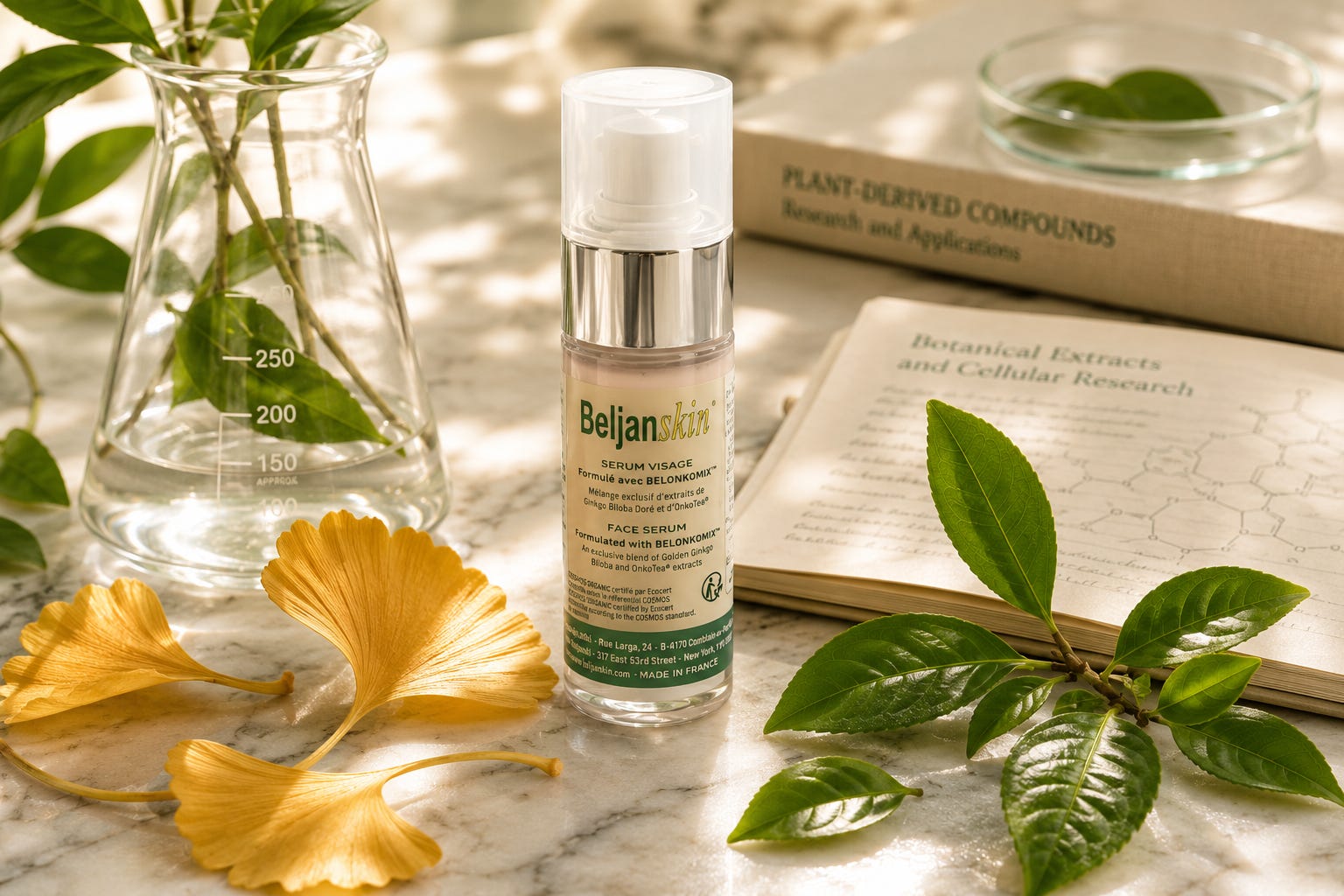
That philosophy eventually inspired the creation of Beljanskin®.
Not because the world needed another skincare brand. There are already plenty of those. Instead, we wanted to create skincare that reflected the values we have embraced for decades.
Certified organic ingredients.
European-quality formulation.
Glass packaging instead of plastic whenever practical.
Airless pump technology to help preserve the integrity of the formula while minimizing contamination.
Most importantly, botanical ingredients chosen not because they were fashionable, but because they had a scientific story worth telling.
To me, that’s the difference between marketing and intention.
Most of us will never remember the moisturizer we used on a random Tuesday morning.
But we will remember the habits that shaped our lives.
The meals we prepared.
The walks we took.
The conversations we had.
The books we read.
The choices we made, day after day, often without realizing they were shaping our future.
Perhaps skincare belongs in that same category.
Not because it replaces good nutrition or exercise.
Not because it promises extraordinary results.
But because it becomes one more opportunity to live intentionally.
One more reminder that prevention isn’t built through grand gestures.
It’s built quietly, patiently, one thoughtful decision at a time.
If this article encourages you to look more closely at the products you use every day—to ask not only what has been left out, but also what has been intentionally included—then I hope it has served its purpose.
After all, if we nourish our bodies with foods chosen for their quality and their nutritional value, why shouldn’t we nourish our skin with ingredients selected with the same intention?
Readers interested in the research behind these botanical extracts can explore the scientific publications supported by The Beljanski Foundation.
Editor’s Note: Curious what this philosophy looks like in practice? Explore the Beljanskin® collection and discover the botanical ingredients behind each formulation by visiting the Maison Beljanski website.
REFERENCES:
1- Chen P, Wang T, Chen Q. “Ginkgo biloba Golden Leaf Extract (GGLE) Inhibits Melanoma Cell Invasion and Angiogenesis Through Inhibition of Angiogenin” Integr Cancer Ther. 2023 Jan-Dec;22:15347354221134513. doi: 10.1177/15347354221134513. PMID: 36859800; PMCID: PMC9983097.
2- Chen P, Qi Chen Q. “Effects of Different Tea Products on the Growth of Cancer Cells”. EC Nutrition 14.12 (2019): 01-13.
Thanks for reading Working To Cure Cancer The Natural Way! This post is public so feel free to share it.
No posts
Comments
Nothing yet. Say the first thing.
Sign in to join the conversation.