
This year, America celebrates 250 years of independence.
For most people, the Fourth of July is a celebration of freedom, democracy, and the birth of a nation.
For me, it is also an opportunity to reflect on innovation, integrative medicine, and the extraordinary journey of ideas between France and the United States.
As the daughter of Dr. Mirko Beljanski, a French molecular biologist whose work explored environmental health and natural approaches to wellness decades before these topics became mainstream, I have spent much of my life watching ideas travel across the Atlantic.
Some flourish.
Some are rejected.
And some, curiously, find greater acceptance abroad than in the country where they were born.
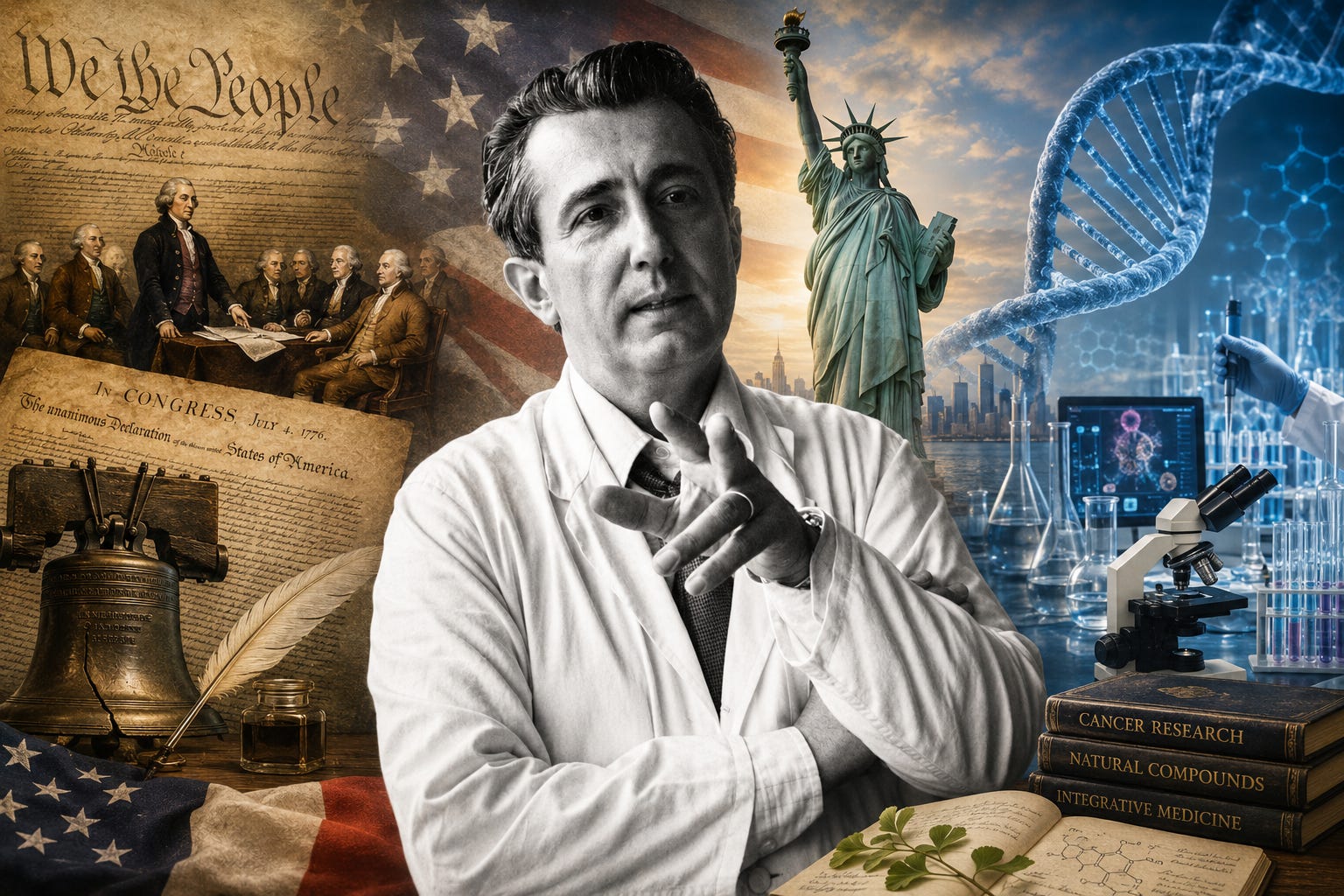
A French-American Exchange of Ideas
Two hundred and fifty years ago, the American Revolution challenged the established order and introduced a radical notion: that individuals should have the freedom to think for themselves, govern themselves, and shape their own future. Those ideas did not remain confined to America. They crossed the Atlantic and helped inspire the French Revolution.
As a Frenchwoman who has spent much of her adult life in the United States, I have always been fascinated by this exchange between our two countries.
France influenced America. America influenced France. For centuries, our nations have inspired one another.
Yet in one area, I have witnessed a surprising reversal.
Medicine.
When I first arrived in New York, I discovered a culture very different from the one I had left behind.
Americans were curious.
They asked questions.
They challenged assumptions.
Most importantly, they did not automatically dismiss a new idea simply because it fell outside the mainstream.
Sometimes they embraced questionable ideas.
Sometimes they got it wrong.
But they were willing to explore.
That openness is one of America’s greatest strengths.
America’s Openness to Integrative Medicine
Over the past three decades, I have watched the United States become a global center for innovation in integrative medicine, functional medicine, environmental health, holistic health, and patient-centered care.
Americans increasingly want to understand why they become sick, not merely which drug they should take afterward. They ask questions about nutrition, toxins, prevention, lifestyle, stress, and environment.
And they expect to participate in decisions about their own health.
In many ways, this mindset reflects the same spirit that gave birth to the nation itself: a healthy skepticism of authority and a belief that individuals have both the right and the responsibility to think for themselves.
France, by contrast, has often maintained a more centralized vision of healthcare.
The physician knows.
The institution decides.
The patient follows.
Of course, this is a simplification. Both countries have exceptional physicians, researchers, and healthcare systems. But culturally, the difference is real.
And nowhere have I seen it more clearly than in the reception of my father’s work. Dr. Mirko Beljanski spent his career asking questions that many considered uncomfortable. Long before environmental medicine became fashionable, he warned about the impact of environmental toxins on human health.
Long before conversations about endocrine disruptors, pesticides, pollution, and environmental exposures entered the public consciousness, he was studying how our environment interacts with our biology.
Today, many of those concerns have become mainstream topics of scientific discussion.
Yet his name remains relatively unknown in France.
Ironically, I often encounter more curiosity about his work in the United States than in the country where he conducted his research.
When Scientific Ideas Find Fertile Ground
Over the years, I have met physicians, researchers, practitioners, and patients throughout America who are genuinely interested in exploring new ideas, asking difficult questions, and looking beyond conventional boundaries.
That openness has allowed The Beljanski Foundation to continue a mission that began in France but found new momentum in America: supporting independent scientific research into plant-based compounds, cancer stem cells, environmental health, and integrative approaches to wellness.
That reality was impossible to ignore recently.
Hundreds of people gathered in San Diego last weekend for the Beljanski Integrative Cancer Conference.
Researchers, physicians, healthcare professionals, patients, and advocates came together to discuss innovation, prevention, integrative medicine, and the future of healthcare.
The conference received an official welcome letter from the Mayor of San Diego.
As I stood there, I could not help but smile at the irony.
A French scientist.
A French scientific legacy.
A conference inspired by ideas born in France.
Officially welcomed by an American city.
Perhaps history has a sense of humor.
Or perhaps it simply reminds us that ideas belong to no nation.
The best ideas travel.
They evolve.
They find fertile ground where people are willing to explore them.
Sometimes they even cross the Atlantic twice.
When I arrived in New York as a young French immigrant, I never imagined that I would one day find greater openness to my father’s ideas in America than in the country where those ideas were born.
Yet that is precisely what I have experienced.
The Freedom to Think Differently
As America celebrates its 250th birthday, I find myself grateful for many things. But perhaps most of all, I am grateful for a culture that continues to value curiosity.
A culture willing to challenge assumptions.
A culture willing to ask difficult questions.
A culture that understands that progress begins not with certainty, but with inquiry.
Whether in politics, science, medicine, or life itself, freedom is never simply the freedom to agree.
It is the freedom to think differently.
And that may be America’s most enduring gift to the world.
Happy 250th Birthday, America!
If this reflection resonates with you, I invite you to subscribe and follow The Beljanski Foundation’s work as we continue supporting independent research, education, and a freer conversation about the future of health.
Support The Beljanski Foundation’s research:
The Beljanski Foundation
No posts
Comments
Nothing yet. Say the first thing.
Sign in to join the conversation.