
Hello,
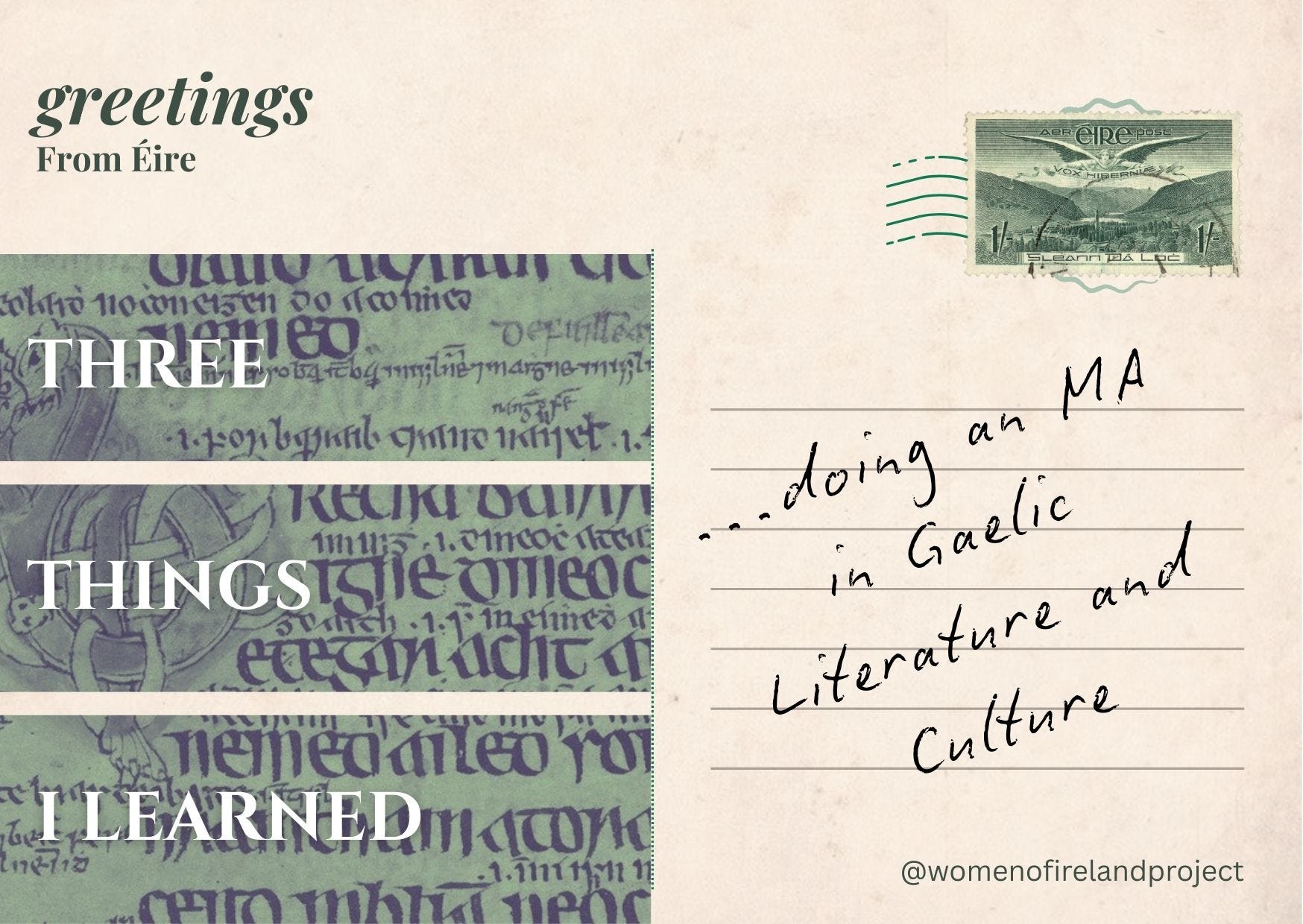
It’s been a while, I know. The last month and a half since I last shared something here (this mammoth piece on The Gaelic (Re)Revival) has been hectic and intense and I found myself lacking in both energy and time to dedicate the usual level of research depth I put into most of the pieces for this Substack. A significant contributor to this lessening of time was my rather last minute, and mad-cap, decision to do an MA in Gaelic Literature and Culture, online through UCC. It has been a very interesting and challenging experience to return to formal education and there are some weeks I can’t actually believe I’m doing it and somehow keeping on top of all the reading and coursework!
But, on the whole, it has been a fascinating first semester spent exploring the transmission and evolution of Gaelic literature (think religious texts, bardic poetry, medical texts, brehon laws, Dindsenchas (place-lore), hagiography, pseudo-history, geneologies etc.) from the medieval period up to the 19th century, and the social history of the Irish language (how it has changed and developed over time, and what has impacted it). It’s already challenged so many ‘taken-for-granted’ assumptions I had about Gaelic culture, society and Ireland’s past and given me a much clearer framework, or trellis, on which to hang and make sense of its many many complexities and nuances. And so, I thought it might be fun to reflect on and share with you here, three things I didn’t know before I started this MA in Gaelic Literature and Culture.

1. The earliest sources of written Irish are ‘in the margins’
As I write this here, I am near laughing at my own ridiculousness, but when I had previously read things about Old Irish being one of the oldest written vernacular languages in Europe, it had conjured up images of full-texts as sean-ghaelige—of lenghty tomes scribed in the angular Gaelic alphabet of insular minuscule—but that is not the case.
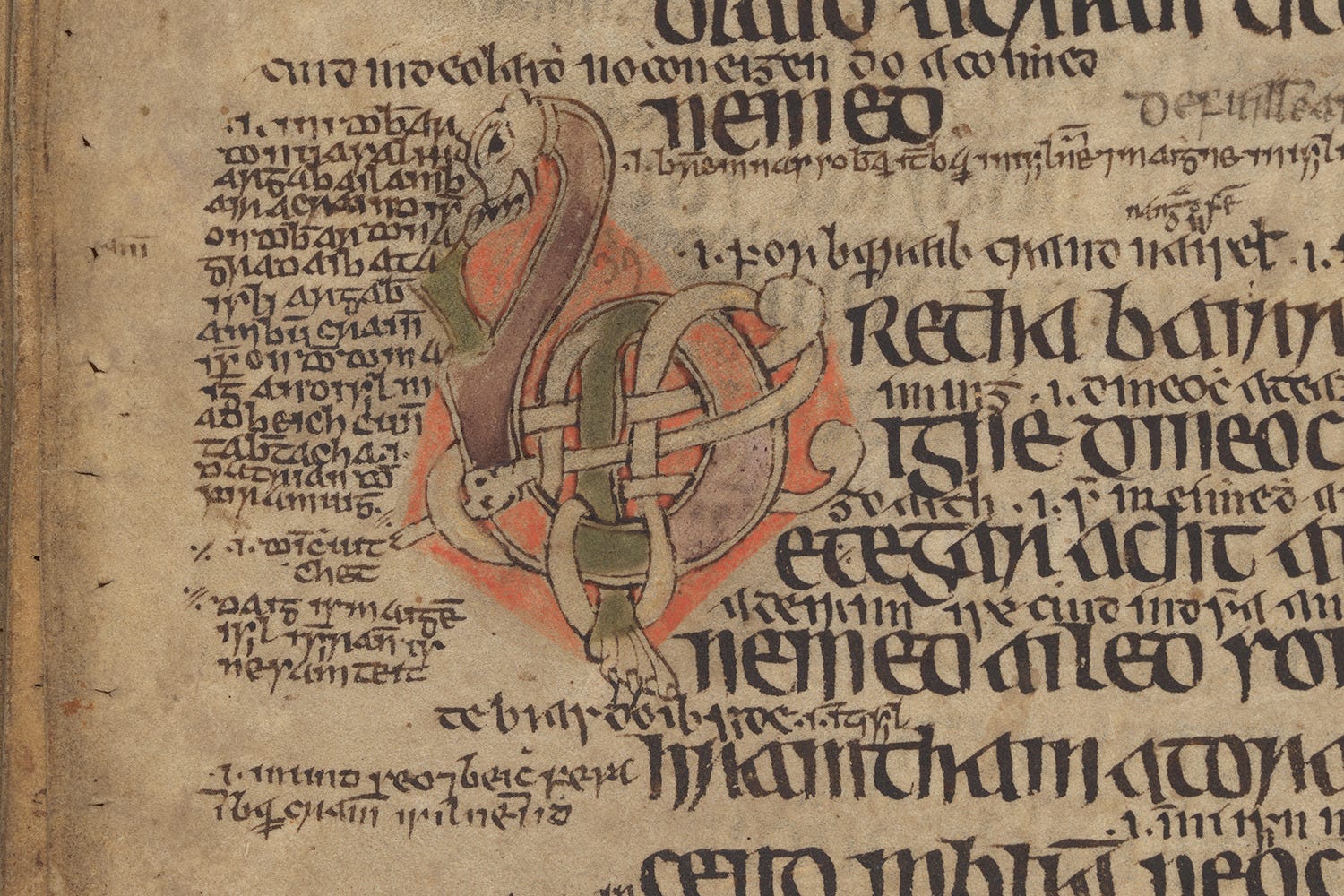
The earliest written sources of Old Irish are not ‘full-texts’ written in Irish but ‘scribbles in the margins’ of Latin manuscripts. They are the marginalia and annotations, the ‘notes-to-self’ and reflections of 6th century monastic scribes as they dutifully and painstakingly transcribed the gospels, and other religious and teaching texts, in Latin. They are notes just as we might make in the margins of a book we are reading—criticisms, thoughts, questions, explanations—while others are full-blown complaints, like the vellum they are writing on being no good, the ink being too thin, or the pain in their hands from all their scribing. They are a beautiful and relatable connection to people who lived nearly 1500 years ago, and experienced just the same pain, anguish, weariness and self-doubt as those of us writing and studying today.
One of the very oldest (or earliest) pieces of literature in Irish is a short, powerful poem written in the margins of a manuscript called the Codex Sangallensis 904 (can view it online here):
Is acher in gaith innocht fufuasna faircae findfholt
ni ágor réimm minn dond laechraid lainn óa lothlind.
Bitter is the wind tonight it tosses the ocean’s white hair
I do not fear the coursing of a clear sea by the fierce warriors from Norway
(Translated by Pádraig Ó’Macháin, course professor, who describes it as Haiku-like. Listen to pronounciation in Old Irish here)

Written in Ireland sometime in the 9th century, the Codex Sangallensis is a manuscript of Latin Grammar, later brought to the St. Gallen monastery in Switzerland by an Irish monk (indeed, in another point I wasn’t aware of, most of the sources of early Irish writing and literature are preserved in texts which Ireland’s many wandering monks and scholars brought or sent to mainlaind Europe). You can just imagine this poor monk, sat in some cold, drafty monastic scriptorium, listening to the wind howl outside and the waves rising, and the strange relief he felt in such awful weather for how it would protect him from raids from Norsemen (i.e. what we today call the Vikings). That it is possible for scholars today to piece together and make sense of Old Irish is thanks to people like him who, mid scribing, chose to jot down their thoughts, not just in Latin, but in their own language, in the margins of the manuscripts they were scribing.
2. Just how old some aspects of the Brehon Laws are:
One of the things I was most excited to learn about on this course were the Brehon Laws, or the old legal system of Gaelic Ireland which, in written form, date from the 7th century. What I wasn’t quite prepared for were just how nuanced and complicated they are. If I’m honest, I have come away even more confused and befuddled by them because, now, I have been briefly initiated into, not only their mind-breaking complexity, but also how non-homogenous they are.
The term ‘Brehon Laws’ can be somewhat misleading, as it suggests a singular, uniform legal code. In practice, early Irish law consisted of a corpus of legal tracts that were interpreted and applied by hereditary legal families (such as the Mac Egan’s, O’Davoren’s, Doran’s, and O’Breslin’s). The specific rules or judgments on any given matter could vary significantly depending on the manuscript tradition consulted, regional customary practice, and the interpretive traditions of particular schools of jurists. Gaelic society was extremely hierarchichal and family-defined—you didn’t just become a lawyer, or a poet, or a doctor, you were born into a professional family who had that skill and then passed it on to the next generation. Rather than a fixed legal code, what we today call ‘Brehon Law’ is more of an umbrella term for a dynamic and context-dependent legal tradition. So, if you were to say, “The Brehon Law’s tell us….” really what you would be meaning is that, “This particular legal text, which is part of that body of law codes we today call Brehon Laws, said this….” For example, there are notable differences in the kind of reparations that are favoured between different law texts. The Senchas Már places greater emphasis on fines—reparation by payment— while others, such as Cáin Adomnáin, highlighted the death penalty.1
But, anyway, despite the utterly befuddling complexity of them and how unbelievably detailed they are, going into the absolute minutia of how, for example, a person injured illegally should be cared for during their recovery (provided for by a whole body of legal codes known as ‘sick-maintenance’) what completely blew me away was just how old some of these legal codes are believed to be.
In “A Guide to Early Irish Law,” Fergus Kelly writes:
“It is clear from linguistic evidence that many of the essentials of the early Irish legal system go back to at least as far as the Common Celtic Period (c.1000 B.C.)”
1000 B.C!!!
Here he goes on to single out the Old Irish Legal term ‘athgabál’—which refers to distraint: the practice of seizing another person’s property or goods in order to satisfy a claim, or in reparation for an injury—as one such legal proces which can be traced back to this Common Celtic Period.
Laurence Gimmell in “The Brehon Laws: A Legal Handbook” specifically highlights how ‘distraint by fasting,’ whereby an individual who had been wronged by another, and not received their reparations, could protest against this by fasting outside the other’s property. Because of the importance placed on hospitality in Gaelic culture, the idea that someone was starving themselves outside your home was such an attack an on one’s reputation it was often enough to bring about the desired effect of ensuring that individual, often someone in a position of much greater power, paid whatever debt or goods were owed to the protestor.
Scholar Mary Condren2 has drawn on this legal to history to explain why Hunger Striking has always played such an important role in Irish political protest, especially in situations were there is a disaparity of power between the hunger striker and the individual, or entity, they are seeking reparations from. The survivors of the horrors of Ireland’s Industrial Schools, who have been driven to the point of having to Hunger Strike (for 47 days and counting) outside Leinster House to get medical cards and state pensions thus stand on the shoulders of nearly 3000 years of legal practice which, Laurence Gimmell writes, was “clearly designed in the interests of honesty and of the poor against the mighty.”
3. The decline of the Irish langauge, in the 19th century, was a gradual happening, rather than a traumatic rupture
This is the learning which has been the most surprising. The narrative I had of the decline in the Irish language was that it was swift and dramatic—cataclysmic—and was felt as a great wrench and a loss to people. Turns out that story originated in twentieth-century nationalist discourse which retrofitted a narrative of loss and trauma onto a much less dramatic reality of a gradual waning of the Irish language. As Aidan Doyle, my lecturer on the course and author of “A History of the Irish Language,” explained, when you go back and look at the 19th century (the period most associated with Irish language decline), there is a “complete absence of trauma on part of the communities which underwent change,” where their attitude to the lack of transmission of Irish from one generation to another could best be described as “casual.” It’s not until the 20th century that the narrative of language shift as a traumatic loss emerged, retrospectively, within the nationalist movement.
Similarly, the forces that contributed to this language shift are nuanced and complex. Colonisation and how it resulted in English becoming the language of the law, the economy, and administration and placed it on a hierarchy as superior to Irish, of course, underlies them all, but it’s interesting to have a sense of the various things which contributed to the decline of the Irish language.
The language was not being passed on between generations: Of critical importance for the survival of any language is its transmission, usually from parent to child, from one generation to the next. However, this intergenerational transmission had been slowly waning in Ireland. Writing in 1894, Douglas Hyde, recalled meeting “a young man on the road” who answered him in English despite Hyde having addressed him in Irish. “Don’t you speak Irish?” Hyde asked. “Well, I declare to God, Sir… my father and mother hasn’t a word of English but still, I don’t speak Irish.” Although this young man could understand Irish well enough, he couldn’t speak it, his main language was English. While that sounds entirely bizarre, it’s not so different from a child who has grown up in a household where their parent(s) speak a language which is not the dominant language of the wider society they live in— they can probably understand or grasp the general gist of what their parent is saying, but that doesn’t mean they themselves can speak and converse in that language. This was the reality in many households across Ireland in the 19th century.
Catholic Emancipation: Of course, if parents are choosing not to pass their language onto their children and are expressing a preference their child speaks English, then that is not without reason and most of those were pragmatic. English was the language of administration, of the law and of commerce, and for the first time in centuries, Catholic emancipation (i.e. the repeal of the Penal Laws) meant that Catholics could feasibly pursue a ‘professional’ career in things like law, politics, medicine and so on. A growing and increasingly confident Catholic middle-class, supported by the hierarchy of the Catholic Church, thus saw English as their ticket to greater status and power and encouraged and sought the education of their children in English.
Education system and English literacy: Another key contributor to the decline in language was that English, not Irish, was associated with literacy. Partly because few texts in Irish were printed in the form of mass publications, an had remained part of an unbroken manuscript tradition whereby books were hand-scribed and copied, and partly because that manuscript tradition favoured an elitist style of writing which honoured the codes of that manuscript tradition but did not reflect how ordinary people spoke Irish, there were very few books available to the general population to either teach or achieve literacy. Consequently, even in regions where Irish was the dominant spoken language, English was viewed as the language of literarcy—it was nearly inconceivable to people that they would learn to read and write in Irish even if this was their first-language. The introduction of the National School system in 1831 thus further accelerated this. We, today, of course recognise this system of education as just another part of the colonial playbook, however, when it was introduced the vast majority of parents welcomed its introduction, seeing English literacy as something which would enable their children to seek opportunities they could not. The Great Famine also further contributed to this view, with Irish becoming associated with poverty and English with progress in the minds of the majority.
“Histories of the Irish language written in the twentieth century all stress the negative impact of the national schools on the Irish language. One of the main attractions of the new system, from the point of view of the parents, was that English was the language of instruction. This point is brought out in the report of a schools inspector from 1856 which stated that ‘It is natural to inquire how this strong passion for education could have possessed a people who are themselves utterly illiterate . . . Their passion may be traced to one predominant desire — the desire to speak English.’ In other words, the enthusiasm for the new schools was part of the more general trend in Irish society towards becoming part of the Anglophone world.”
From Doyle. A. A History of the Irish Language : From the Norman Invasion to Independence
Irish language was not made part of Irish identity: Today, most people consider the Irish language to be a core part of Irish identity and culture, however this, again, is a relationship which was consciously created by nationalist discourse in the 20th century. In previous centuries, while Ireland was part of and adopted many of the views of the wider nation-state movement happening in Europe at the time, which called for the creation of individual nation-states identified by a unique national and cultural identity, the one aspect of that movement it did not adopt was the association between language and national identity. While other nationalist movements across Europe made language a cornerstone of national identity, 18th and early 19th century Irish nationalism did not. Phrases such as “Tir gan teanga, tir gan anam” would have baffled any of those involved in movements such as the United Irishmen or Daniel O’Connell and his fight for Catholic Emancipation. Indeed religion, not language, was what Ireland looked to, to identify the Irish as Irish. This is further highlighted by how Irish emigrants, unlike most other emigrant communities, so quickly adopted English when they moved to the United States. Numerous factors of course influence this, including the need of emigrants to quickly assimilate into a new society, and the exposure most Irish emigrants, even when majority Irish speaking, had already had to English. However, another critical factor is that, unlike other emigrant communities, Irish emigrants did not seem to see the Irish language as a core part of their identity—religion was, again, how they defined and differentiated themselves from others.
In reflecting on why some communities manage to maintain a language better than others, even when experiencing intense pressure from another, more dominant language, Sociolinguist Michael Clyne writes:
“There is evidence that the most successful language maintenance occurs in groups for whom language is intertwined as a core value with other core values, such as religion and historical consciousness or family cohesion, rather than those for whom language stands in isolation as an identity marker.”3
And it appears to be that, in Ireland, at a time when the Irish language was still the spoken, everyday language of most, there was not an intertwining of it with other critical social values such as religion or family cohesion. Rather, language was somewhat left islanded and cut-off from the other values which may have supported it. While this did, eventually, arrive in the form of the Gaelic Revival and the Irish nationalism after 1870 it was, in many ways, too late.
Thanks for reading The Women of Ireland Project! Subscribe for free to receive new posts and support my work.
Kelly, F. (1988). A Guide to Early Irish Law. Dublin Institute for Advanced Studies.
Condren, M. (1995). Sacrifice and Political Legitimation: The Production of a Gendered Social Order. Journal of Women’s History, 7(1), 160–189. https://doi.org/10.1353/jowh.2010.0375
Clyne, Michael (1997). ‘ Multilingualism ’. In Florian Coulmas (ed.). The handbook of sociolinguistics . Oxford: Blackwell, 301-314 .
Comments
Nothing yet. Say the first thing.
Sign in to join the conversation.