
I have been reflecting lately on how I want to create and what I want to share, and ‘with depth’ is the conclusion I reached. I am remarkably fortunate in that, with this Substack newsletter, the only demands of time I have are those I put upon myself. In the past I used to try and keep to a roughly 'bi-monthly’ schedule, but over time, I realised that this was forcing me to simply create content for the sake of keeping to a self-imposed deadline. I don’t want that. I don’t want you to have to read the outputs of that, and so, I am committing now (apart from the ‘general life update’ pieces I write now and then) to only sharing with you here something that has lived with me for a while. Something which has spent long being mulled over in my thoughts, and something which has emerged from, what is often, a lengthy research process.
This essay I share with you here, now, is just such a piece. The idea for it came to me a few years ago. I wrote the first words at the end of last year, and I have spent from January until now researching it on and off. Is it perfect, no, but is it a topic that I have given a level of depth and time to that I feel happy enough to share it with you, yes.
For this reason, it is a long piece and, if you receive this by email it will likely be truncated, so it might be best to read it either in the Substack App or Online.
The ‘Women of Ireland Project” is free for all to read and share, and I so appreciate everyone who takes the time to read my words and who share it with others. However, if you have found something meaningful here, or in the past, and would like a way to support my ongoing work, research and writing, you can “Buy me a coffee” via the link below.
Walking side-by-side through the streets of Dublin, wearing their “Irish costume” of “blue-green” dress, covered by a “brath (cloak) of the same colour,” adorned with embroideries” of “two snakes eating their tails” copied from “the Book of Kells,” pinned at the chest with a “little silver harp fastening the brath” and accessorised with a “blue-stone necklace,” a “silver Claddagh ring and a silver snake bracelet,” Mary Colum1 and her good friend Siav Trench cut the dashing pair.2
It was the late 1890s and the two young women were on their way to a meeting of the Gaelic League (an organisation founded in 1893 to promote Irish language, culture and national identity). En route they passed a ‘fishwoman’ selling her wares who, hardly missing a beat, took one look at them and called out:
“Will yez look at the Irishers trying to look like stained-glass windows! What is this country coming to at all? Them Irishers are going daft!”3
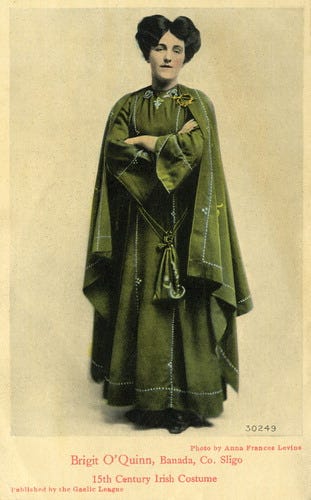
Since first encountering these mordant words of this 19th century ‘fishwoman’ in Ann Matthews book Renegades, several years ago, I will admit to having thought of them on more than a few occasions, quietly chuckling to myself at her penetrating wit, usually while stood among a crowd gathering to see in a seasonal festival at one of Ireland’s many ancient, sacred sites. What would the same woman make of those of us who flock to places like Uisneach each year for quarter days and solstices, were cloaks, shawls, and a general style which, for want of a better phrase, I’m going to just call ‘retro-pagan,’ is not uncommon, I wonder?
I don’t say this to mock—my own mother is an ordained priestess in the Irish pagan tradition, and I saw the years of work, study and deep self-analysis she had to go through to achieve that. As part of that journey, she was required to hand-make her own cloak and attire upon which was sewn and embroidered imagery of symbolic importance. It is a beautiful and entirely personal work of art.
Regardless of your views on such things, I feel you would be hard pressed not to recognise the symbolic weight in something made with such intention and meaningful purpose. And I imagine that this was exactly what “Nellie Bushell, a linen-weaver from Newmarket Street in Dublin4” was seeking to do when she made and designed an ‘Irish costume’ to inspire, reignite and represent a unique sense of Irishness among the female members of the Gaelic League at the end of the 19th century.
So, I share this story of the ‘fishwoman’ and the ‘Irishers,’ not simply to ponder on the symbolic power of clothing but to highlight the parallels between that past and our present. For what was happening in the Ireland of Mary Colum and Siav Trench (of which their ‘Irish Revival’ dress was but one of expression of it) bears, I feel, distinct similarities to what is happening now.
Contemporary Ireland is undergoing and experiencing a Gaelic Revival. It’s the 21st century version of the 19th century one, so I’m going to call it the Gaelic Re-Revival. And I notice it, I see it happening everywhere—distinguished and sparked by similar patterns and themes as its 19th century precursor—in so many different areas of art, culture, spirituality, community, folk practices, storytelling, fashion and music.
It’s there in the surge of interest which seems to be growing all the time, in everything to do with Irish culture, heritage, craft, nature, story-telling, language, music, spirituality, myth, dress, healing, sport, art, and history. Things which would have been dismissed a few years ago as twee, old-fashioned, archaic, or even “woo woo” and “hippy-dippy nonsense” are going mainstream and capturing the imagination and interest of a whole new generation of people, both in Ireland and across the world, as they do.
Things like:
The Resurgence of interest in the Irish language and the work of many to deinstitutionalise it from the school setting most of us learnt it in:
Here I think of incredible múinteoirí like Mollie Guidera, and movements such as those of Scoil Scairte, along with Census statistics showing a growing increase in those claiming some fluency. And that is without even mentioning the more intangible fact that the Irish language has undergone a cultural and psychological reinvention—it’s ‘cool’ now. Or the pivotal, instrumental, role people in Northern Ireland are playing in keeping the language alive and breathing. (I once heard a speaker from, and representative of, a Gaeltacht region say, near moved to tears by the immensity of what he was feeling, ‘That Northern Ireland was going to save the Irish language.’)
The Revival of, and desire to reclaim and keep alive, older customs, crafts, arts, skills, technologies, healing and folk practices, sports, and modes of life:
I could list so many things here. From indigenous forms of basket-making, to the social practice of going rambling, to rekindling the art of keening, Irish herbalism and folk healing practices, Teach Allais (sweat-houses), farming with native breed animals and traditional systems of soil management, the recording and reclaiming of disused Holy Wells and the revival of the venerative customs associated with each, even the growing interest in Brehon Law, Ireland’s ancient legal system and, in the realm of sport; stone-lifting and bataireacht (the martial art of stick-fighting).
The Reclamation of Irish ‘Celtic’ Spirituality:
I apply the term Irish ‘Celtic’ Spirituality to loosely cover so many different forms, facets, and happenings relating to the spiritual and the imaginative, the sacred and the ritual in Ireland. Some might come under the umbrella of neo-paganism or animism, but more generally they are the things considered ancestral, ancient, and indigenous (and/or pre-Christian or pre-Colonial) and which people adopt as (or engage with as part of) a spiritual practice or paradigm, and/or view as sacred, healing, divine, numinous, ceremonial or enchanting.
Simply put, it is the reclamation, or revival and reimagination, of the rituals we believe our ancestors practiced and the paradigms which shaped how they connected with the world around them. And I see the material manifestation of this reclamation in the increasing-by-the-year numbers of people attending ancient, ceremonial sites like Uisneach, or Brú na Boinne (Newgrange) to celebrate seasonal festivals, and the growing desire for retreats, workshops, courses, teachers, circles, festivals etc. which offer something in this regard. The ‘woo-woo’ has never been more mainstream, and there seems to be a particular draw, globally, to the spiritual and ritual practices of the ‘Celtic’ lands.
The Reimagining of Irish cultural motifs and symbols in newer, contemporary forms
In fashion, music, visual art, film-making, dance, poetry, literature, and nearly every other form of creative expression I can think of, cultural motifs, sounds and symbols of Ireland are being re-imagined in a way which nods to their heritage and origin, but updates, reenvisions or repurposes them in a way that speaks more to contemporary culture and reflects a more diverse and multicultural Ireland. This seems to be happening big-style in the realm of fashion and music.
But above all, I want to call this 21st-century resurgence of interest in Irish culture the Gaelic Re-Revival (and I am certainly not claiming to be the first to have used that phrase) because I see that it too is: (i) a movement that is responding and reacting to similar things which sparked and drove the original movement in the 19th and 20th century; (ii) that it similarly looks to the past for inspiration to (re)imagine, (re)create and (re)affirm Irish identity and express an sense of Irishness, and (iii) just as the 19th century and 20th century movement was first and foremost a movement of imagination—a movement of creation, art, story and creativity— so too is this contemporary one.
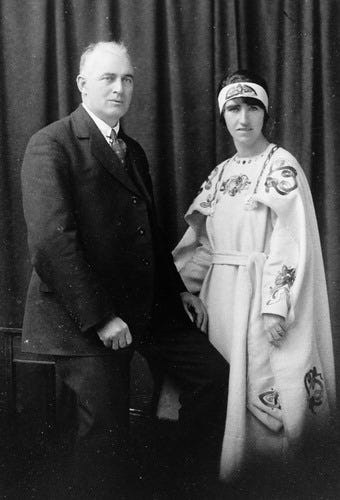
“Not until the mid-eighteenth century does the first formulation [of a modern nationalist idea of Ireland] appear, in the works of a small group of antiquarian scholars who, pleading for a rejection of the destructive English images of the Irish past, advocated a revival of national life by the return of their fellow Irishmen to the authentic wisdom encoded in the distinctive linguistic, literary, religious and political culture of their ancestors. [The Gaelic Revival was one of] three ethnic revivals which, from the eighteenth century, sought with growing intensity and sophistication to 'return' to an identity in Ireland's Gaelic past that would dichotomise Ireland from England, unite the members of its different religious and social groups, and provide alternative models for national economic, social and political development”
Pg. 14 in Dynamics of Cultural Nationalism: The Gaelic Revival and the Creation of the Irish Nation State by John Hutchinson
The 19th and 20th century Gaelic Revival is synonymous with names like W.B. Yeats, Lady Augusta Gregory, Douglas Hyde, J.M. Synge, Eoin MacNeil, Standish O’Grady, George William Russell (aka Æ), Michael Cusack, Maud Gonne and, towards its latter years, Patrick Pearse. As a term, it encompasses the plethora of different literary, cultural, poetic, artistic, spiritual, sporting, linguistic, and social movements that co-occurred in the late 19th and early 20th centuries, and which centred on the restoration and reinvigoration of the Irish language, culture, folk ways and national identity.
Or at least that is how it is generally introduced. In truth, what it exactly was, or how it should be captured has had those who have studied its artistic outputs, numerous organisations and figure-heads trapped in heated debates for decades—Was it really a Revival, or rather a Renaissance? Is it appropriate to group all of the disparate and disconnected organisations, and artistic developments which emerged in this period under the one umbrella term? Can it really be thought of as a cultural movement when it was largely driven by a small-group of idealistic, middle and upper-class elites who romanticised the life-ways of the rural poor, in particular, and did not reflect the interests or realities of those whose culture it claimed to revive? (As historian Dr. Ann Matthews highlights, the comment of the ‘fishwoman’ about the ‘Irishers’ exemplifies the “chasm” that existed “between those involved in the nationalist movement and the general population5”).
What is clear, however, is that from around the 1880s onwards, Ireland experienced a moment—at first among its artists, intellectuals, and cultural leaders—of renewed interest in all things Irish. And that moment grew into a movement of imagination—a movement of inspiration and creativity, a movement of art, story, beauty, mysticism and romance, inspired by, and responding to the idea of a glorious and ancient Gaelic past—and it ‘imagined’ the place we today call Ireland into existence.
But like all movements, the Gaelic Revival cannot be separated from the wider social, political and historical context within which it occurred, nor can the form its imagination took be understood without understanding what it was reacting to; what it was responding to.
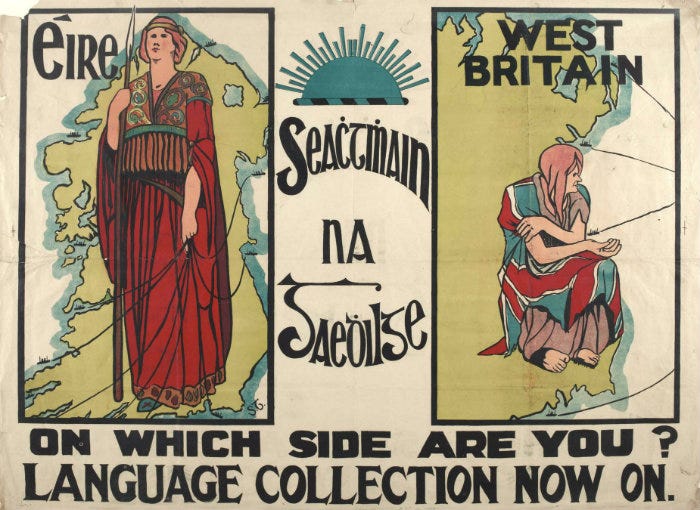
The Gaelic Revival was wrapped up in, and influenced by the growth, across Europe, in the 1800s in cultural and political nationalism and the idea, which we now know as the ‘nation-state,’ that a group of people who share the same language, culture and history should be distinguished from others as their own, independent sovereign state. Within this were increasing anxieties about racial purity, fears of hybridisation and the need to protect a people’s cultural or national identity from imagined threats to that purity.6
But the successful creation of a nation and a national identity relies largely upon the ability of one group to successfully differentiate themselves from an ‘Other.’ To legitimise their claims to nationhood by identifying and expressing what makes them unique, or different, to that ‘Other.’ In Ireland’s case, for reason of England being it’s colonial oppressor and nearest neighbour, this ‘Other’ was always England.
However, in the 19th century, Ireland worryingly appeared to be failing in that regard—it had, and was, becoming Anglicised. The things which set it apart from England, such as the Irish language, having waned dramatically in the face of the Penal Laws, the Great Famine, the late 1800s establishment of the national school system, and a wide acceptance among the population that it was better, more useful, to speak English.
Yet, expressions of the fear that Ireland was ‘losing herself’ to Anglicisation and that something needed to be done about it, did not come, as we might expect, from the Catholic nationalist movement we tend to more strongly associate constructions of Irish identity with. Catholic nationalists were largely accepting and pragmatic about Ireland’s hybridity. The “Great Liberator” Daniel O’Connell, who had fought for Catholic emancipation, famously discouraged the speaking and teaching of the Irish language on practical grounds, believing it was better for children to speak English so that they could make their way in the world. Instead, anxieties about hybridisation and fears about what this may mean for an Irish national identity, were coming from a group you may least expect—The Protestant Ascendency, that group most often thought of as the Anglo-Irish.
In what is widely considered one of the founding texts of Irish cultural nationalism, it was Protestant Douglas Hyde, who argued for the “Necessity for De-Anglicising Ireland” and expressed his heart-felt urge for Ireland to be “herself,” by recognising, championing and encouraging the promotion of the things which set Ireland apart from Britain (most especially the Irish language). Out of his fear of what Ireland stood to lose, Hyde would go on to found the Gaelic League, an organisation whose mission was to revive the Irish language and promote a unique Irish cultural identity. In this way, the Gaelic Revival was first and foremost a movement of a middle and upper class Protestant, artistic and literary elite.
However, the Ireland at the time of the Gaelic Revival didn’t know itself, it didn’t have a clearly expressed identity or sense of what made Ireland Ireland. This may sound strange to us today, so accustomed and inculcated as we are into the symbols and motifs of Irish national identity. But we forget that the very things which we think of as ‘Irish’ today originate, not in time immemorial, but in the 19th and 20th century Gaelic Revival.
As Declan Kiberd writes in Inventing Ireland, the Ireland of the 19th century was “a sort of nowhere, waiting for its appropriate images and symbols to be inscribed in it.” Before Irish national identity found solid form in the political nationalist and revolutionary movements of the 20th century, it was first imagined into existence through art (story, poetry, myth, painting, literature, drama, and so on). It was the poets, the writers and the artists who created the idea of Ireland we still carry today, long before political leaders began to put it into action.
Yet, even artists need some form of inspiration for their imagination, and it was here that the wider European context within which the Gaelic Revival took place would once again shape how it responded to fill the void of Irish national identity.
The Gaelic Revival and the Romantic Movement
The Gaelic Revival was part of the wider ‘Romantic’ artistic and cultural movement, that emerged in the late 18th century, and which emphasised emotion, imagination, nature, folklore and a glorification of an ‘authentic’ past. Critical to understanding the Romantic movement is to know that it was reactionary. It was reacting to the sense of what was being lost in the face of modernity, rapid industrialisation (especially in Britain) and the rationalism of the Enlightenment and it sought to counter this by creating a vision, and a return, of an idyll of a simpler, rural past, championing it as the origin, or more authentic form, of the people.
To understand it, and how it grew out of a longing of an industrialised, ‘civilised’ people for a rural and primitive, ‘simpler’ past, I can think of no better description than the following offered by William Irwin Thompson:
"There was Elizabethan England. The men of that time wished to forget the Wars of the Roses, the crude, vulgar days of baronial strife. The story of Elizabethan England is one of zest for the present, for the new Italian clothes, the new refinement, the new literature, and the New World. The land was coming to consciousness of itself in a city; civilization and elegance were the exciting values of the time. But excitements cannot endure forever, and even civilizations are subject to boredom and changes of interest. A century and a half would make any nation bored with civilization and elegance. By the middle of the eighteenth century a gentleman seated in a rococo drawing room might look out of the window at some wild and rugged prospect and think of the country as a place holding some values the city had overlooked. In a quiet mood, he might dream fondly of the good old days. He would dream, not of civilization, but of a simple community; not of elegance, but of energy; not of the city, but of the moor or glen. In Tudor days the country folk were moving into the city and doing their best to become refined. The country held no romance for them, but painful memories of drudgery. The myth of the pastoral landscape where the shepherd sweetly pipes to his innocent lass is the dream of a busy man of city affairs. To an eighteenth-century London gentleman, the descriptive poetry of primitive places, the meditations among ruins, the Norse and bardic odes of Gray, and most sensationally of all, the lays of Ossian by James Macpherson, offered a new mode of consciousness. We have since named this mode Romanticism, and the Irish Literary Renaissance has its beginnings in this larger movement."
If it wasn’t Thompson’s direct reference to the 18th century, such a description of a desire for a slower, pastoral way of life free from the pressures and trappings of modernity could just as easy be a description of current times, and the yearning many of us have today to quit the day job and go hide in the woods or live on a small-holding. Social media’s aestheticisation of such pastoral ideals in trends like ‘cottagecore,’ ‘cabincore’ and ‘slowliving’ are perhaps today’s version of this Romantic Movement of previous centuries. And just as today’s trends look to the past for inspiration, so too did the Romantic movement, turning as it did to medievalism, folklore and ‘peasant’ traditions, in the belief that within them was contained an ‘authentic’ past.
It is from within such an artistic movement, and it’s search for the primitive and ancient ‘truer’ origins of society, that a previously unheard of interest in nature, folklore, the mysterious and the mystical began to emerge. In Germany, for instance, the Grimm brothers began their collecting of fairy tales and Germanic myth and folklore, and in Scandinavia a similar movement began with renewed interest in old Norse and wider Scandinavian poetry, story and myth. But more relevant to Ireland and the emergence of ‘Celticism’ was the publication of the “Lays of Ossian” by Scot, James MacPherson.
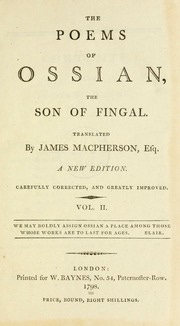
A sensation across Europe, they told the myths and legends of Óisín, his father Fionn MacCumhaill and their famous band of warriors, The Fianna. In keeping with the wider Romantic movement and it’s search for ‘national origins’ and an ‘authentic past,’ MacPherson presented these tales as evidence of a proud, older, heroic Gaelic warrior culture that had been lost but which still lived on in the stories told by the Gaelic speaking locals where he grew up in Scotland.
But what enthralled many in the Romantic movement angered those in Ireland. To them, MacPherson had stolen a unique Irish history, appropriated Irish, not Scottish, heroes, and refused (to their minds) to address that the Scots only had those stories because they were Irish in the first place. Faced with a Scot threatening to claim the primacy of the Celtic mythical hierarchy by ‘stealing’ an Irish story for their own, many scholars and folklorists in Ireland suddenly developed a a keen interest in Celticism—In reacting to MacPherson, they discovered a previously overlooked and forgotten source of national pride in the golden Gaelic past contained in Ireland’s myths and legends.
“Unkind as Macpherson was, the Irish are in his debt, for his embellished version of the detritus of Irish sagas that he encountered in the Highlands started the gradual landslide of Celtic materials. Soon after the poem's publication, newly founded Ossianic societies rediscovered the imaginary island of Finn, Oisin, and Cuchulain.”
Pg. 6 in “Imagination of an Insurrection” by William Irwin Thompson
This reaction, both to MacPherson and those inherent to the wider Romantic Movements response to modernity, is, on many levels, why our sense of Irishness today is still so strongly connected to Celtic mysticism and the idea of a heroic, Gaelic past. Because, it was in these mythical tales, the stories carried down in the oral traditions, and the manuscripts of the early medieval Irish scholars that the artists of the Gaelic Revival found Ireland—an Ireland that was different and unique to Britain because of it—and this Gaelic past became the basis from which they imagined, or as Declan Kiberd explains, invented Ireland.
Yet, beyond anxieties about Anglicisation and the dominant influence of the Romantic movement on the artistic endeavours of the late 19th century, there was a further force driving the Gaelic Revival’s focus on the past—the dominance of the Pagan Survivals hypothesis in 19th century antiquarian and intellectual thought.
The Gaelic Revival and the influence of ‘Pagan Survivals’
Influenced by the evolutionary models which were in vogue in the 19th century, many of the early folklorists and Celticists adopted a view that human society had evolved through various stages from the barbarous and primitive, until eventually culminating in the civilised and ordered world of modern European society. Within this framework, the customs, rituals, superstitions, and oral traditions that persisted in remote rural communities (such as the West of Ireland and the mountainous, remote regions of Europe) were interpreted as ‘Pagan Survivals’—fragments of an earlier, more ‘primitive’ stage of human culture that had somehow endured into the present.
Rural ‘peasant-folk’ came to be idealised as living fossils who could be observed and mined for knowledge of an ancient past which had been lost elsewhere to the polluting encroachment of modernity and industrialisation. Such a view completely overlooked the fact that people and their culture, no matter how isolated, are never static, but grounded as it was in 19th century hierarchical ideas about the ‘simplicity’ of the peasant, this was not a factor considered at the time.
“What are called the popular customs of a nation are always best preserved by the agricultural and village portions of the population, a class especially numerous in Ireland from the fact that the peculiar political conditions of the country compel the great bulk of the people to draw their living directly from the soil, leaving them but scant opportunity to acquire an education or to become familiar with modern progress.”
Extract from a talk given by James Mooney, close friend of Douglas Hyde, to the American Philosophical Society, in 1889.
In Ireland, the notion of Pagan Survivals carried even greater weight and influence than elsewhere in Europe, because (i) English colonial discourse had always cast Ireland and the Irish people as more primitive, uncivilised and backwards, and (ii) the painters, writers, poets and folklorists of the Gaelic Revival, influenced by the Pagan Survivals hypothesis, believed that the ‘true, Gaelic’ past they sought could be found among the rural poor and, in response to that colonial discourse, saw the ‘humble Irish peasant’ as the one member of society not tainted by colonisation and Anglicisation.
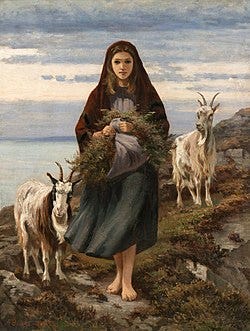
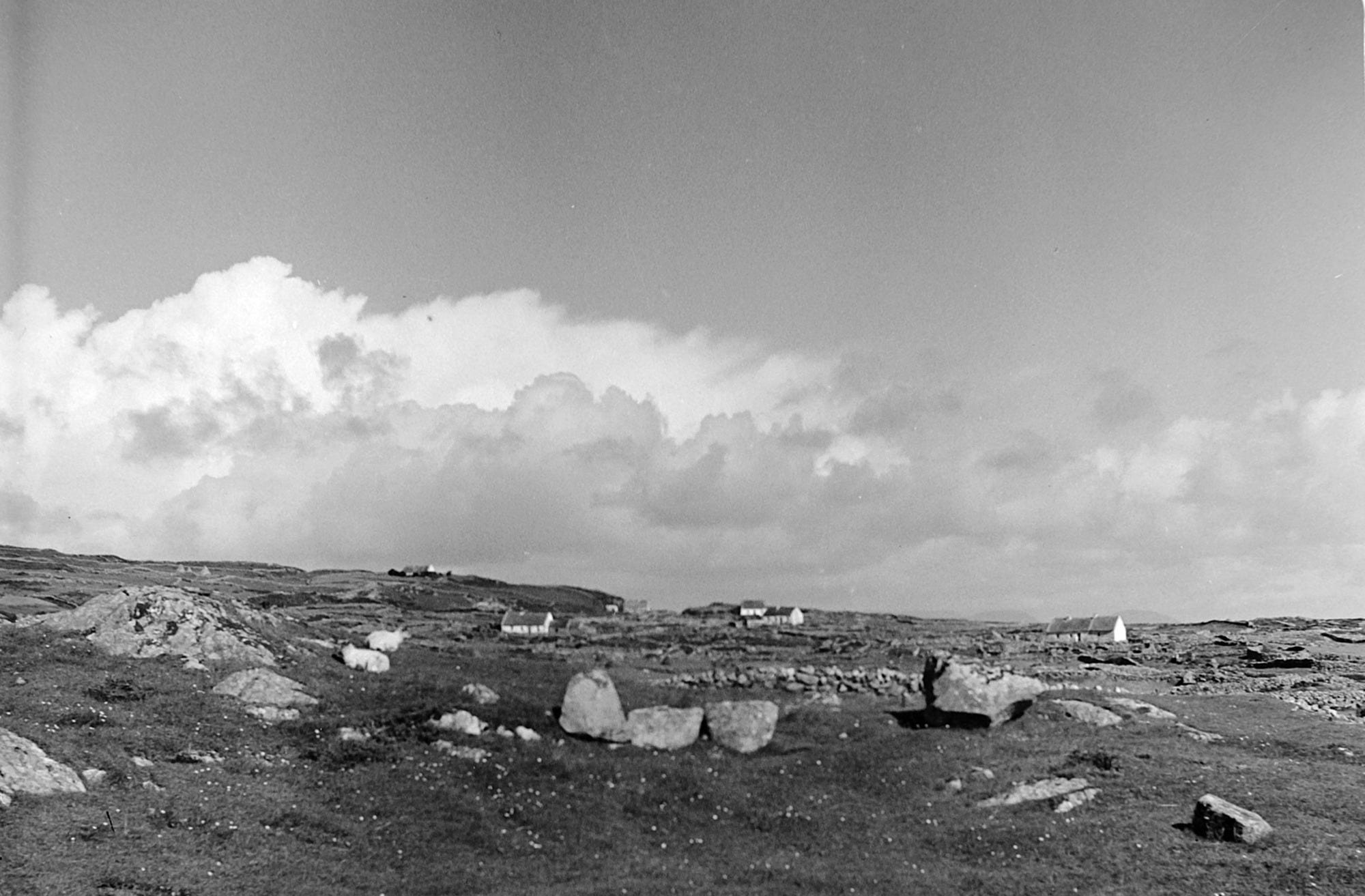
Learned city-folk—scholars, enthusiasts, amateur folklorists, writers, artists and other intellectuals of the time—flocked to the Rural West and the islands off the Atlantic coast, both to learn the Irish language and because they believed that such remote and ‘primitive’ places were the last great repository of this ancient culture MacPherson had awakened them to. As one inhabitant of the Aran Islands would later remark, “Believe me there are few rich men now in the world who are not studying the Gaelic.”7 For artists and cultural revivalists of the Gaelic Revival, the cottages of ‘rural peasants’ were the last stronghold of an ancient, proud, pre-colonial Irish culture; to walk across the threshold of their white-washed cottage, was to walk back in time 700 years.
This ‘Looking West,’ to the folk and oral traditions of the Rural West of Ireland in search of a ‘true’ Irish identity, is critical to understanding where the motifs, symbols, ideals and images we still think of today as uniquely ‘Irish’ come from. For it was in this search for a living, untainted, unchanged, glorious Gaelic past in the remote West of Ireland that so many of the images from which Irishness was constructed originate:
“When the Literary Revival emerged at the end of the nineteenth century, poets and playwrights such as George Russell, W.B. Yeats, Lady Gregory and J.M. Synge looked towards native themes for inspiration as they were considered important to those involved in Irish cultural life. By the turn of the century, the West and its traditional culture formed an expression of a national identity that had rural, pastoral and ancient Celtic overtones.”8
However, there was another reason why the pastoral, agrarian idyll of the rural peasants’ way of life, and its framing as ‘truly Irish’, was so compelling to the artistic and intellectual elites at the heart of the Gaelic Revival—it provided the Anglo-Irish Ascendency a way to legitimate their position in society.
The Gaelic Revival and Anglo-Irish Anxiety
The Gaelic Revival largely originated among, and was championed by, a Protestant and Anglo-Irish elite (Think W.B. Yeats, Lady Gregory, Douglas Hyde). Modernisation was particularly worrisome to this group because it threatened their status in society—their power and influence largely rested in their role as owners of large estates worked by a tenanted, ‘peasant’ class of small-holders and labourers. Promoting a bucolic idyll as the nature of true ‘Irishness’ and bolstering the idea of Ireland as a rural, pastoral society whereby the ‘happy peasant’ and the morally upright landlord co-existed in hierarchical harmony, bound together by a set of shared cultural values and beliefs, was thus in their interests. In this way, the Gaelic Revival was as much about reviving Irish culture as it as about affirming the place of the landed class within that culture:
“The Gaelic revival was initially fostered by a Protestant elite anxious to reaffirm its place in Irish society at a time when it faced political marginalisation and when an increasingly strident political rhetoric identified Irishness with Catholicism. The Protestant Young Irelander movement of the mid-nineteenth century began the revival of Gaelic at a time when Catholic nationalism professed a distaste for the Irish language on utilitarian grounds.”9
This vision, or interpretation, of Ireland’s ‘true nature’ as rural and agrarian sits at the centre of so many of the texts and artworks which the Gaelic Revival produced, and came to be a core paradigm of Irish identity adopted and championed by many of its key actors.
The great writer, poet, painter and theosophist, William George Russell, or Æ, for example, edited a paper called “The Irish Homestead.” It was a paper which promoted the belief that co-operative agriculture should be the basis of Irish society. Fully entrenched in the ideal of the ‘pure Irish peasant,’ as well as being a theosophist and thus “immersed in a belief system which looked to the past,10” Æ believed that the poorest of Ireland’s rural peasants, those who lived in the remote mountain regions of the rural West, were possessed with an “innate dignity and closeness to the spiritual world.11” He saw the communal, family-oriented system of farming they lived, as well as the spiritual belief system he perceived they exemplified, as the ideal antidote to the materialistic and individualistic scourges of the modern world. Thus, the “cultural future of Ireland envisioned by Æ was premised on the adoption, as a national standard, of the lifestyle and values of the small-scale farming class—simple and anti-materialistic as he perceived them.”12 Critically, however, he saw how creating this ‘true vision’ of Ireland would both require and create a new role for the Anglo-Irish; they would be the cultural and intellectual leaders of the nation, thus mantaining their position in the hierarchy whilst also, paradoxically, promoting communality and co-operation as the nexus of Irish society.
In their search for a ‘true Ireland,’ and in reaction to modernity, hybridity and their waning status in society, and influenced by the closely intertwined siblings of Romanticism and Pagan Survival theory, the predominantly Anglo-Irish cultural leaders of the Gaelic Revival looked West in search of a ‘true, authentic, Ireland.’ And from their idealised conception of its ‘noble peasants,’ white-washed thatched cottages and bucolic landscape—the last keepers of a mighty Gaelic culture—they created an image which would become the cornerstone of Irish national identity. As Professor of Human Geography, Catherine Nash explains, the Rural West of Ireland was placed at the “centre” of a complex web of images, stories, words and symbols, all intertwined with particular ideals about “racial and cultural identity, femininity, sexuality and landscape,” which would eventually be used as the basis from which “ cultural identity and political freedom” would be sought, legitimised and secured.13
In sum, the Gaelic Revival of the 19th and 20th century was a knot of interrelated and diverse cultural, literary, artistic and mystical movements (and many others I haven’t even mentioned, like the GAA) reacting to an even more complex set of social, cultural and political factors prevalent in that epoch: modernity, industrialisation, the concept of nationhood, anxieties about hybridity and racial purity, romanticism, the theory of pagan survivals, and the shifting social status of the Anglo-Irish, colonisation and so many more.
But seeing how this movement reacted to those forces is critical. For it is the Gaelic Revival’s focus on a romanticised and idealised ancient Gaelic past, believed to still exist among the rural peasant, as the source-material for both the revival and reimagination of Irish culture and identity, that is the most important thing for understanding how and why the political nationalism which grew out of this cultural revival constructed Ireland as it did.
From cultural revival, to political nationalism and the construction of the nation-state
“We have now a literary movement, it is not very important; it will be followed by a political movement, that will not be very important; then must come a military movement, that will be important indeed”
The words of Standish O’Grady, recorded from a night in 1899, in Yeats’ Autobiographies
These prophetic words of Standish O’Grady did indeed come to pass; the imaginative and artistic movement of the Gaelic cultural and literary revival developed into a political nationalism which sparked the military, revolutionary years of the early twentieth century and ultimately led to the independence of the 26-county Irish Free State from Britain in 1922.
If ever you are in need of evidence of the power of art and story—of the power of imagination and creation—and it’s capacity to move and change things in the world, then you need not look much further than Irish history; the relationship between cultural and artistic imagination and practical action have always been direct in Ireland. As the artist Beatrice Elvery later recounted (with no small amount of horror), a painting of hers, Éire, purchased by Maud Gonne and donated to Patrick Pearse’s school St. Edna’s, had, according to one former pupil, “inspired him to want to die for Ireland”14—such was the power of the nationalist iconography, which had originated in the previous century’s Gaelic Revival, to rouse and inspire both feeling and practical action among a new generation of Irish nationalists.
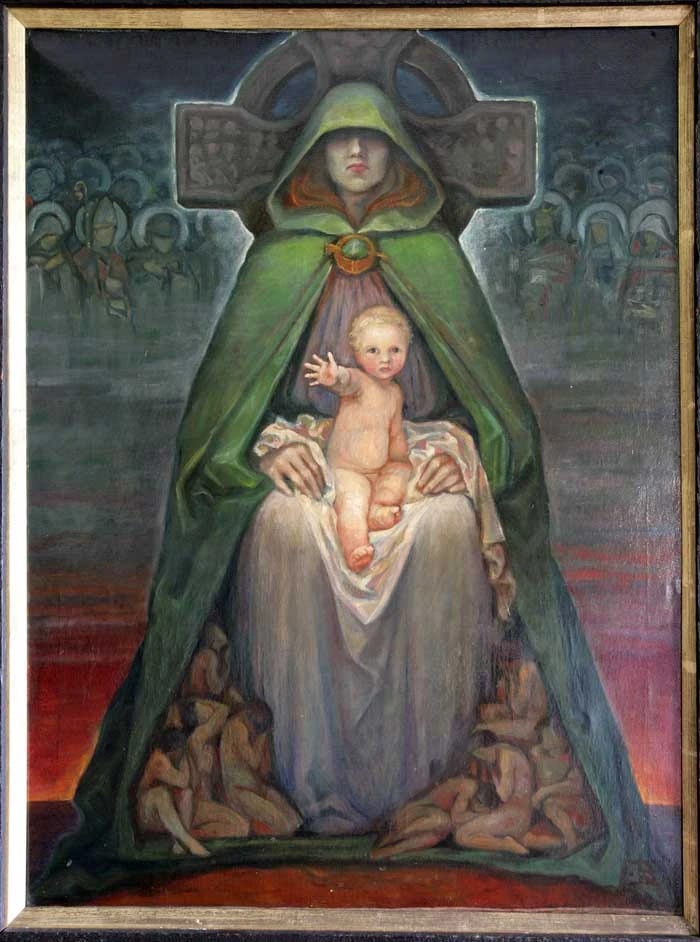
In the early twentieth century, as cultural nationalism began to give way to political nationalism, the symbols of Irish identity which had emerged from the Gaelic Revival’s reimagining of the past developed into firmer, established symbols of Irish identity. More importantly, they were what enabled Ireland to differentiate itself from Britain and thus legitimate both its claims to sovereignty, and later, its existence as an independent state.
If Britain was modern, urban, industrial, individualistic, imperialist, rational and Protestant, then Ireland was traditional, rural, agrarian, communal, republican, spiritual and Catholic. Now, the vision which the Gaelic Revival had created—of Ireland as an innately bucolic, agrarian country, populated by anti-materialistic small-farmers who lived in community, in harmony with the landscape, possessed as they were with the values, spirit and stories of the once mighty race of ancient Celtic warriors they descended from—and the moral and traditional ideals of the Catholic political nationalism that had grown out of, and superseded, the largely Protestant Gaelic Revival, would be used to, not only define a national identity, but build a nation from that vision.
However, when the Irish Free State came into being in 1922, Irish identity was far from agreed upon or accepted. Ireland, like any nation, was populated by different groups with different visions and versions of Irishness—they might think of themselves as Irish yes, but the way they defined that would be influenced by other, far more important affiliations: being Pro-Treaty or Anti-Treaty, their religion, their family name, their local and geographical connections, and so many more. Thus, like leaders of any nation seeking to further create, affirm and engender national identity across the population, they set about ensuring the form of Irishness they wanted to create informed every aspect of state functioning. Here, they pulled heavily on all of the motifs, images and symbols created during the Gaelic Revival, and which evoked a sense of ‘what it meant to be Irish.’
Government publications were written using Gaelic style lettering; pamphlets, brochures, posters, visual material were strewn with Celtic knots and artistic styles borrowed from the medieval illuminated manuscripts; images of the Rural West were drawn upon heavily to present “popular views of an idyllic, pastoral and wholesome country” which matched “the political construct of the government in the newly independent state”15; the national school curriculum, as Pádraic Frehan details in his book, “Education and Celtic Myth: National Self-Image and Schoolbooks in 20th century Ireland” was plied with mythical iconography and stories of heroes like Cú Chulainn, Óisín, and Fionn MacCumhail to create an ambience of heroic Irishness and inculcate them in an identity which connected being Irish with a golden, Gaelic past; events like the Tailteann Games were staged to visually display Ireland’s connection to and revival of its Gaelic past; strict gender hierarchies were bolstered by legislation that discriminated against women to support the vision of Ireland as country rooted in traditional values and as morally superior to Britain (where women, ‘scandalously’ worked outside the home); agriculture, in an idealised vision of the small, family farm of bucolic, rural, agrarian, Ireland, was promoted as the primary economic force of the nation; “communalism” as Prof Liam O’Dowd puts it16, was made the dominant social ideology, to the extent that the state repeatedly presented “community” as being what it meant to be Irish, and then used it as a frame to achieve support for various policies (e.g. building this new industrial estate on the edge of town will be ‘good for the community’), and, of course; Catholic doctrine permeated every aspect of daily life, leaving no one in any doubt that ‘Catholic’ and ‘Irish’ were wholly intertwined.
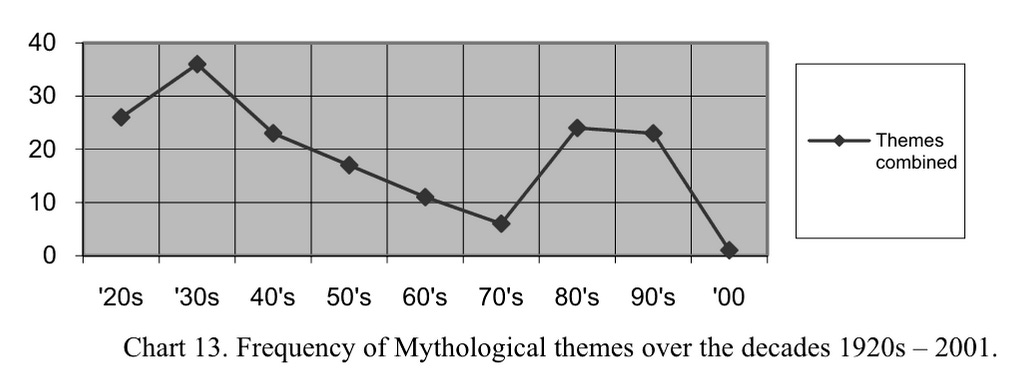
However, this process of identity construction which, in effect, led to Ireland being defined as a Gaelic, rural, traditional, communal and morally superior, Catholic nation (in opposition to Anglo-Saxon, urban, modern, imperialist, industrial, Protestant Britain) was a process not just of creation but of exclusion. In order to define what it meant to be Irish, leaders were also defining what it meant not to be Irish.
As Bryan Fanning explains in a book chapter titled, “Nation-building and exclusion”:
“From the nineteenth century onwards, Irish nation-building has been characterised by the development of exclusionary conceptions of identity and a sociogenesis of homogeneity linked to nationalism.17”
“A process of nation-building which has contributed to contemporary Irish society and the development of the Irish state has been accompanied by a politics of national identity within which claims of social membership of various minority groups were discounted through racialised discourses which distinguished these from the ‘true’ Irish18.”
In this way, Irish identity has always relied upon defining itself against what it is not. It has always relied upon an ‘othering’ to legitimise itself. And throughout the history of the state this has resulted in numerous groups, who did not conform to, or fit within the conceptions of Irish national identity, first envisioned during the Gaelic Revival, and later established by cultural and political nationalism, being othered, discriminated against, not accepted as ‘Irish,’ and, at worst, subjected to xenophobic or racially motivated campaigns or attacks against them.
In his study, Fanning specifically highlights several groups impacted by the exclusionary nature of Irish identity formation. Protestants, being not Catholic, were particularly demarked for exclusion; Other religious minorities (particularly Jews, with the most extreme example Fanning cites being the Limerick Pogrom); Travellers who were, and continue to be, subjected to institutional racism and discrimination, and state-sanctioned directives designed to “address the itinerant problem” through a process of “assimilation” (i.e. cultural and social erasure); Immigrants and, in particular, refugees and asylum seekers (especially from non-white communities), were discourse has framed them as a “threat to Irish society” and “exploiters of the system.” 19
“A growing number of official acknowledgements that Ireland is, or has become, a multicultural society have emerged in recent years. Such acknowledgements sit uneasily with entrenched assumptions of societal monoculturalism although the ideological presumptions of monoculturalism have shifted in recent decades. In particular, the decline of Irish-Ireland nationalism and secularisation have contributed to more pluralistic sense of Irish identity but this has not in itself unravelled dominant monocultural conceptions of Irishness.”
Pg. 184 in Racism and Social Change in the Republic of Ireland, by Bryan Fanning
The Gaelic Revival: A Legacy of Imagination
It is not lost on me that, in framing the current cultural revival and interest in ‘all things Irish’ as a Gaelic Re-Revival that, I too, am ‘looking to the past’ to make sense of our present, just at the proponents of the original revival looked to an ancient, Gaelic past, to find the Ireland they were dreaming of. I think there is great beauty and bounty in that—a looking back can bring not only solace and understanding, but also inspiration and encouragement.
And perhaps, it is for all those reasons, the desire for comfort and solace, the need for inspiration and encouragement, grounding and support, that this current re-revival is occurring. For just as the original movement was a reactionary response to modernity, the loss of nature in the face of industrialisation, and rapid social change, so too, I feel, is the current re-revival a reaction to similar forces today. Late-stage capitalism, globalism, environmental destruction, climate crisis, the hyper-individuation of society and the erosion of community, and the general state of the world. And just as the original revival reacted to such concerns by seeking a return to a vision of a slower, rural, nature-centric, agrarian, and communal way of life perceived as the ‘native way of the Gael’ (i.e. indigenous), so too is today’s revival characterised by a similar desire to revive practices considered more earthy, grounded, traditional, and communal—more ‘of the land.’
Within this, there is also a notable yearning and desire, in the current revival, for a connection to, or a rekindling of, a particular vision of the Irish past, of a ‘Celtic’ past. It is here that so many of the motifs, symbols, and images created during the 19th century Gaelic Revival, and which evoke feelings of ‘Celtic,’ ‘Gaelic,’ and ‘Ireland,’ are once again emerging. Where the 19th century revival may have spoken of ‘a glorious past,’ of ‘noble peasants,’ and ‘The Lays of Ossian,’ we speak of ‘ancestors,’ ‘indigenous ways,’ and the ‘Gods and Goddesses.’ And in search of these things, of older traditions, ancestral practices and our native tongue, we still look to the Rural West, both metaphorically and literally—we still, albeit unconsciously, think in terms of Pagan Survivals.
The very first tendril of thought behind this essay first came to me, sometime in 2021, I think, when I walked through Dublin Airport and passed a long a huge series of billboards depicting various characters from Irish legend and myth—Óisín, Macha, King Lir, Cú Chulainn, Maeve etc.—in an advertisement by the car manufacturer Skoda. I remember being so entirely struck by the sort of gross, blatantly capitalist co-opting of mythical characters I so love to sell cars, and also just how entirely effective they were. Here I was, passing through the airport, with the homesickness of the emigrant, walking as fast as I could across the skybridge of Dublin Airport, desperate to get my feet on Irish soil, on my Éire, to be enlivened and reanimated by her myth-infused landscape and her community-mindedness, and I felt like I was being ushered in by the Gods and the Goddesses—I looked upon those images and my heart exploded with the ‘Irishness’ of it.
Yet, Skoda, I laughed to myself, should probably have credited the 19th century revival for why such imagery was so effective. For, so many of the motifs, symbols, ideals and notions which evoke in us, today, a unique sense of ‘Irishness’ originate, not with an ancient Gaelic past, but with how the 19th century Gaelic Revival imagined it for us. For just as the early Gaelic scholars were influenced by the Greek classics and Christian doctrine when they first committed the myths of an older, oral tradition to vellum, so too were the Gaelic Revivalists influenced by the creative inspirations of their day—the did not so much ‘revive’ an older vision of the past but used it as the inspiration to (re)imagine the future.
In this way, I think perhaps the greatest legacy of the 19th century Gaelic Revival is not so much Irish identity, but the power of imagination—the capacity for creativity and story to shape reality. And this is what makes me so excited by the current Gaelic Re-Revival (if you wish to call it that), because it too is a movement were art and creativity is once again leading, were imagination is once again flourishing between, and responding to, uncertainty and despair, and were opportunities lie everywhere to be inspired by the past in a way that (re)imagines it for the future.
Yet, here, I must also end with a cautionary note, for in inheriting this legacy of imagination we also inherit the legacy of exclusionary nationalism. The legacy of a national identity forming process which used the symbols of identity, created in the 19th century revival, to justify the exclusion of so many members of Irish society. And it is happening again. This current cultural Re-Revival also has a dark-side. For alongside the renewed enthusiasm for all things ‘Irish’ has come a rise in right-wing political ideologies, which draw on the same symbols, ideals, constructions of identity, and narratives of “Irishness” first articulated in the 19th-century Gaelic Revival to advance xenophobic and reactionary agendas. Those fears and anxieties about ‘racial purity’ and ‘hybridisation’ which too underpinned the orignal revival are finding form in the contemporary racist and xenophobic discourse and attacks which have become all too frequent in Ireland in recent times. And as uncomfotable as it is, if we are ever to respond meaningfully, we have to be cognisant of how ‘Irish identity’ was defined through a process of exclusion in the first place.
Imagination is powerful, story is powerful, art is powerful—what we do, say, make, create, and imagine is powerful. And so, in this exciting time (other adjectives are of course available depending on how you may be feeling reading this today, but I always wish to focus on the hope and the opportunity) we are now living in, were people are being inspired by Ireland, were creativity is bursting, were people are looking to the past to imagine the future, where there is a bubbling undercurrent of joy as people find community and connection within the various forms the current, 21st century Gaelic Revival is taking, we have a beautiful opportunity in front of us. We can reimagine Irishness in a way that more closely reflects the Ireland of today and tomorrow, and we can honour the past without being beholden to it. For, if the Gaelic Revival was, as many argue, more of a Renaissance—a time when older ways myths, stories and language were not resuscitated but reinvented—then perhaps this one could be a Renaissance of reinvention too.
Suggested Further Reading, if this topic interests you:
Inventing Ireland: The Literature of the Modern Nation, by Declan Kiberd
Irish Adventures in Nation Building, by Bryan Fanning
The Imagination of an Insurrection: Dublin, Easter 1915, by William Irwin Thompson
References
Mary Colum would go on to become one of the founders of Cumann na mBan
Personal account of Mary Colum, quoted on pg. 27 of Matthews, A. (2010). Renegades: Irish Republican Women 1900-1922. Mercier Press Ltd.
Quoted on Pg. 27 of Matthews, A. (2010). Renegades: Irish Republican Women 1900-1922. Mercier Press Ltd.
Pg. 27 of Matthews, A. (2010). Renegades: Irish Republican Women 1900-1922. Mercier Press Ltd.
Pg. 27 of Matthews, A. (2010). Renegades: Irish Republican Women 1900-1922. Mercier Press Ltd.
Thomas, J. M. (2021). Race, Nation, and the Color-Line in the Twenty-First Century: A Du Boisian Analysis. Social Problems, 68(2), 267–283. https://www.jstor.org/stable/27305737
Barlow, R. A. (2023). Ossian and Irish literature: Owenson, Yeats, Joyce, Beckett. In R. A. Barlow (Ed.), Modern Irish and Scottish Literature: Connections, Contrasts, Celticisms (p. 0). Oxford University Press. https://doi.org/10.1093/oso/9780192859181.003.0002
Pg. 32 in Fanning, B. (2012). Nation-building and Exclusion. In Racism and Social Change in the Republic of Ireland (Second). Manchester University Press.
Pg. 165 in Lane, L. (2003). ‘It Is in the Cottages and Farmers’ Houses That the Nation Is Born’: AE’s “Irish Homestead” and the Cultural Revival. Irish University Review, 33(1), 165–181.
Pg. 167 in Lane, L. (2003). ‘It Is in the Cottages and Farmers’ Houses That the Nation Is Born’: AE’s “Irish Homestead” and the Cultural Revival. Irish University Review, 33(1), 165–181.
Pg. 167 in Lane, L. (2003). ‘It Is in the Cottages and Farmers’ Houses That the Nation Is Born’: AE’s “Irish Homestead” and the Cultural Revival. Irish University Review, 33(1), 165–181.
Pg. 44 in Nash, C. (1993). Remapping and Renaming: New Cartographies of Identity, Gender and Landscape in Ireland. Feminist Review, 44, 39–57.
Matthews, A. (2010). Renegades: Irish Republican Women 1900-1922. Mercier Press Ltd.
https://www.nationalgallery.ie/sites/default/files/2017-11 West_of_Ireland_Paintings_Resource.pdf
O’Dowd, L. (1987). Town and Country in Irish Ideology. The Canadian Journal of Irish Studies, 13(2), 43–53. https://doi.org/10.2307/25512708
Fanning, B. (2012). Nation-building and Exclusion. In Racism and Social Change in the Republic of Ireland (Second). Manchester University Press.
Ibid.
Fanning, B. (2012). The Politics of Traveller Exclusion. In B. Fanning, Racism and Social Change in the Republic of Ireland: Second Edition. Manchester University Press. http://ebookcentral.proquest.com/lib/ed/detail.action?docID=5512451
Comments
Nothing yet. Say the first thing.
Sign in to join the conversation.