
Home · Book · Start here · About · Pricing · Careers · Galleries · Archive . Collecting
Related reading:
How to Organise a Pop-up Art Exhibition: A Complete Guide for Independent Artists
Corporate Art Leasing: A Practical Guide for Independent Artists
How Artists Actually Win Corporate Commissions
Most artists think the only way to make money from a painting is to sell it. That’s only one option. A single painting can earn income many times over while you retain ownership of the original. The mechanism is called art licensing. It’s how artwork ends up on greetings cards, book covers, hotel interiors, stationery, textiles and hundreds of other products.
Yet most independent artists never learn how the licensing industry works or how to approach it professionally. My introduction to art licensing came through the publishing industry, where I worked with artists and illustrators on licensed book projects. Although publishing is just one sector of the licensing market, it gave me first-hand insight into how licensing agreements work and how artists can generate income while retaining ownership of their work. Since then, I've continued to explore how licensing can create additional income streams for independent artists. In this guide, I'll show you exactly how.
Art licensing enables artists to generate recurring income while retaining ownership of both the original artwork and its copyright. Rather than selling the artwork outright, you grant permission for others to reproduce its image for specific purposes, territories and time periods. When managed strategically, licensing creates an additional income stream, introduces your work to new audiences and increases the commercial value of an existing portfolio without compromising your fine art practice.
There is no single type of artwork that succeeds in licensing. The key is matching your style to the right market. A floral painter, an abstract artist and a wildlife illustrator may all have successful licensing careers but often with completely different types of companies and products.
At its core, art licensing is a legal agreement where you (the licensor) grant a business (the licensee) permission to use your artwork for a specific, strictly defined purpose in exchange for compensation. Crucially, you retain the original copyright. You are not selling your art outright, nor are you transferring ownership. You are simply granting a temporary lease.
Licensing vs. Copyright Buyouts
It is vital to distinguish a license from a copyright assignment (often referred to as a “buyout”).
Copyright Buyout: The client buys total, permanent ownership of the rights. They can modify the image, print it on anything forever, and prohibit you from ever using or showing it again. Buyouts should be rare and carry a premium price tag.
Licensing: You maintain total ownership. The client receives permissions bounded by strict conditions: time limits, geography, product type, and distribution channels. Once the term ends, all rights revert fully to you.
When fine artists first hear “licensing,” they often worry about turning their deeply personal work into cheap novelties. But the licensing landscape spans a broad spectrum of markets and quality tiers
Many artists are already familiar with print-on-demand services, where artwork can be uploaded to online platforms and reproduced on products such as mugs, T-shirts and phone cases. While this is a form of licensing, it represents only one small part of a much larger industry.
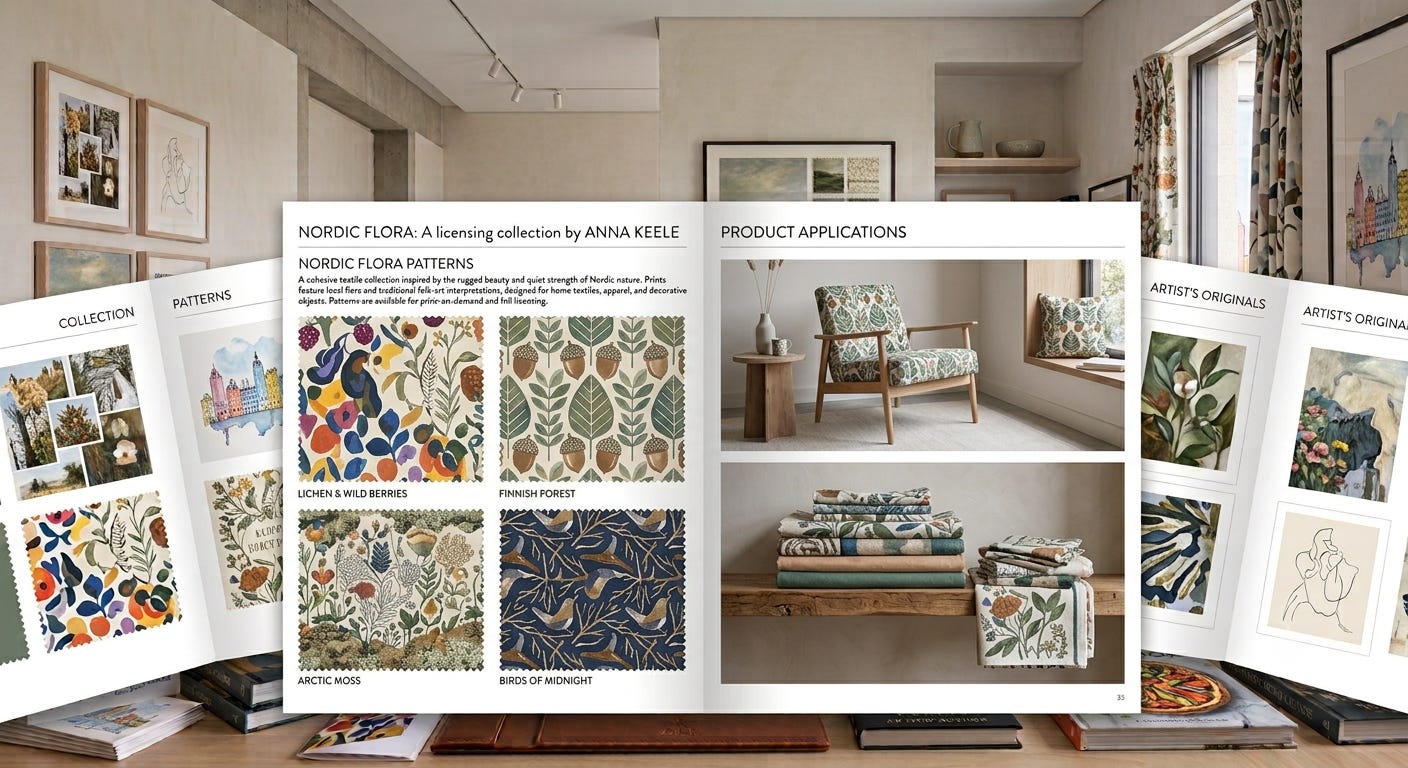
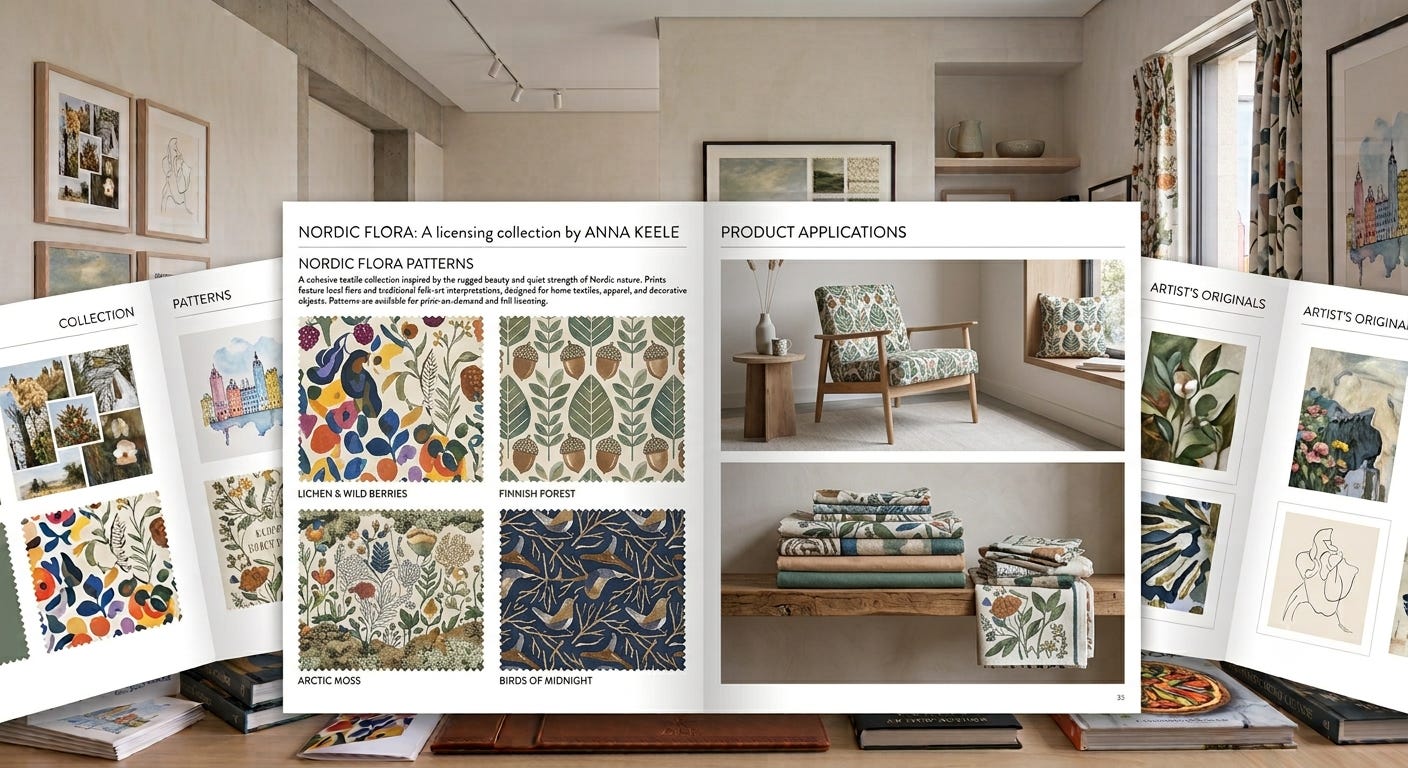
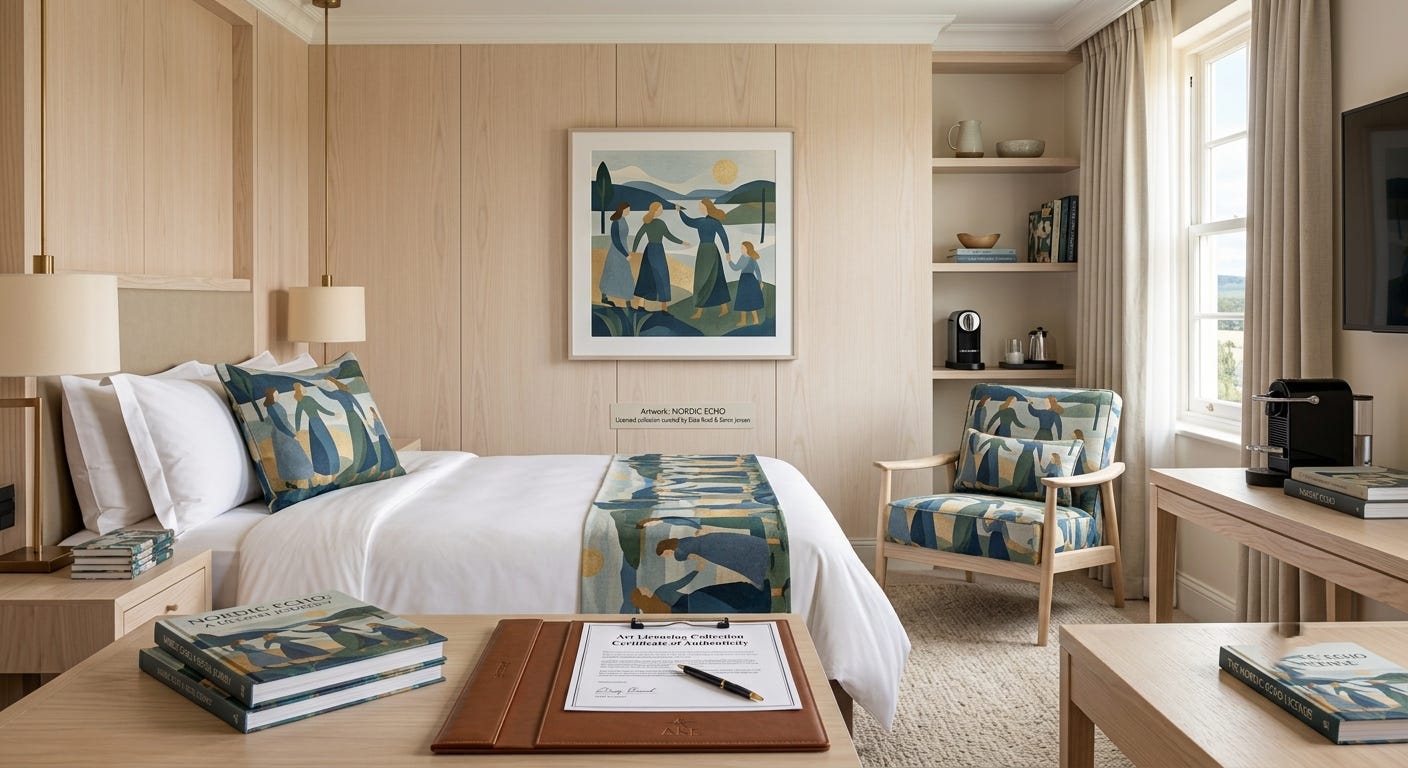
Professional art licensing encompasses everything from greetings cards, giftware and home décor to publishing, textiles, stationery, packaging, advertising, television, film, hotels and corporate interiors. In these sectors, artists often work directly with manufacturers, publishers or licensing companies through negotiated agreements that define how their artwork may be used and how they will be paid.
Depending on your aesthetic and brand, fine art can be licensed across several distinct markets:
Home Décor & Wall Art: High-end hospitality (hotels, restaurants), corporate collections, or luxury residential wallpaper and textiles.
Editorial & Publishing: Book jackets, album covers, and literary magazines seeking distinctive, evocative imagery.
Stationery & Paper Goods: Fine journals, seasonal greeting cards, and luxury gift wrapping.
Apparel & Fashion: Silk scarves, limited-edition designer collaborations, or footwear.
Film & Television: Renting digital usage rights for set decoration in movies or streaming series
Compensation models in licensing typically fall into three primary structures:
The artist receives a negotiated percentage of sales. In physical product licensing, royalties are typically calculated on the wholesale price (the price the manufacturer sells it to retailers for), not the retail price.
Typical Wholesale Royalty Rates: 3% to 10% depending on the industry, product volume, and your brand recognition.
An advance is an upfront payment made to the artist before the product goes into production.
How it works: If a company pays a $2,000 advance against a 5% royalty, you keep that $2,000 immediately. As the products sell, your earned royalties offset the $2,000 advance first. Once earned royalties cross $2,000, you begin receiving ongoing quarterly royalty checks.
Rather than paying per unit sold, the client pays a fixed, lump-sum fee to use the image for a set duration (e.g., $1,500 to use a painting on a book cover for three years). This is common in publishing and short-term promotional campaigns where tracking individual unit sales is impractical.
One of the biggest misconceptions about art licensing is that it only works for certain styles of art.
While some subjects are licensed more frequently than others, there are opportunities for a wide range of artistic styles, from botanical illustration and wildlife to contemporary abstract painting and commercial illustration.
The key is understanding which licensing sectors are looking for your type of work.
In the next section, I’ll explain which styles are in highest demand, where abstract art fits into the licensing market, and what licensing companies are actually looking for when they review submissions.
Understanding how licensing works is only half the equation. The real challenge is knowing how to prepare your artwork, approach companies professionally, negotiate contracts, and avoid the mistakes that cause most submissions to be ignored.
In the remainder of this guide, I’ll walk through the exact workflow I recommend, from building a licensing portfolio and writing pitch emails to understanding contracts and identifying more than 30 reputable companies actively working with artists.
Comments
Nothing yet. Say the first thing.
Sign in to join the conversation.