
By Adrian Ma
The imagination is a curious place. It is a place where our immediate physical reality is suspended, where fact and fiction mingle, where the past coexists with the future, where ideas can be probed, dissected, reassembled and reorganized, or thrown around like furniture by a poltergeist. But what, exactly, is the value of imagination? At our first Curiosity Café of 2026, moderated by Beatrice Turner and Marybel Menzies, we reflected on the potential contributions and pitfalls of both individual and collective uses of imagination—a faculty that has been variously denounced as a “mistress of error” (Pascal) and celebrated as an aid to freedom, truth, justice, and creativity. But first:
Curiosity Café Recap: Imagination
Community Survey
Upcoming Events
Last Chance: Our Annual Public Philosophy Social in January! (January 31st) + A Community Reflection
Our Next Café: Gossip (February 3rd)
Readings & Resources
By Adrian Ma
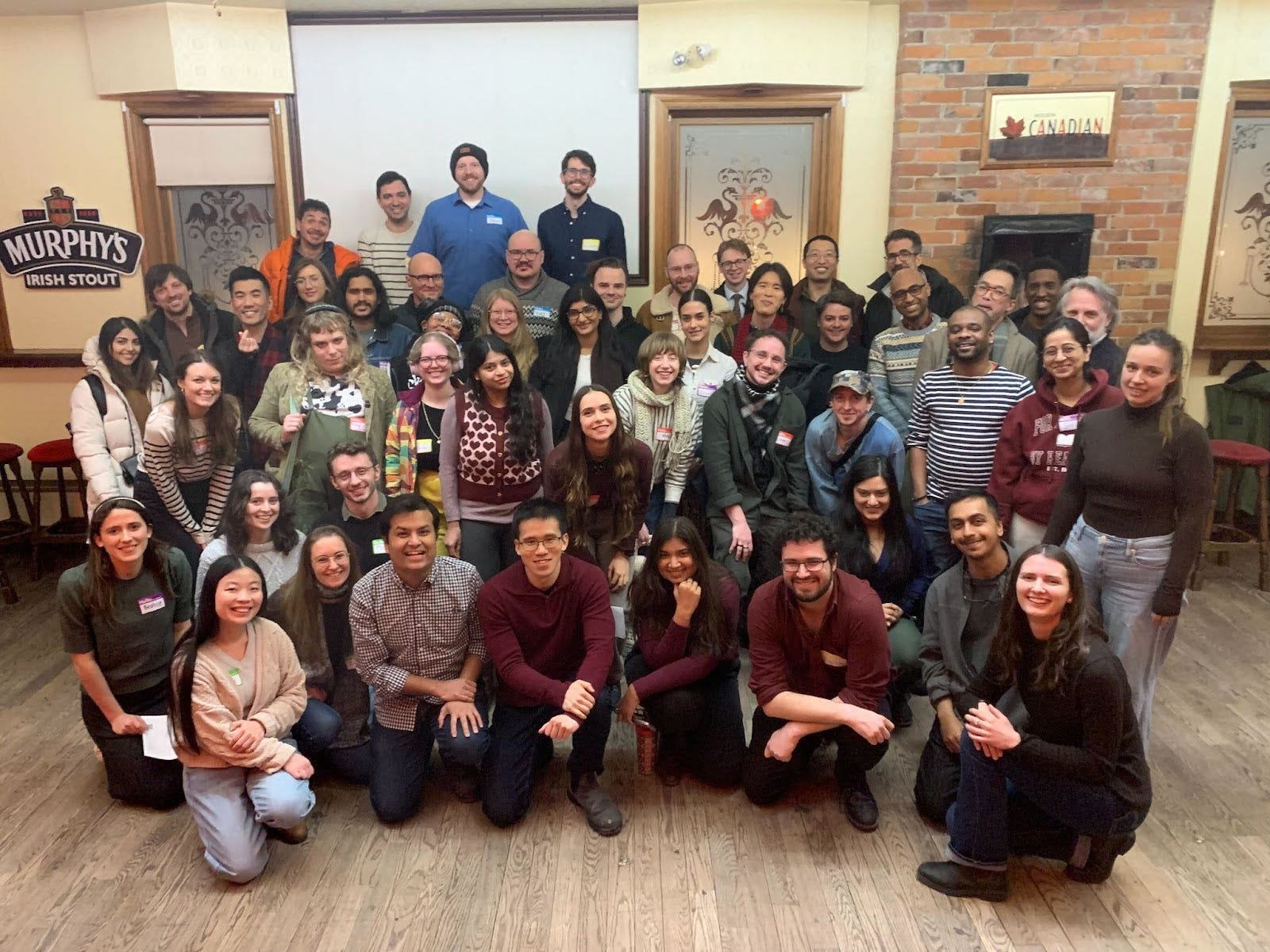
Our latest Curiosity Café, moderated by Beatrice Turner and Marybel Menzies, began with a reflection on the benefits and drawbacks of using our imagination—defined as the capacity to represent things beyond our immediate physical experience, from possible worlds to abstract ideas to stories. We asked:
What are the ways you use your imagination? Consider the following:
Fantasize: a kind of make‑believe or diversion from reality.
Idealize: to represent, imagine, or experience something as better, simpler, or more perfect than it really is.
Reminisce: to think about past experiences, often with a gentle or bittersweet sense of nostalgia.
Catastrophize: where one vividly constructs and fixates on the worst possible future outcomes of a situation.
Think of the last time you imagined something that made you better off as a result.
In what sense did it make you better off? Why?
Think of the last time you imagined something that led you to a negative state.
In what way did your imagination make you worse off? Why?
Do you find imagination useful in your everyday life?
How often do you use it to help you make decisions?
When you imagine, is your imagination connected to the real world, or more of an escape from it?
For instance, a real-world imagining might involve a possible future job, whereas an escapist imagining would be about an unrealistic life goal, such as being the prince or princess of a kingdom.
Here’s what some of you had to say:
I use my imagination largely as a planning tool, both for creative purposes—such as mapping out a novel before writing the first draft—and for far more quotidian purposes—such as organizing my day around an event I plan to attend in the evening.
I tend to use my imagination to catastrophize.
This can have positive outcomes—it can lower my expectations, and pre-empt disappointment! It can also help me prepare for the worst.
But it can also demoralize me to the point of giving up on my goals or duties prematurely, wondering: What is the point? Is it even worth trying?
One of the primary functions of the imagination is storytelling, in particular storytelling with respect to our own lives. We often live our lives imagining ourselves as the protagonists and authors of our own story, and situating our decisions and life events within a narrative arc.
Imagination gives meaning and direction to our lives, by helping us envision and sort through possible futures.
The imagination has decision-making utility: it can help us determine the best way to achieve a desired outcome. But we can also use the imagination in a non-instrumental sense—that is, for its own sake, and not for the sake of something else—such as when I use it to immerse myself in a fictional story for the fun of it.
We navigate the world based in large part on assumptions, on how we imagine things and people to be. For example, how I interact with someone is determined by what I take to be their character, interests, and values, by a kind of mental picture that could be more or less aligned with objective reality. There is a sense, therefore, in which we are exercising our imagination all the time, and it is hard to imagine life without it.
Despite the benefits of using one’s imagination, engaging it can sometimes be counterproductive, because it can naturally lead to paralysis induced by overthinking.
To what extent does imagination influence action? Does frequently imagining a possible outcome increase the likelihood, either directly or indirectly, of that outcome becoming reality?
The things I imagine are grounded in reality in the sense that they are possible, that they fall short of science fiction or logical absurdity. They are, however, radical and “unrealistic” in the sense that they tend not to reflect the status quo or to be shaped by prevailing norms.
Our cultural conditioning often limits our imaginative possibilities, by shaping our ideas of what is and is not realistic and causing “unrealistic” ideas to be nipped in the bud. The elimination of poverty, for example, is often dismissed as an impractical, utopian fantasy. But is a society in which everyone is fed and cared for really so absurd as to warrant such dismissal?
Similarly, the Overton window—the range of politically acceptable ideas and arguments—often constrains our imagination by informing our sense of what is tolerably realistic or intolerably radical.
Our imagination can also be expanded or constrained by the media we consume, by the stories that we are and are not exposed to.
There is an adaptive function to constraining our imaginations: allowing them to run wild and nurture attachments to unrealistic dreams can set the stage for profound disappointment. But we can also overcompensate when imposing these constraints, leading us to prematurely dismiss genuinely promising ideas.
The imagination can provide an escape from reality, as well as closure to events left hanging. I can, for example, give myself emotional closure by imagining what a friend I can no longer talk to would have said or done if they were still around. In this sense, the imagination functions as a coping and/or healing mechanism.
Up to this point, our discussion was largely confined to the private world of individual imagination. After the break, however, we turned our attention to the possibility and uses of collective imagination, asking:
Is it possible to engage in collective imagining (i.e., the shared capacity of a group to jointly envision futures that aren’t yet real—and then to coordinate feelings, expectations, and action around those pictures)?
Is imagination enhanced or hindered by the influence of other minds?
How can the imagination of others impact our own imagination?
Can imagination facilitate social and moral progress?
What are concrete instances of imagination being used to benefit society?
Does a fantastical imagined outcome lead one to be more motivated in achieving it, or less?
How might imagination perpetuate negative outcomes on a large scale?
Consider pre-existing social ideologies; are these instances of imagination gone awry?
How could the imagination of a positive event, state of affairs, etc. (e.g. a utopia) backfire?
Does the capacity for imagination increase with more experience and prior knowledge?
In response, some of you said:
Can it be that the imagination can literally, directly, physically change reality (such as through telepathy) as certain experiments in parapsychology suggest might be possible?
Acts of collective imagination can generate motivation and momentum for social causes, but this means they have the potential to go very wrong as well as very right. Consider the Make America Great Again movement, which appears to have emerged from the collective imagining of a mythical golden age of America—an imagining that has led to dramatic, destructive, real-life consequences.
It is remarkable how many similarities we can observe between cultures’ collective imaginings, and the products thereof—many myths and popular stories, for example, feature a hero who embarks on an adventure, overcomes great challenges, and undergoes a profound transformation. Perhaps these similarities can be explained by the existence of a collective unconscious, a dimension of the human psyche in which universal symbols (archetypes) exist.
We live our lives through storytelling, and in authoring the stories of our own lives, we often draw from, or write against, stories inherited from the collective imagination (about our gender, family, community, country, and so on). We all inhabit two realities: brute, physical reality, the world of atoms and immutable physical laws, and the more human world of our shared stories. Activism, when it is successful, typically involves challenging our inherited or most visible stories, and disseminating the marginalized, new, or amended stories until they spread their roots in our collective imagination.
We are everywhere surrounded by the products of our collective imagination, which include even the concrete, extremely practical inventions we take for granted every day. Take the example of a bench. The world’s first bench was likely not conceived and built through the efforts of a single person (who, presumably, would have at least needed assistance chopping down and transporting the trees that would become the bench). It would likely have involved a group of people who, benchless, collectively imagined a better world—a world in which the bench existed—and a means of creating that world, before working together to turn mind into matter.
Social progress involves casting aside pre-existing belief systems, or at least the ability to envision a world beyond them. This is itself an act of collective imagination!
Progressive triumphs like the 5-day workweek, women’s suffrage, and civil rights protections are all examples of positive moral and social developments that first had to be collectively imagined before they became reality.
Framing the imagination in terms of goodness or badness, which mean different things to different people, may not be helpful. It might be more helpful, instead, to understand it in terms of whether it expands or limits our horizons, our sense of what is possible.
The imagination works best when it is balanced between being structured by reality and being detached from reality, such that it is both grounded and flexible enough to deviate creatively from things as they are. This is a balance that events like the Curiosity Cafés manage to strike very well 🙂
That’s it for the recap. Below is a link to our community survey, which we use to collect valuable feedback from our community members to help us improve our cafés. We can’t imagine you would be cruel enough to skip it. Thanks for reading.
For those who’ve attended our Curiosity Cafés, please consider taking our brief community survey. We are conducting this survey to gather feedback on our events, and it should only take a few minutes to complete. Your responses are completely anonymous and will be invaluable in helping us improve our offerings. Thank you in advance!
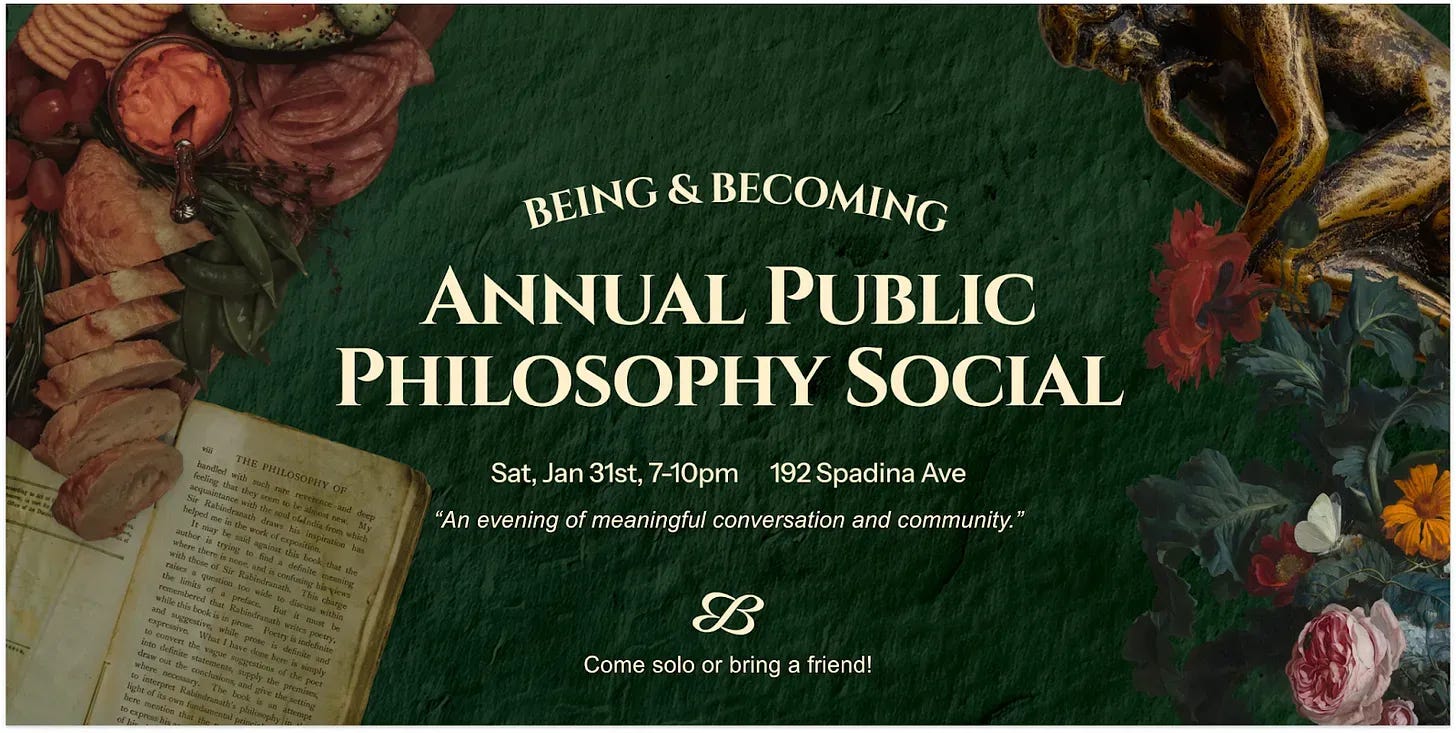
You’re invited to our Annual Public Philosophy Social! Every year we host an event to celebrate public philosophy. This year we’re back at one of our favourite venues for an evening of meaningful conversations and community. There will be just enough facilitation to help you find others who share your curiosity about the same questions, along with refreshments (small bites and non-alcoholic beverages), and a cash bar.
Tickets are selling fast, and the event is fast approaching!
🗓️Date: Saturday, January 31st (7–10pm)
📍Location: Centre for Social Innovation (192 Spadina Ave)
🎟️Tickets: $35
Whether you have attended our events before or are joining us for the first time, we’re excited to welcome you. Spread the word to others who might be interested. We hope you can join us!
This event is supported in part through the Toronto Event Generator.
If you have thoughts on Being and Becoming that you would like us to share at the social, see below!
As we prepare for our social and look ahead to the third year of Being and Becoming, we want to hear from you about how we’ve made a difference. We’ve grown because of people like you, who come to our events, read our newsletter, and engage in both online and offline conversations after our events.
We would like to share these thoughts with the community at our annual social this Saturday, January 31st. All your responses to the following questions are optional and anonymous, unless you would like your name attached. Feel free to skip any questions, and please submit this response by Friday, January 30 at 11:59 PM if you’d like your response to be included.
*hey community! Sophia here, Director of Community Programming. We ask that you consider that our ideal recommended amount for a ticket is now $15, and as you choose what to donate within the bounds of your own financial means, we ask that you keep in mind that your donation will go directly towards compensating those involved in making Curiosity Cafés happen so that we can keep doing this for you.
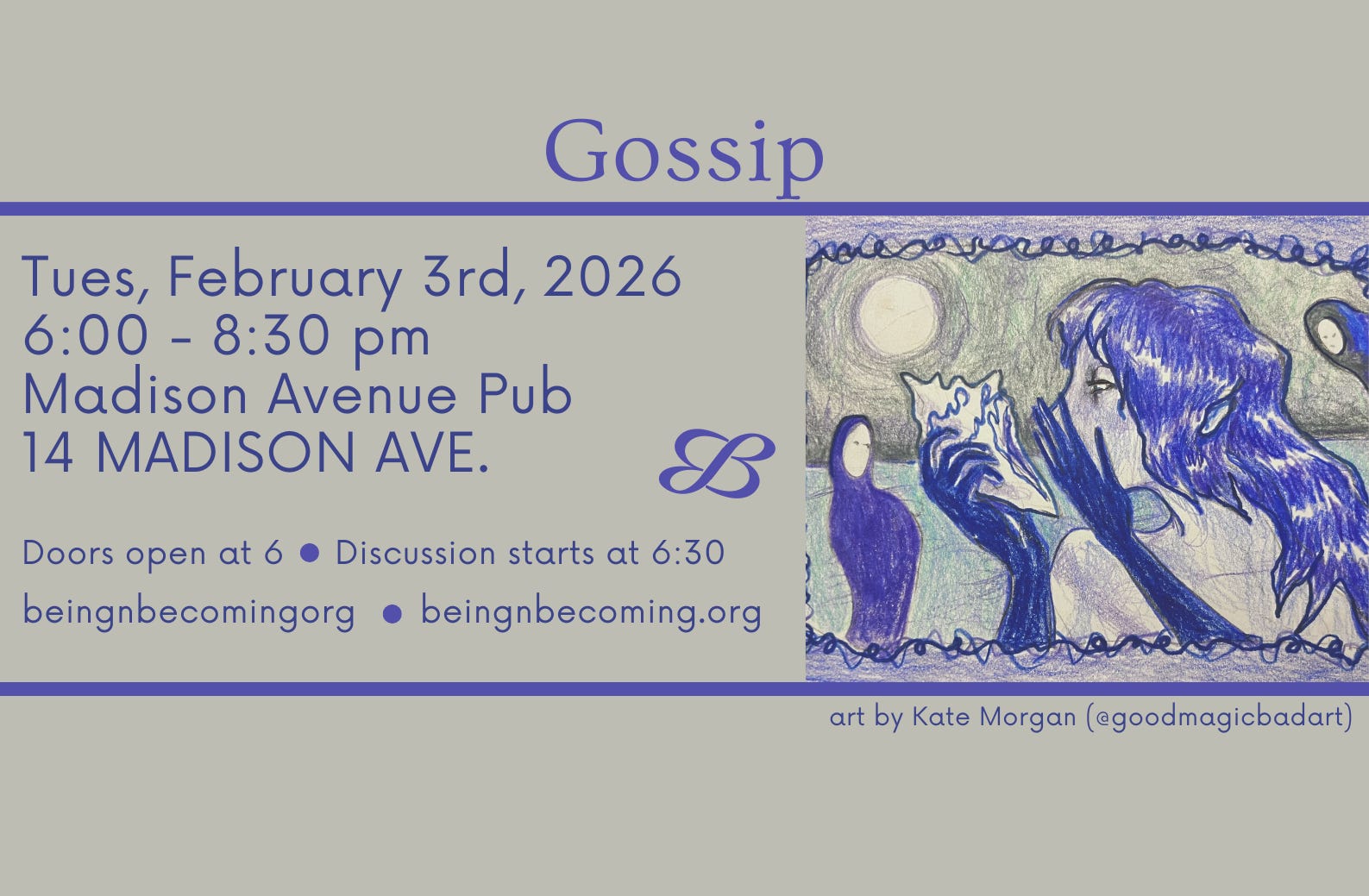
We will be hosting our next Curiosity Café on Tuesday, February 3rd, from 6:00 - 8:30 pm at the Madison Avenue Pub (14 Madison Ave, Toronto, ON M5R 2S1). Come and hang out with us, grab food, and read through our handout from 6:00 - 6:30 pm. Our structured discussion will run from 6:30 - 8:30 pm with a 10 minute break in the middle!
The topic of our next café is: Gossip
Missing the event description? Head over to our Eventbrite page! We’re trying to make the length of our newsletters a little less overwhelming.
If you have accessibility-related concerns, please visit our Eventbrite page—in the event description, you will find some accessibility-related information about the venue and the event.
We still have five free tickets available for our attendees. If paying anything at all is not financially feasible for you or our ticketing system presents some other barrier, please contact our Director of Community Programming, Sophia, at sophia@beingnbecoming.org. These tickets will be given away on a first-come, first-served basis, no questions asked! You can expect to hear back from her within 72 hours.
Sophia’s recommendations: (if you want to borrow a copy, email me at sophia@beingnbecoming.org. Borrowing the first two will require you to be in Toronto.)
Imagination: A Manifesto by Ruha Benjamin. From the inside of the book cover: “In this revolutionary work, Ruha Benjamin calls on us to take imagination seriously as a site of struggle and a place of possibility for reshaping the future.”
Experiments in Imagining Otherwise by Lola Olufemi. One of the best books I read in 2025—through its content and its form, this book reminds us of the essential role of imagination in political resistance and world-building. It even comes with a suggested playlist.
“Imagining Oneself Otherwise” by Catriona Mackenzie. This is a chapter of a book on autonomy, called Relational Autonomy: Feminist Perspectives on Autonomy, Agency, and the Social Self. Mackenzie argues that our capacity to imagine ourselves otherwise plays an important role in the kind of reflection necessary for self-definition.
[D]ream a little before you think.
- Toni Morrison
Our mission is to present a diversity of perspectives and views. The views and opinions expressed in this newsletter are solely those of the individual authors and do not necessarily reflect the views or opinions of Being and Becoming. Being and Becoming disclaims any responsibility for the content and opinions presented in the newsletter, as they are the exclusive responsibility of the respective authors. If you disagree with any of those presented herein, and you feel so inclined, we recommend reaching out to the original author and asking them how they came to hold that opinion. It’s a great conversation starter.
Comments
Nothing yet. Say the first thing.
Sign in to join the conversation.