
Welcome to Being Animal. This newsletter explores the intricacies of human-animal relationships. Through personal stories, commentary on current events, and thought-provoking debates, I hope to challenge your assumptions and deepen your understanding of how animals are treated in our society. How we treat animals matters— for our own health, for our planet, and for our sense of morality and humanity.
I want to make the world a better place for animals. To do this, we have to change how we think about animals. Have you ever heard of “speciesism”? It’s a simple idea, but it’s remarkably impactful on all of our relationships with animals. Read on to learn more.
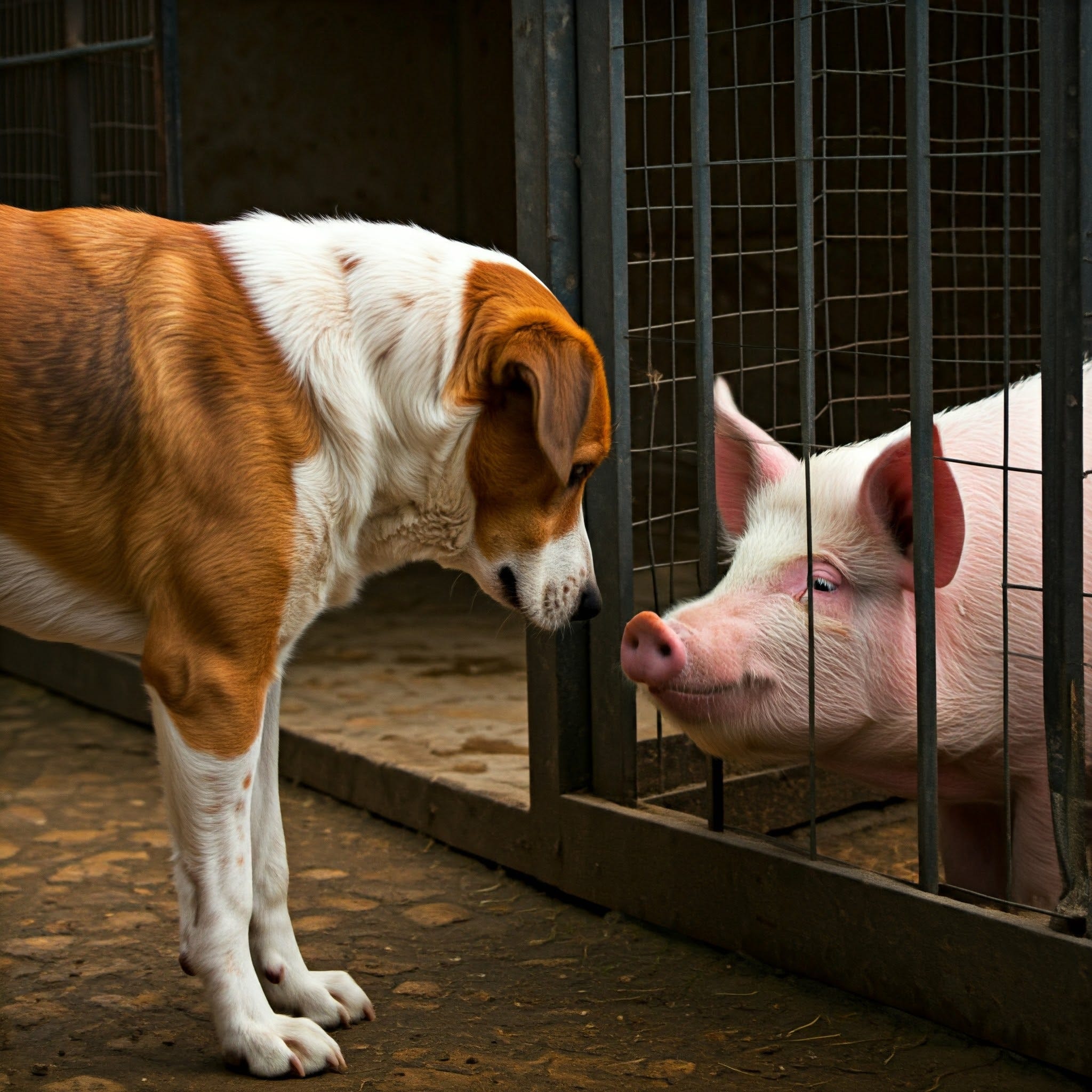
They’re the fifth most intelligent animal in the world. They can learn to sit and perform tricks on command. They are sweet and social, and they can form strong bonds both with each other and with humans. They love treats, and they are incredibly caring and loving creatures.
No, I’m not talking about dogs.
I’m talking about pigs.
Pigs and dogs share remarkable similarities. In the United States, however, we treat these two animals vastly differently. Dogs are “man’s best friend,” kept in peoples’ homes and treated as family members. They receive top of the line veterinarian care, enjoy legal protections, and cannot be abused or killed. Pigs, on the other hand, are legally abused and killed every single day in the agriculture industry. Female pigs are kept in tiny enclosures called gestation crates—so small they can’t turn around—for the duration of their pregnancy, and then spend weeks in a restrictive farrowing crate while her piglets are born and nursing. These extreme forms of confinement are legal and widely accepted in most states. When the female pig can no longer reproduce, she is sent to slaughter.
And while buying “humane” pig products might seem appealing, because it sounds like farmers would abstain from these practices, it turns out that over 98% of all pig-based products in the United States come from pigs who were factory farmed. The companies that label their products as “humane” don’t have many legal requirements restricting their advertising; in reality, many of these companies are “humane-washing” their products to try to get consumers to ignore the reality of the production process.
We kill and eat pigs a lot in American society: bacon, pork chops, and ham are staples of American diet and tradition. Whenever advocates try to make progress for pigs, the industry and the federal government fights back. For example, when California and Massachusetts tried to ban the most extreme forms of confinement—gestation and farrowing crates—for meat products sold in their states, the industry refused to comply and sued. The case went all the way to the Supreme Court, where the court upheld the states’ laws. But the federal legislature introduced the EATS Act in response to these states’ initiatives, which would undermine state efforts to reign in the worst abuses of factory farming.
But even as the legal battles to protect pigs from the worst abuses rage on, it’s actually illegal to slaughter cats and dogs for consumption in the United States.
Why do we treat two similar animals so differently?
The answer is called speciesism.
Speciesism works on two levels. First, we humans have a speciesist belief that all other animals are inferior to us, simply because of their species. We believe we have the right to use, kill, train, capture, and exploit animals for our own use, purely because they are not human. Peter Singer famously laid out this argument in his book Animal Liberation. There are some humans who suffer from serious incapacitation, and some animals have capacities to reason and think that exceed those humans’ abilities to do so. Yet we would never agree it is morally acceptable to treat those humans as lesser than animals. The reason is simple: the human species is morally relevant to how we think about the value of human life. Being human is enough, in other words, to warrant special treatment.
Second, speciesism structures how we treat different animals. We have prejudices about different animals based only on their species. In the United States, we farm and slaughter pigs, goats, cows, and sheep, but we criminalize doing those same activities for dogs, cats, and horses. The reason for this difference is socially determined. In other parts of the world, people eat dogs or horses freely.
Like all forms of discrimination, speciesism is insidious because it creates differential treatment with no rational, objective purpose underlying the difference. Dogs and pigs share so much, yet we treat them differently… just because. We hope to protect some wildlife like polar bears and wolves, even while our government culls other wild animals like horses and burros.
We treat different animals entirely differently based only on their species.
But I don’t think this makes any sense.
When I started to really think about why I thought something about a certain animal, I realized that I wasn’t being rational, or reasoned, or principled. I was just parroting back what I had always heard. I was acting according to prejudice, not information. I used to eat animals and think these are farmed animals, it’s sad, but it’s just how it’s supposed to be. But when I learned more and investigated those animals, I realized they are just like my dog and cat, just like me. They want to live their lives free of pain like all of us. They aren’t different. And we have power to change this default paradigm!
This week, I hope you think about how speciesism manifests in your life. Maybe you even think twice before eating bacon for breakfast, looking into your dog’s eyes and knowing the pig on your plate once had the very same life and joy in its body.
All animals are worthy of safety and protection, no matter their species.
Comments
Nothing yet. Say the first thing.
Sign in to join the conversation.