
Welcome to Being Animal. This newsletter explores the intricacies of human-animal relationships. Through personal stories, commentary on current events, and thought-provoking debates, I hope to challenge your assumptions and deepen your understanding of how animals are treated in our society. How we treat animals matters— for our own health, for our planet, and for our sense of morality and humanity.
I want to make the world a better place for animals. To do this, we have to change how we think about animals. This week, I’m thinking a lot about how truth is essentially what we choose it to be, and how that matters for animals.
P.S. I’m so close to 1000 subscribers! If you know anyone who might like this publication, please share it!
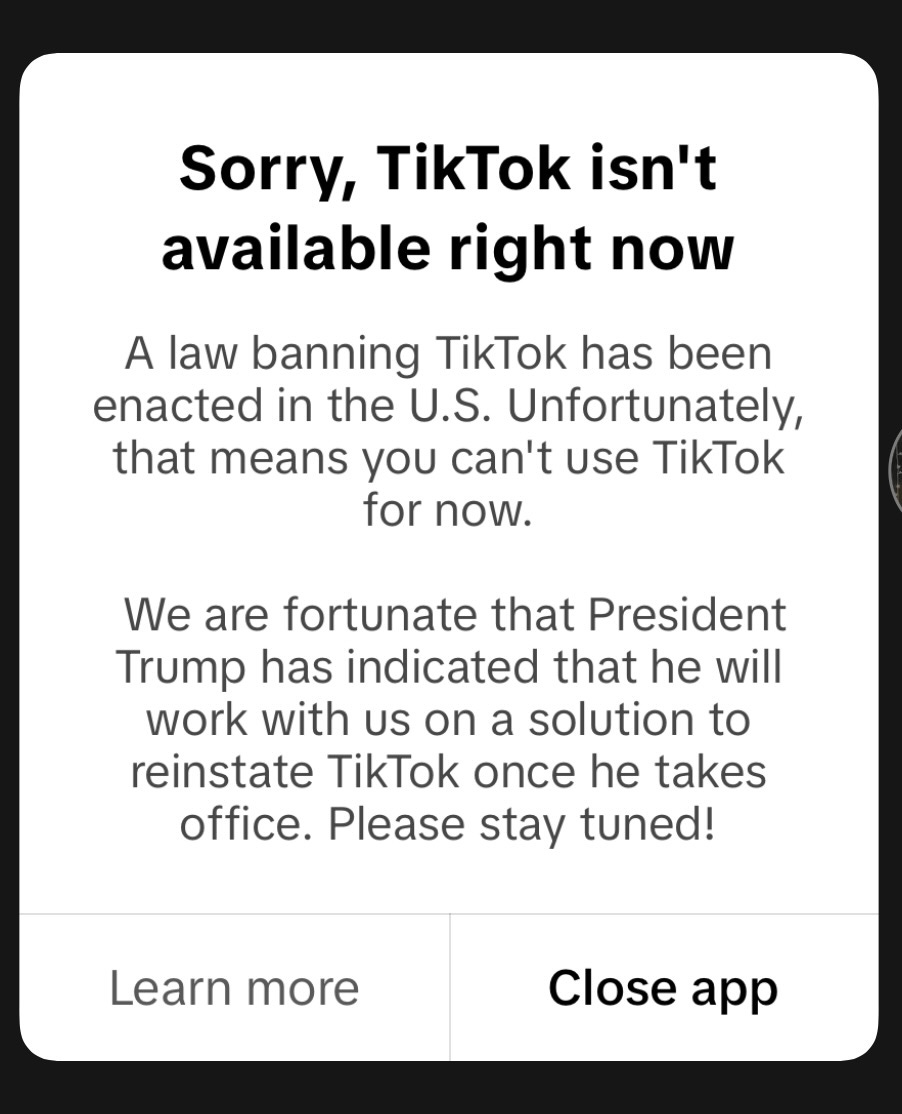
Today, TikTok went dark in the United States, and Donald Trump’s inauguration festivities are getting started.
I live in Washington D.C. right now, and the city has transformed to welcome the former president back into the White House. Police barricades are blocking nearly every street, tourists in bright red hats are flooding the city, and American flags are waving from cars, trucks, and stoops.
Trump’s inauguration is a curious moment in American history. He won the 2024 election by a landslide, pushing numerous cities, counties, and states redder in his bid for the Oval Office. People who voted for Biden in 2020 switched to vote for Trump in 2024. I don’t think those flip flops were primarily rooted in sexism, racism, or some sort of amnesia; I think our relationship to the truth has changed, and with it, our understanding of how to move forward.
Consider TikTok.
About a year ago, I decided to start an account on TikTok. First I simply consumed content and scrolled as a way to pass time and learn how the app’s algorithm worked. But before long, I began experimenting with creating content myself. I uploaded videos about me, my work as an animal advocate, and my life living with my wife, dog, and cats. I shared some insights, footage, and anecdotes from my research for my upcoming book. I found an audience of people who cared about animal issues but who weren’t necessarily searching for “vegan” in the search bar—an exciting demographic I was eager to engage with. I was excited about the opportunities the app might give me if I kept posting.
But I also found the app strange and its incentives skewed. I received analytics for every post telling me the exact second people scrolled away. It was demoralizing and confusing to see how many people thumbed away from my video after only a second or two. I was told I needed better “hooks” to grab people’s attention. But I didn’t want to post videos of me putting lip gloss on or doing a household chore. I wanted to talk about what was on my mind, and I hoped people would want to listen. In the real world, when you have a conversation with someone new, that’s how it works.
But I knew, on some level, that I engaged with content on TikTok the exact same way as these people I was trying to attract: scrolling quickly, making judgments based on only a second or two about whether the video or post was worth my time. The app demands that kind of engagement.
This superficial, quick scrolling habit is hard to break. But it has affected how we communicate, both on the app and in life.
First, it rewards a blunt and superficial style of content.
The most frustrated I got with TikTok was when I shared a condensed form of a blog I wrote on Substack, overlaying some key parts of my message with photos. Commenters jumped in and offered their opinions about my post on a relatively superficial level. People clearly read only the first slide, or listened to only the first sentence, and then dropped a comment. It was clear that many people were engaging only in the way they wanted to: quickly and simply. I was frustrated that people weren’t engaging with the full complexity of my post.
“TikTok isn’t a platform for nuance,” I was told when I complained to my friends and colleagues.
TikTok’s users want simple, clean stories. But everything in life is nuanced. So the app and its users’ preferences force our content to be simpler, leaner, funnier, prettier—anything to grab attention.
Second, it shapes how we understand the world by spoon-feeding us what we already like.
The algorithm also wants us to stay on the app, so it is designed to give us more of what we already like. It works to attract us, addict us, and give us more of what we want. I watched one video on journaling, for example (I didn’t even like it or comment on it, simply watched it for a few seconds), and I quickly became inundated with videos on journaling. The app gives us what it sees we want. If we engage, it gives us more of that.
And the app itself had a hand in shaping content, too. When I posted a video about the Rattlesnake Roundup in Sweetwater, Texas—which I feature in my upcoming book about animal festivals around the country—I received hundreds of comments and tens of thousands of views. But TikTok took my post down for showing “animal abuse,” because of a quick 3 second clip I included of an event organizer kicking dozens of rattlesnakes around a pen with his boot.
How could I, as an animal advocate, decry animal abuse in a meaningful, thoughtful way on TikTok if the app itself was going to remove any content that…showed or talked about animal abuse? I appealed the decision and the video was reinstated. But when the app took down my post, it lost momentum. It stopped all of the conversation and views short, preventing the video from getting as much traction as it otherwise might have. I was frustrated. I didn’t film myself doing something horrendous in my own house; I filmed a public figure doing something horrendous in public, in front of tens of thousands of people. If TikTok thought that was animal abuse, well hey—I happen to agree. But taking the video down stopped all conversation short.
But, once again: TikTok isn’t the platform for nuance.
TikTok has changed our world, for better or for worse. TikTok has hacked our attention spans, asking stories and ideas to be condensed into short video format.
But it has also shaped our understanding of truth. TikTok trends have gone viral, spreading “life hacks” and stories around the country and the world in seconds.
Our conception of what is true has blended into what we like, what we find compelling, or what happens to grab our attention for more than one second.
Maybe it shouldn’t be so, but today it seems that truth is a malleable thing.
Circling back to Donald Trump—his candidacy and presidency has always been about reframing the truth. From the “fake news” of his first campaign to the rambling rants of his second, he has demanded that people blindly follow his version of the truth. And largely, people have. His is a simple truth, one basically designed for TikTok: an eye-catching hook, an entertaining plot, a clear “ask” fueled by a narrative story of retribution and vindication. Meanwhile, the democrats were writing a long Substack to post in a TikTok-ified world. People scrolled away, uninterested.
This week, as we head into Trump 2.0 and a post-TikTok America, I feel compelled to think about truth: how we recognize it, what it means, and how we engage with it.
For animals, this is life or death.
So often, we want the easy story: the animal raised on a farm, having a wonderful life until his last day, when he generously grants us his life so we may eat. But the reality is far more nuanced. Cows have holes cut into their stomachs, they’re kept in extreme confinement, and they are forced to give up their babies after birth, all causing immense stress and pain. Many pigs live their entire lives in tiny crates so small they can’t turn around, have their tails docked without anesthetic, and live with no enrichment. All animals farmed for food are slaughtered, not humanely euthanized; they are stunned, hung upside down, and bled. It’s not what we imagine at all when we see cows grazing in a pasture on a dairy advertisement, or chickens roaming a field on a carton of eggs.
One of the last videos I saw on TikTok before it went dark was a calf being raised for veal. When dairy cows have male offspring they are raised for veal because they won’t ever be profitable by producing their own milk. The calf lived in a tiny crate to prevent too much movement, so its muscle would stay lean for the eventual consumer. In the video, the calf reached its head out of its crate and opened its tongue to try to catch a snowflake in its mouth.
“For a lonely cow, even the simplest thing can bring so much happiness,” the caption read. That calf would soon be slaughtered, yet I found myself moved by the beauty and power of the life force that animates us all.
The animal agriculture industry floods us with pro-meat narratives, propaganda about protein and the putative harms from plant-based foods, and stories about family farmers raising healthy animals on picturesque land. They craft the reality they want us to believe, and they push it at us, hard. But the truth is something much harsher, with real consequences: animals suffering and dying on a massive scale.
We can choose to accept the TikTok version of the truth, the one that is comfortable and spoon-fed to us, the one that doesn’t challenge our behaviors or attitudes. Or we can choose to engage with the nuance, the facts, and the complexity.
Today, truth appears malleable. But in reality, truth is immutable. There is always a core truth, deeper than the “get ready with me” stories we tell each other over and over. TikTok and Trump may have hacked our brains, but there is nuance and truth everywhere if we just stop to think for ourselves.
For me, that truth is simple: animals deserve lives free from suffering, exploitation, and harm, just like we do. It is a radical thing to take time to appreciate the nuance of life, to resist the fraying of our attention, and to opt out of harmful forces. As we head into the second Trump administration, there is a lot that we can’t control; but we can control what we put into our mouths, what industries we support, and what truths we adhere to.
Thanks for reading Being Animal! This post is public so feel free to share it.
Comments
Nothing yet. Say the first thing.
Sign in to join the conversation.