
Welcome to Being Animal. This newsletter explores the intricacies of human-animal relationships. Through personal stories, commentary on current events, and thought-provoking debates, I hope to challenge your assumptions and deepen your understanding of how animals are treated in our society. How we treat animals matters— for our own health, for our planet, and for our sense of morality and humanity.
I want to make the world a better place for animals. To do this, we have to change how we think about animals.
Animals were thrust into the news this week when Trump accused immigrants of eating cats and dogs in the presidential debate. But this isn’t the first time animals have played an unwitting role in human politics…
“They're eating the dogs, the people that came in, they're eating the cats,” Trump complained during the Presidential debate last week in response to a question about immigration. “They're eating the pets of the people that live there, and this is what's happening in our country, and it's a shame.”
This quote instantly went viral. “They’re eating the dogs” was trending on X before the end of the debate, and the internet was awash with memes and gifs within hours. My feeds were full of adorable puppies lodged between two pieces of sandwich bread, or kittens stuffed into takeout bags captioned, “Your Doordash is here.” The extremity of the remark seemed to beg for mockery. Even intellectual outlets were captivated by Trump’s statement, finding it worthwhile to explain the background of his comment and to put it in context; for example, the New York Times podcast The Daily did an entire episode on this quote on Friday.
Everyone, it seemed, found this particular comment—only one of many ridiculous and vitriolic comments made by former President Trump that night—captivating.
Why is that?
It’s not the first time animals have been used to make a political point. To the contrary, animals have long been used as metaphors, symbols, and leverage in politics.
Sometimes animals are literally the topic of debate, their very presence and management a microcosm of debates about national-versus-local political control. In 1992, an election year, for example, the Bush administration’s treatment of the endangered Northern Spotted Owl became a hot topic. Protecting the owl’s habitat risked losing thousands of timber jobs in the northwest. Throughout the West even today, predator control measures continue to stoke political fire, as conservatives protect landowners’ and cattle owners’ rights to kill wolves and bears, while conservationists decry the killing as unnecessary and detrimental to the species’ health. In these examples, and more, animals are actually at the center of the political landscape.
Other times, animals are invoked symbolically, or as metaphors. In 2022, for example, after the Supreme Court’s draft decision overturning Roe v. Wade was overturned, a Montana lawmaker complained that a bill attempting to protect abortion access would mean that “an unhatched sea turtle would have more protections than an unborn human baby.” The senator’s comment pitted humans against animals, using protections for endangered species to establish and heighten the supposed absurdity of the abortion protections. Liberal thinkers were, on the other hand, frustrated that a conservative senator would compare adult human women to breeding sea turtles, as if the two experiences are identical.
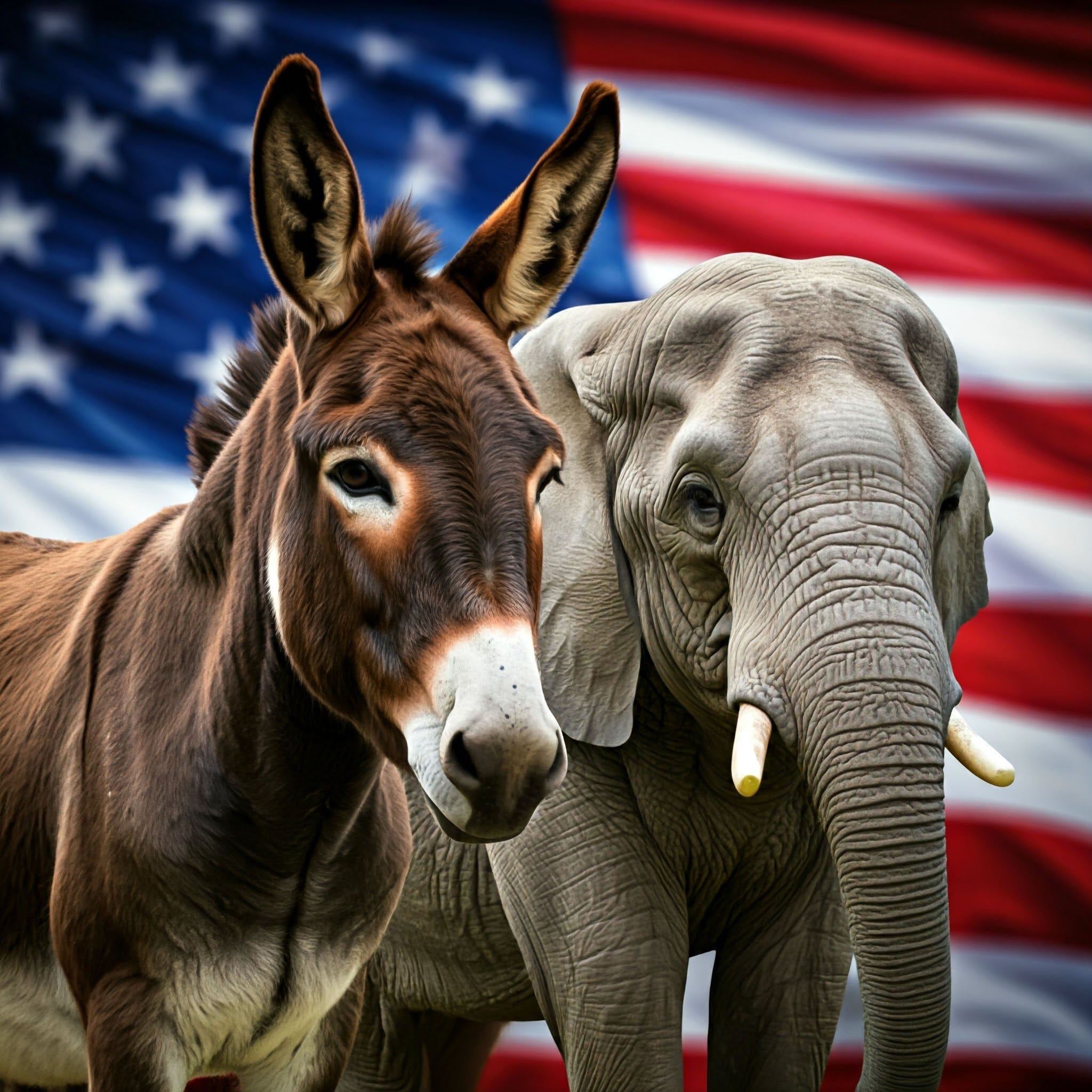
And, of course, Democrats and Republicans are represented by donkeys and elephants.
Animals are part of how humans make sense of our world. It’s natural that we turn to them to help explain ourselves, and that we use them for rhetorical flourish and metaphorical emphasis.
But even against this backdrop of the ubiquity of animals in politics, it’s undeniable that dogs and cats have a special place in our American hearts.
Trump, and the conservatives who promoted the rumor of pet-eating in Ohio before him, were clearly using this image to invoke—and prey upon—xenophobia. It is a form of fear-mongering, threatening Americans with the idea that outsiders would come and harm something so important to us. And not just harm, but eat. There’s a savageness embedded in this accusation, an inversion of the social contract we have as Americans.
Eating or harming pets is incredibly subversive to the American mind; it goes against our societal norms, our moral code, and our emotional instincts. In addition to all of the attention rightfully being paid to the hostile and unfair treatment of the immigrant communities in the Trump campaign’s rhetoric, I think this offers an opportunity for all of us to ask ourselves why this particular image is so offensive.
After all, we eat cows and pigs and chickens, many of us multiple times a day. Why is eating cats and dogs really so different?
Maybe it’s because cats and dogs are pets; as human owners and caretakers, we assume a responsibility for their care and safety. When Mitt Romney put his dog in a crate tied to the roof of his car for a 12-hour road trip, for example, he was lambasted in the press for poor treatment of his pet. It became a political topic because of how this decision might have reflected his personality, his morality, and his judgment.
But there’s more going on here with Trump. It’s not simply that the cats and dogs he mentions from Ohio were supposedly peoples’ pets. Being a pet isn’t enough to automatically render an animal worth caring about. For example, in California, a 9-year-old child brought a pet goat to a livestock auction, but changed her mind and didn’t want to see the animal killed. Authorities seized the pet goat anyways, and sent it to slaughter. It didn’t matter that the goat was her pet, loved and cared for as a member of the family. It was a goat, so it was appropriate to kill it; the inversion of social norms was in ever treating it like a pet.
And a few months ago, another dog-related story captured the political news. Kristi Noem explained in her book how she shot her 14-month old puppy in a gravel pit because it wasn’t behaving. This admission, meant to demonstrate her toughness and willingness to “get the job done,” sparked understandable outrage and condemnation nationwide. But much lesser-reported, and sometimes even omitted, was the accompanying anecdote: she also shot her goat. The goat’s demise was actually even more troublesome, because after “dragging” the goat to the gravel pit and tying it up, Noem’s first bullet didn’t kill it. She had to go back to her truck and re-load her weapon before finishing the job. (And both of these occurrences, it’s worth mentioning, took place while she was on a hunting trip; no major outlets rigorously questioned the ethics of that killing, either.)
The American media cared far more about the puppy than the goat. It wasn’t because the dog was a pet; Noem’s dog was always intended to be a hunting dog. It was because of speciesist views of dogs as sentient individuals worth protecting. Speciesism is a form of discrimination based on treating one species better or worse than another species without a meaningful justification to do so.
As we continue to make sense of Trump’s incendiary claims, I think it’s important that we use the opportunity to assess our own relationships with these animals at the center of our political discourse.
Why is it ridiculous or harmful to eat dogs, but not pigs?
The allegation that immigrants are eating dogs and cats is seen as either deeply dangerous and subversive, in the Trumpian eye, or as ridiculous and absurd, in the liberal view. But we all, as Americans, found this soundbite captivating and worth talking about. Trump’s xenophobic and racist comments aren’t new. So why did this one get under our liberal skin, becoming fodder for memes and viral videos?
It’s because we all take for granted that cows—who act like puppies when given the space—should be raised and killed for their flesh. We take for granted that pigs—who are smarter than our dogs—should be slaughtered for bacon and chops. We take for granted that dogs and cats should not be eaten. Our basic assumption about this last one undergirds the communal guffaw liberals shared after Trump’s comments at the debate. His rant was captivating because of how absurd it sounded, how obviously wrong and unlikely.
But the absurdity we felt is not inevitable; it’s simply a social construct, mutable and subject to our behaviors and expectations. We have to investigate this instinct in ourselves. It’s nonsensical at best to treat animals so differently based only on their species. And it’s logically inconsistent to mock the conservatives for parroting this claim without admitting our own prejudicial speciesism that underlies our shock and disgust at it, too.
Trump’s comment left us all reeling. But it’s important we understand why, no matter which side of the aisle we sit on.
I think it’s because of our country’s unexamined and nearly ubiquitous speciesism.
What do you think?
Comments
Nothing yet. Say the first thing.
Sign in to join the conversation.