
Hey everybody, this is going to be a slightly different post than usual, but it’s something I’ve been having a lot of fun with creatively over the last few days.
I was recently inspired by a new game on Steam called Librarian: Tidy Up the Arcane Library. It’s a very simple, cozy game where you literally pick up books in a virtual library and organize them on the shelves. That’s it. What makes it great is that it’s fantasy themed, and all of the books have very silly, fantasy-oriented titles. Books on magic casting, bestiaries, spells, dungeons, romance, the whole gamut. All of it fantasy.
I was struck with an idea. What if these books were real? What if you could actually read them, or at the very least hand one to your players when they pull it off a shelf in one of your games? That would be a lot of fun to write, and it gives me a chance to experiment with different characters and different voices.
So I settled on my first choice, because I love dungeon design: my first “book,” Fundamentals of Dungeon Architecture. It’s meant to be a multi-book “series,” and every post is going to be an excerpt from one of these books, written in the style and voice of the in-world characters who wrote them. I really enjoy writing this way, where the prose feels real-world but in-world, if that makes sense. It’s also another way I can turn these pieces into supplements down the line, or fold them into a new book project.
Here’s what you can expect whenever a post like this drops. It’s similar in spirit to the way Matt Dinniman handles Dungeon Crawler Carl: every post will include excerpts, or pieces of excerpts, from an unedited draft. You can read it, enjoy it, and use it as you wish. Some of these are going to be long, so I want you ready for that.
For the record, I still plan on writing the usual Behind the Screen stuff. This is just another creative outlet alongside it. So stay tuned for more, as always, and I hope you enjoy it.

Excerpt from the Introduction of Fundamentals of Dungeon Architecture
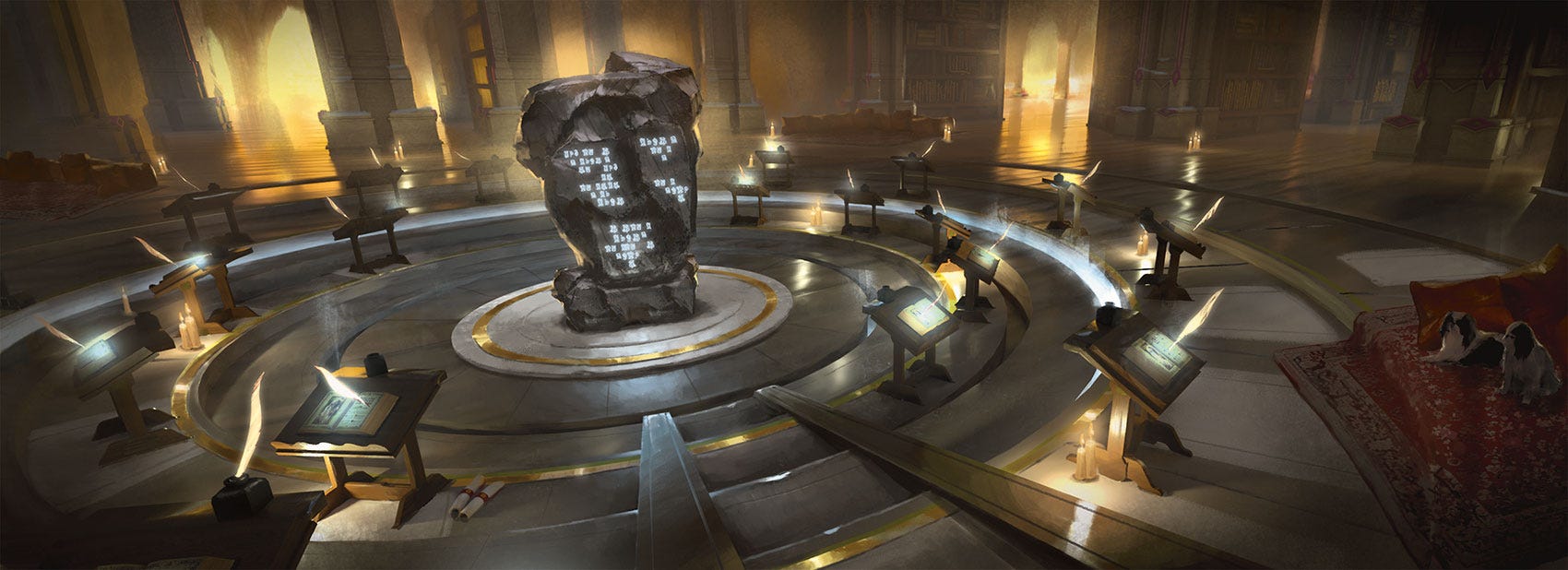
Your party has just slain the evil wizard. Picking through the library they’ve left behind, you find a heavy volume bound in leather and iron. You crack it open. The title page reads:
Fundamentals of Dungeon Architecture, Volume I by J.P. Sherbert, chief architect of the College of Hollow Things, with a foreword from Archlich Siraxis the Undefeatable (defeated once or twice).
Perhaps it could be useful.
Foreword by Archlich Siraxis the Undefeatable
In my early years as a necromancer, when one is still naïve enough to believe that mighty spells, legions of the damned, and sheer force of will are sufficient to conquer first a kingdom and then, naturally, the world, I learned the single most important lesson of my unlife. It is not power or patience. It is real estate.
The site I eventually claimed for my impregnable bastion, the Tower of (Necro) Power, a name I chose after considerable deliberation and on which I will not be taking criticism, was not feared because of its name. Adventurers, I assure you, are far too stupid to be intimidated by clever wordplay. They feared it because of what it looked like, and because of where I had the wisdom to put it. A tower of imbued stone with a gatehouse fashioned from the ribs of a tarrasque. Walls thirty feet high, mortared with the screaming souls of those who had the poor manners to interrupt my research.
It stood for many years before it was finally besieged, and even then it gave a respectable account of itself. Between the magical defenses, the standing garrison of the deceased, and the simple, irreplaceable virtue of a thirty-foot curtain wall, the would-be heroes earned every inch they took. I did, eventually, lose. We do not need to dwell on that. The phylactery worked. I am writing this, am I not?
The architecture of a dungeon is as important as its purpose. Mine housed my rituals and my research. Yours will house whatever pitiable ambitions you happen to harbor. In either case, the principles are the same, and they are not optional. A poorly sited lair is a fancy tomb. A poorly designed lair is a crowded tomb. Dungeon architecture is not a humorous subject. It is the subject upon which every other subject depends, and I would thank you to approach it with the gravity it deserves.
A final note. The author has, against my counsel, scattered a number of so-called “tongue-in-cheek” passages throughout this volume. I have permitted them, but I do not endorse them.
Begin reading. The walls are not going to raise themselves.
— Archlich Siraxis the Undefeatable (defeated once or twice)
Introduction by the Author
I trust by now that you’ve finished reading the foreword. After all, you have turned the page and found yourself here.
I extended the invitation to the Archlich named Siraxis with eyes open, and was, I confess, prepared for some measure of theatrics. Most major antagonists are full of themselves, given to flaunting their ‘superior’ will and pressing it upon whatever realm has had the misfortune to house them. However, I was not prepared for the implication that I have somehow contributed “tongue-in-cheek passages” to a manuscript I have spent six years drafting. I would do no such thing. I was, at the time of writing, up for tenure, and I approach matters of tenure with the utmost seriousness. The work is precisely as serious as the subject demands. The subject, on occasion, demands very little.
I will say this in the Archlich’s defense. On the question of real estate, he is entirely correct. The greatest single failure I have observed in two decades of consulting on fortified structures is not poor masonry, poor planning, or poor warding. It is poor site selection. A magnificent dungeon or lair in the wrong place is a magnificent way to die in the wrong place.
In the volumes that follow you will find the principles I have tried to systematize over a long career: site, form, function, and failure, in that order, because that is the order in which they are tested. Aesthetics has its own volume, despite the protests of certain colleagues in the Tactics and Bestiary fields who continue to insist it is decoration. So does the unglamorous work of keeping a dungeon running once it stands. So does the matter of how dungeons end, which is, in the end, the only question every dungeon eventually answers.
I recommend reading the volumes in order. Architecture, like every discipline worth practicing, rewards correct sequence. One cannot build the second floor before the first, and I have, regrettably, been called to inspect three buildings that attempted otherwise. Consider also that I have written five hundred and seventy-eight drafts of this volume, which makes it, in the most literal sense, the strongest foundation currently available. Like mithril, or adamantine, or whatever else it is that the Bestiary author keeps insisting cannot be properly mined.
Once you have completed a careful reading of this series (and given the material sufficient time to settle), I recommend turning to the companion volumes, with healthy skepticism for any author who tells you that their subject is the most important one. Including, I suppose, this one.
A word, before we begin, on the word itself. A dungeon, from the inside, is never called a dungeon. From the inside it is a tower (or, in the older usage, a donjon), a castle, a mausoleum, a sanctum, a bastion, a manse, a cloud castle run by djinn, a research facility, or a temple. Dungeon is what the people coming to clear it call it. It is a label applied in retrospect, after the place has ceased to be whatever its builders intended. The residents of any well-designed work would call it something more dignified. However, dungeon is the term my readership knows better than the alternatives my colleagues at the College prefer (the hollow, subterrane, or, in the most regrettable of recent fashions, negative architecture), and so, despite my reservations, it is the word I have used throughout this volume and will continue to use. After all, the architect’s task is to design the thing; not to name it.

Part One: Site
The first decision in dungeon architecture is, in nearly every case, the only one made carelessly. The siting of a dungeon governs what may be built upon it, what may defend it, what may supply it, and what may, in due course, take it from you. Every principle in the volumes that follow assumes that this one was settled with care.
Site selection is, in equal measure, a matter of tactics and a matter of terrain. Whether you intend to raise a new structure or to claim and improve an abandoned one, you must understand what surrounds the location before you commit a single stone to it. A solitary tower in an open field is, of course, an excellent way to declare your intentions to your neighbors. Most of my clients prefer a quieter introduction. Above ground, below it, upon it, or in some plane adjacent to it, the principles do not change, but the inventory does. A wooden palisade is, regrettably, of limited utility in a volcano.
The matter of how an enemy might approach the site is treated separately in Chapter 2. For the present, it is enough to observe that the choice of site decides which approaches are even possible. The terrain, in this sense, is your first wall.
…And then the rest is saved for later! :)
What’s Coming Next
Thank you for reading and I hope you enjoyed it! It was a lot of fun to write. Here is a slight teaser to the next section from Fundamentals of Dungeon Architecture: Reading the Land:
To read the land is to take an inventory of what stands upon it, what runs through it, what lives in it, and what is conspicuously absent from it. The cooper notes the strength of the wood and the species of the tree. If he is a particular sort of cooper, he notes how many. The mason notes whether the surrounding hills offer durable limestone, sandstone, or granite, and at what distance from the proposed site. The architect notes both, and several other things besides. He may, if circumstance permits, even consider whether the local fire elementals can be coaxed into the furnace of an underground forge. (They generally cannot, but the consideration is the point.)
There’s also a ‘psychology’ of choice article in the works. The seed came from a reader comment on the I Ran Castle Ravenloft as Situations and My Players Made the Story: they described assessing the paths players might take in a given situation and checking that their prep covered those paths, and asked if I’d write more on that aspect. I’d love to, so thank you for the nudge. It picks up where the Prepping Situations, Not Plots series left off: how we read our players’ wants and desires, and prep the things we know they’ll latch onto.
And expect more Cozyvale, too. I’m still building out the setting and want to keep sharing pieces of it as the world fills in.
Thanks for reading, sharing, and enjoying the content. It’s such a joy to share with you!
Comments
Nothing yet. Say the first thing.
Sign in to join the conversation.