
If you want to understand why the Middle East is trapped in an endless cycle of violence—and, on a much more urgent note, why I am still single—you only need to look at dating apps like Tinder, Bumble, or Hinge.
We are told dating apps are digital cupids designed to cure our loneliness, just like we’re told certain political institutions are here to bring peace. It’s a beautiful lie. In reality, dating apps are meticulously engineered casino games designed to monetize our single nights. A dating app that actually finds you a lifelong partner is one that loses paying subscribers.
From a corporate revenue perspective, a happy, committed marriage is a catastrophic system failure, so the engineers didn’t build an engine for love; they built a breeding ground for chronic hope. The algorithm is fine-tuned to keep you in a perpetual state of romantic starvation, feeding you just enough dopamine-inducing crumbs to keep you from deleting the app, while hiding your actual “soulmate” behind a premium paywall or behind five hundred swipes of exhausting, low-effort small talk.
The Middle East conflict runs on that same logic. You invest. You draft the agreements. You fly delegations to Oslo, Camp David, Annapolis, and Sharm el-Sheikh. You offer concession after concession — land, sovereignty, shared holy sites, billions in aid — and for one shining moment, it looks like this might actually be the time to hold hands and ride into the Mediterranean Sea. And then, like clockwork, it collapses. The rockets start again, the funerals start again. The whole exhausted machinery resets to zero so everyone can do it all over again in another decade, with another summit, another handshake photo, another round of the exact same promises.
What if I told you this isn't bad luck? What if I told you it isn't even a real failure, because failure implies someone was actually trying to succeed? What if, instead, one institution has sat at the center of every one of these collapses for the better part of eighty years — one whose entire budget, staff, and mandate depend on this conflict never ending — and it has a name, a headquarters in New York, and a permanent, self-appointed role as the impartial referee of the very fire it quietly keeps stoking.
You've probably spent your whole life assuming it was trying to end the conflict in the Middle East, but in this piece, I'm going to show you exactly how the UN, hand in glove with the Arab states, has been sabotaging for eighty years the peace process in the Middle East, deal after deal, generation after generation.
If you remember anything from my previous articles, let it be this: the British made the exact same promise to everyone — to the Arabs, to the French, and to the Jews, over the same stretch of land, within the span of three years. For thirty years, Britain tried to sit on top of the mess it made. It didn’t go well. Arab revolt in the 1930s. Jewish underground resistance in the 1940s. Britain did what exhausted empires do when they’ve run out of moves: it quit. It handed the entire mess to a brand-new international body that was, at the time, all of two years old — the United Nations — and walked away.
Exhibit A: The UN's Own Birth Certificate
The UN sent investigators; a special committee, UNSCOP, composed of eleven countries, was dispatched to the territory to see firsthand what was happening on the ground and to recommend a way forward. After months of hearings and site visits, the majority of the committee reached a conclusion: partition. Two states, one Jewish, one Arab. On November 29, 1947, the UN General Assembly didn’t just receive that recommendation and file it away. It voted on it. Thirty-three in favor, thirteen against, ten abstentions. It adopted it as Resolution 181 — and this is the detail I want you to sit with, because it’s the hinge on which this entire article turns:
This was not colonialism; this was not two European powers drawing borders across a map in a back room, the way Britain and France did in 1916 when they secretly carved up the Middle East between themselves with no regard for the people living there.
This was the United Nations itself, the very body that would spend the next eighty years condemning Israel at every turn, standing up in front of the entire world and formally voting to recommend that a Jewish state be allowed to exist. The same institution now calls that decision an act of colonialism. It was not. It was the UN's own resolution.
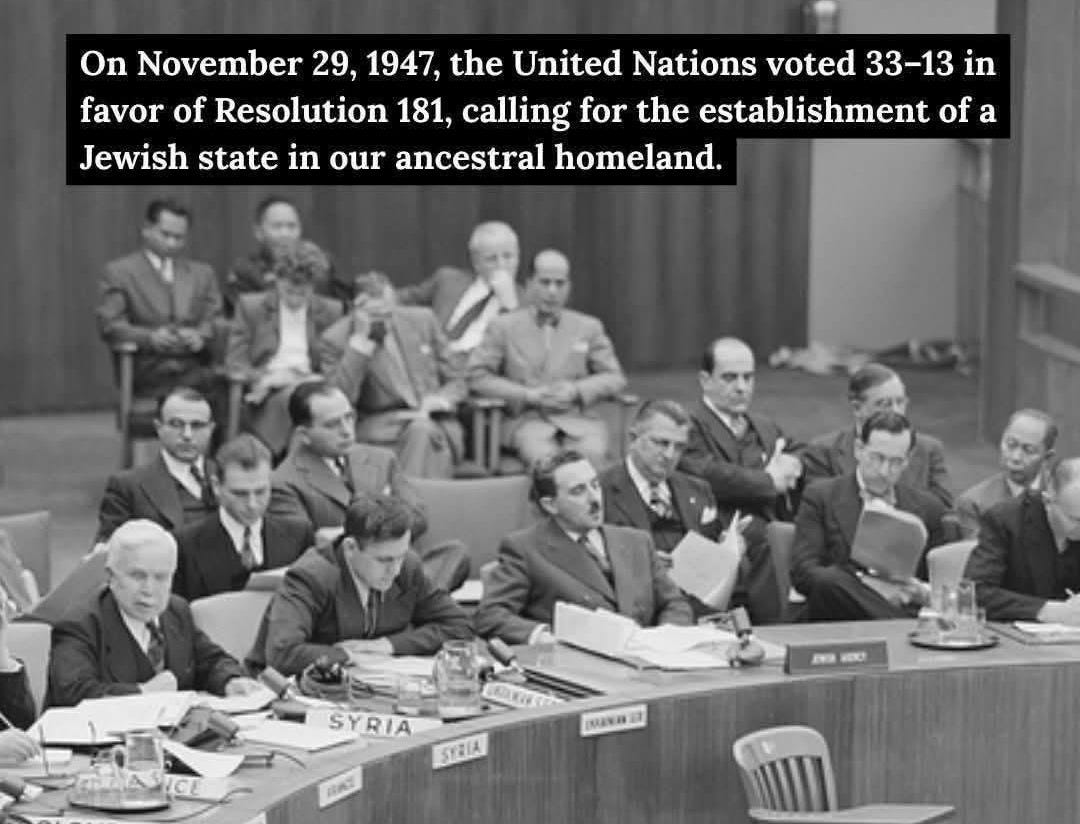
So how does an organization that itself recommended a two-state solution, that watched Israel accept it with joy even as the plan handed the Arab side the fertile highlands and left the Jews mostly desert, and then watched five Arab armies try to strangle that state in its crib the moment it was born, walk away clean? No responsibility. No memory. Just a straight-faced rewrite of its own history.
That is exactly what we’re about to trace, step by step: how the one body that voted a Jewish state into existence became the most corrupt institution on earth.
Exhibit B: Absent From Its Own Delivery Room
The vote took place on November 29, 1947. What happened in the following eighteen months is where the UN’s story actually starts to get interesting.
It voted for partition, then walked away. No peacekeeping force was deployed to enforce the resolution it had just passed. No mechanism existed to stop the violence that erupted within hours of the vote or the five-army invasion that followed Israel’s declaration of independence on May 14, 1948. The UN wrote the prescription and then left the room as the patient nearly died.
The UN watched from New York as Israel fought for its survival alone for a full year, with no military or diplomatic backing from the body that had just legislated it into existence on paper. When Israel won, the UN simply acknowledged the new reality.
On May 11, 1949, the UN voted to admit Israel to membership, formalizing the borders Israel had won and held on the battlefield, beyond the original partition lines. That’s worth sitting with: the UN’s recognition followed the war’s outcome, not the other way around. The vote wasn’t the UN protecting the legitimacy it had granted. It was the UN catching up to a fact Israel had already established without it.
Exhibit C: How the UN Engineered a Permanent Conflict
They Rewrote the Definition of “Refugee”
Every refugee population on earth is defined by the UN the same way: someone who fled persecution and hasn’t yet found a permanent home. Except one. For “Palestinian Arabs,” and only for them, the UN wrote a custom definition — anyone whose “normal place of residence” was Palestine for as little as two years before the 1948 war and who lost their home and livelihood in that conflict. No other population gets a bespoke legal category built around a single conflict and calibrated to catch the maximum number of people.
Why does the UN write a special definition for one group and one group only?
Here’s the detail that gets buried: In 1950, the UN created UNHCR, its global refugee agency. In 1951, the world ratified the Refugee Convention—a single, universal definition of “refugee” meant to apply to everyone, everywhere, forever after. That was the moment to fold the Palestinian caseload into the same system as every other displaced population on earth.
Arab states blocked it. On the record, deliberately, they insisted the Palestinians be kept out of the UNHCR framework and left under UNRWA’s separate, custom mandate instead. Why fight to keep your own people out of the well-funded, professionally run, internationally standardized system — and insist on a smaller, separate agency instead?
Inside UNHCR, Palestinians would have been just another resettled population — processed, absorbed, closed out, forgotten, like every refugee crisis before them and every one since. Kept separate instead, under a custom mandate answerable to no one and measured against no universal standard, they became exactly what the Arab League needed them to be: not a people, a liability — a live, growing, internationally funded grievance with Israel’s name stapled to it in permanent ink. The UN didn’t stumble into building a separate legal category for one population on earth. It was asked to build one, by the states with the most to gain from a wound that never closes — and it said yes without blinking.
Now pay attention: The UN made the Palestinians' refugee status hereditary forever, and only them, in two separate moves. UNHCR extinguishes refugee status the moment someone gets a new passport, a new home, or a new life. UNRWA did the opposite, twice, deliberately. In 1965, it expanded eligibility to the grandchildren of the original 1948 refugees. Then, in 1982, it expanded again — to every descendant through the father’s line, forever, with no cutoff, regardless of whether that descendant holds another country’s citizenship.
Sit with that last part, because it’s the detail that makes the whole thing absurd: citizenship elsewhere doesn’t erase the status. It just sits there, inherited, like a title. Which is how you end up with a supermodel named Bella Hadid — daughter of a real-estate billionaire, raised in Malibu, a fixture at the Met Gala, holder of a U.S. passport since birth — who technically qualifies as a “Palestine refugee” under UNRWA’s own rules, purely because her father, Mohamed Hadid, fled in 1948. Not displaced. Not stateless. Not in need of a single bag of flour. A “refugee” by inherited bloodline, permanently, by design.
Why build the only hereditary refugee status on earth — one so broad it can technically net a Bel Air heiress?
A refugee crisis that reproduces itself, generation after generation, regardless of where its “refugees” actually end up living, is a permanent one — and permanent problems don’t get solved. They get administered, funded, and staffed forever. Go look at who actually pushed for that 1965 and 1982 expansion, and it wasn’t UNRWA’s own accountants worried about running out of casework. It was the same bloc that had already fought, a decade earlier, to keep Palestinians out of the ordinary refugee system altogether — because a shrinking caseload is a weapon that rusts, and they had no intention of ever putting this one down.
Make no mistake about who UNRWA actually answers to. It was never built to serve a peace process — there was no peace process to serve. It was built, expanded, and kept on life support at the Arab League’s request, decade after decade, on the Arab League’s schedule, for the Arab League’s purposes. UNRWA doesn’t work for the Palestinians it claims to represent. It works for the states that have spent seventy-five years ensuring those Palestinians never stop needing it.
In April 1952, just three years into UNRWA’s existence, Lieutenant General Sir Alexander Galloway—UNRWA’s Director in Jordan—exposed the reality to a visiting delegation of American clergy: “It is perfectly clear that the Arab nations do not want to solve the Arab refugee problem. They want to keep it as an open sore, as an affront against the United Nations, and as a weapon against Israel. Arab leaders don’t give a damn whether the refugees live or die.”
Alexander Galloway called out the strategy from inside the building. The geopolitical goal of the Arab states was explicit: to sacrifice the civil rights and human dignity of hundreds of thousands of people, transforming them into infinite demographic ammunition against the one Jewish state.
Exhibit D: The Math of a Manufactured Crisis
Galloway’s confession wasn’t a one-off slip. It was policy, and the numbers prove it. In 1949, approximately 700,000 people fell under UNRWA’s mandate. By design, hereditary status meant that figure could only increase. Today, UNRWA’s own registry lists roughly 5.9 million “refugees” — a ninefold increase, achieved not by displacement but by birth certificates.
No other refugee population on earth works this way. A Vietnamese refugee’s grandchild, born in California, is American. A Rwandan refugee’s grandchild, born in Belgium, is Belgian. Only the descendants of the 1948 Arab refugees remain frozen in amber, “refugees” from a war that ended before their grandparents were born. In some cases, they live their entire lives a few miles from where their great-grandparents once stood, in UNRWA-administered camps, attending UNRWA-run schools, waiting for a “return” to a country most of them have never set foot in.
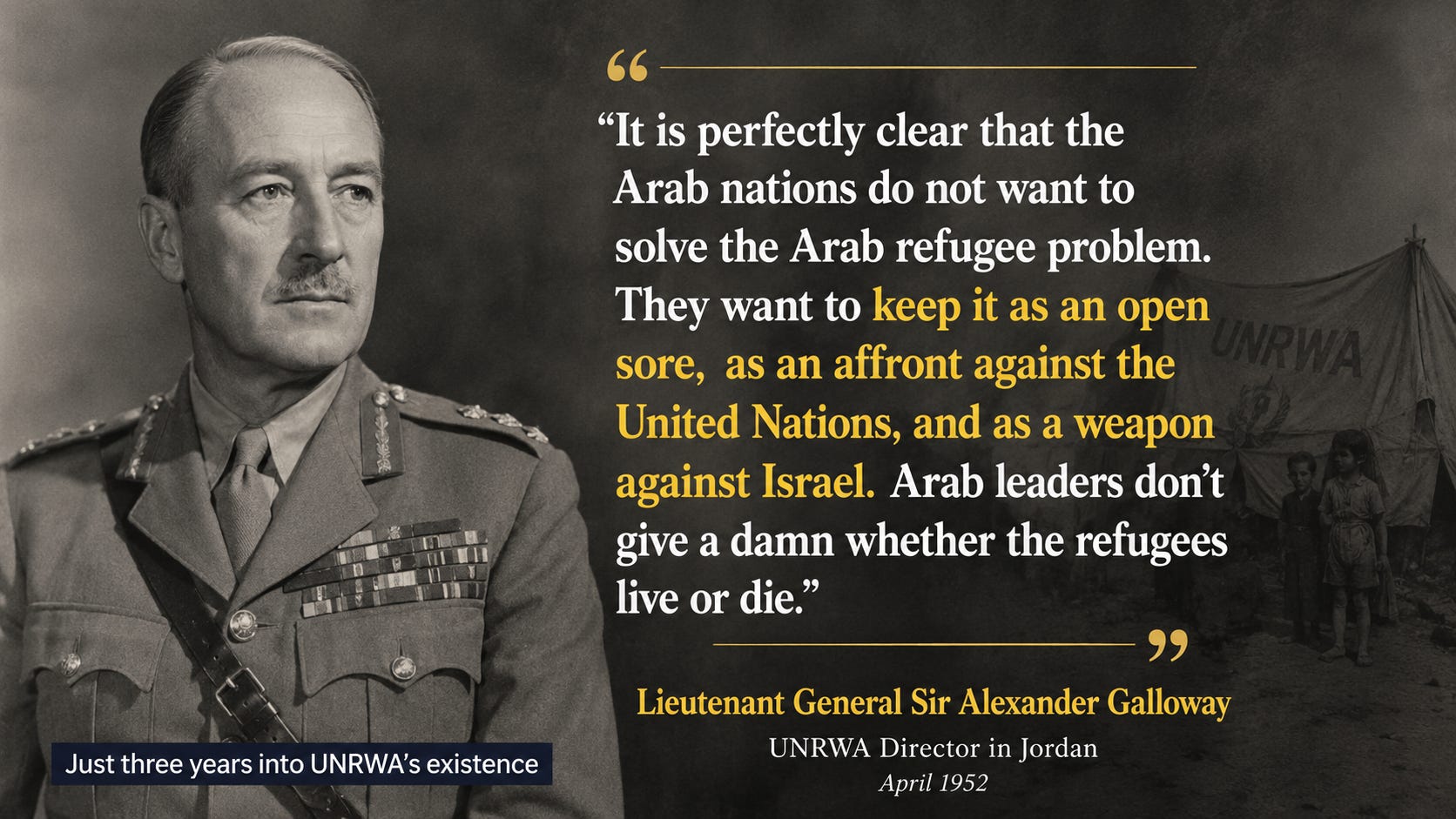
Exhibit E: The Institution Learns to Vote
By the mid-1950s, the UN stopped being a stage and became a weapon. Decolonization emptied Europe's empires and refilled the General Assembly — dozens of new Arab and Muslim-majority states, many of them born from the same anti-colonial movements that had already made the Palestinian cause their founding myth. Every new seat was another vote. And every vote moved in the same direction, on the same issue, without exception.
In 1967, after Arab armies lost the Six-Day War, Arab League leaders met in Khartoum and didn’t apologize, didn’t negotiate, and didn’t blink. They issued the “Three No’s”: no peace with Israel, no negotiations with Israel, and no recognition of Israel. It was a formal policy, and it remained the Arab League’s official position for thirty-five years. The UN’s response to a formal, public, bloc-wide rejection of peace? Nothing. No condemnation, no resolution, no consequence.
Yet since 2006, the UN Human Rights Council has passed 112 resolutions condemning Israel — more than Syria, Iran, Russia, and Venezuela combined — even though the council has adopted exactly zero resolutions condemning Hamas or Hezbollah for anything. Between 2015 and 2024, the General Assembly adopted 173 resolutions against Israel and 80 against literally every other country on the planet combined. In 2024 alone: 17 against Israel, 6 against the rest of the world.
Stop and actually do that math. Do you believe Israel, a country of ten million people, is responsible for more human rights violations than North Korea’s gulags, China’s Uyghur camps, Syria’s chemical weapons, and Iran’s public executions combined?
Nobody believes that. Nobody has to. The machine doesn’t run on belief. It runs on a bloc: 57 Organization of Islamic Cooperation states plus 22 Arab League members, an automatic majority every single time, regardless of the facts on the ground. That bloc includes regimes where being gay is a capital crime, yet they vote session after session to condemn the one country in the region with a Pride parade. This was never about peace. It was never about human rights. It’s a voting machine built to produce one output, and it has never needed the truth to run.
Exhibit F: The Machine Names Itself
On November 10, 1975, the UN passed two resolutions in the same breath. One called Zionism racism — and the world was so ashamed of it that they took it back sixteen years later. The other built a permanent committee for the Palestinian cause, and nobody has ever taken that one back.
Because here’s the difference: every UN mandate is supposed to end when the problem does. This one wasn’t built to end. It was built to renew itself, forever, by design — a job with no finish line, because the day it finishes is the day the office closes and everyone in that room has to find real work.
It even stole the calendar; every year, the UN marks a “Day of Solidarity with the Palestinian People” — on November 29th. The same date, the same resolution, that gave the Jews a state. They took the day of Israel’s birth and turned it into a day of mourning against it.
And who built this thing? The Soviet bloc and the Arab League, writing themselves a permanent seat at a conflict that was never theirs to referee. When the Security Council tried to kill it with a veto in 1976, the committee didn’t die. It just kept coming back — every year, on schedule, as nothing happened. Fifty years later, it’s still there. Still open. Still funded. Because an open file was never a failure, it was the entire business plan.
Exhibit G: The Institution That Didn’t Believe Israeli Women
The UN is supposed to be neutral by charter — the same rules for every victim, regardless of nationality. Here’s what that neutrality looked like on October 7: silence. UN Women, the UN’s own agency for protecting women, took eight weeks to say anything, then deleted it. The UN’s own investigator on sexual violence in conflict didn’t set foot in Israel for nearly four months and didn’t publish her findings on the rape and mutilation of Israeli women until five months after the massacre.
Israel had to fight — publicly, for months — just to get the UN to admit that its own women had been raped. And when the UN finally did, its own investigator couldn’t confirm it without adding, unprompted, that it “does not in any way legitimize further hostilities.” Neutrality doesn’t come with a disclaimer that protects the perpetrator. That’s not neutral; that’s a system that only finds its values when the victim isn’t Israeli.
Exhibit H: The Agency That Was Never Neutral to Begin With
If UNRWA were merely negligent, that would be one story, but it isn’t. The UN’s own watchdog investigated 19 UNRWA staff members regarding the October 7 massacre and found that nine had actually participated. Israeli intelligence puts the real number above 30, including a teacher ordered to deliver anti-tank missiles on the morning of the attack.
Then came the tunnels: the IDF found a Hamas command center wired directly into UNRWA’s electrical grid, beneath UNRWA’s Gaza headquarters. Weapons under UNRWA schools. Missiles launched at Israeli soldiers from inside those schools. The bodies of four hostages were recovered from a tunnel that opened inside a UNRWA school. UNRWA’s director claimed he had no idea — a claim Israel’s foreign minister called an insult to basic intelligence, since digging that tunnel took months.
This is the same agency that draws more funding per refugee than any other on Earth, an agency built, as we’ve already shown, never to finish its job. Now you know what the money was buying.
Exhibit I: The New Ideology of “Neutral”
By now the pattern should worry you more than any single name. This isn't just the Arab League pulling strings, or a Soviet-Arab bloc that built these committees fifty years ago. Something has shifted since: the people staffing "neutral" UN bodies today aren't cynics following someone else's script. They're true believers running their own, raised on postcolonial theory, sincerely convinced the world splits into colonizer and colonized, with Israel pre-sorted into the first column before the facts get read. It's the same worldview reshaping progressive politics across the West, fused here with an unexamined sympathy for political Islam.
And the irony is total: the institution that voted Israel into existence is now staffed by people who've disowned that vote — and rebranded the one state the UN actually built as the last colonial power on Earth.
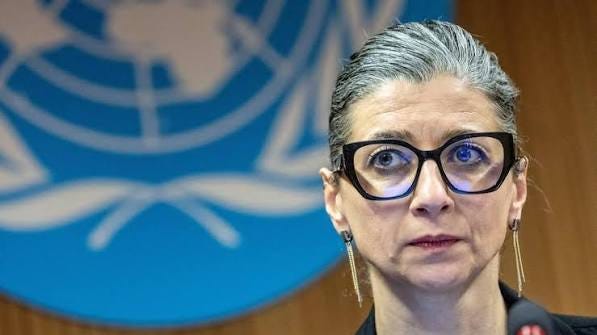
Francesca Albanese, the UN’s Special Rapporteur on the Palestinian territories, spent the days after October 7 casting doubt on the mass rapes Hamas had just committed. She later wrote that Jews had learned to see themselves as “the chosen people... chosen to rule.” She was reappointed anyway, her conduct waved through by a committee that found her “detailed explanations” satisfactory. She isn’t an aberration. She’s the type.
Chris Sidoti mocked Israel’s official response to a genocide finding as “so boring,” while his fellow commissioner, Miloon Kothari, publicly mused that a “Jewish lobby” controls social media and openly questioned whether Israel should even retain its UN membership. Their colleague, Navi Pillay, the commission’s chair and a former UN Human Rights Commissioner, brushed off accusations of bias by insisting the panel’s work was simply “based on law” — as if repeating the word were a substitute for practicing it.
None of these people report to the Arab League anymore, nobody has to pay them. That’s the real upgrade — the Arab states, and Qatar in particular, spent decades buying influence the way Qatar buys the rest of the world: soft power, funding, patient cultivation. And it worked so well the investment became self-sustaining. The West doesn’t need to be paid to hate Israel anymore. It learned to do it on its own.
This is the UN as a microcosm: the exact fusion that’s quietly taking over European politics — progressive ideology and political Islam, each supplying what the other lacks — isn’t some fringe phenomenon happening “out there.” It’s sitting in Geneva and New York, in full uniform, running the very institution that’s supposedly in charge of solving the world’s conflicts. Or whatever it is they do there. At this point, genuinely — does anyone still know?
Same as the dating app that keeps us swiping instead of loving, this conflict keeps bleeding instead of healing — because a resolved Middle East is a lost subscriber. The UN doesn’t want peace. It wants renewal. Every office named in this piece — the committee, the council, the rapporteur, the agency — is a subscription plan with a diplomat’s salary attached, and none of them get paid the day the war ends.
And the Arab states didn’t just build the machine. They’ve spent eighty years running the con from the other end — dangling the Palestinians like bait on a low flame, decade after decade, never enough to win, never enough to lose, just enough to keep the cause alive and the money flowing. Not liberation. Leverage. The Palestinians were never the point. They were the subscription fee — the price everyone else agreed to keep paying so the war would never end.
This piece took hours to research, fact-check, and write, and I published it for free because some truths are too important to come with a subscription fee — even if the UN thinks they should. I'm writing this from Europe, where I keep overhearing fellow tourists confidently repeat the same myths this article just dismantled: about who colonized whom. It's not just wrong. It's the kind of wrong that gets people killed on both sides of a border most of these tourists couldn't find on a map. If you read this and nodded along even once, send it to the person in your life who still thinks the UN is neutral. And if you want me to keep doing this — the hours, the footnotes, the arguing with strangers in coffee places all over Lisbon — consider becoming a paying subscriber. Support one-time, or get one of my books; all the links are in bio. Unlike the UN, I have every intention of delivering.
Much Love. Yama. B
Sources: National Interest, “Corrupted from Birth: The UNRWA’s Forgotten History”; CNN, “UN probe finds 9 UNRWA employees ‘may have’ been involved in October 7 attack”; United Nations, “Note to correspondents – on the OIOS investigation of UNRWA”; UN Watch, “Evidence Of UNRWA Aid To Hamas On And After October 7th”; The Times of Israel, “Directly beneath UNRWA’s Gaza headquarters, IDF uncovers top secret Hamas data centre”; Israel National News, “Under an UNRWA building | The tunnel where the hostages’ bodies were found”; UN Watch, “2025 UNGA Resolutions on Israel vs. Rest of the World”; UN Watch, “2024 UNGA Resolutions on Israel vs. Rest of the World”; Grokipedia, “List of United Nations resolutions concerning Israel”; Jewish People Policy Institute, “UNRWA’s Existence Spells Doom for Rebuilding Gaza”; Algemeiner, “UNRWA Forces Refugee Status on Palestinians in Perpetuity”; Algemeiner, “UN Special Rapporteur Francesca Albanese Urges Germany to Get Over Holocaust Guilt in Antisemitic Tirade”; All Israel News, “UN official Albanese sparks outrage with Holocaust-linked remarks”; JNS, “Israel rejects apology of UN official who claimed ‘Jewish lobby’ controls social media”; UN Watch, “The Compendium of World Condemnations of Antisemitic UN Investigator Miloon Kothari”; OHCHR, “Commissioners of the CoI”; OHCHR, “Human Rights Council President appoints Members of the Commission of Inquiry”; FDD, “Time to End UN’s Anti-Israel and Anti-American Commission of Inquiry”; The Times of Israel, “UN finds evidence of rape on Oct. 7 and after; Israel: They tried to downplay issue”; The Times of Israel, “Eight weeks after Oct. 7 onslaught, UN Women condemns ‘brutal attacks by Hamas’”; United Nations, “Briefing by SRSG-SVC, Ms. Pramila Patten to the Security Council”; Jewish News, “’You knew’: Israel accuses UNRWA chief after Hamas tunnel discovered beneath its HQ”; American Jewish Committee, “What to Know about UNRWA and Its Controversial Role in the Israeli-Palestinian Conflict”; USAID Office of Inspector General, “Investigative Summary: USAID Inspector General’s Continuing Investigation Leads to Referral of Over 100 Current and Former UNRWA Staff Linked to Hamas
No posts
Comments
Nothing yet. Say the first thing.
Sign in to join the conversation.