
It was late summer in 1947 when a Bedouin teenager was doing what he did most days: chasing a runaway goat through the cliffs above the Dead Sea. Frustrated, he threw a rock into a dark opening in the rock face, hoping to startle the animal out of hiding. Instead of a bleat, he heard something shatter.
Curious, he climbed inside. He found a row of tall clay jars, sealed shut, each containing rolled-up scraps of leather covered in ancient writing he couldn’t read. He had no way of knowing it yet, but the goat had just led him to the twentieth century’s biggest archaeological find — and to the beginning of a story involving a Syrian archbishop, a smuggling route through a war zone, a classified ad in the Wall Street Journal, and an Israeli spy who would end up buying back a piece of his own people’s history without the seller ever knowing who he really was. The Bedouin boy had just found the Dead Sea Scrolls, and this is the unbelievable story behind it.
Almost Burned, Almost Lost
The scrolls sat in the family’s tent for a while, treated as nothing more than old, strange-smelling leather. At one point, someone reportedly used a piece of it to start a fire. The Bedouin family then split what they had between two Bethlehem antiquities dealers: three scrolls went to a dealer named Faidi Salahi, the other four to a dealer named Khalil Iskander Shahin, known as Kando. Neither man fully understood what he had; they just knew old parchment sometimes sold. It was Salahi’s contact — an Armenian antiquities dealer with connections on both sides of the city — who reached out to Professor Eleazar Sukenik at Hebrew University.
Sukenik almost said no; getting to the meeting point alone was dangerous. But something about the message made him go anyway. They met at the edge of Military Zone B — armed checkpoints on both sides, barbed wire strung between them. The dealer didn't hand anything over; he just held up a single fragment of leather, close enough for Sukenik to see, too far to touch.
Sukenik stared through the wire, and even at a distance, even through a fence built to keep two peoples apart, he recognized something: the shape of the letters. He’d seen that same handwriting before — carved into Jewish burial chambers dating back to the first century. He knew, in that instant, that this wasn’t a forgery and wasn’t ordinary. What he didn’t yet know was that getting the rest of it into his hands would mean risking his life on a bus full of strangers on the single most dangerous day Jerusalem had seen in a decade.
The Bus to Bethlehem
Sukenik had to see more. But “more” meant Bethlehem — a town that was, at the time, overwhelmingly Christian, yet that distinction didn’t make the trip any safer. With the UN vote on partition days away and Arab militias already mobilizing against Jews across “Palestine,” any Jew crossing into Arab-controlled territory, whether Christian or Muslim, was taking his life in his hands.
Five days later, on November 29, 1947, Sukenik got his pass and boarded a public bus full of Arab passengers, carrying the scrolls back to Jerusalem, wrapped like an ordinary parcel under his arm. That same day — the exact same day the United Nations General Assembly in New York was voting on the partition of “Palestine”.
Sukenik got home, unrolled one of the scrolls with shaking hands, and later wrote in his diary that he felt himself privileged by fate to look upon a Hebrew text unread for two thousand years. As he sat with the ancient words before him, the radio in the next room announced the outcome of the vote: the United Nations had approved the creation of a Jewish state. Outside, Jerusalem erupted — in both celebration and violence. In the days that followed, Arab rioters moved through the streets.
Sukenik agreed to buy the scrolls — for the equivalent of about $170. He would go on to decipher and painstakingly reconstruct them while the city was under siege, working through the sound of mortar and artillery fire outside his window. Piecing together fragments written in an archaic Hebrew script, he wrote that it felt as if the scrolls weren’t merely describing an ancient past — they were speaking directly into his present. Sukenik didn’t get all seven scrolls that day, only three.
The other four had gone to a different buyer entirely — a Syrian Orthodox archbishop named Mar Athanasius Yeshue Samuel, who had his own plans for them. Getting those four back would take Sukenik’s son seven more years, an ocean, and a stranger’s classified ad.
The Archbishop’s Gamble
In the meantime, another man already had four of the seven scrolls in his office — and he had no idea what to do with them. It was early 1947, and Mar Athanasius Yeshue Samuel, Metropolitan of the Syrian Orthodox Church in Jerusalem, was sitting at St. Mark’s Monastery, drinking Turkish coffee with a Bethlehem antiquities dealer named Kando. Kando reached beneath his robe and produced a package wrapped in old newspaper. Samuel looked down at the parchment — and something stirred in him. He didn’t recognize the script. It wasn’t the Syriac he read every day in the liturgy. But it was old in a way that made the air in the room feel different. He didn’t hesitate. He told Kando he wanted to buy them.
Samuel made a decision that would define the next seven years of his life: he would not sell cheaply and would not sell locally. He wanted a Western buyer, a real institution, and real revenue. But the timing could not have been worse. Within days of the partition vote, Jerusalem was a war zone. Moving anything valuable across the city — let alone irreplaceable ancient manuscripts — had become a gamble with one's life. Samuel kept the scrolls hidden at the monastery through the fighting, waiting for a moment safe enough to move them.
That moment came in February 1948, when one of his assistants, a young clergyman, contacted the American School of Oriental Research in Jerusalem — an organization of Western scholars who might actually know what they were looking at. An American scholar named John Trever examined the scrolls, photographed them, and sent copies to a leading biblical archaeologist in the United States for authentication. The verdict was stunning: They were roughly two thousand years old. In March 1948, Samuel made his move: he had the four scrolls smuggled out of Jerusalem entirely, south to Beirut, for safekeeping. It would be the first of several border crossings the scrolls would survive. It would not be the last.
Crossing Borders
Beirut was meant to be only a stopover. But as 1948 turned into full-scale war — the British Mandate ending, Israel declaring independence, and five Arab armies invading within a day of that declaration — returning to Jerusalem was no longer an option. In January 1949, nearly a year after the scrolls left Jerusalem, Samuel arrived in the United States, carrying his four scrolls.
He met again with John Trever, the American scholar who had first authenticated them, hoping Trever’s connections might help him find a buyer worthy of what he held — a major university, a national museum, or some institution that understood exactly what these objects meant.
What followed was almost comic: Samuel met with scholars and wrote letters. He approached universities — Yale among them — to interest them in acquiring the scrolls. Everyone was fascinated, but nobody would commit to a price. Partly it was the sheer novelty of the objects — nothing like this had ever come up for sale before, so nobody knew how to value them. And partly it was politics: both the newly declared State of Israel and the Kingdom of Jordan had real and asserted claims over material excavated from land now caught in an unresolved international dispute. No reputable Western institution wanted to buy something two governments might later call stolen.
Samuel was stuck holding a fortune no one would touch. Years passed. He settled in New Jersey, waiting, while the scrolls quietly aged in a box in the New World, half a planet from the caves where they’d been sealed for two thousand years. By 1954, Samuel had run out of patience. He decided to try something almost absurdly direct: he would advertise them, the way you’d advertise a used car or an old piano.
On June 1, 1954, on page fourteen of the Wall Street Journal, tucked between listings for office equipment and industrial machinery, a small classified ad appeared under “Miscellaneous for Sale”: “The Four Dead Sea Scrolls. Biblical manuscripts dating back to at least 200 B.C. are for sale. This would be an ideal gift to an educational or religious institution by an individual or group.”

The Ad That Shouldn’t Have Worked
Think, for a moment, about what had to happen for that ad to reach the right eyes. It had to be read by someone who understood exactly what the words “Dead Sea Scrolls” meant. In 1954, that wasn’t a small ask. Most Americans had never heard the phrase. Most people who had would have been unable to distinguish an authentic two-thousand-year-old biblical manuscript from an elaborate forgery. It had to be read by someone who happened to be in New York that week, not anywhere else on Earth, but specifically within reach of a copy of the Wall Street Journal on June 1, 1954.
The odds of one person meeting all three conditions at once were vanishingly small. Yet that week, in that city, a man who matched all three was sitting in a hotel room in New York — there to deliver a series of lectures, nothing more — when someone put a copy of the Wall Street Journal in front of him. His name was Yigael Yadin, and his father was Eleazar Sukenik. He read the ad once, and he knew he must act.
The Man Who Couldn’t Be Seen
Yigael Yadin wasn't just Sukenik's son. By the time the four remaining scrolls surfaced for sale in America, he was the second Chief of Staff of the Israel Defense Forces — the man who, as head of the Operations Section of the Haganah General Staff, made many of the decisions that led to Israel's victory in the 1948 war. Yadin knew, almost instantly, that he had a problem — and it wasn’t money.
Archbishop Samuel had spent seven years trying to sell these scrolls, and in all that time, he had made one thing consistently clear: he would not sell to Israel. He’d refused Sukenik himself years earlier. He was not going to reverse course now, no matter how good the price, if he learned the buyer on the other end of this ad was the dead professor’s son — acting, in effect, on behalf of the Jewish state.
Yadin found an American businessman with no visible ties to Israel, ordinary enough not to raise questions — and asked him to respond to the ad as the buyer. On paper, on the phone, and in every conversation that followed, the man negotiating for the Four Dead Sea Scrolls was simply an American interested in acquiring some old manuscripts.
Ten days after the ad ran, on June 11, 1954, a price was agreed upon: $250,000 for all four scrolls — funded partly by a private American donor and partly, secretly, by the government of Israel. Samuel signed the deal believing he’d sold his scrolls to an American businessman who thought they’d make a fine donation to a university or a church somewhere. He had no idea he’d just sold them home, where they belong.
Coming Home in Silence
The scrolls left the United States quietly. No press, no fanfare, no announcement — just four of the most significant manuscripts in human history, packed and shipped across the ocean, retracing in reverse the exact path Archbishop Samuel had taken seven years earlier to smuggle them out of a warzone.
For months, Yadin said nothing. Then, on February 13, 1955 — eight months after a stranger in New York responded to a classified ad — the Israeli government finally broke the silence and announced: the missing four Dead Sea Scrolls, including the only complete ancient copy of the Book of Isaiah ever found, are home.
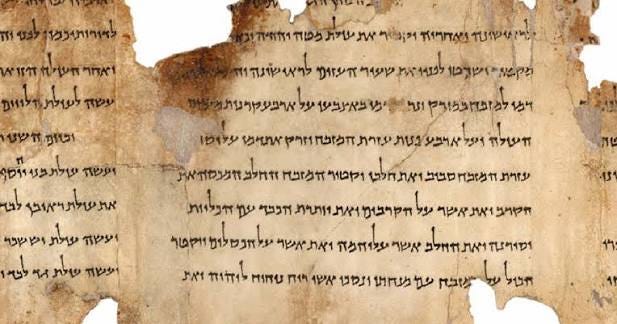
Here's a 2,000-year-old scroll, finally home, found in the Judean Desert, written in Hebrew I can read without a dictionary. Now explain to me again how Jews are 'European colonizers' with no connection to this land.
How These Scrolls Prove the Jews Were Always Here
The Dead Sea Scrolls are a library, buried in the Judean Desert two thousand years ago, written in Hebrew and Aramaic by a Jewish community in Judea on Jewish law, prophecy, and national destiny. It is the unbroken, self-authored record of a people who never left. They contain fragments of almost the entire Hebrew Bible—Genesis, Exodus, Deuteronomy, Psalms, Ecclesiastes, Ruth, Ezra, and more—scattered across hundreds of manuscripts.
One scroll stood apart from all the rest: the Great Isaiah Scroll — nearly the entire book, 24 feet of parchment, preserved almost intact. When scholars laid it beside the Isaiah read in synagogues today, the text was nearly word-for-word identical, using the same language and words, unbroken across two thousand years.
A Story About Today
The Book of Isaiah tells the story of the Jewish people in exile, their Temple destroyed, their land taken, and their king dethroned. In that darkness, they cry:
“וַתֹּאמֶר צִיּוֹן עֲזָבַנִי ה’ וַאדֹנָי שְׁכֵחָנִי”
“Zion said, the Lord has forsaken me, my Lord has forgotten me.”
And the answer that comes back — the answer sealed in a jar in a cave for two thousand years, waiting — is this:
“הֲתִשְׁכַּח אִשָּׁה עוּלָהּ... גַּם־אֵלֶּה תִשְׁכַּחְנָה וְאָנֹכִי לֹא אֶשְׁכָּחֵךְ. הֵן עַל־כַּפַּיִם חַקֹּתִיךְ”
“Can a woman forget her nursing child... Yet I will not forget you. Behold, I have engraved you on the palms of My hands.”
Today, it’s hard not to feel the same way. October 7th flipped every card on the table. Instead of compassion, Jews faced hatred. Instead of solidarity, they faced boycotts. Students marched in the streets against them. Antisemitism, out in the open again, was celebrated rather than hidden. Enemies rose, openly, to finish what they’ve tried to finish before.
The Scrolls exist to connect us to a message that has echoed for two thousand years, reminding us that this is a burden we've always carried and that it must never pull us from our truth, from who we are, or from our unity. "Empires rise and fall, rewriting the same story of hatred in a hundred different ways. But they never understood our real strength: turning inward, toward one another, again and again, and refusing to let the noise, the hatred, the darkness break what we've always known — that we are one.
Why They Wanted These Scrolls Gone
There’s a reason Archbishop Samuel—sitting on a fortune for seven straight years—refused every offer from a Jewish buyer. And it wasn’t really about money. It was about what these scrolls prove if you read them for what they say rather than what you’ve been told they say.
The scrolls don’t just prove the Jews never left this land. They prove something almost nobody wants said out loud:
Judaism in the first century wasn’t a single unified block. It was an ecosystem of distinct Jewish movements — Pharisees, who built the legal tradition that became rabbinic Judaism; Sadducees, the priestly aristocracy tied to the Temple; and Zealots, who pushed for armed revolt against Rome.
But there was another stream of Judaism in that era — one far fewer people have ever heard of, hidden in the cliffs above the Dead Sea itself. Among the hundreds of fragments pulled from those caves, one document did something none of the others did: it didn’t just record law, scripture, or ritual. It read like a battle plan. Scholars call it the War Scroll. It belonged to the Essenes — they left a prophecy and specific instructions for a war they were certain was coming. A final war. In it, they named the two sides: the ‘sons of light’ against the ‘sons of darkness’.
This is the war we're living through right now — a spiritual war. On one side stand the values of coexistence, of mutual responsibility, of love for one another. On the other stand forces that want to impose their religion on everyone else, silence women, erase them, and rule through force and violence.
Jesus of Nazareth stepped into exactly that world as a rabbi — teaching in synagogues, debating Pharisees in their own language, and quoting the same prophets the Qumran sect quoted. He never left Judaism, never renounced it, and never intended to replace it; whatever he founded, he founded it from within it, one more Jewish voice arguing what faithfulness to God required under Roman occupation.
The separate religion that came after — with its own institutions and hierarchy, eventually fusing with the machinery of Rome itself — was built by other people, generations later. For anyone who calls themselves a follower of Jesus today, it’s worth remembering: the man at the center of your faith lived, prayed, and died within Judaism.
The Secret Hidden in the Dead Sea Scrolls
There’s another book buried in those caves — one that never made it into the Bible. Among the fragments pulled from the caves was a text called the Book of Enoch. To understand why it matters, you have to go back to something even older: the opening lines of Sefer Yetzirah, the Book of Creation, the foundational text of Jewish mysticism. It describes God forming the universe through thirty-two mystical paths of wisdom — ten sefirot, the ten divine emanations, and the twenty-two letters of the Hebrew alphabet, the building blocks of reality itself. The implication is staggering: creation isn’t chaos. It runs on structure. There are laws beneath the laws.
The Torah, deliberately, doesn’t hand us that blueprint. It doesn’t ask us to master the mechanics of creation. It asks us to trust that creation is working in our favor, even when we can’t see the wiring behind it. That trust — not technical mastery, but surrender to it — is at the heart of Kabbalah.
The Book of Enoch goes exactly where the Torah pulls back. It’s saturated with visions of the celestial order, the movements of the stars, the hierarchy of angels, the mechanics of judgment — the wiring itself, laid bare. That’s precisely why it never entered the canon: it says too much about things Judaism chose, deliberately, to leave veiled. But it survived anyway — preserved whole, for over a thousand years, only in the Ethiopian Orthodox Bible. And Qumran proved something remarkable: this wasn't some later invention. It was a real, first-century Jewish text — proof that it simply took a different road to survival than the rest of the Hebrew Bible did.
The Evidence Was Never the Issue
Here's the question I keep coming back to: the Dead Sea Scrolls are out there — physical, dated, undeniable proof that Jews have lived, prayed, and written in that land for three thousand years. And they're not the only proof; they're one artifact among thousands, including the City of David, excavated layer by layer beneath Jerusalem's streets. The Arch of Titus in Rome, carved with the Temple's own menorah being carried off in chains — Rome's own proof that a Jewish Temple stood in Jerusalem and that Rome destroyed it. The words of Jesus himself, a Jewish rabbi preaching in a Jewish land to Jewish crowds. Coins, inscriptions, burial caves — an unbroken archaeological record proving a continuous Jewish presence in this land for three thousand years.
And still, people choose to believe the Palestinian Myth, invented by Yasser Arafat, amplified by Soviet propaganda — that Jews are foreign colonizers with no ancient connection to this land at all.
Why?
When the truth threatens someone’s identity, the mind doesn’t reach for evidence. It reaches for comfort. Cognitive dissonance is the discomfort of holding a belief that reality keeps contradicting, and the powerful, often unconscious pull to protect the belief rather than update it.
Ordinary people keep pressing a button they believed was delivering real electric shocks to another human being — a person screaming, begging them to stop — simply because someone in a lab coat told them it was fine, told them to keep going, told them they weren’t responsible.
Most of them kept going because obedience to authority, and the fear of what it means about themselves if they stop and admit they were wrong, was stronger than the evidence in front of them. That is, in part, how the Holocaust happened. And it is exactly how this keeps happening now, every time someone chooses a comfortable lie over an inconvenient truth.
So here’s what I’m asking. Not of the people who’ve already made up their minds — of those still listening, still turning it over, still willing to hold two things at once and see which the evidence actually supports. Stay curious. Let yourself be surprised. Ask whether what you’ve been taught is what actually happened, or just what was easiest to believe.
Because this is the moment we’re living in — the same war the Essenes wrote about two thousand years ago, still being fought today. What you choose to believe and which side you decide to stand on isn’t just about you. It’s a choice you’re making for your daughters and for their daughters after them — whether they grow up in a world that lets them choose who to love, what to study, and what to become. Or whether they grow up veiled and silenced, told that ambition is a sin and that their voice doesn’t belong in the room.
Sons of light, sons of darkness. None of us gets to sit this one out. One day your daughter may ask why she's covered, or why she's free. The answer will be the choice you made today.
If you made it this far — thank you. I didn’t put this behind a paywall again because I thought it mattered too much to lock away. But if you’re not a subscriber yet, please consider subscribing. Support one time or get one of my books. It genuinely helps me cut back hours on other work so I can spend more time here, writing the things I think need to be said.
If you’d like me to write more about the Book of Enoch, and about how mistranslation — in Enoch and elsewhere — has shaped beliefs that were never actually there in the original text, let me know in the comments.
I’m sorry I can’t keep up with every comment, but I promise I read every single word. Thank you for reading and sharing, and for the kindness of everyone who’s sent a coffee, a kind word, and shares our truth with others.
Much Love, Yama B
This Substack is reader-supported. To receive new posts and support my work, consider becoming a free or paid subscriber.
Comments
Nothing yet. Say the first thing.
Sign in to join the conversation.