
My article last week generated some debate. It sometimes surprises me that equity investors don’t pay more attention to bond markets. I recall a gilt salesman moving to the equities desk and becoming one of the biggest hitters without even knowing what the companies did.
There has been much more attention this week, with the Treasury Department announcing a doubling of buybacks of long bonds and the Government debt hitting $40 trillion. US debt made the front page of the FT, at least twice (after I had written this!).
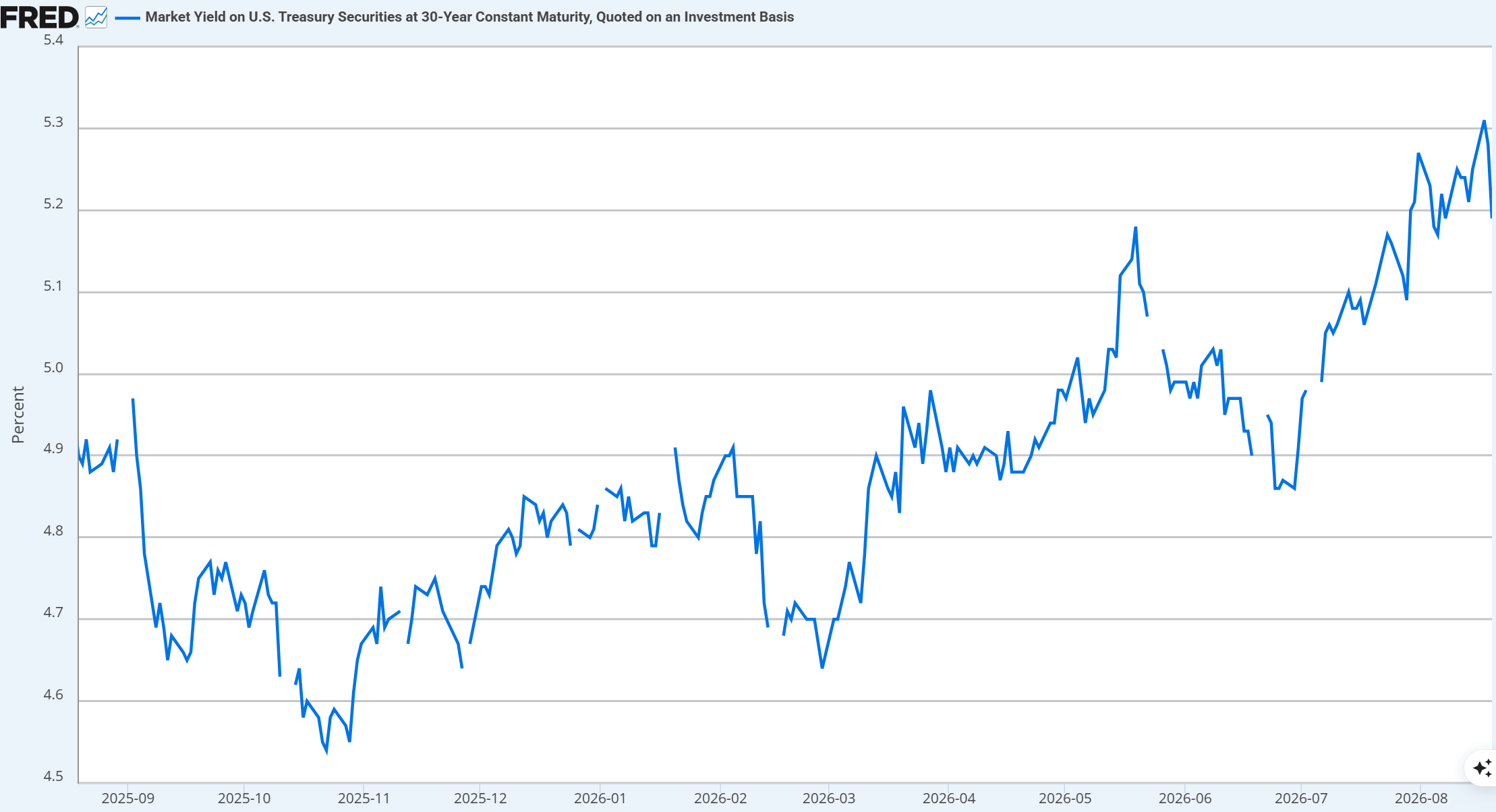
The yield on the US long bond as I write this on Thursday evening has retreated to 5.25% and the bonds have recovered a little, but the yield is close to the recent high:
30 Year Treasury Yield -1Y
And here is that chart on a 5 year scale which is a graphic illustration of the change in the price of money:
30 Year Treasury Yield -5Y
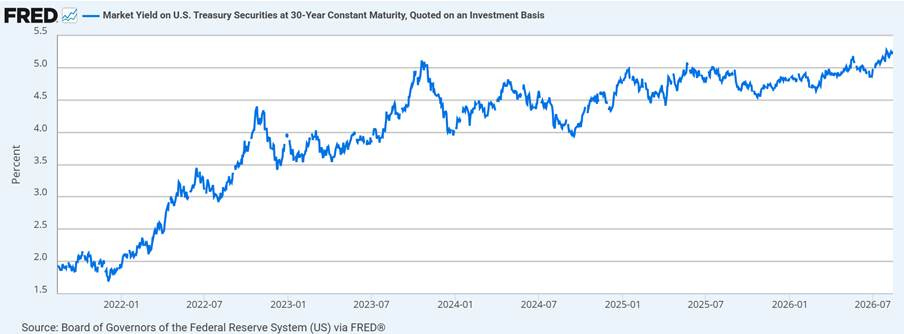
If you showed that chart to someone who didn’t know what the stockmarket had done, they would guess that the market had gone down, led by growth companies. Of course, markets have done the opposite, fuelled by the AI narrative. That may now be reversing, as the hyperscalers underperform, and high beta stocks also lag.
Here is that chart in a longer term context:
30 Year Treasury Yield Long Term
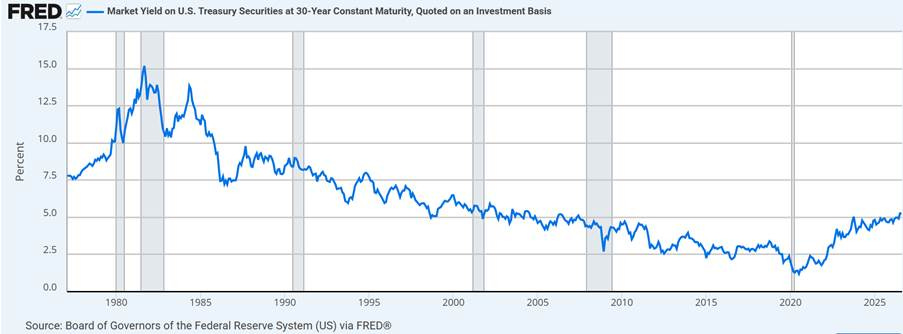
Source: FRED
I am not suggesting that we shall return to the days of the early 1980s with mortgages in the 15-20% range. But this move in the price of money is significant. Perhaps it will be sufficient to encourage the Japanese, the largest holder of Treasuries, to buy more. But that wasn’t Scott Bessent’s thinking when he intervened in the Yen.
I discussed with James Aitken in podcast #29 in December, 2023 the risk that Bessent fears, that the Japanese repatriate their US Treasury holdings. And the currency will also play a role in that – if it weakens, that will colour overseas investors’ attitudes. I have been surprised by its resilience.
I have no particular insight as to what Mrs Watanabe will do, but it’s possible she holds the key to the US economy, bond market and stock market.
The US strategy of borrowing largely (85%) short term, is quite a dangerous one, which no corporate treasurer would countenance. This might cause Kevin Warsh a headache when he thinks about increasing rates. Meanwhile, corporate bond issuance is surging and two of the most experienced allocators on the planet have warned about a US bond crisis, although they do work for the same bank.
In March, I interviewed Michael Cembalest, probably the most senior asset allocator at JP Morgan. He predicted a US bond crisis. That podcast is here (it has had over 200k views on YouTube). A few weeks later, I listened to Jamie Dimon at Norges Bank Investment Management’s conference make the same prediction. Cembalest thought it wouldn’t happen for some time, after he retired. Let’s see.
Good news: we are running our forensic analysis bootcamp again in the fall. It kicks off in early October, and will run for 8 weeks every Monday night, usually at 17.30 London, 12.30 EST, 9.30 PST. Classes run for 60-90 minutes and allow plenty of time for questions.
The curriculum is the full setup we offer to institutional investors but with some additional explanation and extra time allowed for a more considered deliberation. This year, we have tailored the content for AI application. And every session is recorded, so if you are travelling one week, no problem, simply watch the recording.
These courses are popular and we limit numbers so that everyone has the chance to ask questions and participate. Sign up for the waitlist and be sure to be notified when the discounted early bird tickets are released.

Not one, but two podcasts to tell you about this week. A common theme between them is that both guests survived the dot.com bubble, but only just. In 2000, Rich Pzena was down 60% vs the market in February and recovered all of that by December. Alex Roepers lagged the Nasdaq by 10% in January; by year-end, he was up 50% and the Nasdaq was down 40%. That’s how violent the swing can be when a bubble bursts.
I have been remiss in not telling you about my podcast last month with Rich Pzena. It was honestly one of the best conversations I have had on the show. Rich is a deep value investor who has built a firm with $80bn of AUM. But he explained that it wasn’t plain sailing.
He launched and soon found himself in trouble. It was the dot.com era and he underperformed for 10 consecutive quarters, ending up 60% behind the market. And in February, 2000 the firm was losing money and he recommended to his backer, Joel Greenblatt, that they sell to another company. Greenblatt insisted he continue and promised to underwrite the losses, without asking for any additional equity.
By the end of 2000, the dot.com bust meant that their fund was ahead of the market, recovering that >60% lag. Rich had another story about the dot.com era which I won’t spoil for you, but there was much more in this fascinating conversation.
Rich explained his deep value approach in some detail and came out with a lot of sage advice for investors, both professional and private. Honestly, there was so much wisdom on offer here, you really should listen, or watch. We are now recording in a TV studio and the video quality is much improved.

This month’s guest is also a deep value investor but with a rather different style. Alex Roepers takes a behind the scenes activist approach. In the podcast, he explains the strategy which he has exploited over nearly 35 years to outperform the S&P by delivering a 12.3% pa (equivalent to a 48x return) net of fees. Those fees are significant – the returns gross are pretty spectacular.
Roepers had an unconventional journey from engineering intern in the Netherlands to activist fund manager. Alex’s career spans factory floors, conglomerate clean ups, M&A at the principal level and ultimately building his own firm focused on deep fundamental work and engaged ownership.
At a family owned conglomerate, he was involved in a lot of M&A, proposed some public equity targets and then started to monitor the performance of those recommendations. He eventually set up his own fund with the backing of that family and one or two others. His experience inside manufacturing companies has stood him in good stead in evaluating businesses as an investor.
Similar to Pzena, his fund initially struggled. Soon after he launched, markets were rocked by the savings and loan crisis, a recession and the Iraq War. He responded by launching a long-short fund in 1992 and his 33-year track record has been impressive.
Our conversation spans his investment philosophy, what he learned in his early career working at two large conglomerates and how he implements his constructive shareholder activism approach. We discuss his journey from the corporate to the investing world, his playbook for constructive activism, including how he interacts with management teams, and how he evaluates management quality, capital allocation and operational improvement opportunities.
There is a lot to take away on how to influence management as well as on identifying cheap boring companies that offer asymmetric return opportunities. You are bound to enjoy this one too.

Roepers presented four ideas at the recent London Value Investor Conference and I would be surprised if all four were still independent companies in 12 months’ time. One is headquartered in the UK and he was heading to see the CEO after our recording. He had a compelling list of ideas for improving that share price.
In that presentation, he highlighted the four picks from the previous conference which had gained, 51%, 42%, 37% and 19% in the intervening 12 months.
The four ideas Alex presented are all interesting, but one stood out to me because it combines several things I look for: a favourable capital cycle, improving pricing power, strong cash generation and an exposure to one of the biggest investment themes in markets today - without being an obvious AI stock.
This is a classic boring value play which could be taken out or revalued as current circumstances in its market have delivered some extra pricing power. It also has a data centre angle and a catalyst for a rerating.
It is not a classic deep-value bargain, and there are some very real risks. But the combination of constrained supply, improving industry economics and a growing power-generation business creates an interesting asymmetry. Alex sees around 40% upside, which I think is credible if the operational improvement continues.
Below, I show the four current ideas, how last year’s picks performed (Alex still holds two), and then take a closer look at the least well-known of this year’s stocks, including its valuation, the capital cycle angle, the main risk and a potential catalyst.
Finally, a quick word from my sponsor, AlphaSense which has a seriously generous offer for my readers. You can get a FREE Deep Research report on any stock when you click the button below. There are 3 reasons to try this out:
I use this Deep Research tool as a core part of my investigation of any new stock. It uses the company’s own filings and earnings call transcripts so there aren’t any hallucination issues. It’s reliable and understands finance - much better than ChatGPT etc.
If you are doing some research on a new stock right now, this will be a massive time-saver.
It really helps me. AlphaSense are my main sponsor and that helps me produce the podcast and this Substack. They use this to generate leads and that’s how they measure my performance. Don’t worry, you won’t be spammed.
Thanks for trying this out and for your support.
Comments
Nothing yet. Say the first thing.
Sign in to join the conversation.