
“We are in an anticipation era, not an extrapolation era.”
That was the central message from Scottish Mortgage manager Tom Slater at this week’s London Quality-Growth conference. It was one of the most interesting investing presentations I have heard this year.
Quality-Growth Conference
Quality has not performed well recently. This is part the SaaScopalypse rout, with software often representing a significant component of quality portfolios, and part under-representation in tech hardware, with semi-conductor related stocks historically perceived as highly cyclical.
One presenter even asked if quality was about to have a decade-long “style winter” as experienced by value in the last 10 years, when it massively underperformed growth. Presenters included many of the big names in the space with investors from Baillie Gifford, Lingotto, Lindsell Train, Jennison, Artisan Partners and a few others.
The 2024 conference picks were assessed and it was highly polarised – the best stock was a 7 bagger, the number 2 a double. But the 2 worst stocks had fallen by between 50% and 60%. Overall the stocks beat the ACWI by 2 percentage points, but few outperformed and almost as many went down as went up.
This week I cover a fascinating presentation on AI exposure from Tom Slater, manager of the Scottish Mortgage investment trust. In the next few weeks, I shall drill down into the individual stocks, including a quality compounder with a value rating and an intriguing media disruptor.
One Growth Investor’s Approach to AI
Slater has been a guest on my podcast and Scottish Mortgage, the largest equity investment trust in the UK, has over 20% of the fund in SpaceX (at the rumoured IPO valuation). In a presentation titled “AI and the New Growth Epoch”, Tom explained how he is approaching investing in AI.
He acknowledged that a huge amount of capital is going into AI and that a lot will be lost. Things have moved a long way in the last 18 months and the pace of change is accelerating. He acknowledged that the title of his talk – a new growth epoch - sounded grandiose, but we should not under-estimate the rate of change.
He recently met the Spotify co-CEOs and in their budgeting process, they are looking out over the next 10 years. Because the next 10 years cannot be navigated by extrapolation. That worked in the last 10 years but it’s not appropriate now. He compared 2025 with 2005.
If you had extrapolated from past experience in 2005, you would have missed the whole wave of mobile which was transformative for tech.
Back then, you needed to anticipate because the future winners look different and incumbents may not be “just fine”. As back then,
we are in an anticipation era, not an extrapolation era.
Tom believes that the companies which will define the next decade are not the obvious ones. Many are private. Many he has not met yet.
Historical Precedent
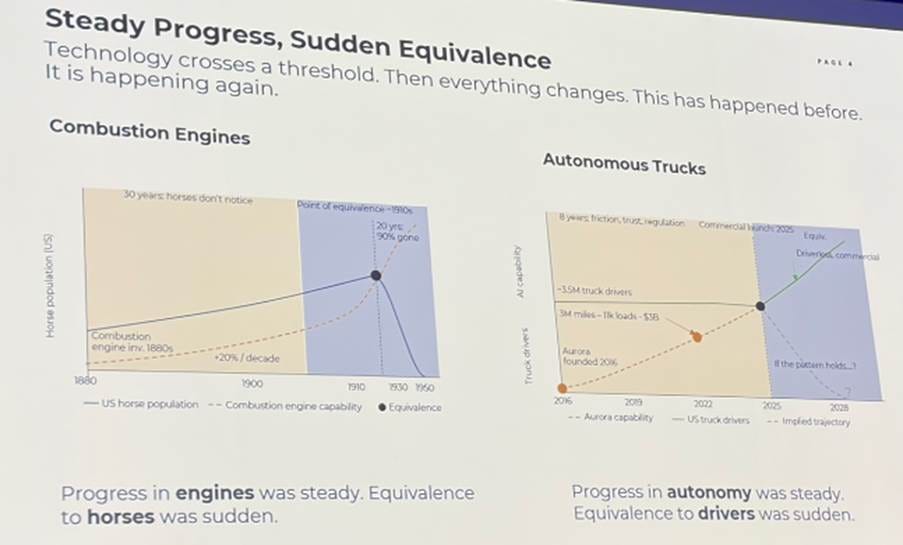
He compared autonomous trucking to the introduction of the motor car in the late 19th century:
Autonomous Trucks vs the First Cars
Source: Baillie Gifford
The automobile was invented in the 1880s yet as the slide shows, the horse population continued to grow for the next 30 years. Internal combustion engines improved at 20% pa for 30 years (displacing the steam and electric competition). In 1910, the car became the economic equivalent of the horse. In 20 years, 90% of horses were gone.
By 2022, Aurora Innovation, the leader in autonomous trucking which I highlighted here last year, had driven 3 million miles and had hauled 11,000 loads. It launched commercially in 2025, which Slater explained could be the equivalent of the horse population’s 1910 for 3.5 million truck drivers. The adjustment on the other side could be as painful (albeit less so than for the horses).
While capability curves can be smooth, adoption curves can be sudden and even violent, and investors need to recognise when we are at inflection points.
Anthropic
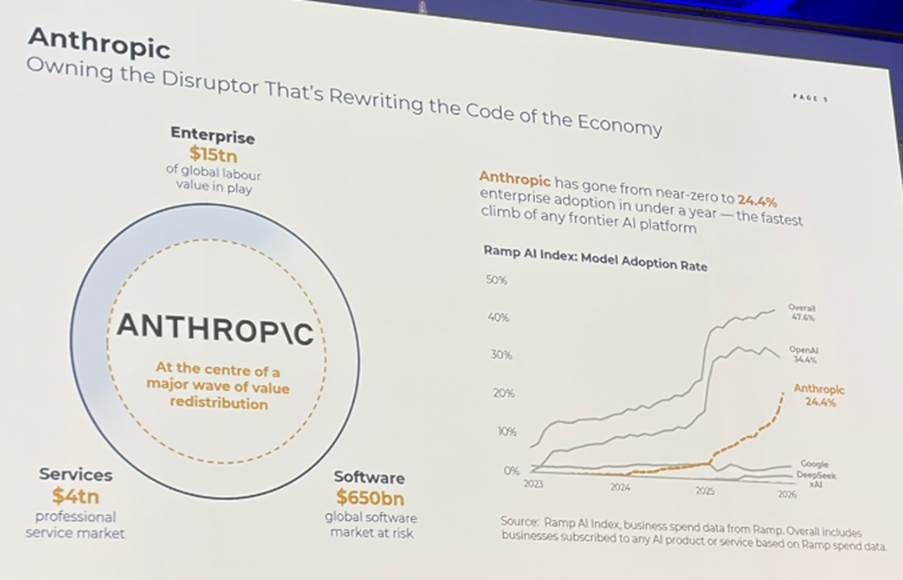
He owns Anthropic and its revenue progression has been extraordinary:
2025 annualised revenues of $9bn
February ‘26: $14bn
March ‘26: $19bn
April ’26: $30bn
May ’26: $45bn is rumoured
Of course, annualised revenues are moving so quickly that investors should treat extrapolations cautiously – at this rate, it would probably overtake most countries’ GDP by year end .
Its current revenue is close to that of Coca Cola, a 140 year old company. The adoption curve looked fine until Claude Code then it exploded. Already 5% of code is thought to be written by Claude.
Anthropic faces clear risks:
Its competition is exceptionally capable and is well-funded.
Its growth cannot continue at the same rate.
It faces political headwinds, notably the Pentagon supply chain risk we saw in March.
Hence he is not betting 100% on Anthropic – he didn’t mention the risk of running out of compute.
And you should not underestimate the opportunity – his Anthropic slide mentioned 3 markets:
Global software: $650bn
Professional services: $4tn
Enterprise labour: $15tn
Anthropic’s Opportunity
Source: Baillie Gifford
He spoke to Shopify recently who told him that they are spending more on tokens for their best engineers than their salaries and are getting more value. Another CEO told him that historically they would pick the top 200 of their 1000 potential projects. Now with Claude Code, they are doing all 1000.
US vs China
He highlighted the need to be invested in AI in both the US and China which has an alternative eco-system. China has the advantages of cheap energy, much lower costs, an exceptional pool of talent, extraordinary engineering pragmatism and one billion domestic consumers.
With two competing AI philosophies, he believes in owning assets in both systems, China could win the race for 2.3bn users in Asia and those in Latin America who have less money. Although there are clear investment risks in China, declaring that half of AI is uninvestible could prove an expensive mistake.
Europe is absent from this – we are structurally on the wrong side of this trade and part of the trillion dollar valuations is justified by an ongoing trade deficit - we have the research capability but not the commercial execution capacity.
Tech Founders
He cited corporate culture – as I explored here recently – as one of the most under-analysed forces in the investment world. As he explained in my podcast with him, he believes that tech founders make a dramatic difference in the way companies absorb AI. It’s a part of the Baillie Gifford philosophy that founder-led companies outperform. The founder has the moral authority to drive radical change as the company “belongs to them”.
He highlighted Jensen Huang at Nvidia who is first an engineer and second a CEO – he deeply understands the technology. Toby Lutke at Shopify regretted not requiring merchants to attach metadata to their products ten years ago. They have now gone back and built a comprehensive catalogue so that ChatGPT, Claude et al can find those products. Slater asserts that a non-tech CEO would not have spotted or implemented this.
He cited Dario Amodei at Anthropic and Ali Ghodsi at Databricks as examples of CEOs who are AI engineers. Manager-CEOs will hire AI consultants but the gap will widen.
How to Invest in AI
The question now is what to own and in the early stages, it’s hard to spot winners. Enablers tend to be the first group to perform. In the PC revolution, that was Intel and in the internet era it was Cisco.
The infrastructure group tends to deliver larger and more durable wealth creation. In software, that was Microsoft; Amazon was the infrastructure of e-commerce and AWS was the equivalent in cloud computing; while Google created the infrastructure of search.
While it’s difficult to spot the likely survivors, the winners make you more than you lose in the inevitable failures – Amazon vs pets.com.
He sees this as a construction process, he is not trying to predict which ones will win. None of the businesses he owns (he showed us a dozen examples – see below) have locked in their positions in the way Microsoft and Google are set up today.
Conclusions
He concluded that 3 disciplines matter:
Being positioned across the three layers
Having exposure to both the US and China
Backing tech founders
He also pointed out that perhaps the hardest aspect is idea event horizon, a term coined by Marc Andreesen. You might be able to understand Facebook and Instagram but don’t get TikTok – the biggest risk is calcification of your own thinking.
He accepts that he will miss things and will get some stocks wrong but this is an exciting era with huge opportunity and there is a huge prize from owing a few exceptional companies.
Premium subscribers can read on for:
What Tom Slater told me privately about SpaceX.
Scottish Mortgage’s full AI exposure across applications, infrastructure and compute.
The complete list of 19 quality and growth stock picks from Baillie Gifford, Jennison, Artisan Partners and others.
My quick reactions to the most interesting ideas and where I think presenters may be wrong.
IPOs
Big news this week is the IPO of a wave of private companies, starting with SpaceX, then OpenAI. I have written before about how the IPOs of major private companies will change the public equity landscape – see What If the Mag 7 Concentration Problem Is About to Get Worse?. SpaceX and OpenAI have had fundraisings at eye-watering valuations and the hype is breathtaking. More below on how Slater, one of SpaceX’s largest shareholders, views the business.
Comments
Nothing yet. Say the first thing.
Sign in to join the conversation.