
Your team implemented a new feature based on an advanced language model. The architecture works flawlessly, the interface is clean, and the response time is instant. Despite this, users are not interacting with the product the way you planned. They freeze before making a major decision, they refuse to let the agent send an email, or they blindly accept generated errors, which leads to terrible mistakes.
The classic UX process is no longer sufficient. Product success rarely depends solely on technological parameters. More often, the problem lies in interaction design. The fight for the user takes place in the invisible layer, which is the space between the interface and the human mind. Product teams and designers must learn how to design this zone so that customers can safely collaborate with algorithms.
Three adoption barriers according to Wharton School
The Wharton Blueprint for AI Agent Adoption shows that resistance to software agents is now a psychological problem. Researchers identified three frictions that stop people from handing over control to a machine.
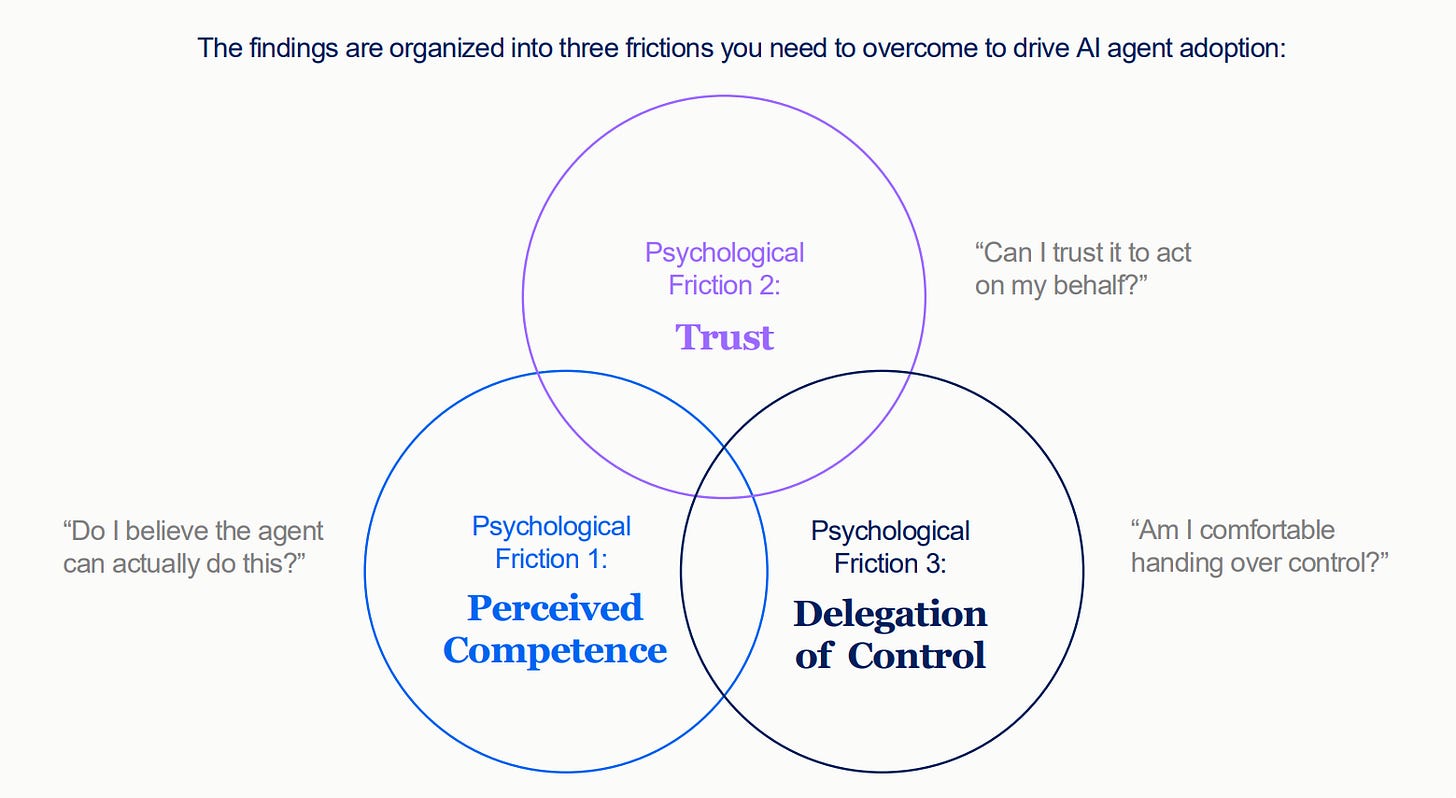
The first is perceived competence
Users are looking for effectiveness, not human warmth. Software becomes more credible when it clearly explains its thinking process. In high stakes tasks, resistance drops when the agent is positioned as an assistant supporting an expert, rather than an equal partner.
The second is trust
People trust systems more when they openly communicate their limitations. Proof of effectiveness also builds credibility. A message stating that the system booked 531 flights can increase belief in the algorithm accuracy by over 22 percent. It is also worth using precise numbers in the interface. Using a value like 8.2 out of 10 instead of a rounded 8 out of 10 increases trust by 12 percent because it signals analytical rigor.
The third is delegating control
Users hate fully automated systems that strip them of their power. Fear of not being able to audit the agent actions accounts for 26 percent of the reasons people reject the technology. On the other hand, allowing a human to personalize the software early on can increase the desire to adopt it by 20 percent.
The Epistemia Trap
Focusing solely on making the interface simple and fast creates a risk called Epistemia. This is a state where grammatical correctness and language fluency replace actual knowledge verification. The classic design school teaches us to make the user journey as easy as possible. However, an overly smooth interface puts the brain to sleep. People confuse the fluency of the system output with its reliability, which leads to blind acceptance of generated results. Shifting the content evaluation to the model poses a massive threat to important decisions.
The RIFT Framework™
To design a safe and engaging experience, product teams need the right tools. A good solution is the RIFT Framework™ created by BehaviorAI, which is based on behavioral science. This model divides the invisible layer into four areas.
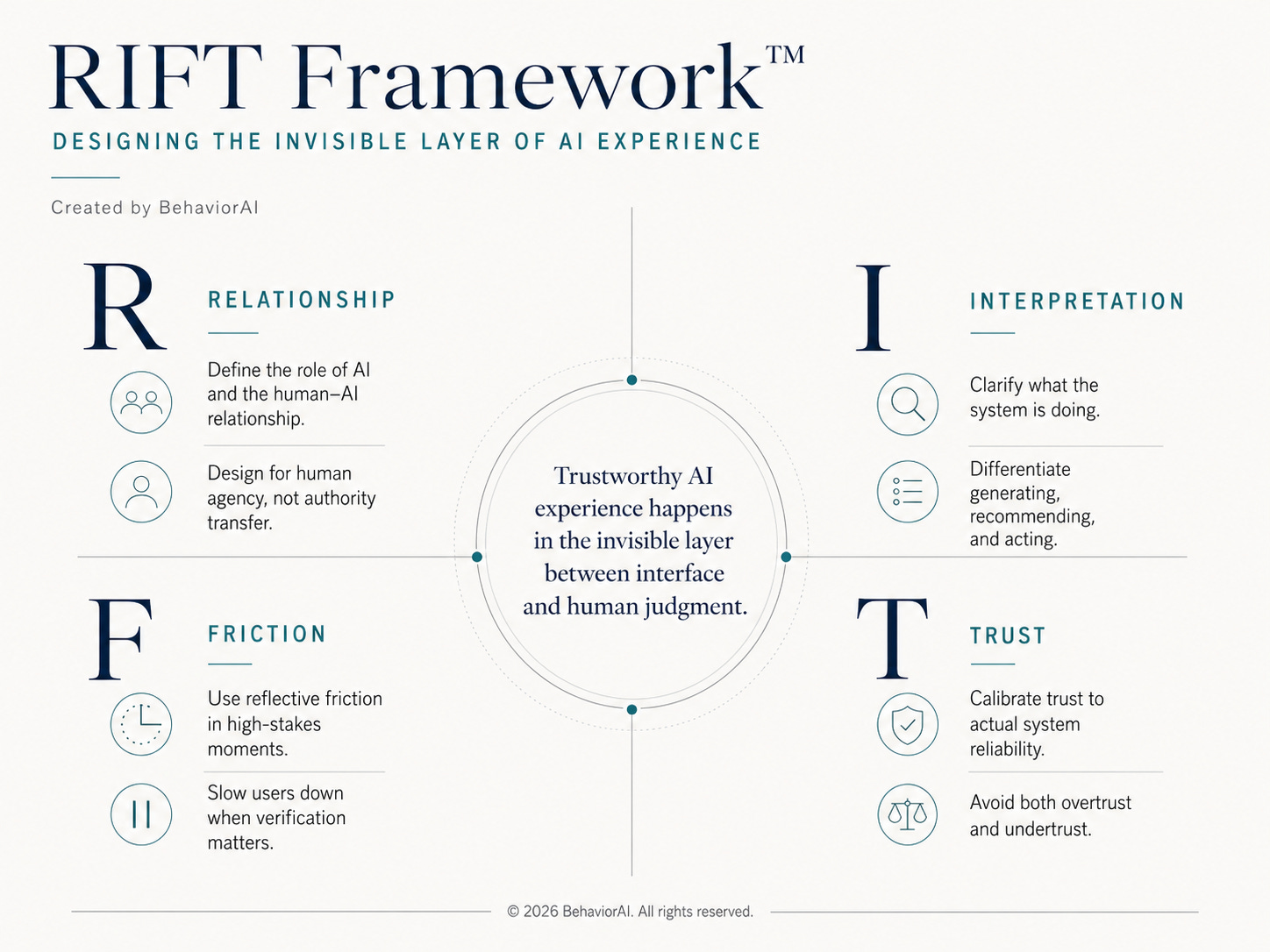
R stands for Relationship
You need to consciously design the role of the system. Humanizing the agent too much creates false expectations and can lead to a dangerous transfer of authority, where the human gives the machine responsibility for decisions. The tool should strengthen human agency, not weaken it.
I stands for Interpretation
The interface must clearly communicate the difference between generating text, recommending an option, and actually taking a binding action. Lack of clarity breeds the illusion of knowledge. Limitations and sources must be shown directly on the screen.
F stands for Friction
In these products, friction is not always bad. In critical moments, you purposely need to introduce a pause for reflection or verification. Forcing the user to click an extra confirmation, consider an alternative, or check a source protects them from automatically accepting a wrong result.
T stands for Trust
The goal of design is not to maximize trust but to calibrate it. Too much trust ends in ignoring errors. Too little trust makes users reject accurate recommendations. The level of trust should be proportional to the actual reliability of the software in a given task.
A Shift in Approach
Current tools cause humans to outsource part of their cognitive processes to the external environment. Our job is to build habits, manage attention, and properly calibrate user confidence. Applying behavioral science will allow you to build products that users will trust exactly as much as they should.
Build the Invisible Layer with BehaviorAI
This is why we are building BehaviorAI: a behavioral design platform for teams creating AI products, AI agents, and human AI workflows.
BehaviorAI helps product, UX, and innovation teams understand how users interpret the system, where they lose trust, when they need more control, and where friction should be removed or added on purpose.
It brings behavioral science into the design process, so teams can move beyond “Does the interface work?” and start asking: “Will people understand it, trust it, and safely delegate to it?”
We are now preparing the beta version of BehaviorAI.
If you are building an AI product, designing an AI agent, or working on AI adoption inside your organization, you can join the beta and help us shape the product.
Join the BehaviorAI beta and design the invisible layer of AI experience.
Comments
Nothing yet. Say the first thing.
Sign in to join the conversation.