
In this article, you will learn:
how human AI interaction differs from traditional HCI,
why trust calibration matters more than trust maximization,
when human AI collaboration actually leads to better outcomes,
how to design moments in which people can still think, decide, and remain in control.
”This article is based on my own ideas, reflections, professional experience, and the framework I’m developing at BehaviorAI. I used AI models as editorial support, mainly to help structure the text and refine the language. All sources and research referenced in the article are listed at the end.”
Kasia ❤

Some time ago, I started noticing that people were asking me completely different questions than they used to. No one asks me anymore how to design a good form or a website. They ask how to design a situation in which a person trusts a system exactly as much as they should. Not an ounce more, not an ounce less.
That question no longer fit neatly within traditional UX. I simply had to build my own language to be able to answer it. And it turns out I am not the only one. There is already a distinct field devoted to this phenomenon: human AI interaction, sometimes referred to as HAX or HAII. It is a relatively young area of research that grew out of traditional human computer interaction, but it treats AI very differently from the way computers were treated over the past forty years.
Wikipedia defines human AI interaction as a field of research and a subfield of human computer interaction focused on user experience and psychological factors. As artificial intelligence has become more widespread, a dedicated area of HCI research has emerged to study how people interact with AI and how AI affects them.
In traditional HCI, a person gives a command and a machine executes it. It is a relatively simple, one way relationship. In the relationship between a person and AI, that structure becomes much less clear. AI stops being perceived only as a tool and starts being seen as an active participant in the interaction. It suggests, recommends, and sometimes makes decisions on its own.
That is why researchers describe four possible modes of this relationship: collaboration, competition, conflict, and symbiosis.
This is exactly the space I have been working in for a long time. I combine behavioral science, experience design, and an understanding of how AI systems work to answer what I believe is now one of the most important questions in product design. Not: what should AI do. But: how should a person think, decide, and act together with AI.
One of the things that fascinates me most about this field is how strongly people rely on their internal model of how a particular AI system works. That model develops with every interaction. The more someone uses a tool, the better they understand its logic and the better they become at working with it.
The problem is that this model is rarely complete. People draw conclusions from limited experiences and build a simplified picture of what AI can and cannot do.
This is exactly the mechanism behind one of my favorite paradoxes in this field. When a company improves an AI model so that it performs better, teams made up of a human and AI can sometimes begin to perform worse. Not because the model itself is weaker. Because the fit between the system’s new behavior and the old mental model the user has already developed becomes disrupted.
This is what I call trust calibration in my framework, rather than trust maximization. The goal is not for people to trust AI as much as possible. The goal is for them to trust it exactly as much as it deserves in a given context.
Research on human and AI collaboration shows something I love sharing with clients because it challenges a very common assumption. Intuitively, we expect a human plus AI to always produce a better result than either the human or the AI working alone. In practice, this is what we call synergy, and it happens less often than we might think.
Much more often, we see augmentation, where AI supports what a person would already do without necessarily producing a meaningful increase in quality. And sometimes the outcome is even worse. People begin to rely too heavily on system recommendations and stop thinking independently, even when they have information that contradicts what the AI is suggesting.
This is where behavioral design becomes important. We already know that a simple prompt encouraging someone to actively analyze a situation before accepting a recommendation can meaningfully reduce excessive reliance on the system. This is not simply an interface problem. It is about designing a moment in which a person has a chance to think before they agree.
There is another topic in this field that I find especially interesting because it directly connects with what I have been exploring in the context of Article 50 of the AI Act.
Research suggests that people who disclose that they used AI at work can be perceived as less hardworking than people who complete the same task without revealing AI use. Disclosing the use of AI can also reduce the perceived credibility of a person’s work and decisions.
This shows how deeply AI transparency is a social and behavioral phenomenon, not just a regulatory checkbox. A company can comply with the letter of the law and still completely misunderstand how that information changes the way people perceive one another.
Recently, while working on new projects, I rebuilt my own framework. Not in theory, but in practice, through real client diagnoses. Every time I tried to name why a particular moment in a product worked or did not work, I added another piece to the structure.
At some point, I realized that the five steps I had carried in my head for a long time needed to be reorganized so they could actually be applied step by step, rather than simply understood as an idea.
Mental models, trust calibration, augmentation versus synergy, and the perception of transparency are not separate observations from unrelated research. They are parts of a larger system that I have organized into the BehaviorAI Design Framework.
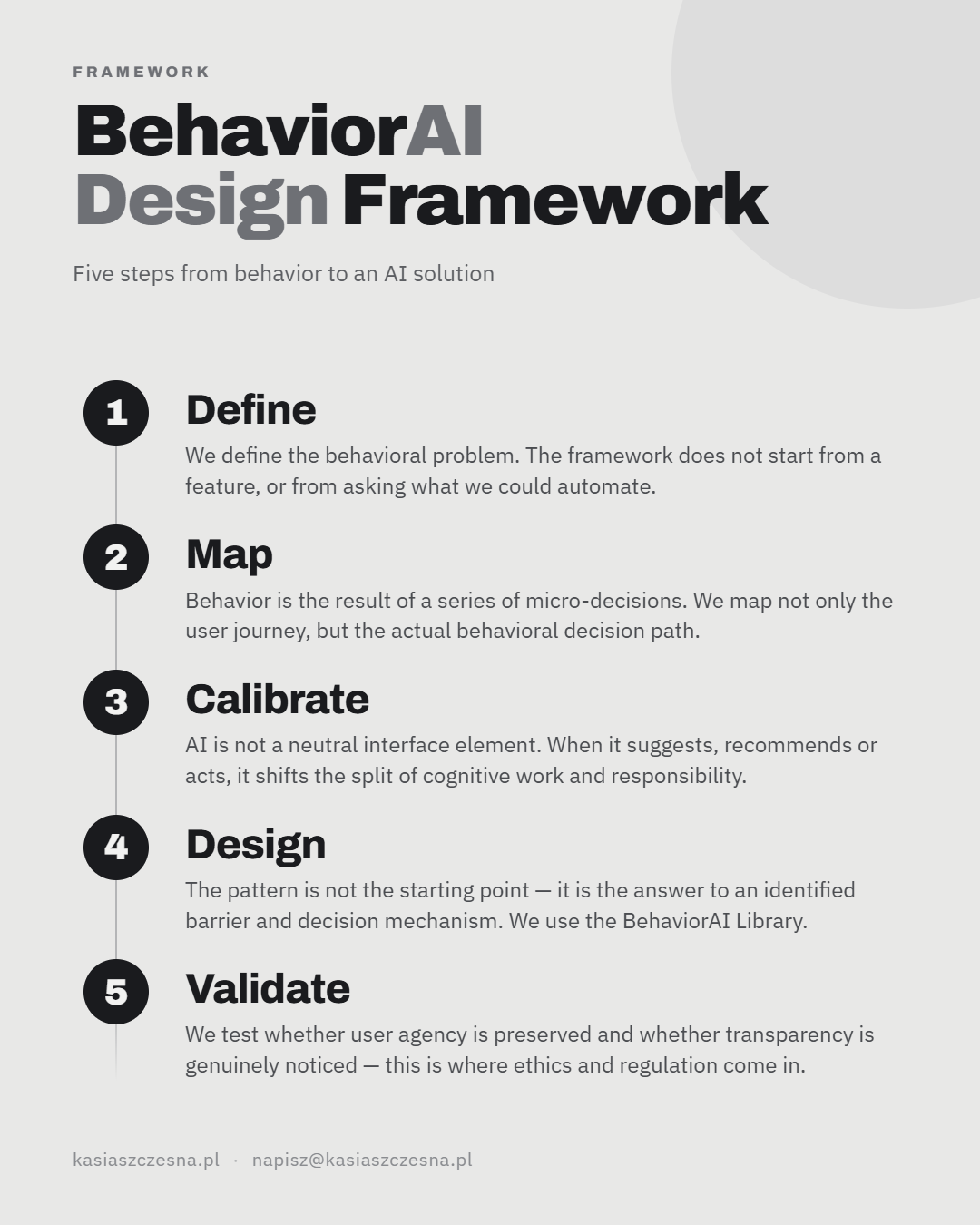
Today it looks like this.
1.Define.
Instead of starting with the question of what AI feature we should add to a product, I start with the question of what behavior we want to design. Who should do what, when, and why.
2.Map.
I look at how a decision actually happens. Where the barriers are, which cognitive biases are involved, and at exactly what point AI enters the journey.
3.Calibrate.
I define what collaboration between a person and AI should look like in that specific moment. Who analyzes, who decides, who acts, and who verifies.
4.Design.
Only then do I choose the intervention and the pattern. One behavior, one moment, one hypothesis. This is where the BehaviorAI library becomes useful.
5.Validate.
I test whether the solution actually preserves user agency and whether transparency is truly noticed and understood, rather than simply looking good on paper. This is also where ethics and regulation become part of the evaluation.
At its core, it all comes down to two sentences I have repeated to my clients for years. Behavior first, interface second. Diagnosis first, intervention second.
The field of human AI interaction is still developing, and it still lacks a shared language. I have a sense that my work, combining behavioral science, design, and regulation, is an attempt to build that language through practice rather than waiting for it to emerge in theory.
Because the relationship between people and AI is already happening, whether someone is designing it intentionally or not. I would rather be on the side that designs it.
—
Wikipedia, Human–AI interaction: https://en.wikipedia.org/wiki/Human–AI_interaction
Amershi i in., Guidelines for Human-AI Interaction, CHI 2019: https://doi.org/10.1145/3290605.3300233
Vaccaro, Almaatouq, Malone, When combinations of humans and AI are useful: A systematic review and meta-analysis, Nature Human Behaviour 2024: https://doi.org/10.1038/s41562-024-02024-1
Bansal i in., Beyond Accuracy: The Role of Mental Models in Human-AI Team Performance, AAAI HCOMP 2019: https://doi.org/10.1609/hcomp.v7i1.5285
TopSpeed, BMW Spider-Man In-Car Ads Draw Owner Backlash in 2026: https://www.topspeed.com/bmw-spider-man-in-car-ads-backlash/
AI zmienia nie tylko to, jak projektujemy produkty, ale też samą relację między człowiekiem a technologią. Klasyczny UX coraz częściej nie wystarcza, żeby opisać zaufanie, sprawczość, sposób podejmowania decyzji i współpracę człowieka z AI.
Z tego artykułu dowiesz się:
czym różni się human AI interaction od klasycznego HCI,
dlaczego kalibracja zaufania jest ważniejsza niż jego maksymalizacja,
kiedy współpraca człowieka z AI faktycznie daje lepsze wyniki
jak projektować momenty, w których człowiek nadal myśli, decyduje i zachowuje kontrolę - BehaviorAI Design Framework
“Ten tekst jest oparty na mojej własnej koncepcji, przemyśleniach, doświadczeniach z pracy i frameworku, który rozwijam w BehaviorAI. Przy redakcji korzystałam ze wsparcia modeli AI, głównie po to, żeby uporządkować tekst i dopracować język. Wszystkie źródła i badania, do których się odwołuję, znajdziecie na dole artykułu.”
Kasia
❤🙌
Jakiś czas temu zaczęłam zauważać, że ludzie pytają mnie o zupełnie inne rzeczy niż kiedyś. Nikt już nie pyta, jak zaprojektować np. dobry formularz czy stronę. Pytają, jak zaprojektować sytuację, w której człowiek ufa systemowi tyle, ile powinien. Ani grama więcej, ani grama mniej.
To pytanie nie mieściło się w klasycznym UX. Musiałam po prostu zbudować sobie własny język, żeby móc na nie odpowiadać. I okazuje się, że nie jestem w tym sama. Na rynku istnieje już osobne hasło poświęcone temu zjawisku: human AI interaction, w skrócie HAX albo HAII. To młoda gałąź badań, wyrastająca z klasycznego human computer interaction, ale traktująca AI zupełnie inaczej niż komputer traktowano przez ostatnie czterdzieści lat.
Wikipedia definiuje human AI interaction jako obszar badań i poddziedzinę human computer interaction, która koncentruje się na doświadczeniu użytkownika i czynnikach psychologicznych. Wraz z rozwojem sztucznej inteligencji powstał osobny nurt badający, w jaki sposób ludzie wchodzą w interakcje z AI i jak AI na nich wpływa.
W tradycyjnym HCI człowiek wydaje polecenia, a maszyna je wykonuje, czyli mamy prosty, jednokierunkowy układ. W relacji człowieka z AI ten układ się rozmywa. AI przestaje być narzędziem, a zaczyna być postrzegane jako aktywny uczestnik interakcji. Sugeruje, rekomenduje, czasem decyduje samodzielnie.
I właśnie dlatego badacze mówią o czterech możliwych trybach tej relacji: współpracy, rywalizacji, konflikcie i symbiozie.
Ja od dawna pracuję właśnie w tym miejscu. Łączę nauki behawioralne, projektowanie doświadczeń i wiedzę o tym, jak działają systemy AI, żeby odpowiadać na pytanie, które moim zdaniem jest dziś najważniejsze w projektowaniu produktów. Nie: co powinno robić AI. Tylko: jak człowiek powinien myśleć, decydować i działać razem z AI.
Jedną z rzeczy, które najbardziej fascynują mnie w tym temacie, jest to, jak bardzo ludzie polegają na swoim wewnętrznym modelu tego, jak działa dany system AI. Ten model buduje się z każdą interakcją. Im więcej ktoś korzysta z narzędzia, tym trafniejsze podpowiedzi potrafi mu dawać, bo lepiej rozumie jego logikę.
Problem w tym, że ten model rzadko jest kompletny. Ludzie wyciągają wnioski z ograniczonych doświadczeń i budują sobie uproszczony obraz tego, co AI potrafi, a czego nie.
To dokładnie ten mechanizm stoi za moim ulubionym paradoksem w tej dziedzinie. Kiedy firma poprawia model, żeby działał lepiej, zespoły złożone z człowieka i AI czasem zaczynają działać gorzej. Nie dlatego, że model jest słabszy. Dlatego, że zaburza się dopasowanie między nowym zachowaniem systemu a starym modelem mentalnym, który użytkownik zdążył sobie zbudować.
To jest coś, co w moim frameworku nazywam kalibracją zaufania, a nie jego maksymalizacją. Celem nie jest, żeby ludzie ufali AI jak najbardziej. Celem jest, żeby ufali mu dokładnie tyle, na ile ono zasługuje w danym kontekście.
Badania nad współpracą człowieka i AI pokazują coś, co uwielbiam pokazywać klientom, bo obala popularny mit. Intuicyjnie wydaje się, że człowiek plus AI zawsze da lepszy wynik niż sam człowiek albo samo AI. W praktyce to się nazywa synergią i zdarza się rzadziej, niż myślimy.
Znacznie częściej mamy do czynienia z augmentacją, czyli AI po prostu wspiera to, co człowiek i tak by zrobił, bez realnego skoku jakości. A czasem jest jeszcze gorzej. Ludzie zaczynają zbytnio polegać na sugestiach systemu i przestają myśleć samodzielnie, nawet gdy mają informacje, które przeczą temu, co pokazuje AI.
I tutaj wchodzi projektowanie behawioralne. Wiemy już, że proste przypomnienie, żeby aktywnie przeanalizować sytuację, zanim zaakceptuje się rekomendację, potrafi realnie ograniczyć nadmierne poleganie na systemie. To nie jest kwestia interfejsu, tylko zaprojektowania momentu, w którym człowiek ma szansę pomyśleć, zanim zdąży się zgodzić.
Jest jeszcze jeden wątek z tego obszaru, który bardzo mnie zaciekawił, bo łączy się wprost z tym, czym zajmuję się przy okazji artykułu 50 AI Act.
Okazuje się, że osoby, które ujawniają w pracy, że korzystały z AI, są częściej postrzegane jako mniej pracowite niż osoby wykonujące to samo zadanie bez takiej informacji. Ujawnienie użycia AI obniża postrzeganą wiarygodność decyzji i pracy danej osoby.
To pokazuje, jak bardzo transparentność wokół AI jest zjawiskiem społecznym i behawioralnym, a nie tylko regulacyjnym checkboxem. Można spełnić literę prawa i jednocześnie zupełnie nie rozumieć, jak ta informacja wpływa na to, jak ludzie oceniają się nawzajem.
Ostatnio, pracując nad kolejnymi projektami, sama przebudowałam swój framework. Nie w teorii, tylko w praktyce, przy realnych diagnozach dla klientów. Za każdym razem, kiedy próbowałam nazwać, dlaczego dany moment w produkcie działa albo nie działa, dokładałam kolejną cegiełkę.
W pewnym momencie zorientowałam się, że pięć kroków, które od dawna miałam w głowie, trzeba było poukładać na nowo, żeby dało się je faktycznie stosować krok po kroku, a nie tylko rozumieć jako ideę.
Cały ten obszar, modele mentalne, kalibracja zaufania, augmentacja kontra synergia, percepcja transparentności, to nie są osobne ciekawostki z różnych badań. Tylko elementy jednej większej układanki, którą poukładałam w BehaviorAI Design Framework.
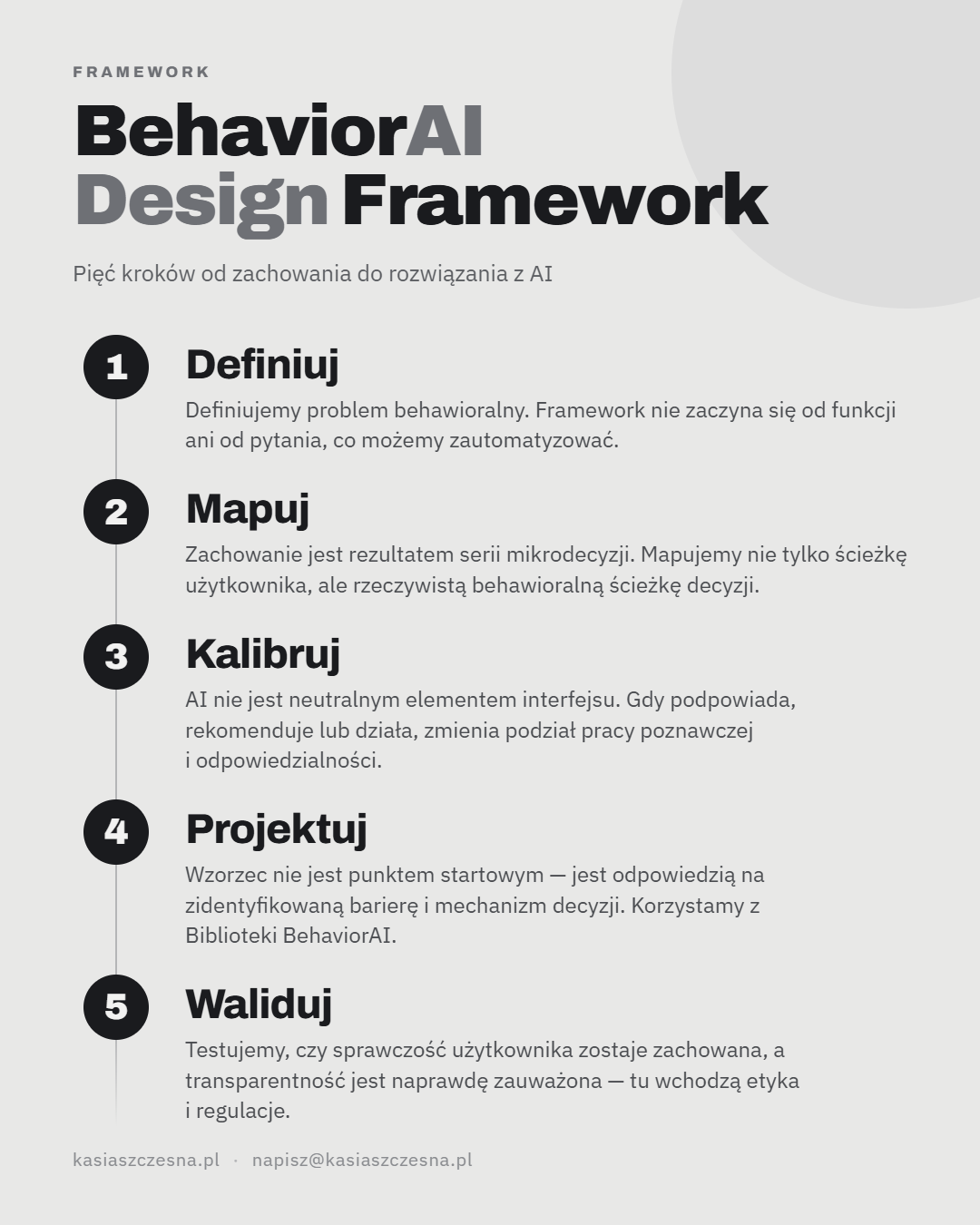
Wygląda dziś tak.
1.Ustal.
Zamiast zaczynać od pytania, jaką funkcję AI dodać do produktu, zaczynam od pytania, jakie zachowanie chcemy zaprojektować. Kto, co, kiedy i po co.
2.Mapuj.
Sprawdzam, jak naprawdę dochodzi do decyzji. Gdzie są bariery, jakie błędy poznawcze wchodzą w grę i w którym dokładnie momencie AI wchodzi w tę ścieżkę.
3.Kalibruj.
Ustalam, jak powinna wyglądać współpraca między człowiekiem a AI w tym konkretnym momencie. Kto analizuje, kto decyduje, kto działa, kto weryfikuje.
4.Projektuj.
Dopiero teraz wybieram interwencję i wzorzec. Jedno zachowanie, jeden moment, jedna hipoteza. Tutaj pomocna jest biblioteka BehaviorAI.
5.Sprawdź.
Testuję, czy rozwiązanie faktycznie zachowuje sprawczość użytkownika i czy transparentność jest naprawdę zauważona i zrozumiana, a nie tylko wygląda dobrze na papierze. Na tym etapie bierzemy również pod uwagę etykę i regulacje.
Dziedzina human AI interaction dopiero się rozwija i wciąż brakuje jej wspólnego języka. Mam wrażenie, że moja praca, łącząca behawiorystykę, projektowanie i regulacje, jest właśnie próbą zbudowania tego języka w praktyce, zamiast czekać, aż powstanie w teorii.
Amershi i in., Guidelines for Human-AI Interaction, CHI 2019: https://doi.org/10.1145/3290605.3300233
Vaccaro, Almaatouq, Malone, When combinations of humans and AI are useful: A systematic review and meta-analysis, Nature Human Behaviour 2024: https://doi.org/10.1038/s41562-024-02024-1
Bansal i in., Beyond Accuracy: The Role of Mental Models in Human-AI Team Performance, AAAI HCOMP 2019: https://doi.org/10.1609/hcomp.v7i1.5285
TopSpeed, BMW Spider-Man In-Car Ads Draw Owner Backlash in 2026: https://www.topspeed.com/bmw-spider-man-in-car-ads-backlash/
No posts
Comments
Nothing yet. Say the first thing.
Sign in to join the conversation.