
Manipulation is moving from the visual user interface such as hidden buttons or misleading navigation flows into the conversational layer itself, where AI utilizes language, tone, and simulated empathy to capture and retain our attention.
Global awareness of these threats is growing, and regulators and courts around the world are beginning to hold tech giants accountable. Recent developments in Los Angeles, New Mexico, Brazil, and India perfectly illustrate how different nations and legal systems are tackling the challenge of dark patterns and addictive algorithms.
In the US, the debate over addictive interface design has aggressively shifted to the courtrooms, evidenced by landmark rulings.
In Los Angeles, a jury delivered a precedent-setting verdict against Meta (owner of Instagram) and Google (owner of YouTube), ordering them to pay $6 million in damages to a 20-year-old woman. The plaintiff demonstrated that her childhood addiction to these platforms led to severe depression, body dysmorphic disorder, and self-harm. The court recognized that these corporations had effectively built “addiction machines,” utilizing deliberate design choices like infinite scroll to maximize the time young users spent on their screens.
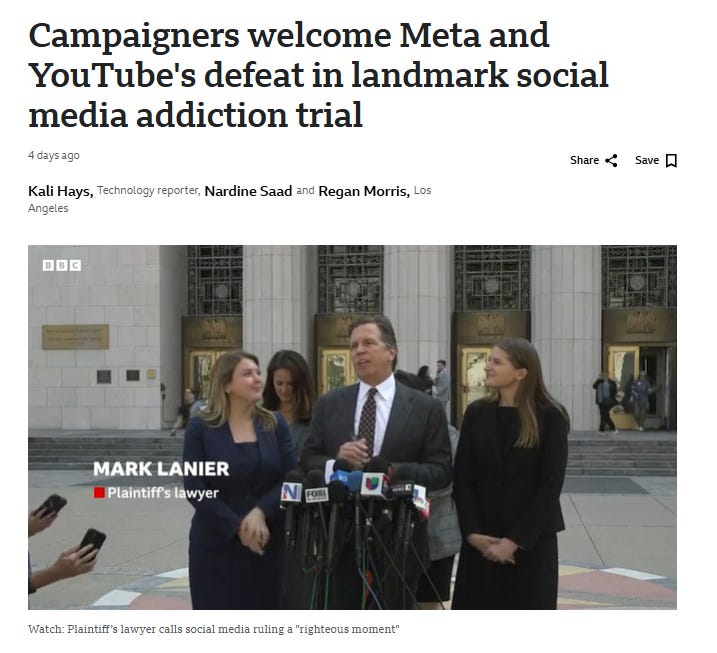
BBC “Campaigners welcome Meta and YouTube’s defeat in landmark social media addiction trial”
Just one day prior to the LA verdict, a jury in New Mexico ordered Meta to pay a $375 million civil penalty. In this case, the jury found that Meta deliberately misled consumers regarding the safety of its platforms, enabling situations where its algorithms and social features exposed minors to sexually explicit material and predators.

The Guardian “Meta ordered to pay $375m after being found liable in child exploitation case”
Brazil has adopted a strictly preventative legislative approach. Sparked by public outrage including a viral video exposing the sexualization of children online the government enacted the Digital Statute of Children and Adolescents.
This law directly targets dark patterns by prohibiting platforms from using addictive features such as infinite scroll and the automatic playback of videos for minors. Furthermore, users under the age of 16 are required to have their social media accounts linked to a legal guardian to ensure proper supervision. Digital services must also implement effective age verification mechanisms. In response to this new legal framework, Google announced it will use artificial intelligence to estimate whether a user is a minor or an adult in Brazil, allowing the system to automatically block inappropriate content.

India, on the other hand, illustrates an earlier stage in the fight against deceptive design. The Indian Central Consumer Protection Authority (CCPA) recently issued an advisory for e-commerce platforms to identify and eliminate dark patterns.
The CCPA identified 13 specific types of dark patterns, such as “basket sneaking” (secretly adding items to a cart), “false urgency” (pretending an item is about to sell out), and “confirm shaming” (guilting a user into agreeing). The authority directed platforms to conduct self-audits and submit declarations of compliance. However, legal experts point out that India’s current framework is heavily reliant on “soft law”. Unlike the massive financial penalties seen in the US or strict regulations in the EU, the CCPA’s advisory lacks enforceable penalties, mechanisms for formal investigation, and mandatory rulemaking, meaning compliance relies largely on voluntary corporate behavior.
Our work is focused on supporting product teams, designers, and product managers - especially in small and medium-sized technology companies that are rapidly adopting AI without fully developed responsible AI frameworks.
BehaviorAI is designed to bring structure to a fragmented landscape of knowledge by combining legal insights, behavioral science, and practical design guidance. Rather than promoting ready-made solutions to be copied blindly, we aim to foster critical thinking and informed decision-making. Our goal is to equip teams with tools, patterns, and materials that not only improve product design but also strengthen communication with stakeholders and help justify responsible choices.
Through an accessible knowledge library, curated design patterns we seek to raise awareness of cognitive biases and their influence on AI systems, while building stronger competencies in human-centered AI. Ultimately, BehaviorAI is about improving the quality of both products and the decision-making processes behind them - so that technology serves users in a transparent, trustworthy, and ethical way.
We are launching our beta on April 9.
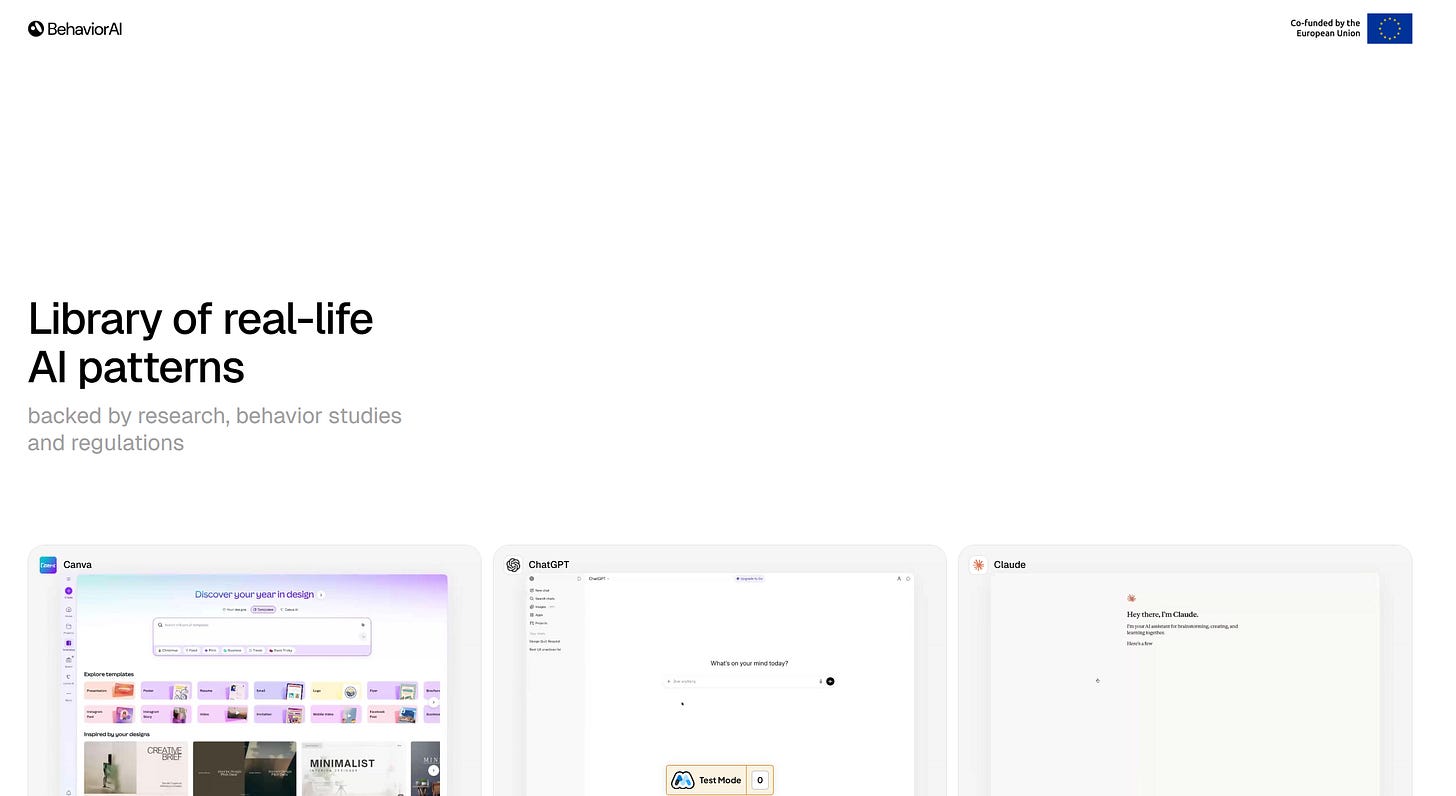
BehaviorAI - behaviorai.eu
We are launching our beta on April 9!

BehaviorAI is Responsible Responsible AI design library.
The goals of the project are:
combining inspiration with an interpretive layer and responsible AI design,
organizing dispersed knowledge and use-case examples,
building greater trust in curated content compared with generic AI responses.
The project is aimed at product teams, designers, and product managers working on AI products in small and medium-sized technology companies that implement AI without mature responsible AI standards.
Project value: PLN 462,551.00
European funds contribution: PLN 322,911.34
The Startup Booster for Social Impact project of SWPS University is implemented with funds from the Polish Agency for Enterprise Development (PARP) under Priority II of the European Funds for a Modern Economy 2021–2027 (FENG) programme, in accordance with the grant agreement No. FENG.02.28-IP.02-0003/23-00.
No posts
Comments
Nothing yet. Say the first thing.
Sign in to join the conversation.